7908 results for "Science"

The richness of life: the essential Stephen Jay Gould

Gould, Stephen Jay
"Nature is so wondrously complex and varied that almost anything possible does happen....I rejoice in its] multifariousness and leave the chimera of certainty to politicians and preachers." --from Ever Since Darwin Upon his death in 2002, Stephen Jay Gould stood at the pinnacle among observers of the natural world, recognized by Congress as a "living legend." His prodigious legacy--sixteen best-selling and prize-winning books, dozens of scientific papers, an unbroken series of three hundred essays in Natural History --combined to make Gould the most widely read science writer of our time. This indispensable collection of forty-eight pieces from his brilliant oeuvre includes selections from classics such as Ever Since Darwin and The Mismeasure of Man , plus articles and speeches never before published in book form. This volume, the last that will bear his name, spotlights his elegance, depth, and sheer pleasure in our world--a true celebration of an extraordinary mind.
W.W. Norton 2007 654 pages

Hen's teeth and horse's toes

Gould, Stephen Jay
"Darwin relegated humanity to a species descended from apes ; Stephen Jay Gould adds that it is bound for extinction. Why all species, including our own, are destined to die out is just one of the fascinating questions addressed in this collection of essays by the author of Ever Since Darwin and The Panda's Thumb. In considering them, Stephen Jay Gould challenges the view that science is irrelevant to life. Darwinism has changed our view of the world and Gould brilliantly conveys here the active excitement of modern evolutionary theory. Fair, amusing, perceptive, eminently readable, Gould looks at facts that -- if we even know them in the first place -- we take for granted and, with a true scientist's desire for knowledge, digs beneath them to uncover their significance for evolutionary theory" -- Back cover.
Penguin 1984 413 pages

The rise and fall of Adam and Eve

Greenblatt, Stephen
Humans cannot live without stories. But one story has proved itself the most durable and hauntingly real of all time. The mythic tale of Adam and Eve has shaped conceptions of human origins and destiny for centuries. Stemming from a few verses in an ancient book, it became not just the foundation of three major world faiths, but has evolved through art, philosophy and science to serve as the mirror in which we seem to glimpse the whole, long history of our fears and desires. What is it about Adam and Eve's story that fascinates us? What does it tell us about how our species lives, dies, works or has sex? In a quest that begins at the dawn of time, Stephen Greenblatt takes us from ancient Babylonia to the forests of east Africa. We meet evolutionary biologists and fossilised ancestors; we grapple with morality and marriage in Milton's Paradise Lost; and we decide if the Fall is the unvarnished truth or fictional allegory. Ultimately, The Rise and Fall of Adam and Eve allows us a new understanding of ourselves.
The Bodley Head 2017 419 pages

Madness and memory: the discovery of prions--a new biological principle of disease

Prusiner, Stanley B.
In 1997, Stanley B. Prusiner received a Nobel Prize, the world's most prestigious award for achievement in physiology or medicine. That he was the sole recipient of the award for the year was entirely appropriate. His struggle to identify the agent responsible for ravaging the brains of animals suffering from scrapie and mad cow disease, and of humans with Creutzfeldt-Jakob disease, had been waged largely alone and in some cases in the face of strenuous disagreement. In this book, Prusiner tells the remarkable story of his discovery of prions - infectious proteins that replicate and cause disease but surprisingly contain no genetic material - and reveals how superb and meticulous science is actually practiced with talented teams of researchers who persevere. He recounts the frustrations and rewards of years of research and offers fascinating portraits of his peers as they raced to discover the causes of fatal brain diseases. Prusiner's hypothesis, once considered heresy, now stands as accepted science and the basis for developing diagnoses and eventual cures. He closes with a meditation on the legacy of his discovery: What will it take to cure Alzheimer's, Parkinson's, Lou Gehrig's and other devastating diseases of the brain?
Yale University Press 2014 320 pages

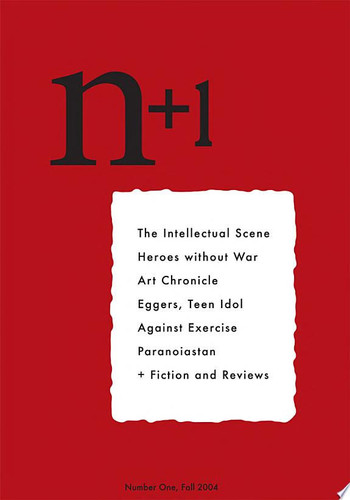
n+1, Number One: Negation

n+1,Masha Gessen,Sam Lipsyte,Vladimir Sorokin,Benjamin Kunkel,Keith Gessen,Mark Greif,Dushko Petrovich,Joshua Glenn,Marco Roth
Review The mag's design is modeled on the Partisan Review, but its attempt to historicize snark is... refreshing. -- Ben Williams, Slate.com, July 27, 2004 To read the contents of the journal...is to realize that the science of the literary brawl has been revivified. -- Joshua Glenn, Boston Globe, July 25, 2004 n+1 is distinguished from academic journals by its readability... [I]t canvasses big ideas while informing a wider public. -- Gary Shapiro, New York Sun, July 26, 2004 Product Description Inaugural issue. Polemics against the New Republic, McSweeney's, and the Weekly Standard. Mark Greif's "Against Exercise" and "Mogadishu, Baghdad, Troy." Keith Gessen's "Eggers, Teen Idol." Benjamin Kunkel's "Horse Mountain." Patrick Giles on James McCourt. And the first and only English-language translation of Vladimir Sorokin's The Norm.
n+1 Foundation, Inc. 2004-07 185 pages

First American Into Space

Robert Silverberg
Here is the spine-tingling, true story of that first American blast into the realm of the stars, of the men who underwent rigorous training for that epic mission, and of the one man who made the safe journey. This is the factual account of the history of rocketry, its triumphs and its failures, our shame in the neglect of it, and our pride in its later accomplishments. Here, too, is a glimpse into the future, as only science fiction writer Robert Silverberg could foresee: orbiting space stations, a man on the moon, and more!
Wildside Press LLC 2008-04-01 144 pages

Bad ideas? an arresting history of our inventions

Winston, Robert M. L.
We are born with the instinct to create and invent. Indeed, our ability to do so is what separates us from the rest of the animal world. But have our creative ideas always produced desirable results? Have they always served us well? Bad Ideas? traces the fascinating history of our attempts at self-improvement but also questions their value. The dubious consequences of the development of weaponry, for example, is self-evident. But what of apparently more innocuous advances such as farming, writing and medicine? Science has produced huge good but has also had unforeseen consequences. Can science and scientists find solutions to the perils that now menace us? We join Robert Winston on a thrilling journey from our earliest days to the present. We meet some key individuals along the way and share quirky anecdotes about their lives and brainwaves. Inspiring, unusual and at times controversial, Bad Ideas? assesses the past and looks forward to the opportunities of the future. In so doing it celebrates man's extraordinary capacity for achievement and offers a hopeful way forward to protect humanity against what sometimes seem like bad ideas.
Bantam 2011 558 pages

The dialectical biologist

Levins, Richard,Lewontin, Richard
Scientists act within a social context and from a philosophical perspective that is inherently political. Whether they realize it or not, scientists always choose sides. The Dialectical Biologist explores this political nature of scientific inquiry, advancing its argument within the framework of Marxist dialectic. These essays stress the concepts of continual change and codetermination between organism and environment, part and whole, structure and process, science and politics. Throughout, this book questions our accepted definitions and biases, showing the self-reflective nature of scientific activity within society.
Harvard University Press 1985 303 pages

Stealing God's thunder: Benjamin Franklin's lightning rod and the invention of America

Dray, Philip
“Dray captures the genius and ingenuity of Franklin’s scientific thinking and then does something even more fascinating: He shows how science shaped his diplomacy, politics, and Enlightenment philosophy.” –Walter Isaacson, author of Benjamin Franklin: An American Life Today we think of Benjamin Franklin as a founder of American independence who also dabbled in science. But in Franklin’s day, the era of Enlightenment, long before he was an eminent statesman, he was famous for his revolutionary scientific work. Pulitzer Prize finalist Philip Dray uses the evolution of Franklin’s scientific curiosity and empirical thinking as a metaphor for America’s struggle to establish its fundamental values. He recounts how Franklin unlocked one of the greatest natural mysteries of his day, the seemingly unknowable powers of lightning and electricity. Rich in historical detail and based on numerous primary sources, Stealing God’s Thunder is a fascinating original look at one of our most beloved and complex founding fathers.
Random House 2005-12-27 279 pages

Jewish women in America: an historical encyclopedia

Paula Hyman,Deborah Dash Moore,Phyllis Holman Weisbard,American Jewish Historical Society
This encyclopedia provides the first standard reference work on the lives, history and activities of Jewish women in the United States. Covering a period which extends from the arrival of the first Jewish women in North America in 1654 to the present, this two-volume set presents the most comprehensive and detailed portrait of American Jewish women ever published, and brings together for the first time the wealth of recent scholarship on this subject. Includes: * Biographical entries on over 800 individual women. * 128 topical articles on organizations such as Hadassah, the National Council of Jewish Women, Mizrachi, and the Ladies' Garment Workers' Union. * Major essays on Jewish women's participation in the movement for women's suffrage, social reform, civil rights, and the recent women's movement. * The activities of Jewish women in politics, business, education, the arts, and religion. * A readable, inviting format with over 500 large photographs. * Bibliographies at the end of each entry which include overviews of major scholarship in the field, complete citations of more general works and citations of additional bibliographical and reference sources. * The comprehensive index includes citations to every substantive discussion in the entries as well as all proper names appearing in the text, such as organizations, book, song and film titles, schools, and individuals. The "Encyclopedia" provides information on American Jewish women in all fields of endeavor, and pays special attention to the work of women in the arts, academics, law, the labor movement, education, science, medicine, journalism and publishing, and on the lives of ordinary Jewish women during all time periods and in all regions of the United States.
Routledge 1997 1770 pages

Conservation biology for all

Sodhi, Navjot S.,Ehrlich, Paul R.
Conservation Biology for All provides cutting-edge but basic conservation science to a global readership. A series of authoritative chapters have been written by the top names in conservation biology with the principal aim of disseminating cutting-edge conservation knowledge as widely as possible. Important topics such as balancing conversion and human needs, climate change, conservation planning, designing and analyzing conservation research, ecosystem services, endangeredspecies management, extinctions, fire, habitat loss, and invasive species are covered. Numerous textboxes describing additions
Oxford University Press 2010-03-12 344 pages

Psych: the story of the human mind

Bloom, Paul
How does the brain-a three-pound wrinkly mass-give rise to intelligence and conscious experience? Was Freud right that we are all plagued by forbidden sexual desires? What is the function of emotions such as disgust, gratitude, and shame? Renowned psychologist Paul Bloom answers these questions and many more in Psych, his riveting new book about the science of the mind. Psych is an expert and passionate guide to the most intimate aspects of our nature, serving up the equivalent of a serious university course while being funny, engaging, and full of memorable anecdotes. But Psych is much more than a comprehensive overview of the field of psychology. Bloom argues that a number of widely accepted theories in the field are probably wrong, and he reveals what psychology can tell us about the most pressing moral and political issues of our time-including belief in conspiracy theories, the role of genes in explaining human differences, and the discussion around implicit racial bias. Bloom also shows how psychology can give us practical insights into important issues-from the treatment of mental illnesses such as depression and anxiety to the best way to lead happy and fulfilling lives. Psych is a riveting guide to the most important topic there is: it is the story of us.
Ecco, an imprint of HarperCollins Publishers 2023 454 pages

Poetry Rx: how 50 inspiring poems can heal and bring joy to your life

Norman E. Rosenthal
" I used to believe that poetry did not "speak" to me, but I now see how wrong I was. I lived for 44 years with a husband, a lyricist, whose beautifully crafted, heartfelt lyrics touched my every fiber and continue to uplift and inspire me a decade after his death. The special beauty of Dr. Rosenthal''s book for me is his discussion of what each poem is saying, what the poet was likely feeling and often how the poems helped him personally, as when he left his birth family in South Africa for a rewarding career in the United States. " - Jane Brody , Author & New York Times Columnist Poetry to Heal, Inspire and Enjoy Poetry Rx presents 50 great poems as seen through the eyes of a renowned psychiatrist and New York Times bestseller. In this book, you will find insights into love, sorrow, ecstasy and everything in between: Love in the moment or for a lifetime; love that is fulfilling or addictive; when to break up and how to survive when someone breaks up with you. Separate sections deal with responses to the natural world, and the varieties of human experience (such as hope, reconciliation, leaving home, faith, self-actualization, trauma, anger, and the thrill of discovery). Other sections involve finding your way in the world and the search for meaning, as well as the final stages of life. In describing this multitude of human experiences, using vignettes from his work and life, Rosenthal serves as a comforting guide to these poetic works of genius. Through his writing, the workings of the mind, as depicted by these gifted writers speak to us as intimately as our closest friends. Rosenthal also delves into the science of mind and brain. Who would have thought, for example, that listening to poetry can cause people to have goosebumps by activating the reward centers of the brain? Yet research shows that to be true. And who were these fascinating poets? In a short biosketch that accompanies each poem, Rosenthal draws connections between the poets and their poems that help us understand the enigmatic minds that gave birth to these masterworks. Altogether, a fulfilling and intriguing must-read for anyone interested in poetry, the mind, self-help and genius. CONTENTS Introduction PART ONE Loving and Losing Chapter One Is There an Art to Losing? One Art by Elizabeth Bishop Chapter Two Can Love Transform You? How do I love thee? Let me count the ways by Elizabeth Barrett Browning Chapter Three The Heart versus the Mind Pity me not because the light of day by Edna St. Vincent Millay Chapter Four Love in the Moment Lullaby by W. H. Auden Chapter Five When Love Fades Failing and Flying by Jack Gilbert Chapter Six Getting Over a Breakup I: Acceptance Why so pale and wan fond lover? by Sir John Suckling Chapter Seven Getting Over a Breakup II: Reclaiming Yourself Love after Love by Derek Walcott, Chapter Eight Declaring Your Love Sonnet 18: Shall I compare thee to a summer''s day? by William Shakespeare Chapter Nine Consoled by Love Sonnet 29: When, in disgrace with fortune and men''s eyes by William Shakespeare Chapter Ten In Praise of the Marriage of True Minds Sonnet 116: Let me not to the marriage of true minds by William Shakespeare Chapter Eleven Loss of a Loved One Stop all the clocks, cut off the telephone (Funeral Blues) by W. H. Auden Chapter Twelve Will I Ever Feel Better? Time Does Not Bring Relief by Edna St. Vincent Millay Chapter Thirteen Love Remembered When You Are Old by William Butler Yeats Chapter Fourteen Love after Death Remember by Christina Rossetti, PART TWO That Inward Eye Chapter Fifteen Transcendence in Nature Daffodils by William Wordsworth Chapter Sixteen The Memory of Daffodils Miracle on St. David''s Day by Gillian Clarke Chapter Seventeen Transcendence in Body and Mind Lines Composed a Few Miles above Tintern Abbey (excerpt) by William Wordsworth Chapter Eighteen The Power of Dark and Light There''s a certain Slant of light by Emily Dickinson Chapter Nineteen In Praise of Diversity Pied Beauty by Gerard Manley Hopkins Chapter Twenty A Plea to Save the Natural World Inversnaid by Gerard Manley Hopkins Chapter Twenty-One The Importance of Being Needed Stopping by Woods on a Snowy Evening by Robert Frost Chapter Twenty-Two The Choices We Make The Road Not Taken by Robert Frost Chapter Twenty-Three The Force of Longing Sea Fever by John Masefield Chapter Twenty-Four Finding Hope in Nature The Darkling Thrush by Thomas Hardy PART THREE The Human Experience Chapter Twenty-Five The Power of Hope "Hope" is the thing with feathers by Emily Dickinson Chapter Twenty-Six Welcoming Your Emotions The Guest House by Jalaluddin Rumi Translated by Coleman Barks Chapter Twenty-Seven The Healing Power of Reconciliation Out beyond Ideas by Jalaluddin Rumi (Translated by Coleman Barks) Chapter Twenty-Eight Leaving Home Traveler, there is no road by Antonio Machado Translated by Mary G. Berg and Dennis Maloney Chapter Twenty-Nine And Those You Leave Behind Letter to My Mother by Salvatore Quasimodo Translated by Jack Bevan Chapter Thirty The Importance of Self-Actualization On His Blindness by John Milton Chapter Thirty-One The Power of Faith Psalm 23 A Psalm of David Chapter Thirty-Two The Thrill of Discovery On First Looking into Chapman''s Homer by John Keats Chapter Thirty-Three The Enduring Thrill of the Moment High Flight by John Gillespie Magee Jr Chapter Thirty-Four The Long Reach of Trauma The Sentence by Anna Akhmatova Translated by Judith Hemschemeyer Chapter Thirty-Five The Danger of Anger A Poison Tree by William Blake PART FOUR A Design for Living and the Search for Meaning Chapter Thirty-Six Principles for a Good Life Polonius'' Advice to Laertes by William Shakespeare Chapter Thirty-Seven Remaining Steady through Life''s Ups and Downs If by Rudyard Kipling Chapter Thirty-Eight Never Give Up Invictus by William Ernest Henley Chapter Thirty-Nine Putting One Foot in Front of the Other The Waking by Theodore Roethke Chapter Forty Should You React or Proact? Waiting for the Barbarians by Constantine Cavafy Translated by Edmund Keeley and Philip Sherrard Chapter Forty-One It''s the Journey That Matters Ithaka by Constantine Cavafy Translated by Edmund Keeley Chapter Forty-Two Hold On to Your Dreams Dreams by Langston Hughes PART FIVE Into the Night Chapter Forty-Three Should You Just Go for It? An Irish Airman Foresees His Death by William Butler Yeats Chapter Forty-Four Or Should You Be Careful? Musée des Beaux Arts by W. H. Auden Chapter Forty-Five Dying Too Soon We Real Cool by Gwendolyn Brooks Chapter Forty-Six Aging by Degrees I Know I Am Getting Old by Wendell Berry Chapter Forty-Seven The Critical Importance of Communication Not Waving but Drowning by Stevie Smith Chapter Forty-Eight Should You Rage? Do not go gentle into that good night by Dylan Thomas Chapter Forty-Nine Or Is it Time to Go Gently? Because I could not stop for Death by Emily Dickinson Chapter Fifty I Did Not Die! Do not stand at my grave and weep by Mary Elizabeth Frye A Few Last Thoughts Source Materials and Further Reading Permissions Acknowledgments Index About the Author INTRODUCTION You may well wonder how I, a psychiatrist with no formal literary credentials, have chosen to write about the power of poetry to heal, inspire, and bring joy to people. It all started with a single phone call that came in late one night. The caller was my friend David, and I knew immediately by the tone of his voice that something was wrong. He choked up as he told me that he had recently lost someone very dear to him. "How can I go on?" he mused. "How will I manage?" Clichés and generalities readily come to mind in such situations, but I searched for something specific to say, something that might actually help. Recognizing that David is a person steeped in the arts, I said, "There is an art to losing, and like all art, it can be developed." He was silent for a while, and when he spoke again, his voice sounded more cheerful, as though he had tapped into some hidden source of hope. . "Do you know the poem ''One Art''
G&D Media 2021 380 pages

Beyond the university: why liberal education matters

Roth, Michael S.
From the president of Wesleyan University, an eloquent defense of liberal education, seen against the backdrop of its contested history in America Winner of the 2016 Frederic W. Ness Book Award sponsored by the Association of American Colleges and Universities Contentious debates over the benefits--or drawbacks--of a liberal education are as old as America itself. From Benjamin Franklin to the Internet pundits, critics of higher education have attacked its irrelevance and elitism, often calling for more vocational instruction. Thomas Jefferson, by contrast, believed that nurturing a student's capacity for lifelong learning was useful for science and commerce while also being essential for democracy. In this provocative contribution to the disputes, university president Michael S. Roth focuses on important moments and seminal thinkers in America's long-running argument over vocational vs. liberal education. Conflicting streams of thought flow through American intellectual history: W. E. B. Du Bois's humanistic principles of pedagogy for newly emancipated slaves developed in opposition to Booker T. Washington's educational utilitarianism, for example. Jane Addams's emphasis on the cultivation of empathy and John Dewey's calls for education as civic engagement were rejected as impractical by those who aimed to train students for particular economic tasks. Roth explores these arguments (and more), considers the state of higher education today, and concludes with a stirring plea for the kind of education that has, since the founding of the nation, cultivated individual freedom, promulgated civic virtue, and instilled hope for the future.
Yale University Press 2015 228 pages

The madhouse effect: how climate change denial is threatening our planet, destroying our politics, and driving us crazy

Mann, Michael E.
The award-winning climate scientist Michael E. Mann and the Pulitzer Prize-winning political cartoonist Tom Toles have been on the front lines of the fight against climate denialism for most of their careers. They have witnessed the manipulation of the media by business and political interests and the unconscionable play to partisanship on issues that affect the well-being of billions. The lessons they have learned have been invaluable, inspiring this brilliant, colorful escape hatch from the madhouse of the climate wars. The Madhouse Effect portrays the intellectual pretzels into which denialists must twist logic to explain away the clear evidence that human activity has changed Earth's climate. Toles's cartoons collapse counter-scientific strategies into their biased components, helping readers see how to best strike at these fallacies. Mann's expert skills at science communication aim to restore sanity to a debate that continues to rage against widely acknowledged scientific consensus. The synergy of these two climate science crusaders enlivens the gloom and doom of so many climate-themed books--and may even convert die-hard doubters to the side of sound science.
Columbia University Press 2016 186 pages

A short history of the Jews

Brenner, Michael
From the Publisher: A Short History of the Jews is the story of the Jewish people told in a sweeping and powerful historical narrative. Michael Brenner chronicles the Jewish experience from Biblical times to today, tracing what is at heart a drama of migration and change, yet one that is also deeply rooted in tradition. He surveys the latest scholarly perspectives in Jewish history, making this short history the most learned yet broadly accessible book available on the subject. Brenner takes readers from the mythic wanderings of Moses to the unspeakable atrocities of the Holocaust; from the Babylonian exile to the founding of the modern state of Israel; and from the Sephardic communities under medieval Islam to the shtetls of eastern Europe and the Hasidic enclaves of modern-day Brooklyn. This richly illustrated book is full of fascinating and often personal stories of exodus and return, from that told about Abraham, who brought his newfound faith into the land of Canaan, to that of Holocaust survivor Esther Barkai, who lived on a kibbutz established on a German estate seized from the Nazi Julius Streicher as she awaited resettlement in Israel. Brenner traces the major events, developments, and personalities that have shaped Jewish history down through the centuries, and highlights the important contributions Jews have made to the arts, politics, religion, and science. Breathtaking in scope, A Short History of the Jews is a compelling blend of storytelling and scholarship that brings the history of the Jewish people marvelously to life.
Princeton University Press 2010-06-13 421 pages

Symbiotic planet: a new look at evolution

Margulis, Lynn
Although Charles Darwin's theory of evolution laid the foundations of modern biology, it did not tell the whole story. Most remarkably, The Origin of Species said very little about, of all things, the origins of species. Darwin and his modern successors have shown very convincingly how inherited variations are naturally selected, but they leave unanswered how variant organisms come to be in the first place.In Symbiotic Planet, renowned scientist Lynn Margulis shows that symbiosis, which simply means members of different species living in physical contact with each other, is crucial to the origins of evolutionary novelty. Ranging from bacteria, the smallest kinds of life, to the largest—the living Earth itself—Margulis explains the symbiotic origins of many of evolution's most important innovations. The very cells we're made of started as symbiotic unions of different kinds of bacteria. Sex—and its inevitable corollary, death—arose when failed attempts at cannibalism resulted in seasonally repeated mergers of some of our tiniest ancestors. Dry land became forested only after symbioses of algae and fungi evolved into plants. Since all living things are bathed by the same waters and atmosphere, all the inhabitants of Earth belong to a symbiotic union. Gaia, the finely tuned largest ecosystem of the Earth's surface, is just symbiosis as seen from space. Along the way, Margulis describes her initiation into the world of science and the early steps in the present revolution in evolutionary biology; the importance of species classification for how we think about the living world; and the way “academic apartheid” can block scientific advancement. Written with enthusiasm and authority, this is a book that could change the way you view our living Earth.
Basic Books 1998 147 pages

Everything that rises: a book of convergences

Weschler, Lawrence
From a cuneiform tablet to a Chicago prison, from the depths of the cosmos to the text on our T-shirts, Lawrence Weschler finds strange connections wherever he looks. The farther (and further) one travels (through geography, through art, through science, through time), the more everything seems to converge -- at least, it does through Weschler's giddy, brilliant eyes. Weschler combines his keen insights into art (both contemporary and Renaissance), his years of experience as a chronicler of the fall of Communism, and his triumphs and failures as the father of a teenage girl into a series of articles -- complemented by color photos and illustrations throughout -- that are sure to illuminuate, educate, and astound.
McSweeney's 2007 232 pages

The physics of climate change

Krauss, Lawrence M.
The news is full of hotly debated and divergent claims about the impacts and risks of climate change. Lawrence Krauss, one of the world's most respected physicists and science popularizers, cuts through the confusion by succinctly presenting the underlying science of climate change. The Physics of Climate Change provides a clear, accurate and accessible perspective of climate science and the risks of global inaction. Krauss's narrative explores the history of how scientists progressed to our current understanding of the Earth's climate and its future. Its generous complement of informative diagrams and illustrations allows readers to assess which climate predictions are securely based on analysis of empirical data, and which are more speculative.
Head of Zeus Ltd 2021 191 pages