2501 results for "American History"

Temptations of a superpower

Steel, Ronald
America is the last remaining superpower. Yet what does this triumph mean when the challenges we face often defy military solutions? In Temptations of a Superpower , one of our most eloquent and incisive foreign policy analysts takes a hard look at this question, with all its implications for America's role in the post-Cold War world. Ronald Steel offers a devastating critique of a high-stakes game of foreign policy played by rules that no longer apply, and then proposes a more realistic--and pragmatic--view of the world and our place in it. The Cold War imposed a certain order on the world, giving us a secure sense of our enemies and allies, our interests and our mission. Steel paints a disturbing picture of the world now deprived of its ordering principle, where ethnic conflicts and national rivalries once held in check erupt in violence, where the shifting allegiances and fevered ambitions flout familiar strategies for keeping peace, conducting trade, and protecting human rights. He explores the history of our present predicament and explains the dangers of adapting outmoded but habitual policies to a new world whose shape is fast evolving. What, for instance, is the future of America's military, deeply embedded as it is in our culture and economy? If Wilsonian idealism, with its vision of converting the world to democracy, replaces anti-communism as the guiding principle behind foreign policy, how far should it take us? What distinctions should we make between our nearest neighbors and distant nations? How are we to balance economic needs and ethical imperatives? Analyzing the turmoil sweeping the world from China to Bosnia, Haiti to the Caucasus, Steel depicts the shattering dilemmas facing American policymakers. What concern should the United States have with many world quarrels? How can national interest be reconciled with strategic considerations and morality? When should domestic needs take precedence over foreign policy? The alternatives that Steel proposes to current policies defy much of the conventional wisdom and are certain to provoke controversy. He asks not only what America should do for the world, but what it must do for itself. Reminding us that foreign and domestic policy are inseparable, Steel argues that a renewed foreign policy must address not only changes in the world order, but the pressing, unmet needs within America itself.
Harvard University Press 1995 144 pages

Democratization in America: a comparative-historical analysis

Desmond King,Robert C. Lieberman,Gretchen Ritter,Laurence Whitehead
The essays in this volume examine democracy’s development in the United States, demonstrating how that process has shaped—and continues to shape—the American political system. Scholars of American politics commonly describe the political development of the United States as exceptional and distinct from that of other advanced industrial democracies. They point to the United States as the longest-lived and most stable liberal democracy in history. What they often fail to mention, though, is that it took considerable time to extend democracy throughout the country. The contributors to this volume suggest that it is intellectually fruitful to consider the U.S. case in comparison to other countries. They argue that the development of democracy is ongoing in America; that even with a written constitution grounded in liberal democracy, the meaning and significance of U.S. democracy are still evolving. This volume shows that democratization and the pursuit of democracy are processes affected by multiple and continuing challenges—including such issues as citizenship, race, institution building, and political movements—as patterns and practices of politics and governance continue to change. This innovative approach contributes significantly to comparative democratization studies, a field normally confined to Latin America and former communist countries. The U.S. case is a unique reference point for students of American political development and comparative democratization.
Johns Hopkins University Press 2009-08-05 337 pages

VIXI: memoirs of a non-belonger

Pipes, Richard
A distinguished historian, Harvard professor, and White House adviser looks back on his own life and on the tumultuous twentieth century. Sixteen-year-old Richard Pipes escaped from Nazi-occupied Warsaw with his family in October 1939. Their flight took them to the United States by way of Italy, and Pipes went on to earn a college degree, join the U.S. Air Corps, serve as professor of Russian history at Harvard for nearly forty years, and become adviser to President Reagan on Soviet and Eastern European affairs. In this engrossing book, the eminent historian remembers the events of his own remarkable life as well as the unfolding of some of the twentieth century’s most extraordinary political events.From his youthful memories of bombs falling on Warsaw to his recollections of the conflicts inside the Reagan administration over American policies toward the USSR, Pipes offers penetrating observations as well as fascinating portraits of such cultural and political figures as Isaiah Berlin, Ronald Reagan, and Alexander Haig. Perhaps most interesting of all, Pipes depicts his evolution as a historian and his understanding of how history is witnessed and how it is recorded.
Yale University Press 2006 264 pages

Only in America: Al Jolson and The Jazz Singer

Bernstein, Richard
"Al Jolson, born Asa Yoelson, immigrated from his shtetl in Lithuania to the United States in 1894 after his father secured a job as a rabbi in Washington, D.C. A poor, Yiddish-speaking newcomer navigating a racially segregated and antisemitic America, young Jolson dreamed of becoming a star, and he did. Thanks to his immense talent and his knack for assimilating into new environments, by the time he reached his twenties he was the most famous and highly paid entertainer in America, making almost $5,000 a week at a time when the average American made $800 a year. Jolson's public adoration and widespread acceptance as a star marked the beginning of an enriching cultural transformation, a moment when the American mind opened up to ethnic and racial differences, widening the gap of acceptability. And yet Jolson himself, despite being ferociously ambitious and gigantically talented, was crippled by insecurity, often nervous to the point of collapse, prisoner to his many vices. Through Jolson, Bernstein simultaneously breaks open the history and legacy of the cultural sensation The Jazz Singer. Not only was The Jazz Singer the first feature length film with synchronized music and dialogue, but it was also taboo smashing in its content: The Jazz Singer is all about Jews, Orthodox and otherwise. Bernstein expounds on the making of The Jazz Singer, what the film meant then and now, introducing the many individuals involved in its production, including Samson Raphaelson, a young Jewish writer whose short story was the basis for the movie; the four Warner brothers who made a fortune off it; and George Jessel, Jolson's rival and the star of Raphaelson's stage adaptation of his short story. In the background emerges a picture of old Hollywood in the Roaring Twenties: cutthroat and greedy yet visionary and progressive. And while The Jazz Singer represented the future in many ways, it also dredged up the worst of the past, including Jolson's use of blackface, common at the time. At once a tale of the Judaizing of American culture and an acknowledgment of the challenges to come, Only in America is a glistening examination of a man at the center of a watershed moment in the arts"--
Schocken Books 2024 252 pages

On the Sickle's Edge

Frankel, Neville
What we cannot keep. What we cannot lose. A sweeping masterwork of love and loss, secrets and survival, On the Sickle's Edge is told through the voices of three characters who lay bare their family's saga: the endearing, scrappy South-African born Lena, transported to Latvia and later trapped in the USSR; her granddaughter Darya, a true Communist whose growing disillusionment with Soviet ideology places her family at mortal risk; and Steven, a painter from Boston who inadvertently stumbles into the tangled web of his family's past. Against the roiling backdrop of twentieth-century Russia and Eastern Europe, the novel delivers equal parts historical drama, political thriller and poignant love story. On the Sickle's Edge takes the reader on a roller-coaster ride through some of the most tumultuous events of the 20th century. Instantly immersed in seven generations of the Shtein family, we witness their exhilarating celebrations and provocative controversies, and gain an intimate understanding of the pivotal events in South Africa, Latvia and the Soviet Union. Neville Frankel's ability to combine historical insight and human passion is spellbinding. I couldn't put it down. -- Pamela Katz , The Partnership: Brecht, Weill, Three Women, and Germany on the Brink In the hands of a masterful storyteller, On the Sickle's Edge pits the weight of an oppressive regime against individual tenacity and profound personal courage. Inspired by Frankel's own family history, this multi-generational epic holds up a mirror to a universal truth: all immigrants face the powerful tension between assimilation and cultural identity. We have--all of us--lived life on the edge of the sickle. -- Rabbi Andrew Baker , Director of International Jewish Affairs, American Jewish Committee
Dialogos 2017-01-29 476 pages

The Boy He Left Behind A Man's Search for His Lost Father

Mark Matousek
Search-Cover"I was four years old when my father came back to kidnap me," begins this gripping memoir about Matousek's search for James Matousek, the drifter father he never knew. Described by the New York Times as " part reminiscence, part detective story, part spiritual musing," this memoir is more than the story of one man's search for his father; it is also a look at the meaning of life and how fathers contribute to that meaning. Growing up in a family of troubled women (Matousek's sister committed suicide when the author was 29), he describes the turmoil of growing up "fatherless in America" - an experience shared by millions of children in what sociologists have called the Age of the Absent Father - and the difficult, ultimately successful, struggle to figure out what being a man really means in an age of shifting definitions, evolving sexuality, and "breaking out the man box" of stereotyping and patriarchy. With the tension of a mystery story, the climax occurs when Matousek meets a man he believes to be his father. But is he? And does Matousek, who has reconciled with his mother as she lay dying, really care? These are just two questions leading to this memoir's surprising conclusion. Praise for The Boy He Left Behind "Mark Matousek's memoir The Boy He Left Behind begins with the gripping sentence, 'I was four years old when my father came back to kidnap.' Part reminiscence, part detective story, part spiritual musing, the book is more than the story of one man's search for his father, it is also a look at the meaning of life and how fathers contribute to that meaning." -The New York Times Book Review "This thoughtful and lovingly rendered portrait of an American childhood is a refreshing addition to the genre. Matousek not only tells his own story but brilliantly evokes the troubled lives of his mother and sisters with humor, honesty, and above all, compassion." -Kathleen Norris, author of The Cloister Walk and Amazing Grace "A riveting story in the hands of a master storyteller. Mark Matousek has written a family memoir that is tight and revealing. This is one fine book." -James McBride, author of The Color of Water "[A] searing memoir....The writing is exhilarating...deeply soulful, compassionate, and self-scrutinizing. It is an explosive memoir filled with prose that sings, one that provokes readers to question where we come from and what our places are in this world. Matousek...writes from the heart. Read this book" -Los Angeles Magazine "Matousek's account of his search for the father he hadn't seen since he was four [is] sharp and funny, thanks to the punchy dialogue and dead-on character sketches." -Elle "Interweaving the frustrating suspenseful search for his long-lost father with unsparing recollections of a fatherless boyhood and his confrontation with a life-threatening disease, Mark Matousek expertly guides you through the particulars of his life into a harrowing meditation on the difficulties of becoming a man in a country without fathers. The Boy He Left Behind is beautifully crafted, artful and inspiring. It merits a place alongside the late Paul Monette's masterwork, Becoming a Man; Half a Life Story. Like Monette, Matousek's triumph is twofold - In the book he has written, and in the man he has become. Matousek's probing memoir of lost childhood and found history celebrates the power of manhood." -The Utne Reader "Mark Matousek has produced [a] riveting account of his search-at age 38, with the help of a private detective-for the father who abandoned him at age four. A searing meditation on the psychic harm suffered by men and women without fathers, this wise odyssey wrestles with questions of life and death and the search for the meaning of one's existence." -Publishers Weekly (starred review)
CreateSpace Independent Publishing Platform 2008-06 272 pages

Light fantastic: adventures in theatre

Lahr, John
As drama critic for The New Yorker, John Lahr has always striven to tell the story behind the story; to use biography and history as well as his skill as a critic to illuminate the theater and all of its players. "Light Fantastic is a wide-ranging, comprehensive collection of his best critical pieces exploring the heart and soul of the theater. From his penetrating examination of Oscar Wilde's path to self-destruction, to his tragic portrait of Joe Orton's corrosive relationship with Kenneth Halliwell; from his chronicle of the rise and fall and reprisal of the American musical to his insightful commentary on such playwrights as Tennessee Williams, Tony Kushner, Lillian Hellman, Arthur Miller and Tom Stoppard, John Lahr brilliantly illuminates the dazzling world of contemporary theater.
Dial Press 1996 381 pages

Goethe's Literary Essays

J. E. Spingarn
Goethe's Literary Essays is a collection of critical essays written by the renowned German writer Johann Wolfgang von Goethe. The book is edited and introduced by J. E. Spingarn, an American literary critic and scholar. The essays cover a wide range of topics, including literature, art, philosophy, and science. Goethe's insights and observations are presented in a clear and engaging style, making this book a valuable resource for anyone interested in the history of literature and the arts. The essays are accompanied by extensive notes and commentary, providing readers with a deeper understanding of Goethe's ideas and their relevance to contemporary culture. Overall, Goethe's Literary Essays is a fascinating and illuminating collection that offers a unique perspective on the literary and cultural landscape of the late 18th and early 19th centuries.This scarce antiquarian book is a facsimile reprint of the old original and may contain some imperfections such as library marks and notations. Because we believe this work is culturally important, we have made it available as part of our commitment for protecting, preserving, and promoting the world's literature in affordable, high quality, modern editions, that are true to their original work.
Kessinger Publishing, LLC 2006-05-26 312 pages

The Secret Code of the Superior Investor How to Be a Long-Term Winner in a Short-Term World

James K. Glassman
What should your investment strategy be now that the steady, upward trend of the U.S. stock market seems like history? The years ahead promise to be volatile, full of ups and downs, so is this the time for investors to hunker down and scale back? Not at all, is Jim Glassman’s advice. Sure, there were some people who bailed out of the market early and came out ahead, but that was luck—the kind of luck that wins the lottery once in a blue moon: it’s not a strategy. And if there is one clear lesson to be learned from all of the recent market drama, it’s that you need a point of view and a coherent investment strategy. And that’s just what Glassman provides in The Secret Code of the Superior Investor. If you believe that the long-term outlook for the American economy is positive (as Glassman and most experts do), then the best strategy is the tried-and-true approach that has worked well for more than a hundred years: acquiring a diversified portfolio of stocks in great companies and then holding on to them forever. Jim Glassman’s investing principles provide the ballast to help you keep your investing balance no matter how the markets bubble or bobble. His rigorous, practical, straightforward way of thinking and taking action enables you to build a portfolio that performs well no matter what the economic climate. Here is invaluable advice on what stocks and mutual funds to buy—and when to sell them. (Hint: Almost never.)
Crown Publishing Group 2002 336 pages

A woman wanders through life and science

Koprowska, Irena
Irena Koprowska's autobiography illuminates the struggles of a young immigrant woman to combine family responsibilities and a demanding medical career. Irena Koprowska's autobiography chronicles the life and struggles of an immigrant woman who successfully pursued a career while raising a family. In the process, she became an award-winning physician, professor, and research pioneer at a time in history when it was believed a woman's place was in the home. Born in Warsaw in 1917, Irena Koprowska was married, pregnant, and a physician by the age of twenty-two. Forced to flee the Nazis, first in Poland and then in France, she fled to Brazil in 1940. Four years later she immigrated to the United States. Unable to speak English, she started her academic career as a volunteer at the Department of Pathology at Cornell University Medical College. During the years of her subsequent Research Fellowships at Cornell University Medical College, she worked with George N. Papanicolaou, inventor of the Pap smear. The two co-authored a case report of the earliest diagnosis of lung cancer by a sputum smear. Eight years later, she was appointed Assistant Professor of Pathology at State University of New York Downstate Medical College and went on to become the first woman physician to become a full professor at Hahnemann Medical College and Hospital (now known as Hahnemann University) in Philadelphia. Later she joined the faculty of Temple University Medical School where, upon her retirement in 1987, she became Professor Emerita. She was recognized as "Woman Physician of the Year" by a Gold Medicus award of the Polish American Society in 1977 and received the Papanicolaou Award of the AmericanSociety of Cytology in 1985.
State University of New York Press 1997-01-01 306 pages

Historical Fiction and Other Reading References for Classes in Junior and Senior High Schools

Hannah Logasa
Text extracted from opening pages of book: HISTORICAL FICTION and other Reading References for Classes in JUNIOR AND SENIOR HIGH SCHOOLS Compiled by HANNAH _ LOGASA The University of Chicago Home-Study Department Author of The High School Library, The Study Hall FOURTH REVISED AND ENLARGED EDITION Philadelphia McKinley Publishing Co. 1949 SYMBOLS USED IN THIS WORK * Especially valuable x Junior high school level Copyright, 1949 McKinky Publishing Co. Made in the United States [ 2] TABLE OF CONTENTS'-PACE Symbols usecrm tms woric _ r v .. A . K, .... r: --. 2 Preface to the Fourth Revised and Enlarged Editioi.: .....: ..: .*.: .*..: ....: .. r.: .?... $ Introduction ., .*...... 5 ANNOTATED LIST OF HISTORICAL MATERIAL ANCIENT HISTORY I. Primitive life 13 II. Oriental life '. 17 III. Ancient Greece and her civilization 21 IV. Early Rome and the Roman Empire 25 MEDIEVAL AND MODERN EUROPE I. Traditional and legendary history: Empire of Charlemagne and the invasion of the Northmen, 600-1000 31 II. Medieval life institutions, 1000-1400 35 III. Renaissance and the Reformation to 1643 44 IV. Absolutism and the struggle for colonial and commercial supremacy, 1643-1786 56 V. French revolution and the Reign of Napoleon Bonaparte, 1789-1815 61 VI. Reaction, revolution and the nationalizing of the European states, 1815-1871 66 VII. Democracy, Liberalism, and the nineteenth-century expansion of Europe, 1871-1914 70 VIII. The World War, 1914-1918 73 IX. Post-War Europe, and Spheres of Influence, 1918-78 X. World War II and after 86 CANADA I. Discovery, exploration, colonization, 1000-1673 91 II. Anglo-French rivalry, 1673-1867 93 III. Confederation, and after, 1867-97 LATIN AMERICA I. Discovery, exploration and conquest, 1400-1808 102 II. Struggles for independence, 1808-1867 106 III. Experiments in democratic government, and development, looe-luv UNITED STATES HISTORY I. Discovery and exploration, 1400-1607 v .......... 116 II. Colonization and the struggle for supremacy in North America, 1607-1753 118 III. Revolution and the establishment of the American Nation, 1763-1789.... 127 IV. Nationalism and democracy, 1789-1829 135 V. Expansion, 1829-1861 } g VI. Conflict, 1861-1865 -* * J* i VII. Reconstruction and consolidation, 1865-1897 lol VIII National expansion and the new democracy, 1897-1914 loo IX. The World War, 1914-1918 #] X. The United States since the World War, 1918-1942 174 XL World War II and after 179 APPENDIX I. Islands of the Sea 183 II. Selected List of Source Books Ancient History; v { JJ Medieval and Modern European History --.. *&* United States History } Jg World War II and after * j Author and title index iyD [ 3] THE FOURTH REVISED AND ENLARGED EDITION The present revision consists of over 900 new titles. Three hundred of the older titles were omitted, not because they were no longer useful, but in order to make room for the newer material. A new section, Islands of the seas has been added to the Appendix. These small land areas have become of increasing importance because of their geographic location, political influence, and economic possibili ties. The larger islands, and continents that play a world role were not included in this section. Added also, were two sections of World War II, and after. These will be found in their chronological order. For different reasons compiling this work has presented problems. A few might be mentioned: ( a) The periodcovered by this revision coincided with the world conflict. Few books on various periods, and phases of history were published, e. g., Ancient history; World War I. This had its effect on the proportion of material in the list. ( b) The book output was marked by a change of format in many books. The binding, margins, paper, and print was not up to pre-war standards. This has a bearing on the life of the physical book, and its possible rebinding. ( c) The language in some of the books was frank, and in other cases crude. In each such case the book had to be judged
Literary Licensing, LLC 2012-04 282 pages

The Windsor caper

Klein, Gerda Weissmann
When two American girls, Alysa and Julie, visit London's Windsor Castle, the day turns into a much bigger adventure than expected - they find themselves locked in for the night. Taking refuge in the royal bedchamber, the girls meet some famous (and not-so-famous) figures from English history and get a crash course in heraldry. Then things turn nasty as they come face-to-face with a pair of thieves . . . This delightful, gentle and magical story by Gerda Weissmann Klein brings alive the fascinating pageantry of English history.
Martin Good 2013-08 247 pages

The New standard Jewish encyclopedia

Geoffrey Wigoder
Since its original publication in 1958, The New Standard Jewish Encyclopedia has been acknowledged as the authoritative sourcebook of information about all aspects of Jewish life. Its entries cover not only Jewish history and religion, but also current political events, personalities, traditions, archaeological findings and culture. This is the most comprehensive, one-volume Jewish reference book available, spanning all things Jewish from Biblical times to the present era. In the three decades that have passed since the first publication of The New Standard Jewish Encyclopedia, major world events, such as the Six Day War, the Camp David Accords and the dissolution of the Soviet Union, have wrought changes that affect Jewish life everywhere. This edition has been continually and thoroughly updated to incorporate this new information. Its timeliness is best illustrated by the inclusion of articles on the mass exodus of Ethiopian and Soviet Jews to Israel, and the latest statistics available about Jewish populations in the Commonwealth of Independent States. Here also is a wealth of information about Jews who have affected our cultural lives: Woody Allen, Leonard Bernstein, Albert Einstein, Chaim Potok, to name but a few of the more than 8,000 entries that comprise this massive endeavor. The revisions of existing entries and the inclusion of new articles make The New Standard Jewish Encyclopedia not only one of the most comprehensive reference works available but also the most current. This edition also contains a complete list of Jewish Nobel Prize winners. Prepared in Jerusalem by a team of 200 scholars and the staff of the Encyclopedia Hebraica, this edition was completed by an editorial board headed by the highly regarded Geoffrey Wigoder, also general editor of the universally acclaimed Encylopaedia Judaica, working in concert with the American Advisory Board headed by I.J. Carmin Karpman, chief editor of Who's Who in World Jewry. Authoritative, comprehensive and up-to-date, this work belongs on the shelves of everyone who is interested in all things Jewish.
Facts on File 1992 1001 pages

Pigboats

Edward Ellsberg
It's 1914 and war has gripped the world... Lieutenant Thomas Knowlton awakes after a night of heavy drinking with Hans Erhardt, a German P.O.W who has been interned at the neutral port of Manila.Much to Knowlton's dismay, he soon realises he's missed his Submarine. It had left without him!Baker an inexperienced sailor and friend of Knowlton's, covers for his absence. However, without Knowlton to do his duty, the submarine sinks to the ocean floor, with all those on board perishing inside.What is Knowlton to do? He's has been presumed dead, as well as being the presumed cause of the tragedy for not doing his duty. If he's found to still be alive he would certainly be court martialled and executed.To make things worse, he sees Erhardt has stolen his uniform and is boarding a Dutch liner to make his way back to the war.This was all Erhardt's fault!He now goes by the name of Tom Knowles and has been making a living as a hard-working, hard-drinking riveter in shipyards around the world.He has been doing well for himself.Soon, however, he hears about a German U-boat, U-38 that has been targeting and wreaking havoc among neutral American merchant vessels. This particular U-boat appears to be captained by none other than Hans Erhardt...It can only be a matter of time before the U.S.A enters the theatre of war and Tom Knowles can enact his vengeance...After a series of brave feats of ingenuity and horrific experiences at sea, he once again finds himself captaining a submarine and going head to head with the figurehead of his anger.The detail and depth of emotion present in this chilling and claustrophobic tale in enthralling. A story of heroism and revenge in the harshest of conditions. A must-read for anyone with an interest in the history of the First World War, or any fan of Naval history. Commander Ellsberg's attention to detail and bleakly realistic storytelling are simply brilliant. Praise for Edward Ellsberg 'done in high adventure style' - Kirkus Reviews 'Authentic material in a good yarn' - Kirkus Reviews Rear Admiral Edward Ellsberg returned to active service with the navy the morning after Pearl Harbour, after a life of hazardous adventure in salvage operations, during which he won the United States Navy's Distinguished Service Medal. He thereby became the first man to gain the award in peacetime. At Massawa he raised the two Italian Floating Docks, in spite of expert opinion that it was impossible. Later he served as Principal Salvage Officer under General Eisenhower in North Africa and afterwards in the Normandy Invasion. Rear Admiral Ellsberg was awarded the C.B.E. by His Majesty King George VI, and two Legions of Merit by the United States Government.
Independently Published 2017-06-11 229 pages

The Songs of Ben Sidran 1970-2020, Vol. 1

Ben Sidran
Sheet music, lyrics, stories and images for 56 original Ben Sidran compositions. Ben Sidran is widely recognized as the host of National Public Radio's landmark jazz series "Jazz Alive", which received a Peabody Award, and as the host of VH-1 television's "New Visions" series, which received the Ace Award for best music series. A pianist, producer, singer and composer, he has recorded more than thirty solo albums, including the Grammy nominated Concert for Garcia Lorca, and produced recordings for such noted artists as Van Morrison, Diana Ross, Michael Franks, Rickie Lee Jones, Mose Allison and Steve Miller (with whom he co-wrote the hit song "Space Cowboy"). He is the composer of the soundtrack for the acclaimed film Hoop Dreams, and scored the documentary Vietnam: Long Time Coming, which won both the Aspen Film Festival audience award and an Emmy. Sidran has authored two books on the subject of jazz, Black Talk, a cultural history of the music, and Talking Jazz, a series of conversations with inspirational musicians. He holds a PhD. in American Studies from Sussex University, Brighton, England, but has studiously avoided the academic life, preferring instead to spend his time performing, producing and writing. His latest works include the memoir, A Life in the Music, the groundbreaking text There Was a Fire: Jews, Music and the American Dream, and The Ballad of Tommy LiPuma, along with the recordings Picture Him Happy and Swing State.
Nardis Books 2023-08-14 186 pages

Breaking ground: a century of craft art in Western New York

Barbara Lovenheim,Suzanne Ramljak,Paul J. Smith
This is the first book that fully explores the rich history of craft art in the region of Western New York. In the early 1900's, Western New York became the hub of the American Arts and Crafts movement with the founding of the Roycroft community in East Aurora; Gustav Stickley's furniture workshops in Syracuse;and Steuben Glass in Corning. In 1950 the NY School of Clay-Working and Ceramics at Alfred University, developed by Charles Fergus quickly became a leader in its field. In 1950, Aileen Osborn Webb, a major patron of the craft movement, founded the School for American Crafts (SAC) at the University of Rochester. The region still boasts of professional artists and programs, making the area a vital community for the arts. This book features four master Wendell Castle (wood), Albert Paley (metal), Michael Taylor (glass), and Wayne Higby (clay). It concludes with a selection of contemporary work by other notable artists. This 157 page, 9" x 11" book is beautifully illustrated, and contains original interviews with the four artists mentioned.
University of Rochester 2010 157 pages

Views in review: politics and culture in the state of the Jews

Margalit, Avishai
When Zionists first advocated a national home for the Jewish people, they also propounded a revolution in the values that Jews should live by, a whole new way of thinking about Jewish life and Jewish history. Has this revolution in fact occurred? And what the consequences been for Jews and their neighbors? Especially given the extraordinary circumstances that link the United States and Israel, Americans may find the answers to such questions vexing - but the remarkable work of Avishai Margalit goes far to clarify the issues and enlighten the debate. Over the past two decades, Margalit has written major essays for American readers about the political leaders, cultural crises, and historical background of the contemporary Israeli scene. In Views in Review these essays are brought together with new commentary and observations, and their publication in one volume clearly shows that the whole is much more that the sum of its parts. From Ben Gurion to Netanyahu, from "Israeli kitsch" to the meaning of the Holocaust for "the seventh million," Margalit's work traverses the terrain of Israeli life and history and brings a tragically conflicted country into sharp and memorable focus.
Farrar, Straus and Giroux 1998 336 pages

Myself when young: growing up in the 1890's

Krock, Arthur
In Myself When Young, Arthur Krock returns to a way of life only briefly explored in his Memoirs, to a time and a place long past, yet here richly and fully recaptured. From 1887 to 1910, Krock grew up in the fields and streets of rural and urban Kentucky, learning about the world around him, and eventually, about the particular world of newspaper journalism. With a keen eye and a clear prose, Krock brings back those days — the lazy summer afternoons and sense of community of rural Glasgow, the bustling excitement and activity of Louisville. He recreates the big brick house he lived in, surrounded by uncles and aunts and ruled by the strict but gentle hand of his grandfather; the rituals of country courting and of melon-patch raiding in August; the pleasures of a very infor- mal type of fox-hunting, in which the hounds and handlers went chasing while the "hunters" sat on a hill and drank bourbon. He recalls fiery camp meetings, led by Negro preachers and filled with spirituals; tumultuous Saturday nights, when normally peaceable citizens displayed a "special inclination to violence under the influence of alcohol"; breezy stagecoach rides to near-by villages; and the exciting process of learning the "three useful things" — how to ride, shoot, and draw a bow. And then he moves to Louisville and the picture changes to the rough-and-tumble world of newspaper reporting with its legendary figures like editor Henry Watterson, with his one blazing blue eye, and cartoonist Fontaine Fox, creator of the Toonerville Trolley. He creates a penetrating portrait of the fierce newspaper competition in 1907 and of Louisville in general: its atmosphere, social life, and entertainments, its prominent personalities and characters, like Mother Savage, the proprietress of Louisville's famed theatrical boarding house. And Krock talks about his initiation into politics, his stories resounding with the likes of William Jennings Bryan, William Taft, William Randolph Hearst, and local figures like the "mountain of a man," Senator Ollie James. The book ends with Krock's triumphant arrival in Washington, D.C., in 1910, the beginning for him of a "new and awesome phase of national journalism that was to post me twice in Washington: for the Haldeman papers (1910-1915) and for the New York Times (1932-1966)." This is a warmly nostalgic memoir of another age, a book both entertaining and informative about the details of Arthur Krock's personal life — and about the whole way of life of the simpler American society that preceded World War I. "There have been localities in a span of history in which the conditions of living seem to have overbalanced the human bent for destruction and the day-to-day problems were minimal in comparison with the pleasure of existence. This was true of the region where one individual, myself, grew to young manhood."
Little, Brown 1973 237 pages

Amy Goldin: art in a hairshirt : art criticism, 1964-1978

Goldin, Amy
Amy Goldin's critical writing inspired many artists of the 1960s and '70s. Her unconventional acceptance of the new art forms emerging during the time and her challenge to the traditional teaching of art history in the classroom paved the way for broader parameters within the definition of art. Thirty of Goldin's extensive writings have been selected and coupled with insightful first-person accounts from fellow art critics and art historians in this presentation. Goldin's thought-provoking articles on Islamic art, conceptual art, folk art, Abstract Expressionism, and African American art are featured along with in-depth analysis of such artists as Henri Matisse, George Sugarman, Manny Farber and Morris Louis. SELLING POINTS: *This collection of essays includes contributions by Irving Sandler, Betsy Baker, Holland Cotter, Joan Simon, Oleg Grabar, Max Kozloff and others *Selected essays by noted art critic Amy Goldin, taken from prominent art publications and her personal journals, have been gathered by artist Robert Kushner ILLUSTRATIONS: 15 colour
Hard Press Editions 2011 254 pages

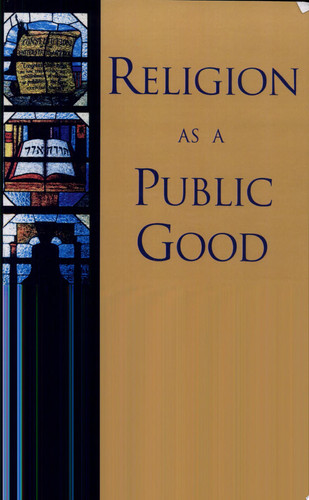
Religion as a public good: Jews and other Americans on religion in the public square

Alan Mittleman
Religion as a Public Good: Jews and Other Americans on Religion in the Public Square explores the often controversial topic of how religion ought to relate to American public life. The sixteen distinguished contributors, both Jewish and Christian, reflect on the topic out of their own disciplines-social ethics, political theory, philosophy, law, history, theology, and sociology. and take a stand based on their religious convictions and political beliefs. The volume is at once scholarly and committed, polemic and civil, reflective and activist. Written in the shadow of 9/11, it invites a new consideration of how religion enhances democratic public life with full awareness of the dangers that religion can sometimes pose. The volume is polemical, as befits the topic, but also civil, as befits a dialogue about an issue of profound significance for democratic citizenship.
Rowman & Littlefield 2003-12-09 336 pages