14302 results for "History"

Not out of Africa: how Afrocentrism became an excuse to teach myth as history

Lefkowitz, Mary R.
Not Out of Africa has sparked widespread debate over the teaching of revisionist history in schools and colleges. Was Socrates black? Did Aristotle steal his ideas from the library in Alexandria? Do we owe the underlying tenets of our democratic civilizaiton to the Africans? Mary Lefkowitz explains why politically motivated histories of the ancient world are being written and shows how Afrocentrist claims blatantly contradict the historical evidence. Not Out of Africa is an important book that protects and argues for the necessity of historical truths and standards in cultural education.For this new paperback edition, Mary Lefkowitz has written an epilogue in which she responds to her critics and offers topics for further discussion. She has also added supplementary notes, a bibliography with suggestions for further reading, and a glossary of names. --
BasicBooks 1996-01-25 222 pages

Boots of Leather, Slippers of Gold The History of a Lesbian Community

Elizabeth Lapovsky Kennedy,Madeline D. Davis
Boots of Leather, Slippers of Gold traces the evolution of the lesbian community in Buffalo, New York from the mid-1930s up to the early 1960s. Drawing upon the oral histories of 45 women, it is the first comprehensive history of a working-class lesbian community. These poignant and complex stories show how black and white working-class lesbians, although living under oppressive circumstances, nevertheless became powerful agents of historical change. Based on 13 years of research, Boots of Leather, Slippers of Gold ranges over such topics as sex, relationships, coming out, butch-fem roles, motherhood, aging, racism, work, oppression and pride. Kennedy and Davis provide a unique insider's perspective on butch-fem culture and argue that the roots of gay and lesbian liberation are found specifically in the determined resistance of working-class lesbians.
Taylor & Francis Group 1993-04-19 464 pages

The Shortest History of China

Linda Jaivin
"Modern China is at once an economic powerhouse and authoritarian state, an increasingly assertive superpower and an icon of modernity. Chinese history is no less contradictory. ... Jaivin distills this vast, complex story into a vivid narrative, from ancient times to Xi Jinping the Covid-19 pandemic and the rise of teh 'wolf warriors'. She dismantles ideas of a monolithic China, revealing a nation of startling diversity. And she gives China's women, from ancient warriors, inventors and rebels to their 21st century counterparts, long overude attention." -- Dust jacket.
Old Street Publishing 2021-09 278 pages

Gay L.A: a history of sexual outlaws, power politics, and lipstick lesbians

Faderman, Lillian
The exhortation to “Go West!” has always sparked the American imagination. But for gays, lesbians, and transgendered people, the City of Angels provided a special home and gave rise to one of the most influential gay cultures in the world. Drawing on rare archives and photographs as well as more than three hundred interviews, Lillian Faderman and Stuart Timmons chart L.A.'s unique gay history, from the first missionary encounters with Native American cross-gendered “two spirits” to cross-dressing frontier women in search of their fortunes; from the bohemian freedom of early Hollywood to the explosion of gay life during World War II to the underground radicalism set off by the 1950s blacklist; and from the 1960s gay liberation movement to the creation of gay marketing in the 1990s.
University of California Press 2009-08-03 431 pages

From text to tradition: a history of Second Temple and Rabbinic Judaism

Schiffman, Lawrence H.
From Text to Tradition examines the history of Judaism as it developed from the religion on the biblical Israel to the Judaism of the Talmudic rabbis. Each step in this process is discussed from the historical, literary and religious points of view and the context of the political history of the Jews. Among the topics covered in this connection are the biblical heritage which underlies all later Judaism, the importance of the Persian period for laying the groundwork for post biblical Judaism, the confrontation of Judaism with Hellenism, apocrypha, pseudepigrapha and the Dead Sea Scrolls, Pharisees, Sadducees and Essenes, the Jewish-Christian schism, the impact of the Jewish revolts against Rome and the destruction of the Temple, the rise of Rabbinic Judaism, and the development of the Mishnah, Talmud and Jewish Law. One of the book's major theses is that the various approaches to Judaism shared sufficient common ground as to be classified as one, albeit variegated, religious tradition. Diverging trends may be - and are - traced during this period, as is the question of the role of interpretation, the impact of external influences, and the process by which the competing approaches were eventually supplanted by the rabbinic tradition, which became the basis for medieval and modern Judaism. In this way, Judaism is shown to have traveled the long road from the textual heritage of the Hebrew Bible to the oral tradition of the rabbis.
Ktav Pub. House 1991 299 pages

Truth has a power of its own: conversations about a people's history

Zinn, Howard,Suarez, Ray
"Truth Has a Power of Its Own is an engrossing collection of never-before-published conversations with Howard Zinn, conducted by the distinguished broadcast journalist Ray Suarez in 2007, that covers the course of American history from Columbus to the War on Terror from the perspective of ordinary people--including slaves, workers, immigrants, women, and Native Americans. Viewed through the lens of Zinn's own life as a soldier, historian, and activist and using his paradigm-shifting People's History of the United States as a point of departure, these conversations explore the American Revolution, the Civil War, the labor battles of the nineteenth and twentieth centuries, U.S. imperialism from the Indian Wars to the War on Terrorism, World Wars I and II, the Cold War, and the fight for equality and immigrant rights, all from an unapologetically radical standpoint. Longtime admirers and a new generation of readers alike will be fascinated to learn about Zinn's thought processes, rationale, motivations, and approach to his now-iconic historical work."--Amazon.com.
The New Press 2022 223 pages

After Jackie: pride, prejudice, and baseball's forgotten heroes : an oral history

Fussman, Cal
To commemorate the sixtieth anniversary of the breaking of baseball's color barrier, an exploration of Jackie Robinson's impact and legacy by the people whose lives were transformed by his courage. When Robinson joined the Brooklyn Dodgers in 1947, he forever changed the game of baseball--and America itself. Sportswriter Fussman traces Robinson's enormous legacy in sports, politics, and the civil rights movement through the men (and women) who came after him. With moving and intimate interviews of more than one hundred former major league players of African-American descent, as well as such luminaries as Jimmy Carter, Muhammad Ali, and Walter Cronkite, among others, this book recalls the day one man altered history for so many, and the history that followed.--From publisher description.
ESPN Books 2007-04-03 243 pages

Surfing USA! an illustrated history of the coolest sport of all time

Marcus, Ben
Surfing is not just a sport; it is a pop-culture phenomenon. Surfing has created legends, while seizing the spotlight in every aspect of beach culture, in movies, in fashion, and in music. Surfing has evolved from its mystical beginnings in Polynesia, where it was valued as noble, positive, and deeply imbued with spiritual meaning but condemned by critics (mostly religious conservatives) who considered it “pagan, immoral, and corrupting.” And we've come a long way from pre–World War II days, when Hawaii' was as remote as Timbuktu; when itchy wool swimsuits and heavy hardwood surfboards were the norm. We've matured since the 1950s and 1960s, with their trendy popularity—the culture and fashion, the movies and music, from “Gidget” to the Beach Boys and those bushy, bushy blond hairdos—to today, when the glitz of sophisticated marketing campaigns and media-savvy surfers are “de rigueur.” Yet, through the years, surfing has maintained its reputation as a refuge for non-conformists; the often-below-the-radar individualistic lifestyle defies a dry chronicle neatly tied up with a bow. A comprehensive history of the sport by Ben Marcus, a man who lived it and who knows and loves it like nothing else, Surfing USA! is anything but dry; it truly captures the glamour and excitement of this extreme sport. If you are still in awe of that first surfboard, still stoked by hanging ten, or still dreaming of that elusive wave, then this book is for you. Ben Marcus, the former editor of “Surfer” magazine and current freelancer for such publications as “Surfer's Journal,” brings you up close and personal to the exciting world of surfing.
Voyageur Press 2005 207 pages

A history of the Cuban Revolution

Chomsky, Aviva
This work presents a concise socio-historical account of the Cuban Revolution of 1959, an event that continues to spark debate 50 years later. It balances a comprehensive overview of the political and economic events of the revolution with a look at the revolution's social impact, and provides an on-the-ground look at the lives of ordinary people. It also features both U.S. and Cuban perspectives to provide a complete and well-rounded look at the revolution and its repercussions, and encourages students to understand history through the viewpoint of individuals living it
Wiley-Blackwell 2011 241 pages

The pity of it all: a history of the Jews in Germany, 1743-1933

Elon, Amos
Presents a cultural history of German Jewry from Moses Mendelssohn's arrival in Berlin until the end of the Weimar Republic. Refers to antisemitism in a number of contexts: Mendelssohn is hailed by German intellectuals as an exception among the Jews; acceptance of the Jew was sometimes soon followed by rejection; despite or because of disproportionate Jewish contributions to culture and society, Jews are viewed as foreigners; rights are granted only to rich and useful Jews; despite Jewish patriotism, Jews are often portrayed as traitors and subversives. Among the prominent Jews discussed are Heinrich Heine, whose ambivalence toward Germans reflected their ambivalence toward him, and Walther Rathenau who was assassinated by radical nationalists whose activities the Weimar Republic was unable to curb. The section devoted to the latter reveals how Weimar's weaknesses opened the door of power to the Nazis.
Metropolitan Books 2002-11 446 pages

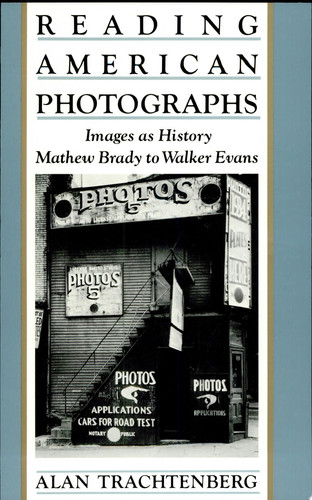
Reading American photographs: images as history, Mathew Brady to Walker Evans

Trachtenberg, Alan
Winner of the Charles C. Eldredge Prize In this book, Alan Trachtenberg reinterprets some of America's most significant photographs, presenting them not as static images but rather as rich cultural texts suffused with meaning and historical content. Reading American Photographs is lavishly illustrated with the work of such luminaries as Mathew Brady, Timothy O'Sullivan, and Walker Evans--pictures that document the American experience from 1839 to 1938. In an outstanding analysis, Trachtenberg eloquently articulates how the art of photography has both followed and shaped the course of American history, and how images captured decades ago provocatively illuminate the present.
Hill and Wang 1989 326 pages

The Israel-Arab reader: a documentary history of the Middle East conflict

Laqueur,Walter,1921-,Rubin,BarryM
Report (August 31, 1947) / UN Special Committee on Palestine. Resolution on the Future Government of Palestine (Partition Resolution) (November 29, 1947) / UN General Assembly -- Pt. II. From Israel's Independence Through the 1973 War's Aftermath. Proclamation of Independence (May 14, 1948) / State of Israel. Resolution 194 (December 11, 1948) / UN General Assmbly. Resolution 303, On the Internationalization of Jerusalem (December 9, 1949) / UN General Assembly. Law of Return (July 5, 1950) / State of Israel. Resolution 619, Concerning Restrictions on the Passage of Ships Through the Suez Canal (September 1, 1951) / UN Security Council. On Zionism and Israel (1960-1963) / Gamal Abdel Nasser. Manifesto (April 1963) / United Arab Republic.
Penguin Books 2001-08-01 580 pages

Totems and teachers: perspectives on the history of anthropology

Sydel Silverman
This classic volume, edited by Sydel Silverman, presents the insiders' reflection of distinguished contemporary anthropologists on nine prominent figures who helped shape the discipline. This is one of few books that traces the theoretical development of anthropology through the lives of the well-known figures who have influenced its historical trajectory.
Columbia University Press 1981 322 pages

American Jewish women's history: a reader

Pamela S. Nadell
“It gives me a secret pleasure to observe the fair character our family has in the place by Jews & Christians,“Abigail Levy Franks wrote to her son from New York City in 1733. Abigail was part of a tiny community of Jews living in the new world. In the centuries that followed, as that community swelled to several millions, women came to occupy diverse and changing roles. American Jewish Women’s History , an anthology covering colonial times to the present, illuminates that historical diversity. It shows women shaping Judaism and their American Jewish communities as they engaged in volunteer activities and political crusades, battled stereotypes, and constructed relationships with their Christian neighbors. It ranges from Rebecca Gratz’s development of the Jewish Sunday School in Philadelphia in 1838 to protest the rising prices of kosher meat at the turn of the century, to the shaping of southern Jewish women's cultural identity through food. There is currently no other reader conveying the breadth of the historical experiences of American Jewish women available. The reader is divided into four sections complete with detailed introductions. The contributors include: Joyce Antler, Joan Jacobs Brumberg, Alice Kessler-Harris, Paula E. Hyman, Riv-Ellen Prell, and Jonathan D. Sarna.
New York University Press 2003-04-05 326 pages