2604 results for "World History"

Philo-Judaeus of Alexandria

Norman Bentwich
"In his study of Philo Mr. Bentwich has done good service by demonstrating this characteristically Jewish combination of qualities in the spirit of the great Alexandrine, and by vindicating the claim of Philo to rank among the great teachers of Judaism." -The Jewish Review "Philo, the chief light of Hellenistic Judaism, by a strange fate was rejected and forgotten by his own people, while he was taken up by the Christians and almost adopted as one of their own. This difference of attitude towards him on the part of Jews and Christians is easily explained. Philo was alien in spirit to the narrow rabbinical Judaism which became universal among the Jews in the second century after Christ, and hence was suspected as unorthodox and put under the ban. On the other hand, his philosophy and exegetical method appealed to the early Fathers, especially those of the Alexandrian school, and even much of his religious teaching was more in sympathy with Christian than with later Jewish thought. In modern times, however, Jewish sentiment towards this illustrious coreligionist has undergone considerable change. In the volume before us Mr. Norman Bentwich has undertaken to make him better known among his own people, and to remove any prejudice that might still exist against him by showing that, after all, he was a true Jew. Though the work is written for Jews, and, as the author frankly tells us, from a Jewish standpoint, by reason of its subject it is likely to attract also some Gentile readers." -America "Having specialized in Jewish history and literature, Mr. Bentwich was eminently fitted to undertake the work on Hellenism. It is this movement in Judaism which Mr. Bentwich has set himself to describe. During the last two or three centuries before the common era the Jewish people came in close contact with the Greek-speaking world, and naturally, could not entirely escape its influence. Greek thought prevailed throughout the Eastern world, and Hellenism, or the culture of Greece, for which Hellas is the older name, dominated the intellectual activity of men. Although the Jews were always opposed to foreign influences which conflicted with their mode of thinking, the Greek culture nevertheless penetrated Jewish life in one way or another....The struggle of Judaism with Hellenistic culture marks one of the most fundamental conflicts in the march of civilization, and as a result, Hellenistic Judaism is one of the most remarkable contributions to Jewish genius to the world's thought....The author treats this subject from the Jewish point of view. Others are chiefly interested in the relation of Hellenism to Christianity. The school of writers contrast the broad universalism of Hellenistic Judaism with the supposed narrow legalism of the Pharisees which eventually prevailed in Palestine. Mr. Bentwich combats this attitude. The present volume is popular in character and the author has not refrained from pointing out parallels in modern Jewish life....Mr. Bentwich apart from giving historical descriptions of the various phases of Hellenism in Palestine and in the Diaspora, fully describes the literature produced by the Jews during that period. He graphically and minutely describes the life and works of Philo, Josephus and other important Jewish writers. He gives a fine resume of the wisdom of Ben Sira and also, deals with the influence of the Septuagint and the attitude of the Jewish Rabbis toward it. The book will appeal to the cultured layman who wishes to be informed on the various movements of Judaism." -The Advocate: America's Jewish Journal
CreateSpace Independent Publishing Platform 2016-11-13 244 pages

Let my people go: the untold story of Australia & the Soviet Jews 1959-89

Lipski, Sam,Rutland, Suzanne D.
For 50 years, until the Berlin Wall fell in 1989, the Soviet Union ran a campaign of repression, imprisonment, political trials and terror against its 3 million Jews. In Australia, political leaders and the Jewish community contributed significantly to the international protest movement which eventually triumphed over Moscow's tyranny and led to the modern Exodus of Soviet Jews to Israel and other countries. Lipski and Rutland make this largely unknown Australian story come alive with a combination of passion, personal experience and ground-breaking research."The struggle for the freedom of Soviet Jewry was one of the most powerful displays of strength and solidarity by the world Jewish community... even those intimately familiar with the struggle will be surprised to discover in Let My People Go how the Australian Jewish community and its leaders were among the campaign's initiators, and how they saw it through to its successful conclusion. This is a unique testament to how a small group can play a big role in history." - Natan Sharansky, Chairman Jewish Agency for Israel, Prisoner of Zion (1977-86)
Gefen 2015 273 pages

Surviving sacrilege: cultural persistance in Jewish antiquity

Weitzman, Steven
In a world of relentless and often violent change, what does it take for a culture to survive? Steven Weitzman addresses this question by exploring the "arts of cultural persistence"--the tactics that cultures employ to sustain themselves in the face of intractable realities. Surviving Sacrilege focuses on a famously resilient culture caught between two disruptive acts of sacrilege: ancient Judaism between the destruction of the First Temple (by the Babylonians) in 586 B.C. and the destruction of the Second Temple (by the Romans) in 70 C.E. Throughout this period Jews faced the challenge of preserving their religious traditions in a world largely out of their control--a world ruled first by the Persians, then by the Hellenistic Seleucid Kingdom, and finally by the Roman Empire. Their struggle to answer this challenge yields insight into the ingenuity, resourcefulness, and creativity of a distinctive period in Jewish history, but one with broad implications for the study of religious and cultural survival. Detecting something tenaciously self-preserving at the core of the imagination, Weitzman argues that its expression in storytelling, fantasy, imitation, metaphor, and magic allows a culture's survival instinct to maneuver within, beyond, and even against the limits of reality.
Harvard University Press 2005 193 pages

Religion and the self in antiquity

David Brakke,Michael L. Satlow,Steven Weitzman
Many recent studies have argued that the self is a modern invention, a concept developed in the last three centuries. Religion and the Self in Antiquity challenges that idea by presenting a series of studies that explore the origins, formation, and limits of the self within the religions of the ancient Mediterranean world. Drawing on recent work on the body, gender, sexuality, the anthropology of the senses, and power, contributors make a strong case that the history of the self does indeed begin in antiquity, developing as Western religion itself developed.
Indiana University Press 2005 268 pages

India traders of the middle ages: documents from the Cairo Geniza : India book

Goitein, Shelomo Dov
The India trade in Oriental spices, pharmaceutical, dyeing and other materials was the backbone of medieval economy, especially in the Islamic world. A unique source of documentation is now available in 11th-12th century Geniza letters, written in Judeo-Arabic (Middle Arabic in Hebrew characters), by participants in this activity. The documents are presented in translation with an introduction and notes. They deal with economic history and material, social, and spiritual civilization. Besides illuminating the activities of the traders of the Jewish Indian Ocean and their families in the territories from the Far East to southern Arabia and Egypt, the letters contain valuable information on Jewish and Islamic culture, relations between Jews and Arabs, Mediterranean culture, and Judeo-Arabic.
Brill 2008 918 pages

Shimmering details: a memoir. Volume 1

Nádas, Péter
The magnum opus of one of Europe's greatest living writers. “When telling one’s life story to someone else one manufactures not chronicles but legends for oneself,” Péter Nádas writes in his fiction masterpiece, Parallel Stories . Now, in his illuminating memoir, Shimmering Details , the renowned author investigates what it means to reconstruct a life without recourse to the techniques and embellishments of traditional storytelling. Taking his firmly embedded memories—the “shimmering details” that give this work its title—as his starting point, Nádas dissects them using a method inspired by Freudian dream interpretation. Sounds, scenes, smells, feelings—all are probed for details that might allow him to reconstruct what happened, and when and where. To avoid conscious or unconscious distortions, he deconstructs the stories of others, too—moving in concentric circles toward cause and effect, until their meaning and significance come to light. In Shimmering Details, Volume I , Nádas probes the history of his family from the late nineteenth century to his birth in 1942 and beyond. In a work that encompasses World War II and the Hungarian Revolution, Nádas traces the hidden connections between the seemingly random events of a life and assembles them into a memoir like no other.
Picador 2024-11-19 576 pages

What a life! the autobiography of Pesach'ke Burstein, Yiddish matinee idol

Burstein, Pesach
Pesach Bursrein, an old trouper from the Yiddish theater, recalls dramas both onstage and off in this memoir, which he dictated to his wife, Lillian Lux Burstein. The Story of Burstein's successful stage career is played out against the background of political turmoil in Europe, vignettes of life in small towns and big cities, friendships and rivalries among theater folk, family life, emigration to the United States, and tours through Europe, South America, Israel, and South Africa. Every personal anecdote tells the larger history: theater history and also the history of the Yiddish communities who were his audiences. While Burstein is a legend in Yiddish cheater, he was little known outside that world until he was celebrated in Arnon Goldfinger's acclaimed documentary Der Komedia11t. This memoir provides the first window for English readers into the other side of Yiddish culture—the Yiddish burlesque, the traveling Yiddish theater, and the music hall. It will not only delight readers but also reveal a social and cultural history never before described in such detail. Burstein's life is the story of popular Yiddish theater in the first half of the century.
Syracuse University Press 2003-04-01 309 pages

German-Jewish thought between religion and politics: festschrift in honor of Paul Mendes-Flohr on the occasion of his seventieth birthday

Paul R. Mendes-Flohr
"Since the Enlightenment period, German-Jewish intellectuals have been prominent voices in the multi-facetted discourse on the reinterpretation of Jewish tradition in light of modern thinking. Paul Mendes-Flohr, one of the towering figures of current scholarship on German-Jewish intellectual history, has made invaluable contributions to a better understanding of the religious, cultural and political dimensions of these thinkers' encounter with German and European culture, including the tension between their loyalty to Judaism and the often competing claims of non-Jewish society and culture. This volume assembles essays by internationally acknowledged scholars in the field who intend to honor Mendes-Flohr's work by portraying the abundance of religious, philosophical, aesthetical and political aspects dominating the thinking of those famous thinkers populating German Jewry's rich and complex intellectual world in the modern period. It also provides a fresh theoretical outlook on trends in Jewish intellectual history, raising new questions concerning the dialectics of assimilation. In addition to that, the volume sheds light on thinkers and debates that hitherto have not been accorded full scholarly attention."--Publisher's website.
De Gruyter 2012 458 pages

A chosen calling: Jews in science in the twentieth century

Efron, Noah J.
Scholars have struggled for decades to explain why Jews have succeeded extravagantly in modern science. A variety of controversial theories from such intellects as C. P. Snow, Norbert Wiener, and Nathaniel Weyl have been promoted. Snow hypothesized an evolved genetic predisposition to scientific success. Wiener suggested that the breeding habits of Jews sustained hereditary qualities conducive for learning. Economist and eugenicist Weyl attributed Jewish intellectual eminence to "seventeen centuries of breeding for scholars." Rejecting the idea that Jews have done well in science because of uniquely Jewish traits, Jewish brains, and Jewish habits of mind, historian of science Noah J. Efron approaches the Jewish affinity for science through the geographic and cultural circumstances of Jews who were compelled to settle in new worlds in the early twentieth century. Seeking relief from religious persecution, millions of Jews resettled in the United States, Palestine, and the Soviet Union, with large concentrations of settlers in New York, Tel Aviv, and Moscow. Science played a large role in the lives and livelihoods of these immigrants: it was a universal force that transcended the arbitrary Old World orders that had long ensured the exclusion of all but a few Jews from the seats of power, wealth, and public esteem. Although the three destinations were far apart geographically, the links among the communities were enduring and spirited. This shared experience of facing the future in new worlds, both physical and conceptual provided a generation of Jews with opportunities unlike any their parents and grandparents had known. The tumultuous recent century of Jewish history, which saw both a methodical campaign to blot out Europe's Jews and the inexorable absorption of Western Jews into the societies in which they now live, is illuminated by the place of honor science held in Jewish imaginations. Science was central to their dreams of creating new worlds - welcoming worlds - for a persecuted people. This provocative work will appeal to historians of science as well as scholars of religion, Jewish studies, and Zionism
Johns Hopkins University Press 2014-06 149 pages

After abolition: Britain and the slave trade since 1807

Sherwood, Marika
With the abolition of the slave trade in 1807 and the Emancipation Act of 1833, Britain seemed to wash its hands of slavery. Not so, according to Marika Sherwood, who sets the record straight in this provocative new book. In fact, Sherwood demonstrates that Britain continued to contribute to the slave trade well after 1807, even into the twentieth century. Drawing on government documents and contemporary reports as well as published sources, she describes how slavery remained very much a part of British investment, commerce and empire, especially in funding and supplying goods for the trade in slaves and in the use of slave-grown produce. The nancial world of the City in London also depended on slavery, which - directly and indirectly - provided employment for millions of people. "After Abolition" also examines some of the causes and repercussions of continued British involvement in slavery and describes many of the apparently respectable villains, as well as the heroes, connected with the trade - at all levels of society. It contains important revelations about a darker side of British history, previously unexplored, which will provoke real questions about Britain's perceptions of its past
I. B. Tauris 2007 246 pages

The Chess-monthly

Hoffer, Leopold
Dive into the rich history of chess with "The Chess-monthly, Volume 8", a fascinating glimpse into the world of 19th-century chess strategy and culture. Authored by chess masters Leopold Hoffer and Johannes Hermann Zukertort, this volume offers a wealth of insights into the games, players, and controversies that shaped the era. Originally published as a periodical, "The Chess-monthly" provided enthusiasts with detailed game analyses, tournament reports, and biographical sketches of prominent chess figures. This particular volume captures a pivotal moment in chess history, showcasing the evolution of tactics and the growing popularity of the game across Europe. Whether you're a seasoned chess player, a history buff, or simply curious about the intellectual pursuits of the past, "The Chess-monthly, Volume 8" offers a captivating and informative journey into the world of chess. This work has been selected by scholars as being culturally important, and is part of the knowledge base of civilization as we know it. This work was reproduced from the original artifact, and remains as true to the original work as possible. Therefore, you will see the original copyright references, library stamps (as most of these works have been housed in our most important libraries around the world), and other notations in the work. This work is in the public domain in the United States of America, and possibly other nations. Within the United States, you may freely copy and distribute this work, as no entity (individual or corporate) has a copyright on the body of the work. As a reproduction of a historical artifact, this work may contain missing or blurred pages, poor pictures, errant marks, etc. Scholars believe, and we concur, that this work is important enough to be preserved, reproduced, and made generally available to the public. We appreciate your support of the preservation process, and thank you for being an important part of keeping this knowledge alive and relevant.
Hutson Street Press 2025-05-22 394 pages

The Jewish people and Jesus Christ after Auschwitz

Jocz, Jakób
The author marks the end of World War II as the closing of an important period of history and the possible new beginning for the Jewish people, the church, and the world at large. He cites two events as of major importance, the creation of the Jewish state of Israel and the second Vatican Counsel. He takes a look at the evolution of a new kind of Judaism that is more tolerant and accepting of Jesus as Jew, just as the church intensifies its commitment to Judaeo-Christian dialogue. Originally published by Baker Book House in 1981.
University Press of America 1991-10-08 273 pages

Canada's army: waging war and keeping the peace

Granatstein, J. L.
"Originally published in 2002, Canada's Army quickly became the definitive history of the Canadian military. In the twenty intervening years, we have seen major changes to how Canadians think about their military, and in the ways Canadians fight, train, and serve their nation in peace and in war. Written by J.L. Granatstein, one of the country's leading political and military historians, Canada's Army traces the full three-hundred-year history of the Canadian military. This thoroughly revised third edition brings Granatstein's work up to date with fresh material and new scholarship on the evolving role of the military in Canadian society, along with updated sources, maps, and illustrations. It explores the military from its origins in New France to the Conquest, the Revolutionary War, and the War of 1812; from South Africa and the two World Wars to the Korean War and contemporary peacekeeping efforts. The third edition includes new coverage of the War in Afghanistan; NATO deployments to Poland, Latvia, and Iraq; aid to the civil power deployments; and the role of the army reserve. Granatstein points to the inevitable continuation of armed conflict around the world and makes a compelling case for Canada to maintain properly equipped and professional armed forces. Masterfully written and passionately argued, Canada's Army offers a rich analysis of the political context for the battles and events that shape our understanding of the Canadian military."--
University of Toronto Press 2021 580 pages

Crossing the Jordan: on Judaism, Islam, and the West

Solway, David
During these shocking times of war, violence, and hate many are now seeking answers to important questions. What are the bases of the claims of the Jewish people to the Holy Land? What are the foundations of the conflicts between Muslims and Jews? What does Western Culture and its decline have to do with Israel and the Muslims? How does the rise of extreme leftism in Canada and the United States facilitate and encourage extreme hate and violence at home and in the Middle East? These and many other questions are answered by David Solway in this timely collection of essays-- easily read, easily understood, and written with erudition, scholarship, and style. Solway's style is appropriate for general readers or those with long backgrounds of knowledge of Judaism, Islam, Israel, the Middle East, American and Canadian cultural and political radicalism and decline, the Jewish People, and the intersection of Judaism and Islam in the Middle East. The most recent horror for the Jews that began on October 7, 2023, can be better understood with a clear understanding of Israel, diaspora Jews, ancient and modern Jewish history, and the decline of the West into moral relativism, communism, and leftist utopianism. Times of strife and horror are best explained by clarity of thought and writing. Solway provides both in this important work that provides both context and background to the horrors seen recently in Israel, across Europe, in the United States, and across the world.
New English Review Press 2023 269 pages

Party animals: my family and other communists

Aaronovitch, David
In July 1961, just before David Aaronovitch's seventh birthday, Yuri Gagarin came to London. The Russian spaceman was everything the Aaronovitch family wished for - a popular and handsome embodiment of modern communism, of the forward march of history. When Gagarin went to Highgate to visit the tomb of Karl Marx, the local communists came out to cheer, David's father, a full-time worker for the Communist Party, and his mother among them. But who were they, these ever hopeful, defiant and (had they but known it) historically doomed people? In a sense they were like a non-magical version of the wizards of J K Rowling's world, living part secretly with and parallel to the non-communist majority, sometimes persecuted, sometimes ignored, but carrying on their own ways and traditions. Where others went to church they went to Socialist Sunday School, where others watched the Black and White Minstrels they went to see the Red Army Choir (always providing that visas had been issued). Society's up was their down, its heroes were their villains and vice versa. Trade unions were never more noble than when militant, the blacks were right and the whites were wrong. Who wanted American TV when you could have Russian movies? A memoir of early life among communists and an exploration of the world that created that life, Party Animals first took David Aaronovitch back through his own memories of belief and action. But there was much more to it. He found himself studying the old secret service files, his mother's diaries and letters, uncovering the unspoken shame and fears that provided the unconscious background to his own existence as a party animal. Only then did he begin to understand what had come before - both the obstinate heroism and the monstrous cowardice. And the elements that shape our fondest beliefs
Jonathan Cape 2016 308 pages

You Wake Me Each Morning

Lawn Connie Lawn,Connie Lawn
You Wake Me Each Morning That is what listeners around the world have said to Connie for years, as they heard her radio broadcasts in this country and around the world. The first time she heard the phrase was from Sam Lewis, America's long - time Ambassador to Israel. Some listeners have called the voice sexy, authoritative, funny, snobby, or sophisticated. Connie tries to incorporate it all, as she tells the stories that make the news or change history. Of the many compliments she has received, the most important came from Nelson Mandela. The former South African President said he listened to her broadcasts for years while in prison. He told her, during a Washington news conference, "You Gave My People Hope." Then he went onto say, "You are not as big as I thought you were!" In her autobiography, Connie tells of the struggles of a one-woman news bureau. She recounts such events as the unrest in Washington in 1968; the killing of Robert Kennedy (she had one of the last interviews with him); the Invasion of Czechoslovakia, where she stayed for six months; a brief kidnapping in Lebanon in l982, and White House coverage of Presidents from Lyndon Johnson to Barack Obama and beyond. Connie received the Lifetime Achievement Award for Excellence in Journalism from the New Zealand National Press Club at the New Zealand Parliament on August 15, 2006. This is a book for people of all ages, but especially those who are working the hardest to find themselves. To all the message is - never give up, be different from the crowd, and have fun!
iUniverse 2010-02 356 pages

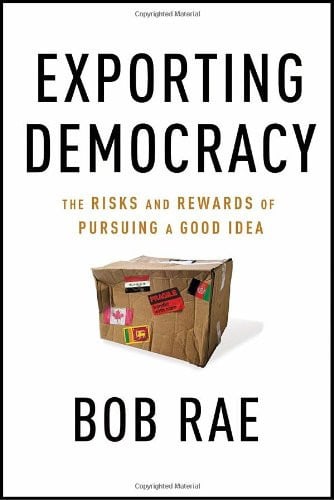
Exporting democracy: the risks and rewards of pursuing a good idea

Rae, Bob
The way most Western politicians talk, democracy is the pinnacle of civilization, the best political system there is. Many think it's the system the rest of the world ought to adopt. Bob Rae is not one of them. He is too well informed about the difficulties and dangers of implanting democracy in foreign lands. Exporting Democracy is an eloquently argued book in which Rae brings his lively, nuanced understanding to bear on the history and current fortunes of this powerful idea. He shows how it and the related ideas of freedom, human rights, and federalism have been pushed to centre stage by the collapse of Soviet communism and by ongoing wars to topple secular and religious dictatorships in the Middle East. He's also witnessed attempts to implant democracy in three countries riven by tribal and ethnic divisions, Iraq, Afghanistan, and Sri Lanka, and offers readers a cool appraisal of the effort.
McClelland & Stewart 2010 275 pages

The African worker

Freund, Bill
The African Worker, first published in 1988, was intended as a synthesis considering issues and debates from the work of many writers on labour history and labour studies in Africa. The development of a particular critical literature, spanning a number of disciplines, is critically considered. In some respects, the concerns of past generations have been to align the understanding of labour issues in Africa with those more generally in the modern world. In others, the emphasis remains on the specific and African. Both directions clearly emerge here. The bibliographical essay, as well as the bibliography itself, is meant to point readers further who want a higher order of detail, a regional focus or a more thorough-going theoretical treatment of all or some of the relevant issues.
Cambridge University Press 1988-08-25 200 pages

Heralds of Science As Represented by Two Hundred Epochal Books and Pamphlets

Bern Dibner
Heralds of Science: As Represented by Two Hundred Epochal Books and Pamphlets is a comprehensive guide to the most significant scientific publications in history. Written by Bern Dibner, a renowned collector of rare scientific books and manuscripts, this book features 200 seminal works that have shaped the course of scientific progress. The book is divided into six sections, each covering a different area of science: astronomy, mathematics, physics, chemistry, medicine, and technology. Each section includes a brief introduction to the field, followed by a selection of books and pamphlets that have had a significant impact on that area of study. The book is beautifully illustrated with full-color photographs of the featured publications, as well as portraits of the scientists who wrote them. The text is written in an accessible style, making it easy for readers of all levels of scientific knowledge to understand and appreciate the importance of these works. Heralds of Science is a must-read for anyone interested in the history of science and the key figures and publications that have shaped our understanding of the world around us. It is a valuable resource for students, researchers, and anyone with a passion for science and its impact on society.This is a new release of the original 1955 edition.This scarce antiquarian book is a facsimile reprint of the old original and may contain some imperfections such as library marks and notations. Because we believe this work is culturally important, we have made it available as part of our commitment for protecting, preserving, and promoting the world's literature in affordable, high quality, modern editions, that are true to their original work.
Literary Licensing, LLC 2013-10 98 pages

Publications Of The American Jewish Historical Society

American Jewish Historical Society
This volume of the "Publications Of The American Jewish Historical Society" (Volume 11) offers a fascinating glimpse into the history of Jewish communities in America. Compiled by the American Jewish Historical Society, these publications serve as a vital resource for understanding the multifaceted experiences of Jewish immigrants and their descendants. The essays and records within shed light on various aspects of Jewish life, including communal organizations, religious practices, cultural adaptations, and contributions to American society. Researchers, historians, and anyone interested in American Jewish history will find this collection invaluable for its primary source material and insightful perspectives. These publications provide a rich tapestry of voices and stories, preserving the legacy of Jewish life in America for generations to come. This work has been selected by scholars as being culturally important, and is part of the knowledge base of civilization as we know it. This work was reproduced from the original artifact, and remains as true to the original work as possible. Therefore, you will see the original copyright references, library stamps (as most of these works have been housed in our most important libraries around the world), and other notations in the work. This work is in the public domain in the United States of America, and possibly other nations. Within the United States, you may freely copy and distribute this work, as no entity (individual or corporate) has a copyright on the body of the work. As a reproduction of a historical artifact, this work may contain missing or blurred pages, poor pictures, errant marks, etc. Scholars believe, and we concur, that this work is important enough to be preserved, reproduced, and made generally available to the public. We appreciate your support of the preservation process, and thank you for being an important part of keeping this knowledge alive and relevant.
Creative Media Partners, LLC 2025-05-22 258 pages