58,196 results in 0.24 seconds

What was liberalism? the past, present and promise of a noble idea

Traub, James
"In the vertiginous era of Trump and Marine le Pen, liberalism's status is challenged. There is a widespread fear that liberal values, long taken for granted, are now in danger -- not only from authoritarian countries abroad, but also from a loss of faith inside the liberal world. What happened? Why did liberalism lose the majority support it once enjoyed? And what is so precious about liberalism in the first place? In What Was Liberalism?, award-winning journalist and author James Traub tackles these questions by examining the history of liberalism, from the American and French revolutions through the writings of John Stuart Mill and early-twentieth-century American progressives to liberalism's midcentury triumph in the West, its shaky present, and its uncertain future. Liberalism, Traub shows, began with a commitment to individual liberty, but it didn't end there. Over time, liberals sought to balance freedom of speech and action with goods like justice and equality, opposing both economic exploitation and totalitarianism. Partly as a result, the relationship between liberalism and democracy also evolved. Many nineteenth-century liberals were deeply worried about the democracy's illiberal effects, but by the middle of the twentieth century, liberalism had become the consensus faith of a wide swath of Americans and Europeans, both left and right. Yet even as the liberal West emerged victorious from the Cold War, liberalism's broad majoritarian foundations were crumbling, falling prey to accelerating economic inequality and the vexing challenges of race and immigration. Traub explores how illiberalism burned out of sight like an underground fire, and how it exploded into view in Europe and the United States in recent decades"--
Basic Books 2019-09-24 311 pages

Revolution from abroad : the Soviet conquest of Poland's western Ukraine and western Belorussia

Gross, Jan Tomasz
Jan Gross describes the terrors of the Soviet occupation of the lands that made up eastern Poland between the two world wars: the Western Ukraine and Western Belorussia. His lucid analysis of the revolution that came to Poland from abroad is based on hundreds of first-hand accounts of the hardship, suffering, and social chaos that accompanied the Sovietization of this poorest section of a poverty-stricken country. Woven into the author's exploration of events from the Soviet's German-supported aggression against Poland in September of 1939 to Germany's attack on the Soviet Union in June 1941, these testimonies not only illuminate his conclusions about the nature of totalitarianism but also make a powerful statement of their own. Those who endured the imposition of Soviet rule and mass deportations to forced resettlement, labor camps, and prisons of the Soviet Union are here allowed to speak for themselves, and they do so with grim effectiveness.
Princeton Univ. Press 2002-05-12 396 pages

Little Frog and the Scary Autumn Thing

Jane Yolen
"Rich colors underscore the intensity of Little Frog's feelings...a low-key way of introducing the idea of change, in nature or otherwise." - KIRKUS REVIEWS Most things that are scary are just new... Little Frog and the Scary Autumn Thing helps families embrace the new and unknown through the story of one little frog learning that change doesn't have to be frightening--especially when families face it together! It's Little Frog's first autumn, and she doesn't like it one bit. It is not the green world she loves so much, but something scarier and ominous, filled with red and gold and yellow. And noise! WHIRRRRR. CHIRRRR. BAROOOOOOM. But encouraged by her Mama, who reminds her that "Most things that are scary are just new," Little Frog bravely sets out into this world. When her courage waivers, she starts to run and soon is lost, miserably lost. She finds her way to Papa Frog, and he shows her what Mama Frog means. In a warm and satisfying ending: At last, arm in arm, Little Frog and Papa Frog happily hopped and danced all the way home to The Pond where Mama Frog had made a fresh shoo-fly pie for dinner, something all three of them knew well. This charmer of a story is by multi-award winning author Jane Yolen, author of Owl Moon and the How Do Dinosaurs...? books. The wonderful autumn palette and adorable pictures are by newcomer Ellen Shi, who is not afraid of trying something new herself. About the LITTLE FROG Series Fear comes in many shapes and sizes. Seasons change. Families change. And change can be a scary thing for a little mind exploring the complicated emotions of facing the unknown. With gentle sweetness, Little Frog makes them laugh and breathe a sigh of relief through life's natural cycles. Little Frog shows young children they can muster up courage in the face of all things strange and new. With a little love, patience, and acceptance, big fears can be turned into bigger discoveries. Praise for LITTLE FROG "Vivid autumn foliage is generally considered to be a thing of beauty, but those unfamiliar colors spell danger to a young frog. Yolen doesn't rush Little Frog's emotional turnaround. Shi's inviting mixed-media landscapes make it clear that the amphibian is never in danger...reasoned reactions to her own nervousness hint at ways readers might tackle their own fears." -- PUBLISHER'S WEEKLY
WunderMill, Incorporated 2016 32 pages

Little Frog and the Spring Polliwogs

Jane Yolen
The feisty young heroine of Little Frog and the Scary Autumn Thing is back with a new adventure--being a big sister! Little Frog is no longer the littlest frog. Some new family members--the spring polliwogs--are so much trouble for the former "Only Frog," and Little Frog is all out of sorts. But when that polliwog trouble becomes nothing compared to a real threat---boys with nets!--Little Frog has to remember all that she's been taught in order to save the tadpoles from disaster. This charmer of a sequel is by multi-award winning author Jane Yolen, author of On Bird Hill, Owl Moon and the How Do Dinosaurs...? books. The wonderful spring palette and adorable pictures are by illustrator of the first Little Frog, Ellen Shi. About the LITTLE FROG Series Fear comes in many shapes and sizes. Seasons change. Families change. And change can be a scary thing for a little mind exploring the complicated emotions of facing the unknown. With gentle sweetness, Little Frog makes them laugh and breathe a sigh of relief through life's natural cycles. Little Frog shows young children they can muster up courage in the face of all things strange and new. With a little love, patience, and acceptance, big fears can be turned into bigger discoveries. Praise for LITTLE FROG "Vivid autumn foliage is generally considered to be a thing of beauty, but those unfamiliar colors spell danger to a young frog. Yolen doesn't rush Little Frog's emotional turnaround. Shi's inviting mixed-media landscapes make it clear that the amphibian is never in danger...reasoned reactions to her own nervousness hint at ways readers might tackle their own fears." -- PUBLISHER'S WEEKLY "This book is great for new/older siblings. It is cute and relatable." -- GOODREADS
Wundermill Publishing Group, Incorporated 2019-03-27 32 pages

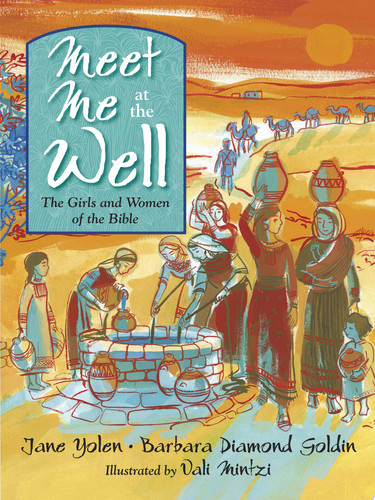
Meet me at the well: the girls and women of the Bible

Yolen, Jane,Goldin, Barbara Diamond
"The inimitable Jane Yolen has teamed up with Barbara Diamond Goldin (a prolific author in her own right) to retell Bible stories from the point of view of twelve women (in nine chapters, as some come in pairs). After each story, there is a reflection "imagine" piece written from the voice of each woman (written by Barbara) and a poem about her (written by Jane). Intermixed with the main text are sidebars called "midrash" in the singular or "midrashim" in the plural. These pose questions about each Bible story, provide more information about traditions, and include scholars' and writers' interpretations. These type of sidebars are traditional in Judiaca, defined as "an ancient commentary on part of the Hebrew scriptures, attached to the biblical text." The book's introduction explains that the stories are all from the "Hebrew Bible," sometimes called the "Old Testament" in communities outside of Judaism. While the book definitely comes from a Jewish standpoint, the book will have religious crossover appeal because these stories are part of many traditions and the commentary is nondenominational"--
Charlesbridge 2017 104 pages