9 results for "Adventure"

Leon Uris: life of a best seller

Nadel, Ira Bruce
As the best-selling author of Exodus, Mila 18, QB VII, and Trinity, Leon Uris blazed a path to celebrity with books that readers could not put down. Uris’s thirteen novels sold millions of copies, spent months on the best-seller lists, appeared in fifty languages, and have been adapted into equally popular movies and TV miniseries. Few other writers equaled Uris’s fame in the mid-twentieth century. His success fueled the rise of mass-market paperbacks, movie tie-ins, and celebrity author tours. Beloved by the public, Uris was, not surprisingly, dismissed by literary critics. Until now, his own life and work—as full of drama as his fiction—have never been the subject of a book. In Leon Uris: Life of a Best Seller, Ira Nadel traces Uris from his disruptive youth to his life-changing experiences as a marine in World War II. These experiences, coupled with Uris’s embrace of his Judaism and desire to write, led to his unprecedented success and the lavish excesses of a career as a best-selling author. Nadel reveals that Uris lived the adventures he described, including his war experiences in the Pacific (Battle Cry), life-threatening travels in Israel (Exodus), visit to Communist Poland (Mila 18), libel trial in Britain (QB VII), and dangerous sojourn in fractious Northern Ireland and the Irish Republic (Trinity). Nadel also demonstrates that Uris’s talent for writing action-packed, yet thoroughly researched, novels meshed perfectly with the public’s desire to revisit and understand the tumultuous events of recent history. This made him far more popular (and wealthy) than more literary authors, while paving the way for writers such as Irving Wallace and Tom Clancy.
University of Texas Press 2010-10-15 352 pages

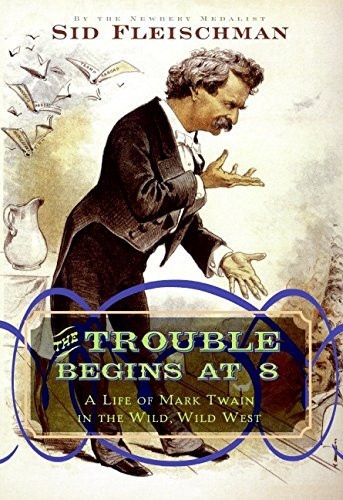
The trouble begins at 8: a life of Mark Twain in the wild, wild West

Fleischman, Sid
"Mark Twain was born fully grown, with a cheap cigar clamped between his teeth." So begins Sid Fleischman's ramble-scramble biography of the great American author and wit, who started life in a Missouri village as a barefoot boy named Samuel Clemens. Abandoning a career as a young steamboat pilot on the Mississippi River, Sam took a bumpy stagecoach to the Far West. In the gold and silver fields, he expected to get rich quick. Instead, he got poor fast, digging in the wrong places. His stint as a sagebrush newspaperman led to a duel with pistols. Had he not survived, the world would never have heard of Tom Sawyer or Huckleberry Finn—or red-headed Mark Twain. Samuel Clemens adopted his pen name in a hotel room in San Francisco and promptly made a jumping frog (and himself) famous. His celebrated novels followed at a leisurely pace; his quips at jet speed. "Don't let schooling interfere with your education," he wrote. Here, in high style, is the story of a wisecracking adventurer who came of age in the untamed West; an ink-stained rebel who surprised himself by becoming the most famous American of his time. Bountifully illustrated.
Greenwillow Books 2008 224 pages

Turning right at Hollywood and Vine: the perils of coming out conservative in Tinseltown

Simon, Roger L.
An Academy Award-nominated screenwriter and a mystery novelist, Roger L. Simon is the only American writer to pull off the amazing trick of being profiled positively in both Mother Jones and National Review in one lifetime. The stunning story of his political odyssey is told in this memoir, where Simon recounts his migration from financier of the Black Panther Breakfast Program to pioneer blogosphere mogul beloved by the right as a 9/11 Democrat. But Simon is beholden to neither right nor left in this tale of Hollywood chic run amuck, as he talks out of school about his adventures with, among many others, Richard Pryor, Warren Beatty, Timothy Leary, Richard Dreyfuss, Woody Allen, and Julian Semyonov, the Soviet Union's version of Robert Ludlum and also a KGB colonel who tempted Simon to join the KGB himself. Among the topics covered along the way: Is there a new blacklist in Hollywood, this one targeting conservatives? Simon's red-carpet tours of the People's Republic of China, Cuba, and the Soviet Union with Hollywood screenwriters and famous mystery novelists. Why Al Gore's documentary on global warming didn't deserve the Oscar on artistic grounds alone; and why the Academy's voting system is so corrupt. And, as they say, there is much, much more besides.
Encounter Books 2010 209 pages

In the province of the gods

Fries, Kenny
A disabled foreigner in Japan--a society historically hostile to difference--Kenny Fries spins a tale of exciting, bewildering adventure. As he visits Japanese gardens, experiences Noh and butoh, and meets artists and scholars, he also discovers disabled gods, one-eyed samurai, blind chanting priests, and A-bomb survivors. When he is diagnosed as HIV-positive, all his assumptions about Japan, the body, and mortality are shaken, and he must find a way to re-enter life on new terms.
The University of Wisconsin Press 2017 198 pages

Master of adventure: the worlds of Edgar Rice Burroughs

Lupoff, Richard A.
So, just how was Tarzan created? Eager to know the inside story about the legendary John Carter and the amazing cities and peoples of Barsoom? Perhaps your taste is more suited to David Innes and the fantastic lost world at the Earth?s core? Or maybe wrong-way Napier and the bizarre civilizations of cloud-enshrouded Venus are more to your liking? These pages contain all that you will ever want to know about the wondrous worlds and unforgettable characters penned by the master storyteller Edgar Rice Burroughs. ø Richard A. Lupoff, the respected critic and writer who helped spark a Burroughs revival in the 1960s, reveals fascinating details about the stories written by the creator of Tarzan. Featured here are outlines of all of Burroughs?s major novels, with descriptions of how they were each written and their respective sources of inspiration. This Bison Books edition includes a new foreword by fantasy writer Michael Moorcock, a new introduction by the author, a final chapter by Phillip R. Burger, as well as corrected text and an updated bibliography.
University of Nebraska Press 2005-01-01 307 pages

Better to have loved: the life of Judith Merril

Merril, Judith
Judith Merril was a pioneer of twentieth-century science fiction, a prolific author, and editor. She was also a passionate social and political activist. In fact, her life was a constant adventure within the alternative and experimental worlds of science fiction, left politics, and Canadian literature. Better to Have Loved is illustrated with original art works, covers from classic science fiction magazines, period illustrations, and striking photography.
Between the Lines 2004 282 pages

Howard Fast: life and literature in the left lane

Sorin, Gerald
Howard Fast's life, from a rough-and-tumble Jewish New York street kid to the rich and famous author of close to 100 books, rivals the Horatio Alger myth. Author of bestsellers such as Citizen Tom Paine, Freedom Road, My Glorious Brothers, and Spartacus, Fast joined the American Communist Party in 1943 and remained a loyal member until 1957, despite being imprisoned for contempt of Congress. Gerald Sorin illuminates the connections among Fast's Jewishness, his writings, and his left-wing politics and explains Fast?s attraction to the Party and the reasons he stayed in it as long as he did. Recounting the story of his private and public life with its adventure and risk, love and pain, struggle, failure, and success, Sorin also addresses questions such as the relationship between modern Jewish identity and radical movements, the consequences of political myopia, and the complex interaction of art, popular culture, and politics in 20th-century America.
Indiana University Press 2012-11-05 512 pages

Conversations with S.J. Perelman

Perelman, S. J.
In these pages one of the delights of sophisticated conversation lives again. His interviews collected in this book comprise a treasury of wit. Perelman (1904-1979) was one of America's best writers and, undeniably, one of its wittiest talkers. His great ability to take the tired English language and make it new and shiny was perhaps his most amazing feat. For his seemingly effortless contributions to the world of humor and to an avid, exhilarated readership flourishing over six decades the New York Times Book Review declared him a national treasure. Spanning his entire career, these conversations show that from the beginning he was a unique practitioner and a professional curmudgeon. He discusses his progress from youthful cartoonist to comic writer. He amuses listeners with accounts of hilarious adventures in Hollywood working with the Marx Brothers and later with Mike Todd on Around the World in 80 Days, for which Perelman won an Academy Award for scriptwriting.
University Press of Mississippi 1995 139 pages