12 results for "Adventure"

Up: my life journey to the top of Everest

Fogle, Ben
In April 2018, seasoned adventurer Ben Fogle and Olympic cycling gold medallist Victoria Pendleton, along with mountaineer Kenton Cool, took on their most exhausting challenge yet - climbing Everest for the British Red Cross in an attempt to highlight the environmental challenges mountains face. The expedition was to become the adventure of a lifetime, the culmination of a journey that started with a moment of tragedy years before. For Ben was inspired to take on this challenge by the memory of his son, Willem, who was stillborn in 2014. This is the story of an incredible journey that has for ever changed the lives of those involved. `The climb from Camp 4 to the summit is like stepping into a parallel universe. One in which life and death become frighteningly close. In places the lines become blurred. There are few places where the margin is so close and visceral. Angels and the grim reaper are bed pals. When you are in the zone, in the moment, you are literally counting by the step. By the second. In some ways you are in your own little bubble. In places, the fear was almost paralysing. ... In that fine line between life and death I only saw brightness. ... While I hope my expedition has helped inspire, it is also a reminder of the fragility of life. Hold those you love close to you. Don't forget to tell them how much you love them and never become complacent in life. We are all mere mortals on this planet, but don't let that reality stop you from living it to the full.' To laugh is to risk appearing the fool. To weep is to risk appearing sentimental. To reach out to another is to risk involvement. To expose feelings is to risk exposing your true self. To place your dreams, ideas before a crowd is to risk their loss. To love is risk not being loved in return. To live is to risk dying. To hope is to risk despair. To try is to risk failure. But risks must be taken, because the greatest hazard in life is to risk nothing. The person who risks nothing, does nothing, has nothing, and is nothing. They may avoid suffering and sorrow, but they cannot learn, feel, change, grow, love, live. Chained by their certitudes, they are a slave: they have forfeited their freedom. Only a person who risks is truly free.
William Collins 2018 288 pages

Catch the Jew!

Tenenbom, Tuvia
Catch the Jew! recounts the adventures of gonzo journalist Tuvia Tenenbom, who wanders around Israel and the Palestinian Authority for seven months in search of the untold truths in today's Holy Land. With holy chutzpah, Tenenbom boldly goes where no Jew has gone before, at times risking his life as he assumes the identities of Tobi the German and even Abu Ali in order to probe into the many stories in this strange land and poke holes in all of them. From the self-hating leftists in Tel Aviv to the self-promoting PLO execs in Ramallah, from the black-clad Haredim of Bet Shemesh to the glowing foreign human rights activists in Beit Hanina, from Jewish settlers and the Christians who come from abroad to toil with them to ardent Jerusalem monks and Bedouins in surprisingly glorious shacks, Tenenbom takes on the people of the land, getting to know them and disarming them as he breaks bread and mingles with anyone and everyone.
Gefen Publishing House 2015 467 pages

Almost somewhere: twenty-eight days on the John Muir Trail

Roberts, Suzanne
"It was 1993, Suzanne Roberts had just finished college, and when her friend suggested they hike California's John Muir Trail, the adventure sounded like the perfect distraction from a difficult home life and thoughts about the future. But she never imagined that the twenty-eight-day hike would change her life. Part memoir, part nature writing, part travelogue, Almost Somewhere is Roberts's account of that hike. John Muir wrote of the Sierra Nevada as a "vast range of light," and that was exactly what Roberts was looking for. But traveling with two girlfriends, one experienced and unflappable and the other inexperienced and bulimic, she quickly discovered that she needed a new frame of reference. Her story of a month in the backcountry--confronting bears, snowy passes, broken equipment, injuries, and strange men--is as much about finding a woman's way into outdoor experience as it is about the natural world Roberts so eloquently describes. Candid and funny, and finally, wise, Almost Somewhere not only tells the whimsical coming-of-age story of a young woman ill-prepared for a month in the mountains but also reflects a distinctly feminine view of nature. This new edition includes an afterword by the author looking back on the ways both she and the John Muir Trail have changed over the past thirty years, as well as book club and classroom discussion questions and photographs from the trip" --
University of Nebraska Press 2023-10 270 pages

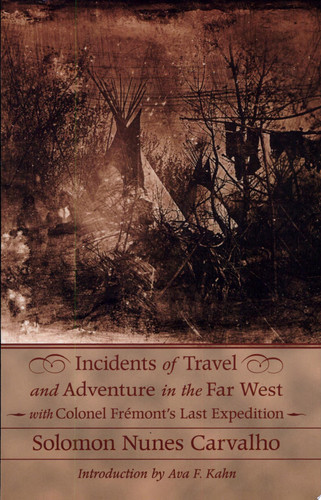
Incidents of travel and adventure in the Far West: with Colonel Fremont's last expedition across the Rocky Mountains, including three months' residence in Utah, and a perilous trip across the great American desert to the Pacific

Carvalho, Solomon Nunes
n August 1853, an American-born Sephardic Jew, Solomon Nunes Carvalho, accepted John Fremont's invitation to join his fifth expedition to find the best overland route to California. A Baltimore artist, inventor, and daguerreotypist, Carvalho was given the job of creating a photographic record of the lands and peoples along the way. Fremont's party left the Missouri on September 14, 1853, traveled up the Kansas River, overland to the Arkansas, upriver past Bent's Fort to the Huerfano, and traversed the Sandhill Pass into the Rocky Mountains. Beset by heavy snows and intense cold, they were reduced to eating their horses and mules and the occasional beaver or porcupine while making their way in midwinter across the Grand, Green, and Sevier Rivers. Suffering from frostbite, scurvy, and dysentery, Carvalho left the expedition in Utah; spent four months among the Mormons in Salt Lake City, where he observed with keen interest their system of spiritual wives; and reached California in 1854. Carvalho became the first Jewish writer to publish accounts of the Great American West and was also one of the first people to photograph the American West. Although only one of his plates is known to survive, others became the models for wood and steel engravings that broadcast the image of the West throughout the world. This Bison Books edition restores the discourses on Mormon doctrine omitted from previous twentieth-century editions. Ava F. Kahn is a visiting scholar at the California Studies Center, University of California, Berkeley. Her books include Jewish Voices of the California Gold Rush: A Documentary History, 1849-1880; Jewish Life in the American West: Perspectives on Migration, Settlement, and Community; and California Jews (coedited with Marc Dollinger).
University of Nebraska Press 2004-01-01 130 pages

Driving to Detroit: memoirs of a fast woman

Hazleton, Lesley
Leaving her home in Seattle in mid-summer to drive 'the long way round' to the Detroit auto show, Lesley Hazleton embarks on a journey to visit the holy places for cars - where they are raced, displayed, crashed, tested and made - as she seeks to understand our deep fascination with automobiles. Her quest takes her on a road trip that teaches her not only about cars and the peculiar passions of car lovers but also about herself. Halfway through this extraordinary adventure, Hazleton's father, the man who taught her to drive, dies suddenly, and her trip becomes a journey of grief and memory.
Scribner 1999 310 pages

The golden dream: seekers of El Dorado

Silverberg, Robert
One of the most persistent legends in the annals of New World exploration is that of the Land of Gold. This mythical site was located over vast areas of South America (and later, North America); the search for it drove some men mad with greed and, as often as not, to their untimely deaths. In this history of quest and adventure, Robert Silverberg traces the fate of Old World explorers lured westward by the myth of El Dorado. From the German conquistadores licensed by the Spanish king to operate out of Venezuela, to the journeys of Gonzalo Pizarro in the Amazon basin, and to the nearly miraculous voyage of Francisco Orellana to the mouth of the Amazon River, encountering the warlike women who gave the river its name, violence and bloodshed accompanied the determined adventurers. Sir Walter Raleigh and a host of other explorers spent small fortunes and many lives trying to locate Manoa, a city that was rumored to be El Dorado—City of Gold. Celebrated science fiction author Robert Silverberg recreates these legendary quests in The Golden Dream: Seekers of El Dorado.
Ohio University Press 1996 437 pages

Manhattan: letters from prehistory

Cixous, Hélène
"Manhattan is the tale of a young French scholar who travels to the United States in 1965 on a Fulbright Fellowship to consult the manuscripts of beloved authors. In Yale University's Beinecke Library, tantalized by the conversational and epistolary brilliance of a fellow researcher, she is lured into a picaresque and tragic adventure. Meanwhile, back in France, her children and no-nonsense mother await her return. A young European intellectual's first contact with America and the city of New York are the background of this story. The experience of Manhattan haunts this labyrinth of a book as, over a period of thirty-five years, its narrator visits and revisits Central Park and a half-buried squirrel, the Statue of Liberty and a never again to be found hotel in the vicinity of Morningside Heights: a journey into memory in which everything is never the same. Traveling from library to library, France to the United States, Shakespeare to Kafka to Joyce, Manhattan deploys with gusto all the techniques for which Cixous's fiction and essays are known: rapid juxtapositions of time and place, narrative and description, analysis and philosophical reflection. It investigates subjects Cixous has spent her life probing: reading, writing, and the "omnipotence-other" seductions of literature; a family's flight from Nazi Germany and postcolonial Algeria; childhood, motherhood, and, not least, the strange experience of falling in love with a counterfeit genius"--
New York Relit, an imprint of Fordham University Press 2023-08 190 pages

Seeing Vietnam: encounters of the road and heart

Brownmiller, Susan
Brownmiller, feminist author and a network television newswriter during the Vietnam era, recounts her journeys in Vietnam in the grand tradition of Evelyn Waugh and Graham Greene, combining reportage, memoir, and adventure in a portrait of a people and a country we have fought but never known. Her descriptions of her encounters with Buddhist monks, Hanoi nightlife, and Saigon markets are interspersed with political insights on the country's history and current situation. Annotation copyright Book News, Inc. Portland, Or.
HarperCollinsPublishers 1994 228 pages

On Ancient Central Asian Tracks

Aurel Stein
This book was written at a time when little of nothing was known of Central Asia. Tibet was still a forbidden land and the conditions in other parts so harsh as to discourage all but the hardiest of travellers and explorers. The author Aurel Stein originated in Hungary and completed his studies in Oxford U. from where he took up the post of principal in Lahore's Oriental College. He later joined the Archaeological Survey of India which allowed him to travel distant lands in some of the most obscure and inaccessible parts of North India and beyond. His descriptions of his travels lead us across almost the same terrain as was followed by Marco Polo on his adventures to China and the Great Kublai Khan. This was the ancient Silk Road, which once joined the civilizations of antiquity and was a main artery of commerce for the ancient world. This most revealing book allows us to see through the eyes of the Author the great expanses of dried up prehistoric oceans now converted into deserts which travellers faced on their long journeys across central Asia.
Pilgrims Publishing, Varanasi 2010 253 pages