20 results for "American History"

America's bitter pill: money, politics, backroom deals, and the fight to fix our broken healthcare

Brill, Steven
NEW YORK TIMES BESTSELLER • A NEW YORK TIMES NOTABLE BOOK • “A tour de force . . . a comprehensive and suitably furious guide to the political landscape of American healthcare . . . persuasive, shocking.” — The New York Times America’s Bitter Pill is Steven Brill’s acclaimed book on how the Affordable Care Act, or Obamacare, was written, how it is being implemented, and, most important, how it is changing—and failing to change—the rampant abuses in the healthcare industry. It’s a fly-on-the-wall account of the titanic fight to pass a 961-page law aimed at fixing America’s largest, most dysfunctional industry. It’s a penetrating chronicle of how the profiteering that Brill first identified in his trailblazing Time magazine cover story continues, despite Obamacare. And it is the first complete, inside account of how President Obama persevered to push through the law, but then failed to deal with the staff incompetence and turf wars that crippled its implementation. But by chance America’s Bitter Pill ends up being much more—because as Brill was completing this book, he had to undergo urgent open-heart surgery. Thus, this also becomes the story of how one patient who thinks he knows everything about healthcare “policy” rethinks it from a hospital gurney—and combines that insight with his brilliant reporting. The result: a surprising new vision of how we can fix American healthcare so that it stops draining the bank accounts of our families and our businesses, and the federal treasury. Praise for America’s Bitter Pill “An energetic, picaresque, narrative explanation of much of what has happened in the last seven years of health policy . . . [Brill] has pulled off something extraordinary.” —The New York Times Book Review “A thunderous indictment of what Brill refers to as the ‘toxicity of our profiteer-dominated healthcare system.’ ” — Los Angeles Times “A sweeping and spirited new book [that] chronicles the surprisingly juicy tale of reform.” — The Daily Beast “One of the most important books of our time.” —Walter Isaacson “Superb . . . Brill has achieved the seemingly impossible—written an exciting book about the American health system.” — The New York Review of Books
Random House 2015-08-18 528 pages

Stone age economics

Sahlins, Marshall David
Stone Age Economics is a classic study of anthropological economics, first published in 1974. As Marshall Sahlins stated in the first edition, "It has been inspired by the possibility of 'anthropological economics,' a perspective indebted rather to the nature of the primitive economies than to the categories of a bourgeois science." Ambitiously tackling the nature of economic life and how to study it comparatively, the book includes six studies which reflect the author's ideas on revising traditional views of the hunter-gatherer and so-called primitive societies, revealing them to be the original affluent society. The book examines notions of production, distribution and exchange in early communities and examines the link between economics and cultural and social factors. It consists of a set of detailed and closely related studies of tribal economies, of domestic production for livelihood, and of the submission of domestic production to the material and political demands of society at large. Marshall Sahlins is one of the most prominent American anthropologists of our time. He holds the title of Charles F. Grey Distinguished Service Professor of Anthropology at the University of Chicago. His most recent book is How Natives Think: About Captain Cook, for Example.
Transaction Publishers 2011 348 pages

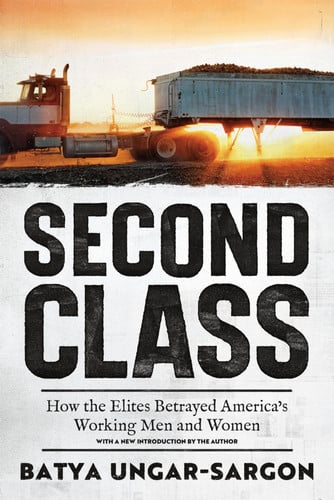
Second class: how the elite betrayed America's working men and women

Ungar-Sargon, Batya
A personal, journalistic ethnography of the modern American working class, based on the travels and interactions of the author through the American heartland. " Second Class is the most important book you will read all year. A political realignment is coming, and it's my hope that the end result will work in favor of our all-too-neglected American working class. When that realignment comes, Batya and her book will help lead the way." --Greg Lukianoff, CEO of the Foundation for Individual Rights in Education, and co-author of The Coddling of the American Mind Who is the American working class? Do they still have a fair shot at the American Dream? What do they think about their chances to secure the hallmarks of a middle-class life? While writing this book, Batya Ungar-Sargon visited states across the nation to speak with members of the American working class who are fighting tooth and nail to survive. In Second Class , working-class Americans of all races, political orientations, and occupations share their stories--cleaning ladies, health care aides, cops, truck drivers, fast food workers, electricians, and more. In their own words, these working-class Americans explain the struggles and triumphs of their increasingly precarious lives--as well as what policies they think would improve them. Second Class combines deep reporting with a look at the data and expert opinions on America's emergent class divide, in which the most basic elements of a secure and stable life are increasingly out of reach for those without a college education. America has broken its contract with its laboring class. So, how do we get back to the American Dream? How do we once again become the land of opportunity, the promised land, where hard work and commitment to family are enough to protect you from poverty? It's not that hard actually. All it would take, as this book illustrates, is for those in power to once again respect the dignity of work--and the American worker.
Encounter Books 2025 248 pages

In an uncertain world: tough choices from Wall Street to Washington

Rubin, Robert Edward
Publisher's description: Robert Rubin was sworn in as the seventieth U.S. Secretary of the Treasury in January 1995 in a brisk ceremony attended only by his wife and a few colleagues. As soon as the ceremony was over, he began an emergency meeting with President Bill Clinton on the financial crisis in Mexico. This was not only a harbinger of things to come during what would prove to be a rocky period in the global economy; it also captured the essence of Rubin himself--short on formality, quick to get into the nitty-gritty. From his early years in the storied arbitrage department at Goldman Sachs to his current position as chairman of the executive committee of Citigroup, Robert Rubin has been a major figure at the center of the American financial system. He was a key player in the longest economic expansion in U.S. history.
Random House 2003 427 pages

The little book of bull moves in bear markets: how to keep your portfolio up when the market is down

Schiff, Peter D.
The Little Book that helps investors avoid big losses in an economic downturn In the wake of falling stock and real estate prices, the American economy is poised for a decade-long bear market, so says Peter Schiff. After he accurately predicted the current market turmoil, savvy investors should pay attention--and start protecting their assets now, before the markets take their toll. The Little Book of Bull Moves in Bear Markets shows investors how to stay safe and stay liquid during economic downturns. Using economic history as a guide, Schiff looks at the bear markets that followed the bull markets of the 1920s and 1960s to predict what the American economy will look like after it corrects for the tech and real estate bubbles of the 1990s and early 2000s. Combining financial, economic, and political perspectives, Schiff looks at what worked in those earlier bear markets and predicts what strategies are most likely to work over the next ten years. In the end, Schiff argues that the next decade will most closely resemble the 1970s, complete with inflation, rising interest rates, and soaring commodity prices. This reversal of trends will make past investment strategies obsolete and pose a challenge for investors trying to build and protect their wealth. Smart investing will always pay off; the key lies in using the best strategies for the market at hand. For investors who see the writing on the wall but don't know what to do about it, The Little Book of Bull Moves in Bear Markets offers a timely, critical answer. Peter D. Schiff (Darien, CT) is President of Euro Pacific Capital, Inc., and one of the few non-biased investment advisors to have predicted the current bear market and positioned his clients accordingly. He appears twice a week on the FOX Business News network and has been quoted in such publications as the Wall Street Journal, Barron's, the Financial Times, and the New York Times.
John Wiley & Sons 2008-10-06 263 pages

For a New Liberty The Libertarian Manifesto

Murray N. Rothbard
In For a New Liberty: The Libertarian Manifesto, Rothbard proposes a once-and-for-all escape from the two major political parties, the ideologies they embrace, and their central plans for using state power against people. Libertarianism is Rothbard's radical alternative that says state power is unworkable and immoral and ought to be curbed and finally overthrown.To make his case, Rothbard deploys his entire system of thought: natural law, natural rights, Austrian economics, American history, the theory of the state, and more.It is relentless, scientific, analytical, and morally energetic — a book that makes an overwhelming case. Indeed, it gave an entire movement its intellectual consciousness and earned Rothbard the titles "Mr. Libertarian" and "The State's Greatest Living Enemy."Society without the nation-state? Rothbard shows that this is the way for peace, prosperity, security, and freedom for all. In the entire history of libertarian ideas, no book has more successfully combined ideological rigor, theoretical exposition, political rhetoric, historical illustration, and strategic acumen. Rothbard poured a lifetime of research and all his intellectual energy into this project and he succeeded in writing a classic.The book is the result of the only contract Rothbard ever received from a mainstream commercial publisher. He was asked to sum up the whole of the libertarian creed. Looking at the original manuscript, which was nearly complete after its first draft, it seems that it was a nearly effortless joy for him to write. It is seamless, unrelenting, and full of life.He cut no corners and pulled no punches. It appeared in 1973 and created a whole movement that set out to crush the political monopoly.In subject after subject, this book is informative, bracing, and challenging. It also features the characteristically clear writing style for which Rothbard is famous, which stemmed from his organized thinking and passionate drive to teach and change the world.The book begins with American history to show that the revolution of 1776 was the most libertarian of any in history. The pastors, pamphleteers, and statesmen who led it held that the state has no rights that the people themselves do not possess. They demanded full liberty, not some truncated version that existed in the old world. In this discussion, the reader comes to appreciate the founders of the United States of America as never before.Rothbard then sets out to rekindle that fire, first through a discussion of the philosophy and ethics of freedom. The central axiom: no man or group of men may aggress against the person and property of anyone else. He justifies the axiom on the basis of natural rights. It is an axiom that has few opponents, until Rothbard spells out its implications: taxation is theft, conscription is slavery, and war is mass murder, among many other points.Bracing indeed! But the state is the primary violator of this simple axiom. It presumes the right to rob and kill while purporting to protect us from robbing and killing. Thus follows a full theory of the state, how it gains and maintains controls over the population (but not through a "social contract"!), the various failed methods for keeping it in check (not even constitutions work!), its operations and tendencies to work its evil (it never has enough power), and how intellectuals become co-opted by the forces of state power.The book is still regarded as "dangerous" precisely because, once the exposure to Rothbardianism takes place, no other book on politics, economics, history, or sociology can be read the same way again.
Ludwig von Mises Institute 2020 420 pages

The Making of Global Capitalism The Political Economy of American Empire

Sam Gindin,Leo Panitch
The all-encompassing embrace of world capitalism at the beginning of the twenty-first century was generally attributed to the superiority of competitive markets. Globalization had appeared to be the natural outcome of this unstoppable process. But today, with global markets roiling and increasingly reliant on state intervention to stay afloat, it has become clear that markets and states aren’t straightforwardly opposing forces. In this groundbreaking work, Leo Panitch and Sam Gindin demonstrate the intimate relationship between modern capitalism and the American state, including its role as an “informal empire” promoting free trade and capital movements. Through a powerful historical survey, they show how the US has superintended the restructuring of other states in favor of competitive markets and coordinated the management of increasingly frequent financial crises. The Making of Global Capitalism , through its highly original analysis of the first great economic crisis of the twenty-first century, identifies the centrality of the social conflicts that occur within states rather than between them. These emerging fault lines hold out the possibility of new political movements transforming nation states and transcending global markets.
Verso Books 2025-08-05 480 pages

Capital and credit in British overseas trade: the view from the Chesapeake, 1700-1776

Price, Jacob M.
In a model study Jacob Price illuminates the dynamic growth of Britain’s foreign trade in the eighteenth century through an investigation of the investment patterns and credit institutions that financed that expansion. Concentrating on the trade between Britain and the Chesapeake tobacco colonies of Virginia and Maryland, for which a unique set of records exists, Price surveys the ways in which commerce developed and working capital was mobilized in Britain to support expanding overseas trade. Price develops the clearest picture ever of the financial environment within Britain as it affected Southern colonies in the preindustrial age. He does so by determining the kind of capital resources merchants in foreign trade actually commanded and measuring how much of their own wealth merchants brought to trade. In great and absorbing detail he discusses also the development of merchant-oriented banks in London and other ports, reinvestment of profits, long-term borrowing on bond, and the long-term credit provided to export merchants by wholesalers in textiles, ironmongery, and other industries. The relationship of debt to the coming of the American Revolution is also treated. Tobacco growers suffered more than others from a psychological unease caused by immense debt and were more revolutionary than farmers with less intensive capital needs and, hence, with lighter debt. This history will enlighten Anglo-American historians, economic historians, and historians of the American revolutionary era.
Harvard University Press 1980-12-02 233 pages

The fall of the Bell system: a study in prices and politics

Temin, Peter
AT&T's divestiture was the largest corporate reorganization in history and has had international repercussions. It was a major development in American economic policy, and a prominent part of the deregulation movement of the late 1970s. This study reveals the internal decision-making process at AT&T and explains how private and public interests combined to shape corporate and public policy in late 20th-century America. Temin weaves the strands of politics, economics, business, and law into an accessible narrative history that will be of interest to the general reader who wants to know about government business interaction and how it affects American citizens. Temin portrays divestiture as a great experiment in public policy, competition, openness, and international policy. He concludes that the experiment has been a mix of deliberate design and uncontrollable forces whose outcome was not foreseen.
Cambridge University Press 1987-12-25 378 pages

Marxism Unmasked From Delusion to Destruction

Ludwig Von Mises
We can't sit under Mises at his famous Vienna private seminar. We can't go back in time and attend his New York seminar, or follow him to his speaking engagements that he held in the 50s and 60s.But thanks to this second volume in a thrilling series (here is volume one), we do have access to what he said. He is warm, funny, passionate, and learned. This book provides a candid look at the man and his teaching style. It demonstrates his dazzling command over the material, and teaches in a breezier way than his treatises.This volume contains nine lectures delivered over one week, from June 23, to July 3, 1952, at the San Francisco Public Library. Mises was at his prime as a teacher and lecturer. He shares a lifetime of learning on topics that were (and remain) central to American public life.As the title indicates, his main focus is on Marxism. He discusses Marx and his place in the history of ideas, the destruction wrought by his dangerous ideology, the manner in which his followers have covered up his errors, and how the Marxists themselves have worked for so long to save Marxism from itself. He discusses Marxist claims about history and refutes the smear of the industrial revolution.The approach is systematic but casual. So the reader encounters wonderful insights in the form of short asides. For example: "The worst thing that can happen to a socialist is to have his country ruled by socialists who are not his friends."As a lecturer, he is steady and relentless. The reader can nearly "hear" him speaking through the prose. And there are times when Mises reveals a level of rhetorical passion that you would never encounter in print. That's because what is printed here are not pre-prepared lectures in the sense that they were written out. They were transcribed by Bettina Bien Greaves from what he actually said.Thus can we hear this passage:It is not true, as Marx said, that the improvements in technology are available only to the exploiters and that the masses are living in a state much worse than on the eve of the Industrial Revolution. Everything the Marxists say about exploitation is absolutely wrong! Lies! In fact, capitalism made it possible for many persons to survive who wouldn't have otherwise.Some readers of Mises's larger works have said that while his rigor is dazzling, the man himself can seem remote. Whether or not you agree with this observation, Mises comes across in these lectures as brilliant but very warm and charming in an old world sense.This approach is particularly fruitful in the last four of the lectures, which cover topics such as savings, interest, inflation, profit and loss, and the place of foreign investment. The lecture on interest rates, for example, must surely rank as one of the best explanations of this complicated topic. He recounts the history of the attempt to suppress interest rates, from the ancient world to the modern period. He explains why this cannot work because interest is merely the objective sign of a phenomenon that is integral to human action. As he moves on to money, Mises reveals himself to be tougher on the issue of fiduciary media than he was when he wrote his 1912 book The Theory of Money and Credit.In response to a question Mises says: "In the future no additional banknotes should be issued, no additional credit should be entered on a bank subject to check, unless there is 100 percent coverage in money."Also not to be missed is Mises's wry defense of "money cranks": at least they were only more consistent than the advocates of Keynesian and monetarism.Mises was clearly pressed for time, so he had to be at once thorough and move quickly through the material. It's still not "light reading" by the normal standards, but for people who want to see a great mind at work, this has a wonderful element of spontaneity about it that attracts and teaches at the same time.
Ludwig von Mises Institute 2019 110 pages

The Lean Years: A History of the American Worker 1920-1933

Bernstein, Irving,
“Pre-eminent among historians of labor history.†—Arthur Schlesinger, Jr. The textbook history of the 1920s is a story of Prohibition, flappers, and unbounded prosperity. For millions of industrial workers, however, the “roaring twenties†looked very different. Working-class communities were already in crisis in the years before the stock market crash of 1929. Strikes in the 1920s and attempts to organize the unemployed and fight evictions in the early 1930s often fell victim to police violence and repression. Here, Irving Bernstein recaptures the social history of the decade leading up to Franklin Delano Rooseveltâ€s inauguration, uncovers its widespread inequality, and sheds light on the long-forgotten struggles that form the prelude to the great labor victories of the 1930s. "In other words, viewed from afar, most of the people who were suffering the hardships of the Depression were depressed and even ashamed, ready to blame themselves for their plight. But the train of developments that connects changes in social conditions to a changed consciousness is not simple. People, including ordinary people, harbor somewhere in their memories the building blocks of different and contradictory interpretations of what it is that is happening to them, of who should be blamed, and what can be done about it. Even the hangdog and ashamed unemployed worker who swings his lunch box and strides down the street so the neighbors will think he is going to a job can also have other ideas that only have to be evoked, and when they are make it possible for him on another day to rally with others and rise up in anger at his condition. —From the new introduction by Frances Fox Piven
Houghton Mifflin Co 1960

A tough row to hoe: the 1985 Farm Bill and beyond

Galston, William A.
This book surveys the history of past agricultural policies, the sources of the current agricultural crisis, and the goals that should guide our choices in the future. It analyzes three key issues that shape the environment for agriculture) macroeconomic policy, tax policy, and farm credit. Overall, it provides an indispensible framework for understanding the bargain between agriculture and the rest of American society. A Hamilton Press book. Co-published with the Roosevelt Center for American Policy Studies.
Hamilton Press 1985-06-17 172 pages

Books and Bidders

A. S. W. (Abraham Simon Wo Rosenbach
"Books and Bidders: The Adventures of a Bibliophile" by A. S. W. Rosenbach offers a captivating glimpse into the world of rare books, book collecting, and the vibrant book trade of a bygone era. Rosenbach, a celebrated figure in bookselling history, recounts his experiences navigating auctions and building remarkable collections. This engaging narrative explores the intricacies of the bookseller's art, offering insights into the acquisition, appraisal, and appreciation of literary treasures. For the passionate bibliophile and anyone fascinated by the history of books, "Books and Bidders" provides a unique perspective on the intersection of business, biography, and the enduring allure of rare and significant volumes. A valuable resource for those interested in library science and collection development, this volume illuminates the thrilling pursuit of literary gems and the colorful personalities who shaped the American book trade. This work has been selected by scholars as being culturally important, and is part of the knowledge base of civilization as we know it. This work is in the public domain in the United States of America, and possibly other nations. Within the United States, you may freely copy and distribute this work, as no entity (individual or corporate) has a copyright on the body of the work. Scholars believe, and we concur, that this work is important enough to be preserved, reproduced, and made generally available to the public. We appreciate your support of the preservation process, and thank you for being an important part of keeping this knowledge alive and relevant.
Creative Media Partners, LLC 2025-03-29 230 pages

The Panic of 1819: Reactions and Policies

Rothbard, Murray N
The panic of 1819 was America's first great economic crisis. And this is Murray Rothbard's masterful account, the first full scholarly book on the topic and still the most definitive. It was his dissertation, published in 1962 but nearly impossible to get until this new edition.The American Economic Review was wild for this book when it appeared: "Rothbard's work represents the only published, book-length, academic treatise on the remedies that were proposed, debated, and enacted in attempts to cope with the crisis of 1819," the reviewer wrote. "As such, the book should certainly find a place on the shelf of the study of U.S. business cycles and of the economic historian who is interested in the early economic development of the United States."And specialists have treasured the book for years. It is incredible to realize that some American historians think of M.N. Rothbard as the author of this book and nothing else!The panic of 1819 grew largely out of the changes wrought by the War of 1812, and by the postwar boom that followed. The war also brought a rash of paper money, as the government borrowed heavily to finance the conflict. This would inevitably lead to suspension of specie payments in some parts of the country in 1814.Freed from the shackles of hard money, the suspension of specie led to a boom. When peace came, the so did the bust.But in the end, there was no widespread confusion on what caused the downturn. Instead, it was widely known that false prosperity is a very dangerous thing. It always turns to bust. But unlike today, the government didn't intervene. And precisely because there was no intervention, the panic ended quickly and peacefully.What we have here, then, is not only a dazzling historical account — the research here is deep and thorough, and the prose a model of exposition; it also points the way to how all economic downturns can and should be handled. For that reason, the Panic of 1819 offers important lessons for us today.To search for Mises Institute titles, enter a keyword and LvMI (short for Ludwig von Mises Institute); e.g., Depression LvMI
Ludwig von Mises Institute 2019 296 pages

The American Federationist

SAMUEL. GOMPERS,John McBride,William Green
"The American Federationist, Volume 18" offers a comprehensive look into the activities and perspectives of the American Federation of Labor (AFL) during a pivotal period in American labor history. Featuring contributions from prominent figures such as Samuel Gompers, John McBride, and William Green, this volume provides invaluable insights into the key issues, debates, and strategies that shaped the labor movement in the early 20th century. Readers will find detailed coverage of topics ranging from workers' rights and wages to union organizing and legislative advocacy. The writings and reports included in this volume reflect the AFL's commitment to advancing the interests of American workers and promoting social and economic justice. This historical record serves as an essential resource for scholars, students, and anyone interested in understanding the evolution of labor relations in the United States. This work has been selected by scholars as being culturally important, and is part of the knowledge base of civilization as we know it. This work was reproduced from the original artifact, and remains as true to the original work as possible. Therefore, you will see the original copyright references, library stamps (as most of these works have been housed in our most important libraries around the world), and other notations in the work. This work is in the public domain in the United States of America, and possibly other nations. Within the United States, you may freely copy and distribute this work, as no entity (individual or corporate) has a copyright on the body of the work. As a reproduction of a historical artifact, this work may contain missing or blurred pages, poor pictures, errant marks, etc. Scholars believe, and we concur, that this work is important enough to be preserved, reproduced, and made generally available to the public. We appreciate your support of the preservation process, and thank you for being an important part of keeping this knowledge alive and relevant.
Creative Media Partners, LLC 2025-05-22 536 pages