4 results for "American History"

Why we watched: Europe, America, and the Holocaust

Hamerow, Theodore S.
While today the Nazi genocide of Jews is seen as a massacre unique in its savagery and a central feature of World War II, in 1933-45 it was accepted in the USA, and in the Western world in general, as one of the many wartime brutalities, almost understandable and predictable. Political leaders, public opinion, and later the Allied military greeted the first news concerning the Nazi persecution and murder of Jews with disbelief; later, when the facts of the Nazi mass murder of Jews became apparent, they tended to conflate the Nazi victimization of Jews with that of other ethnic groups. There was a tendency to diminish the scope of the genocide and even to see it as, at least partly, deserved by the victims. These views found expression in a commonly shared reluctance to receive Jewish refugees from Nazism. Opinion polls of the late 1930s-early 1940s show that the American public was consistently against any relaxation of immigration restrictions. In Western Europe and the rest of the Americas, sentiments were similar: some countries were ready to admit Poles, Czechs, and other refugees, but not Jews. These sentiments can only partly be ascribed to the economic hardships of the 1930s; their main cause was antisemitism, ethnic opposition to the Jewish alien. In the postwar years, the tendency to silence and trivialize the Holocaust persevered; it was only in the 1960s that public opinion recognized the Holocaust as unique. Argues against Peter Novick's view, according to which Holocaust memory initially fell victim to the Cold War. Contends that, in the 1960s, most people thought that the "Jewish question" was finally solved - by emancipation, assimilation and, last but not least, by the Nazi mass murder.
W.W. Norton & Co 2008 520 pages

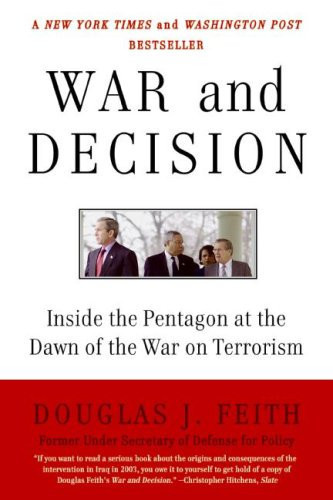
War and decision: inside the Pentagon at the dawn of the War on Terrorism

Feith, Douglas J.
Of all the players in the planning and evolution of the Bush Administration's war on terrorism, few were more integral--or more controversial--than Douglas Feith, the chief strategist on Donald Rumsfeld's Pentagon policy team. A highly influential international policy analyst for more than a quarter century, Feith worked closely with Rumsfeld, Paul Wolfowitz, Colin Powell, Condoleezza Rice, Vice President Cheney, and President Bush in defining the U.S. response to the attacks of 9/11--from the successful war on Afghanistan to the more challenging invasion of Iraq and its aftermath. Now, in this candid and revealing memoir, Feith--a charter member of the neoconservative movement and an architect of the administration's preventive strategy in the war on terrorism--offers the most in-depth and authoritative account yet of the Pentagon's evolving stance during one of the most controversial eras of American history. Drawing upon a unique trove of documents and records, this extraordinary chronicle will put the reader in the room for scores of previously unreported senior-level meetings, showing how hundreds of critical decisions were made in defense of American interests during and after the crisis of 9/11--decisions both successful and controversial. Where journalists like Bob Woodward could only speculate, Feith is the first inside player to reveal the inner workings of the Pentagon, at a time when history hung in the balance.--From publisher description.
HarperCollins 2009-02-03 674 pages

Genesis: Truman, American Jews, and the origins of the Arab/Israeli conflict

Judis, John B.
"A probing look at one of the most incendiary subjects of our time--the relationship between the United States and Israel. There has been more than half a century of raging conflict between Jews and Arabs--a violent, costly struggle that has had catastrophic repercussions in a critical region of the world. In Genesis, John B. Judis argues that, while Israelis and Palestinians must shoulder much of the blame, the United States has been the principal power outside the region since the end of World War II and as such must account for its repeated failed efforts to resolve this enduring strife. The fatal flaw in American policy, Judis shows, can be traced back to the Truman years. What happened between 1945 and 1949 sealed the fate of the Middle East for the remainder of the century. As a result, understanding that period holds the key to explaining almost everything that follows--right down to George W. Bush's unsuccessful and ill-conceived effort to win peace through holding elections among the Palestinians, and Barack Obama's failed attempt to bring both parties to the negotiating table. A provocative narrative history animated by a strong analytical and moral perspective, and peopled by colorful and outsized personalities, Genesis offers a fresh look at these critical postwar years, arguing that if we can understand how this stalemate originated, we will be better positioned to help end it"--
Farrar, Straus and Giroux 2014 432 pages

Prologue to annihilation: ordinary American and British Jews challenge the Third Reich

Norwood, Stephen H.
"American and British appeasement of Nazism during the early years of the Third Reich went far beyond territorial concessions. In Prologue to Annihilation: Ordinary American and British Jews Challenge the Third Reich, Stephen H. Norwood examines the numerous of ways that the two nations' official position of tacit acceptance of Jewish persecution enabled the policies that ultimately led to the Final Solution and how Nazi annihilationist intentions were clearly discernible even during the earliest years of Hitler's rule. Further, Norwood looks at the nature and impact of American and British Jewish resistance to Nazi persecution and the efforts of Jews at the grassroots level to press Jewish organizations to respond more forcefully to the Nazi menace. He examines the worldwide protest and boycott movements against Germany and German goods as well as mass demonstrations by working-class and lower-middle-class Jews in many American and British cities. Prologue to Annihilation details how the events of 1930-1936 tested American and British societies' willingness to accept Nazism and its anti-Jewish philosophy and illuminates the divisions that existed even within the Jewish community about how best to challenge Nazi antisemitic policies and atrocities"--
Indiana University Press 2021 347 pages