6 results for "American History"

Beyond the Melting Pot The Negroes, Puerto Ricans, Jews, Italians, and Irish of New York City

Nathan Glazer,Daniel Patrick Moynihan
About the Book Books about Ethnic Studies consider issues relating to the history of race and ethnicity within broader "mainstream" populations. Titles include: Anglo-Israel; Or, The British Nation the Lost Tribes of Israel, Irish Emigration to the United States: What It Has Been, and What It Is, Les Français au Canada. La jeunesse de Bougainville et la guerre de sept ans, Scotch-Irish in New England, The Czecho-Slovaks in America, The Greeks in America, The Polish Peasant in Europe and America; Monograph of an Immigrant Group, The Russian immigrant, and Wilson's Naturalization Laws of the United States, Showing how to Become an American Citizen. About us Trieste Publishing's aim is to provide readers with the highest quality reproductions of fiction and non-fiction literature that has stood the test of time. Our titles are produced from scans of the original books and as a result may sometimes have imperfections. To ensure a high-quality product we have: thoroughly reviewed every page of all the books in the catalog repaired some of the text in some cases, and rejected titles that are not of the highest quality. You can look up "Trieste Publishing" in categories that interest you to find other titles in our large collection. Come home to the books that made a difference!
Trieste Publishing Pty Limited 2017-09-27 378 pages

The jazzmen: how Duke Ellington, Louis Armstrong, and Count Basie transformed America

Tye, Larry
"This is the story of three revolutionary American musicians, the maestro jazzmen who orchestrated the chords that throb at the soul of twentieth-century America. Duke Ellington [...], Louis Daniel Armstrong [...], William James Basie [...]. What is far less known about these groundbreakers is that they were bound not just by their music or even the discrimination that they, like nearly all Black performers of their day, routinely encountered. Each defied and ultimately overcame racial boundaries by opening America's eyes and souls to the magnificence of their music. In the process they wrote the soundtrack for the civil rights movement. Based on more than 250 interviews, this exhaustively researched book brings alive the history of Black America in the early- to mid-1900s through the singular lens of the country's most gifted, engaging, and enduring African American musicians." -Från bokens baksida.
Mariner Books 2025-05-13 393 pages

Stone age economics

Sahlins, Marshall David
Stone Age Economics is a classic study of anthropological economics, first published in 1974. As Marshall Sahlins stated in the first edition, "It has been inspired by the possibility of 'anthropological economics,' a perspective indebted rather to the nature of the primitive economies than to the categories of a bourgeois science." Ambitiously tackling the nature of economic life and how to study it comparatively, the book includes six studies which reflect the author's ideas on revising traditional views of the hunter-gatherer and so-called primitive societies, revealing them to be the original affluent society. The book examines notions of production, distribution and exchange in early communities and examines the link between economics and cultural and social factors. It consists of a set of detailed and closely related studies of tribal economies, of domestic production for livelihood, and of the submission of domestic production to the material and political demands of society at large. Marshall Sahlins is one of the most prominent American anthropologists of our time. He holds the title of Charles F. Grey Distinguished Service Professor of Anthropology at the University of Chicago. His most recent book is How Natives Think: About Captain Cook, for Example.
Transaction Publishers 2011 348 pages

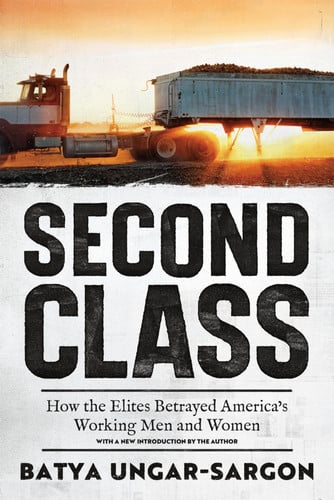
Second class: how the elite betrayed America's working men and women

Ungar-Sargon, Batya
A personal, journalistic ethnography of the modern American working class, based on the travels and interactions of the author through the American heartland. " Second Class is the most important book you will read all year. A political realignment is coming, and it's my hope that the end result will work in favor of our all-too-neglected American working class. When that realignment comes, Batya and her book will help lead the way." --Greg Lukianoff, CEO of the Foundation for Individual Rights in Education, and co-author of The Coddling of the American Mind Who is the American working class? Do they still have a fair shot at the American Dream? What do they think about their chances to secure the hallmarks of a middle-class life? While writing this book, Batya Ungar-Sargon visited states across the nation to speak with members of the American working class who are fighting tooth and nail to survive. In Second Class , working-class Americans of all races, political orientations, and occupations share their stories--cleaning ladies, health care aides, cops, truck drivers, fast food workers, electricians, and more. In their own words, these working-class Americans explain the struggles and triumphs of their increasingly precarious lives--as well as what policies they think would improve them. Second Class combines deep reporting with a look at the data and expert opinions on America's emergent class divide, in which the most basic elements of a secure and stable life are increasingly out of reach for those without a college education. America has broken its contract with its laboring class. So, how do we get back to the American Dream? How do we once again become the land of opportunity, the promised land, where hard work and commitment to family are enough to protect you from poverty? It's not that hard actually. All it would take, as this book illustrates, is for those in power to once again respect the dignity of work--and the American worker.
Encounter Books 2025 248 pages

A little love in big Manhattan

Wisse, Ruth R.
In the early decades of this century, the wave of immigration that brought nearly two million Jews from the Pale of Settlement to the United States included an extraordinary group of gifted Yiddish poets and writers, who came to be called Di Yunge (The Young). A Little Love in Big Manhattan tells the story of two of the Young’s most prominent figures―Mani Leib, a lyric poet intent on refining the hard facts of his life into works of enduring beauty, and Moishe Leib Halpern, for whom poetry had to be the expression of coarse and shattering reality. Through a dual biography of these opposing personalities, Ruth Wisse describes the rich and vital cultural movement that embraced them both. She tells of the burst of creative energy exhibited by the young poets and intellectuals who, after a long day of manual labor, would congregate in the cafes of the Lower East Side for badinage, debate, and literary talk. They started literary journals and compiled anthologies of their writings, which found their way overseas and had a rejuvenating influence on Yiddish poetry abroad. Ironically, their achievement coincided with the decline of the language in which they wrote, so that Yiddish poetry came into its own in America at a time when the next generation could scarcely read it; there were no literary heirs. Ruth Wisse presents modern Jews with a part of their lost inheritance, and also claims for the Yiddish poets a place in the American canon. The first book to present these poets as part of the history of immigrant Jews in America, A Little Love in Big Manhattan (the title is from a poem of Halpern’s) will appeal to readers of poetry and to people interested in facets of the intellectual and artistic atmosphere of the interwar period.
Harvard University Press 1988-07-27 279 pages