11 results for "American History"

Spying on the South: an odyssey across the American divide

Horwitz, Tony
"The author retraces Frederick Law Olmsted's journey across the American South in the 1850s, on the eve of the Civil War. Olmsted roamed eleven states and six thousand miles, and the New York Times published his dispatches about slavery and its defenders. More than 150 years later, Tony Horwitz followed Olmsted's route, and whenever possible his mode of transport--rail, riverboats, in the saddle--through Appalachia, down the Ohio and Mississippi, through Kentucky, Tennessee, Louisiana, and across Texas to the Rio Grande, discovering and reporting on vestiges of what Olmsted called the Cotton Kingdom"--
Penguin Books 2020 486 pages

An empire wilderness: travels into America's future

Kaplan, Robert D.
Having reported on some of the world's most violent, least understood regions in his bestsellers Balkan Ghosts and The Ends of the Earth, Robert Kaplan now returns to his native land, the United States of America. Traveling, like Tocqueville and John Gunther before him, through a political and cultural landscape in transition, Kaplan reveals a nation shedding a familiar identity as it assumes a radically new one. An Empire Wilderness opens in Fort Leavenworth, Kansas, where the first white settlers moved into Indian country and where Manifest Destiny was born. In a world whose future conflicts can barely be imagined, it is also the place where the army trains its men to fight the next war. "A nostalgic view of the United States is deliberately cultivated here," Kaplan writes, "as if to bind the uncertain future to a reliable past." From Fort Leavenworth, Kaplan travels west to the great cities of the heartland--to St. Louis, once a glorious shipping center expected to outshine imperial Rome and now touted, with its desolate inner city and miles of suburban gated communities, as "the most average American city." Kaplan continues west to Omaha; down through California; north from Mexico, across Arizona, New Mexico, and Texas; up to Montana and Canada, and back through Oregon. He visits Mexican border settlements and dust-blown county sheriffs' offices, Indian reservations and nuclear bomb plants, cattle ranches in the Oklahoma Panhandle, glacier-mantled forests in the Pacific Northwest, swanky postsuburban sprawls and grim bus terminals, and comes, at last, to the great battlefield at Vicksburg, Mississippi, where an earlier generation of Americans gave their lives for their vision of an American future. But what, if anything, he asks, will today's Americans fight and die for? At Vicksburg Kaplan contemplates the new America through which he has just traveled--an America of sharply polarized communities that draws its population from pools of talent far beyond its borders; an America where the distance between winners and losers grows exponentially as corporations assume gov-ernment functions and the wealthy find themselves more closely linked to their business associates in India and China than to their poorer neighbors a few miles away; an America where old loyalties and allegiances are vanishing and new ones are only beginning to emerge. The new America he found is in the pages of this book. Kaplan gives a precise and chilling vision of how the most successful nation the world has ever known is entering the final, and highly uncertain, phase of its history.
Random House 1998-08-18 393 pages

If only they didn't speak English: notes from Trump's America

Sopel, Jon
'You see, if only they didn't speak English in America, then we'd treat it as a foreign country - and probably understand it a lot better' 'the sanest man in America' - Bill Bryson 'Jon Sopel nails it' - Emily Maitlis **With a brand new chapter, charting Trump's first year in power** As the BBC's North America Editor, Jon Sopel has had a pretty busy time of it lately. In the time it's taken for a reality star to go from laughing stock to leader of the free world, Jon has travelled the length and breadth of the United States, experiencing it from a perspective that most of us could only dream of- he has flown aboard Air Force One, interviewed President Obama and has even been described as 'a beauty' by none other than Donald Trump. Through music, film, literature, TV and even through the food we eat and the clothes that we wear we all have a highly developed sense of what America is and through our shared, tangled history we claim a special relationship. But America today feels about as alien a country as you could imagine. It is fearful, angry and impatient for change. In this fascinating, insightful portrait of American life and politics, Jon Sopel sets out to answer our questions about a country that once stood for the grandest of dreams, but which is now mired in a storm of political extremism, racial division and increasingly perverse beliefs.
BBC Books 2018-05-31 380 pages

Twenty minutes in Manhattan

Sorkin, Michael
""This is the most brilliant epitome of Manhattan ever written." --Mike Davis Every morning, the architect and writer Michael Sorkin walks from his apartment in Greenwich Village to his office in Tribeca. Unlike most commuters, Sorkin isn't in a hurry, and he doesn't try to drown out his surroundings. Instead, he's always paying attention. As he descends the narrow stairs of his town house, Sorkin explains why New York doesn't have the grand stairwells so common in European apartment buildings. Stepping out onto his block, he imagines a better, more efficient, far less dirty way to dispose of garbage. As he crosses Canal Street, he remembers the mad proposals for tunnels, elevated highways, and mega-structures that threatened lower Manhattan and could have destroyed its urban fabric. Fifty years after Jane Jacobs's groundbreaking The Death and Life of Great American Cities, Sorkin's vision of city life is every bit as perceptive and fine-grained as that of Jacobs's classic. With important insights into history, architecture, and public policy, Twenty Minutes in Manhattan is an extraordinary, deeply personal look at a city undergoing--always undergoing--dramatic transformations"--
North Point Press 2013-03-12 258 pages

Notes from China

Tuchman, Barbara W.
A journalistic tour de force, this wide-ranging collection by the author of the Pulitzer Prize–winning biography Stilwell and the American Experience in China is a classic in its own right. During the summer of 1972—a few short months after Nixon’s legendary visit to China—master historian Barbara W. Tuchman made her own trip to that country, spending six weeks in eleven cities and a variety of rural settlements. The resulting reportage was one of the first evenhanded portrayals of Chinese culture that Americans had ever read. Tuchman’s observations capture the people as they lived, from workers in the city and provincial party bosses to farmers, scientists, and educators. She demonstrates the breadth and scope of her expertise in discussing the alleviation of famine, misery, and exploitation; the distortion of cultural and historical inheritances into ubiquitous slogans; news media, schools, housing, and transportation; and Chairman Mao’s techniques for reasserting the Revolution. This edition also includes Tuchman’s “fascinating” ( The New York Review of Books ) essay, “If Mao Had Come to Washington in 1945”—a tantalizing piece of speculation on a proposed meeting between Mao and Roosevelt that would have changed the course of postwar history. “Shrewdly observed . . . Tuchman enters another plea for coolness, intelligence and rationality in American Asian policies. One can hardly disagree.”— The New York Times Book Review
Random House Trade Paperbacks 2017-01-24 88 pages

Diario de Oaxaca

Kuper, Peter
Painting a vivid, personal portrait of social and political upheaval in Oaxaca, Mexico, this unique memoir employs comics, bilingual essays, photos, and sketches to chronicle the events that unfolded around a teachers' strike and led to a seven-month siege. When award-winning cartoonist Peter Kuper and his wife and daughter moved to the beautiful, 15th-century colonial town of Oaxaca in 2006, they planned to spend a quiet year or two enjoying a different culture and taking a break from the U.S. political climate under the Bush administration. What they hadn't counted on was landing in the epicenter of Mexico's biggest political struggle in recent years. Timely and compelling, this extraordinary firsthand account presents a distinct artistic vision of Oaxacan life, from explorations of the beauty of the environment to graphic portrayals of the fight between strikers and government troops that left more than 20 people dead, including American journalist Brad Will.
PM Press 2009 208 pages

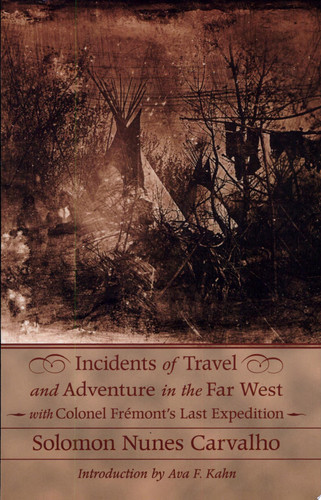
Incidents of travel and adventure in the Far West: with Colonel Fremont's last expedition across the Rocky Mountains, including three months' residence in Utah, and a perilous trip across the great American desert to the Pacific

Carvalho, Solomon Nunes
n August 1853, an American-born Sephardic Jew, Solomon Nunes Carvalho, accepted John Fremont's invitation to join his fifth expedition to find the best overland route to California. A Baltimore artist, inventor, and daguerreotypist, Carvalho was given the job of creating a photographic record of the lands and peoples along the way. Fremont's party left the Missouri on September 14, 1853, traveled up the Kansas River, overland to the Arkansas, upriver past Bent's Fort to the Huerfano, and traversed the Sandhill Pass into the Rocky Mountains. Beset by heavy snows and intense cold, they were reduced to eating their horses and mules and the occasional beaver or porcupine while making their way in midwinter across the Grand, Green, and Sevier Rivers. Suffering from frostbite, scurvy, and dysentery, Carvalho left the expedition in Utah; spent four months among the Mormons in Salt Lake City, where he observed with keen interest their system of spiritual wives; and reached California in 1854. Carvalho became the first Jewish writer to publish accounts of the Great American West and was also one of the first people to photograph the American West. Although only one of his plates is known to survive, others became the models for wood and steel engravings that broadcast the image of the West throughout the world. This Bison Books edition restores the discourses on Mormon doctrine omitted from previous twentieth-century editions. Ava F. Kahn is a visiting scholar at the California Studies Center, University of California, Berkeley. Her books include Jewish Voices of the California Gold Rush: A Documentary History, 1849-1880; Jewish Life in the American West: Perspectives on Migration, Settlement, and Community; and California Jews (coedited with Marc Dollinger).
University of Nebraska Press 2004-01-01 130 pages

Florence, a delicate case

Leavitt, David
David Leavitt brings the wonders and mysteries of Florence alive, illuminating why it is, and always has been, one of the most popular tourist destinations in the world. The third in the critically-acclaimed Writer and the City Series-in which some of the world's finest novelists reveal the secrets of the cities they know best- Florence is a lively account of expatriate life in the 'city of the lily'. Why has Florence always drawn so many English and American visitors? (At the turn of the century, the Anglo-American population numbered more than thirty thousand.) Why have men and women fleeing sex scandals traditionally settled here? What is it about Florence that has made it so fascinating-and so repellent-to artists and writers over the years? Moving fleetly between present and past and exploring characters both real and fictional, Leavitt's narrative limns the history of the foreign colony from its origins in the middle of the nineteenth century until its demise under Mussolini, and considers the appeal of Florence to figures as diverse as Tchaikovsky, E.M. Forster, Ronald Firbank, and Mary McCarthy. Lesser-known episodes in Florentine history-the moving of Michelangelo's David , and the construction of temporary bridges by black American soldiers in the wake of the Second World War-are contrasted with images of Florence today (its vast pizza parlors and tourist culture). Leavitt also examines the city's portrayal in such novels and films as A Room with a View , The Portrait of a Lady and Tea with Mussolini .
Bloomsbury 2002-06-01 176 pages

The Disunited States

Pozner, Vladimir
""By dint of names, dates, and figures, of classified ads, of sundry facts, of statistics, of the confessions of great writers and of anonymous passersby, of quotations from small-town newspapers and from official discourses, Vladimir Pozner reconstructs, vibrantly, so terribly vibrantly and magnificently, the American civilization." --Les Lettres Françaises Vladimir Pozner--influential French novelist, screenwriter, pioneer in literary genre and Oscar nominee, came to the United States in the 1930's. He found the nation and its people in a state of profound material and spiritual crisis, and took it upon himself to chronicle the life of the worker, the striker, the politician, the starlet, the gangster, the everyman; to document the bitter, violent racism tearing its society asunder, the overwhelming despair permeating everyday life, and the unyielding human struggle against it all. In the spirit of Tocqueville's Democracy in America, Pozner writes about America and Americans with the searing criticism and deep compassion of an outsider who loved the country and its people far too much to render anything less than a brutally honest portrayal. Recalling Agee's Let Us Now Praise Famous Men, he shatters the rules of reportage to create a complete portrait of America, enduring and profound"--
Seven Stories Press 2014 302 pages