15 results for "American History"

The color of law: a forgotten history of how our government segregated America

Rothstein, Richard
In this groundbreaking history of the modern American metropolis, Richard Rothstein, a leading authority on housing policy, explodes the myth that America's cities came to be racially divided through de facto segregation--that is, through individual prejudices, income differences, or the actions of private institutions like banks and real estate agencies. Rather, The Color of Law incontrovertibly makes it clear that it was de jure segregation--the laws and policy decisions passed by local, state, and federal governments--that actually promoted the discriminatory patterns that continue to this day.
Liveright Publishing Corporation, a division of W. W. Norton & Company 2017-05-02 345 pages

The accidental empire: Israel and the birth of settlements, 1967-1977

Gorenberg, Gershom
In The Accidental Empire, Gershom Gorenberg examines the strange birth of the settler movement in the ten years following the Six-Day War and finds that it was as much the child of Labor Party socialism as of religious extremism. The giants of Israeli history—Dayan, Meir, Eshkol, Allon—all played major roles in this drama, as did more contemporary figures like Sharon, Rabin, and Peres. Gorenberg also shows how three American presidents turned a blind eye to what was happening in the territories, and reveals their strategic reasons for doing so. Drawing on newly opened archives and extensive interviews, Gorenberg calls into question much of what we think we know about this issue that continues to haunt the Middle East.
Times Books 2006-03-07 454 pages

The return of Marco Polo's world: war, strategy, and American interests in the twenty-first century

Kaplan, Robert D.
"A bracing assessment of U.S. foreign policy and world disorder over the past two decades, anchored by a major new Pentagon-commissioned essay about changing power dynamics among China, Eurasia, and America--from the renowned geopolitical analyst and bestselling author of The Revenge of Geography and The Coming Anarchy. In the late thirteenth century, Marco Polo began a decades-long trek from Venice to China. The strength of that Silk Road--the trade route between Europe and Asia--was a foundation of Kublai Khan's sprawling empire. Now, in the early twenty-first century, the Chinese regime has proposed a land-and-maritime Silk Road that duplicates exactly the route Marco Polo traveled. In the major lead essay, recently released by the Pentagon's Office of Net Assessment, Robert D. Kaplan lays out a blueprint of the world's changing power politics that recalls the late thirteenth century. As Europe fractures from changes in culture and migration, Eurasia coheres into a single conflict system. China is constructing a land bridge to Europe. Iran and India are trying to link the oil fields of Central Asia to the Indian Ocean. America's ability to influence the power balance in Eurasia is declining. This is Kaplan's first collection of essays since his classic The Coming Anarchy was published in 2000. Drawing on decades of firsthand experience as a foreign correspondent and military embed for The Atlantic, as well as encounters with preeminent realist thinkers, Kaplan outlines the timeless principles that should shape America's role in a turbulent world: a respect for the limits of Western-style democracy; a delineation between American interests and American values; an awareness of the psychological toll of warfare; a projection of power via a strong navy; and more. From Kaplan's immediate thoughts on President Trump ("On Foreign Policy, Donald Trump Is No Realist," 2016) to a frank examination of what will happen in the event of war with North Korea ("When North Korea Falls," 2006), The Return of Marco Polo's World is a vigorous and honest reckoning with the difficult choices the United States will face in the years ahead. "These essays constitute a truly pathbreaking, brilliant synthesis and analysis of geographic, political, technological, and economic trends with far-reaching consequences. The Return of Marco Polo's World is another work by Robert D. Kaplan that will be regarded as a classic."--General David Petraeus (U.S. Army, Ret.)"--
Random House 2018 280 pages

War against the weak: eugenics and America's campaign to create a master race

Black, Edwin
Publisher's description: History has recorded the horrors of ethnic cleansing, but until now, America's own efforts to create a master race have been largely overlooked. In War Against the Weak, investigative journalist and author of the New York Times bestseller IBM and the Holocaust Edwin Black reveals that eugenics-sham science made up to justify ethnic cleansing-had an incredible foothold in America in the early twentieth century, and was in fact championed and funded by America's social, political, and academic elite. Even more shocking, Black traces the flow of ideas, research, and money from Cold Spring Harbor (Long Island) to Germany, in the process proving that it was America's eugenics program that gave Hitler the scientific justification to escalate his virulent anti-Semitism into all-out genocide. Black's team of dozens of researchers scoured scores of archives in four countries, unearthing some 50,000 documents, which collectively prove that the eugenics agenda was funded by esteemed philanthropies such as the Rockefeller Foundation and the Carnegie Institution; taught at Yale, Harvard, and Princeton; lauded by leading progressive thinkers such as Margaret Sanger, Oliver Wendell Holmes, and Woodrow Wilson; and even sanctioned by the U.S. Supreme Court. With this kind of backing, American eugenics was quickly able to move beyond the theoretical in its quest to eliminate social "undesirables," getting cruel and racist laws enacted in 27 U.S. states. Ultimately, more than 60,000 Americans were sterilized against their will, and tens of thousands of others were institutionalized and/or denied the right to marry whom they chose. In the last year or so, governors from five states-Virginia, Oregon, California, North Carolina, and South Carolina-have apologized for their states' official efforts to wipe out their unwanted citizens. Surprisingly, the victims of eugenics weren't limited to the groups that have regularly suffered from prejudice in the U.S.; they were also the poor, epileptics, alcoholics, people who wore glasses, petty criminals, the mentally ill, and those deemed "shiftless." War Against the Weak details how those at the forefront of the movement worked tirelessly to establish the biological rationales for persecution, with the goal of continuously eradicating the "lower tenth" until only a pure Nordic super race remained. To achieve that end, eugenics contaminated many otherwise worthy causes, from the birth control movement to the development of psychology and IQ testing, and beyond.After Nuremberg declared eugenics to be genocide and a crime against humanity, the American eugenics movement did not disappear; it simply went underground, changed its name, and reappeared as "human genetics." War Against the Weak closes by bringing its analysis into the present day, pointing out that our increasing knowledge in the realm of genetic selection and gene-mapping is rife with opportunity for misuse.
Four Walls Eight Windows 2003 550 pages

Rez life: an Indian's journey through reservation life

Treuer, David
Overview: Celebrated novelist David Treuer has gained a reputation for writing fiction that expands the horizons of Native American literature. In Rez Life, his first full-length work of nonfiction, Treuer brings a novelist's storytelling skill and an eye for detail to a complex and subtle examination of Native American reservation life, past and present. With authoritative research and reportage, Treuer illuminates misunderstood contemporary issues like sovereignty, treaty rights, and natural-resource conservation. He traces the convoluted waves of public policy that have deracinated, disenfranchised, and exploited Native Americans, exposing the tension and conflict that has marked the historical relationship between the United States government and the Native American population. Through the eyes of students, teachers, government administrators, lawyers, and tribal court judges, he shows how casinos, tribal government, and the Bureau of Indian Affairs have transformed the landscape of Native American life. A member of the Ojibwe of northern Minnesota, Treuer grew up on the Leech Lake Reservation, but was educated in "mainstream" America. Treuer traverses the boundaries of American and Indian identity as he explores crime and poverty, casinos and wealth, and the preservation of his native language and culture. Rez Life is a strikingly original work of history and reportage, a must read for anyone interested in the Native American story.
Grove Press 2012 330 pages

Dark mirror: Edward Snowden and the American Surveillance State

Gellman, Barton
"Edward Snowden chose three journalists to tell the stories in his Top Secret trove of NSA documents: Barton Gellman of The Washington Post, Glenn Greenwald of The Guardian and filmmaker Laura Poitras, all of whom would share the Pulitzer Prize for Public Service. Poitras went on to direct the Oscar-winning Citizenfour. Greenwald wrote an instant memoir and cast himself as a pugilist on Snowden's behalf. Gellman took his own path. Snowden and his documents were the beginning, not the end, of a story he had prepared his whole life to tell. More than 20 years as a top investigative journalist armed him with deep sources in national security and high technology. New sources reached out from government and industry, making contact on the same kinds of secret, anonymous channels that Snowden had used. Gellman's reporting unlocked new puzzles in the NSA archive. And as Snowden's revelations faded somewhat from the public consciousness, the machinations he exposed continue still, with many policies unaltered despite societal outrage. Dark Mirror is a true-life spy tale that touches us all, told with authority and an inside view of extraordinary events. Within it is a chilling personal account of the obstacles facing the author, beginning with Gellman's discovery of his own name in Snowden's NSA document trove. Google notifies him that a foreign government is trying to compromise his account. A trusted technical adviser finds anomalies on his laptop. Sophisticated impostors approach Gellman with counterfeit documents, attempting to divert or discredit his work. Throughout Dark Mirror, the author wages an escalating battle against unknown digital adversaries who force him to mimic their tradecraft in self-defense. With the vivid and insightful style that marked Gellman's bestselling Angler, Dark Mirror is an inside account of the surveillance-industrial revolution and its discontents, fighting back against state and corporate intrusions into our most private spheres. Along the way, and with the benefit of hindsight, it tells the full story of a government leak unrivaled in drama since All the President's Men"--
Penguin Press 2020-05-19 426 pages

"They take our jobs!": and 20 other myths about immigration

Chomsky, Aviva
"Revised and expanded edition of the groundbreaking book which demystifies twenty-one of the most widespread myths and beliefs about immigrants and immigrations. In "They Take Our Jobs!" Aviva Chomsky challenges the underlying assumptions that fuel misinformed claims about immigrants, radically altering our notions of citizenship, discrimination, and U.S. history. Since it was first published, many of the same myths about immigration such as "immigrants take American jobs," " immigrants don't pay taxes," and "immigrants increase crime" continue to be perpetuated and used to promote aggressive anti-immigration policies. In a new introduction, Chomsky reflects on the events of the past ten years. She analyzes declining Mexican immigration patterns, illuminates Mexico's little-known Southern Border Program, and assesses Obama's complicated legacy as "deporter-in-chief" which, Chomsky argues, inadvertently laid the groundwork for Trump's anti-immigrant racism"--
Beacon Press 2018-04-24 243 pages

The last million: Europe's displaced persons from World War to Cold War

Nasaw, David
"In May of 1945, German forces surrendered to the Allied powers, effectively putting an end to World War II in Europe. But the aftershocks of this global military conflict did not cease with the signing of truces and peace treaties. Millions of lost and homeless POWs, slave laborers, political prisoners, and concentration camp survivors overwhelmed Germany, a country in complete disarray. British and American soldiers gathered the malnourished and desperate foreigners, and attempted to repatriate them to Poland, Estonia, Latvia, Lithuania, Ukraine, and the USSR. But after exhaustive efforts, there remained over a million displaced persons who either refused to go home or, in the case of many, had no home to which to return. They would spend the next three to five years in displaced persons camps, divided by nationalities, temporary homelands in exile, with their own police forces, churches, schools, newspapers, and medical facilities. The international community couldn't agree on the fate of the Last Million, and after a year of fruitless debate and inaction, an International Refugee Organization was created to resettle them in lands suffering from labor shortages. But no nations were willing to accept the 200,000 to 250,000 Jewish men, women, and children who remained trapped in Germany. In 1948, the United States, among the last countries to accept anyone for resettlement, finally passed a Displaced Persons Bill - but as Cold War fears supplanted memories of WWII atrocities, the bill only granted visas to those who were reliably anti-communist, including thousands of former Nazi collaborators, Waffen-SS members, and war criminals, while barring the Jews who were suspected of being Communist sympathizers or agents because they had been recent residents of Soviet-dominated Poland. Only after the passage of the controversial UN resolution for the partition of Palestine and Israel's declaration of independence were the remaining Jewish survivors finally able to leave their displaced persons camps in Germany."--
Penguin Press 2020-09-15 654 pages

The last million: Europe's displaced persons from World War to Cold War

Nasaw, David
"In May of 1945, German forces surrendered to the Allied powers, effectively putting an end to World War II in Europe. But the aftershocks of this global military conflict did not cease with the signing of truces and peace treaties. Millions of lost and homeless POWs, slave laborers, political prisoners, and concentration camp survivors overwhelmed Germany, a country in complete disarray. British and American soldiers gathered the malnourished and desperate foreigners, and attempted to repatriate them to Poland, Estonia, Latvia, Lithuania, Ukraine, and the USSR. But after exhaustive efforts, there remained over a million displaced persons who either refused to go home or, in the case of many, had no home to which to return. They would spend the next three to five years in displaced persons camps, divided by nationalities, temporary homelands in exile, with their own police forces, churches, schools, newspapers, and medical facilities. The international community couldn't agree on the fate of the Last Million, and after a year of fruitless debate and inaction, an International Refugee Organization was created to resettle them in lands suffering from labor shortages. But no nations were willing to accept the 200,000 to 250,000 Jewish men, women, and children who remained trapped in Germany. In 1948, the United States, among the last countries to accept anyone for resettlement, finally passed a Displaced Persons Bill - but as Cold War fears supplanted memories of WWII atrocities, the bill only granted visas to those who were reliably anti-communist, including thousands of former Nazi collaborators, Waffen-SS members, and war criminals, while barring the Jews who were suspected of being Communist sympathizers or agents because they had been recent residents of Soviet-dominated Poland. Only after the passage of the controversial UN resolution for the partition of Palestine and Israel's declaration of independence were the remaining Jewish survivors finally able to leave their displaced persons camps in Germany."--
Penguin Press 2020 654 pages

Encyclopedia of drug policy

Mark A. R. Kleiman,James E. Hawdon
"The Encyclopedia of Drug Policy, with a target publication date of 2011, marks the 40th anniversary of the longest "war" in American history. In 1971, President Richard M. Nixon declared drugs "public enemy number one" and waged the War on Drug after tests on returning Vietnam War veterans revealed alarming levels of heroin use. Spanning two volumes of approximately 450 articles in an A-to-Z format, the encyclopedia explores this controversial war through the lens of varied disciplines, and a full spectrum of articles explains topics from Colombian cartels and Mexican kingpins to television reportage; from "just say no" advertising to heroin production; from narco-terrorism to over $500 billion in U.S. government expenditures. These articles, a range of pedagogical elements in the front matter and back matter, and availability in both print and electronic formats combine to comprise an outstanding reference source for students and the general public"--
Sage Publications, Inc 2011-01-12 962 pages

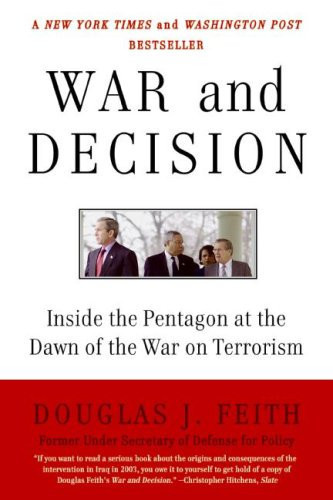
War and decision: inside the Pentagon at the dawn of the War on Terrorism

Feith, Douglas J.
Of all the players in the planning and evolution of the Bush Administration's war on terrorism, few were more integral--or more controversial--than Douglas Feith, the chief strategist on Donald Rumsfeld's Pentagon policy team. A highly influential international policy analyst for more than a quarter century, Feith worked closely with Rumsfeld, Paul Wolfowitz, Colin Powell, Condoleezza Rice, Vice President Cheney, and President Bush in defining the U.S. response to the attacks of 9/11--from the successful war on Afghanistan to the more challenging invasion of Iraq and its aftermath. Now, in this candid and revealing memoir, Feith--a charter member of the neoconservative movement and an architect of the administration's preventive strategy in the war on terrorism--offers the most in-depth and authoritative account yet of the Pentagon's evolving stance during one of the most controversial eras of American history. Drawing upon a unique trove of documents and records, this extraordinary chronicle will put the reader in the room for scores of previously unreported senior-level meetings, showing how hundreds of critical decisions were made in defense of American interests during and after the crisis of 9/11--decisions both successful and controversial. Where journalists like Bob Woodward could only speculate, Feith is the first inside player to reveal the inner workings of the Pentagon, at a time when history hung in the balance.--From publisher description.
HarperCollins 2009-02-03 674 pages

The war at home: the domestic costs of Bush's militarism

Piven, Frances Fox
Frances Fox Piven, one of the country's most celebrated social scientists, raises questions others have not. She examines the ways the war on terror served to shore up the Bush administration's political base and analyzes the manner in which flag-waving politicians used the emotional fog of war to further their regressive social and economic agendas. Always in the past governments that made war sooner or later tried to reward their peoples for the blood and wealth they were forced to sacrifice. During World War II, tax rates on the wealthy rose to 90 percent; toward the end of the Vietnam War, eighteen-year-olds were given the right to vote. In this war, taxes on the rich have been slashed, and democratic rights are being rolled back. Even veteran's benefits have been sharply reduced. The War at Home makes sense of these developments by putting the current domestic fallout of war in the context of history - and by turning an unsentimental eye on the domestic motivations of American militarism.
New Press 2004 165 pages

Moynihan's moment: America's fight against Zionism as racism

Troy, Gil
On November 10, 1975, the UN General Assembly passed a resolution declaring Zionism a form of racism. The move shocked millions, especially in the United States-- the country largely responsible for founding the UN. Daniel Patrick Moynihan, the American Ambassador to the UN, denounced this attack on Israel as an anti-Semitic assault on democracy and stood up to the Soviet-backed alliance of Communist dictatorships and Third World autocracies that supported the resolution. His eloquent stand brought him celebrity in the U.S., but ultimately shortened his tenure at the UN by alienating American allies, adversaries, and much of the foreign policy establishment--including Secretary of State Henry Kissinger. Nevertheless, Moynihan's moment was a turning point: a harbinger of a shift in American culture and politics that would culminate in the Reagan Revolution. Moynihan paved the way for a more muscular, idealistic, neoconservative foreign policy and for a new style of defiant "cowboy" diplomacy. In this book, Gil Troy argues that America's idea of itself--still torn, in the mid-'70s, between post-Vietnam and -Watergate defeatism and a growing sense of optimism--changed with Moynihan, altering both the left and the right in ways that continue to play out in the 21st century. Much of the rhetoric of this era survives in domestic foreign policy debates and the ongoing conflict between Israel and Palestine, suggesting that Moynihan's struggle has much to reveal about American politics and its position on the world stage--Publisher's summary.
Oxford University Press 2013 357 pages

Thinking Palestine

Ronit Lentin
This book brings together an inter-disciplinary group of Palestinian, Israeli, American, British and Irish scholars who theorise 'the question of Palestine'. Critically committed to supporting the Palestinian quest for self determination, they present new theoretical ways of thinking about Palestine. These include the 'Palestinization' of ethnic and racial conflicts, the theorization of Palestine as camp, ghetto and prison, the tourist/activist gaze, the role of gendered resistance, the centrality of the memory of the 1948 Nakba (catastrophe) to the contemporary understanding of the conflict, and the historic roots of the contemporary discourse on Palestine. The book offers a novel examination of how the Palestinian experience of being governed under what Giorgio Agamben names a 'state of exception' may be theorised as paradigmatic for new forms of global governance. An indispensable read for any serious scholar.
Zed Books 2008-04-01 264 pages