11 results for "American History"

Unfreedom of the press

Levin, Mark R.
Fox News host Mark Levin shows how those entrusted with news reporting today are destroying freedom of the press from within: "not government oppression or suppression," he writes, but self-censorship, group-think, bias by omission, and passing off opinion, propaganda, pseudo-events, and outright lies as news. Levin takes the reader on a journey through the early American patriot press, which proudly promoted the principles set forth in the Declaration of Independence and the Constitution, followed by the early decades of the Republic during which newspapers around the young country were open and transparent about their fierce allegiance to one political party or the other. It was only at the start of the Progressive Era and the twentieth century that the idea of "objectivity of the press" first surfaced, leaving us where we are today: with a partisan party-press overwhelmingly aligned with a political ideology but hypocritically engaged in a massive untruth as to its real nature
Threshold Editions 2020-08-11 258 pages

The Best American Science and Nature Writing 2004

Tim Folger,Steven Pinker
Since its inception in 1915, the Best American series has become the premier annual showcase for the country's finest short fiction and nonfiction. For each volume, a series editor reads pieces from hundreds of periodicals, then selects between fifty and a hundred outstanding works. That selection is pared down to the twenty or so very best pieces by a guest editor who is widely recognized as a leading writer in his or her field. This unique system has helped make the Best American series the most respected -- and most popular -- of its kind. The Best American Science and Nature Writing 2004, edited by Steven Pinker, is another "provocative and thoroughly enjoyable [collection] from start to finish" (Publishers Weekly). Here is the best and newest on science and nature: the psychology of suicide terrorism, desperate measures in surgery, the weird world of octopuses, Sex Week at Yale, the linguistics of click languages, the worst news about cloning, and much more.
Houghton Mifflin 2004 209 pages

Media madness: Donald Trump, the press, and the war over the truth

Kurtz, Howard
"According to the media, Donald Trump could never become president. Now many are on a mission to prove he shouldn't be president. The Trump administration and the press are at war -- and as in any war, the first casualty has been truth. Bestselling author Howard Kurtz, host of Fox News's Media Buzz and former Washington Post columnist, offers a stunning exposé of how supposedly objective journalists, alarmed by Trump's success, have moved into the opposing camp. Kurtz's exclusive, in-depth, behind-the-scenes interviews with reporters, anchors, and insiders within the Trump White House reveal the unprecedented hostility between the media and the president they cover."--Jacket.
Regnery Publishing, a division of Salem Media Group 2018-01-29 288 pages

Sweet smell of success

Odets, Clifford
The Faber Classic Screenplay Series presents the very best writing from the history of cinema. Sweet Smell of Success is the smartest, most cynical American film of the 1950s. Written by Ernest Lehman ( North by Northwest , The Sound of Music ) and the celebrated leftist playwright Clifford Odets, it is a vicious dissection of the world of public relations and journalism which conjures up a wprld of creeping hysteria and acid disenchantment. Tony Curtis playing the Scuttling press agent Sidney Falco, and Burt Lancaster as the colimnist J.J. Hunsecker, gave the performances of their careers. With a specially commissioned introduction by Lehman, and an appreciation of the film's director, Alexander Mackendrick, by James Mangold. The Faber Classic Screenplay Series presents the very best writing from the history of cinema. Sweet Smell of Success is the smartest, most cynical American film of the 1950s. Written by Ernest Lehman ( North by Northwest , The Sound of Music ) and the celebrated leftist playwright Clifford Odets, it is a vicious dissection of the world of public relations and journalism which conjures up a wprld of creeping hysteria and acid disenchantment. Tony Curtis playing the Scuttling press agent Sidney Falco, and Burt Lancaster as the colimnist J.J. Hunsecker, gave the performances of their careers. With a specially commissioned introduction by Lehman, and an appreciation of the film's director, Alexander Mackendrick, by James Mangold.
Faber 1998 178 pages

Hard news: the scandals at the New York times and their meaning for American media

Mnookin, Seth
A former Newsweek senior writer tells the story behind the scandal of Jayson Blair, a mediocre former Times reporter who had made up stories, faked datelines, and plagiarized on a massive scale, rocked the Times to its core and revealed fault lines in a fractious newsroom that was already close to open revolt. Staffers were furious about the shoddy reporting that was infecting the most revered newspaper in the world, and the executive editor who had helped lead the paper to a record six Pulitzer Prizes had been forced out of his job. The profound implications of the scandal will shape how we understand and judge the media for years to come.
Random House 2004 330 pages

Finding the Trapdoor Essays, Portraits, Travels

Adam Hochschild
For some 30 years, Adam Hochschild's voice has been one of the most distinctive in American journalism. With grace and wit, he has brought to a startling variety of subjects a combination of adventurous reporting and personal honesty. Hochschild's readers can count on an unobtrusive erudition, a sense of justice, and an irrepressible curiosity about life. Admirers of Hochschild's Half the Way Home: A Memoir of Father and Son will find in these articles the same warm autobiographical voice that made that book so memorable: He revisits his time as a civil rights worker in Mississippi, as a New England prep school student, and as a teenager seeing apartheid firsthand in South Africa. But readers will find much more as well: profiles of an adoptive Gypsy and of a governor general's son turned revolutionary, essays about Ernest Hemingway and John F. Kennedy, a journey to one of the most remote corners of the Amazon rain forest, and a remarkable evocation of two of Hochschild's personal heroes—who, in hillside trenches at the height of the Russian Civil War, faced each other across a battlefield.
Syracuse University Press 1999-09-01 304 pages

Central ideas in the development of American journalism: a narrative history

Olasky, Marvin N.
Originally published in 1991. This fascinating book of journalism history outlines the author's concepts of the three 'central ideas' in journalism which have evolved through time. The first is the Official Story, that which state authorities wanted people to know; the second, the Corruption Story, emphasised the abuse of authority by those in power and focused on a willingness to oppose the official and tell the specific detail; and the third, the Oppression Story, where journalists present the cause of events as down to external influences and work to change the social environment. The book narrates the history from its European beginnings in the 16th and 17th Centuries up to the early 20th Century, expressing how all interpretive journalism has a philosophic, world-view, component and understanding journalism history entails understanding these insights of the times.
Routledge 2015-07-20 192 pages

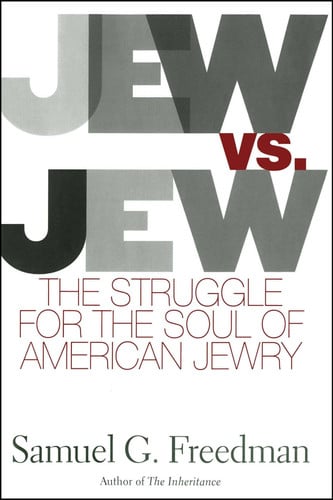
Jew Vs Jew The Struggle For The Soul Of American Jewry

Samuel G. Freedman
At a time when American Jews should feel more secure and cohesive than ever, civil war is tearing apart their community. Congregations, neighborhoods, even families are taking sides in battles about Jewish identity and Jewish authenticity. The conflict pits fundamentalist against secularist, denomination against denomination, even liberal against conservative within each branch of Jewry. Jew vs. Jew tells the story of how American Jewry has increasingly -- and perhaps terminally -- broken apart in the last forty years. Jew vs. Jew stretches in time from 1960 to 2000. It travels the country from Florida to New England, from Los Angeles to the Catskills in New York, from Cleveland to Denver, and it also crosses the ocean to Israel to show how tensions within the Jewish state inflame those among American Jews. The flash-points range from conversion standards to the role of women, from the peace process in Israel to the sexual climate on an Ivy League campus. But behind them all, as Samuel Freedman writes, lie common causes. First, far from unifying American Jews, Israel now divides them on both political and religious grounds. Second, neither America nor the larger world presents Jews with a single enemy against whom to coalesce. Third, and most important, nothing in the Jewish history of persecution, oppression, and exile prepared the Chosen People for the challenge posed by America, the challenge of being absorbed into a tolerant and diverse nation, being accepted so thoroughly that the intermarriage rate tops 50 percent. Jew vs. Jew introduces readers to memorable places and characters. Freedman describes one of the final summers at a Labor Zionist camp in the Catskills whose brand of secular Jewishness is becoming obsolete because Zionism succeeded in creating Israel. He tells the story of Orthodox and Reform Jews in a Cleveland suburb who are fighting about the construction of several synagogues -- and, on a deeper level, about whether unity or pluralism ought to be the goal of Jewish life. He portrays a Florida Jew so violently opposed to the Oslo peace accords that he planted a bomb in a synagogue where Shimon Peres was speaking. He tells about a Los Angeles congregation that spent three years debating whether or not to honor the Biblical matriarchs in its liturgy.We come to know the Long Island neighbors who cannot tolerate sharing even a property line because their versions of Jewish identity are so irreconcilably different. Jew vs. Jew is a work of vigorous reporting, lucid writing, and intellectual curiosity. And even as it chronicles an embittered and polarized community, it refuses to take sides or pass judgment. Instead, with compassion and acuity, Jew vs. Jew bears witness.
Simon & Schuster 2007-09-21 400 pages

The Muse Is Always Half-Dressed in New Orleans And Other Essays

Andrei Codrescu
In twenty-six essays, Codrescu turns his skeptical, amused gaze to such topics as Plato's effect on American sex, the cultural meaning of Ed McMahon, baseball's literary underpinnings, his own conception in a Romanian darkroom, an cuisine under the Ceausescu dictatorship, as well as to larger subjects, including the suicide of communism, American culture and politics, and his adopted city of New Orleans.
Macmillan 1995-05-15 208 pages

Control of Information in the United States An Annotated Bibliography of Books

James R. Bennett
An essential reference book to the most important and relevant publications on the control of information in the United States, it includes books and articles on every aspect of this highly topical subject--from philosophical theory to the freedom of the press. It is the first bibliography to deal exclusively with this area and will be of interest to all those concerned with research in journalism, law, communications, and general American history.
Bloomsbury Academic 1987-12-31 616 pages

You Wake Me Each Morning

Lawn Connie Lawn,Connie Lawn
You Wake Me Each Morning That is what listeners around the world have said to Connie for years, as they heard her radio broadcasts in this country and around the world. The first time she heard the phrase was from Sam Lewis, America's long - time Ambassador to Israel. Some listeners have called the voice sexy, authoritative, funny, snobby, or sophisticated. Connie tries to incorporate it all, as she tells the stories that make the news or change history. Of the many compliments she has received, the most important came from Nelson Mandela. The former South African President said he listened to her broadcasts for years while in prison. He told her, during a Washington news conference, "You Gave My People Hope." Then he went onto say, "You are not as big as I thought you were!" In her autobiography, Connie tells of the struggles of a one-woman news bureau. She recounts such events as the unrest in Washington in 1968; the killing of Robert Kennedy (she had one of the last interviews with him); the Invasion of Czechoslovakia, where she stayed for six months; a brief kidnapping in Lebanon in l982, and White House coverage of Presidents from Lyndon Johnson to Barack Obama and beyond. Connie received the Lifetime Achievement Award for Excellence in Journalism from the New Zealand National Press Club at the New Zealand Parliament on August 15, 2006. This is a book for people of all ages, but especially those who are working the hardest to find themselves. To all the message is - never give up, be different from the crowd, and have fun!
iUniverse 2010-02 356 pages