57 results for "American History"

American Marxism

Mark R. Levin
#1 NEW YORK TIMES BESTSELLER The seven-time #1 New York Times bestselling author, Fox News star, and radio host Mark R. Levin explains how the dangers he warned against in the "timely yet timeless" (David Limbaugh, author of Jesus Is Risen) bestseller Liberty and Tyranny have come to pass. In 2009, Mark R. Levin galvanized conservatives with his unforgettable manifesto Liberty and Tyranny, by providing a philosophical, historical, and practical framework for halting the liberal assault on Constitution-based values. That book was about standing at the precipice of progressivism's threat to our freedom and now, over a decade later, we're fully over that precipice and paying the price. In American Marxism, Levin explains how the core elements of Marxist ideology are now pervasive in American society and culture-from our schools, the press, and corporations, to Hollywood, the Democratic Party, and the Biden presidency-and how it is often cloaked in deceptive labels like "progressivism," "democratic socialism," "social activism," and more. With his characteristic trenchant analysis, Levin digs into the psychology and tactics of these movements, the widespread brainwashing of students, the anti-American purposes of Critical Race Theory and the Green New Deal, and the escalation of repression and censorship to silence opposing voices and enforce conformity. Levin exposes many of the institutions, intellectuals, scholars, and activists who are leading this revolution, and provides us with some answers and ideas on how to confront them. As Levin writes: "The counter-revolution to the American Revolution is in full force. And it can no longer be dismissed or ignored for it is devouring our society and culture, swirling around our everyday lives, and ubiquitous in our politics, schools, media, and entertainment." And, like before, Levin seeks to rally the American people to defend their liberty.
Mark R. Levin 2021 262 pages

New Cold Wars: China's rise, Russia's invasion, and America's struggle to defend the West

Sanger, David E.,Brooks, Mary K.
NEW YORK TIMES BESTSELLER • The fast-paced inside story of America’s plunge into a volatile rivalry with the other two great nuclear powers—Xi Jinping’s China and Vladimir Putin’s Russia—from the Pulitzer Prize–winning journalist and bestselling author of The Perfect Weapon “[A] cogent, revealing account of how a generation of American officials have grappled with dangerous developments in the post-Cold War era . . . vividly captures Washington.”—The New York Times (Editors’ Choice) ONE OF NPR’S BEST BOOKS OF THE YEAR For years, the United States was confident that the newly democratic Russia and increasingly wealthy China could be lured into a Western-led order that promised prosperity and relative peace—so long as they agreed to Washington’s terms. By the time America emerged from the age of terrorism, it was clear that this had been a fantasy. Now the three powers are engaged in a high-stakes struggle for military, economic, political, and technological supremacy, with nations around the world pressured to take sides. Yet all three are discovering that they are maneuvering for influence in a far more turbulent world than they imagined. Based on a remarkable array of interviews with top officials from five presidential administrations, U.S. intelligence agencies, foreign governments, and tech companies, Sanger unfolds a riveting narrative spun around the era’s critical questions: Will the mistakes Putin made in his invasion of Ukraine prove his undoing and will he reach for his nuclear arsenal—or will the West’s famously short attention span signal Kyiv’s doom? Will Xi invade Taiwan? Will both men deepen their partnership to undercut America’s dominance? And can a politically dysfunctional America still lead the world? Taking readers from the battlefields of Ukraine—where Russia uses bullets from North Korea and drones from Iran—to the Taiwan headquarters where the world’s most advanced computer chips are produced and on to tense debates in the White House Situation Room, New Cold Wars is a remarkable first-draft history chronicling America’s return to superpower conflict, the choices that lie ahead, and what is at stake for the United States and the world.
Crown 2026-04-07 544 pages

Countdown 1960 - The Behind-the-Scenes Story of the 312 Days that Changed America's Politics Forever

Chris Wallace
Instant New York Times Bestseller The riveting new book on the momentous year, campaign, and election that shaped American history It’s January 2, 1960: the day that Massachusetts Senator John F. Kennedy declared his candidacy; and with this opening scene, Chris Wallace offers readers a front-row seat to history. From the challenge of primary battles in a nation that had never elected a Catholic president, to the intense machinations of the national conventions—where JFK chose Lyndon Johnson as his running mate over the impassioned objections of his brother Bobby—this is a nonfiction political thriller filled with intrigue, cinematic action, and fresh reporting. Like with many popular histories, readers may be familiar with the story, but few will know the behind-the-scenes details, told here with gripping effect. Featuring some of history’s most remarkable characters, page-turning action, and vivid details, Countdown 1960 follows a group of extraordinary politicians, civil rights leaders, Hollywood stars, labor bosses, and mobsters during a pivotal year in American history. The election of 1960 ushered in the modern era of presidential politics, with televised debates, private planes, and slick advertising. In fact, television played a massive role. More than 70 million Americans watched one or all four debates. The public turned to television to watch campaign rallies. And on the night of the election, the contest between Kennedy and Nixon was so close that Americans were glued to their televisions long after dawn to see who won. The election of 1960 holds stunning parallels to our current political climate. There were—potentially valid—claims of voter fraud and a stolen election. There was also a presidential candidate faced with the decision of whether to contest the result or honor the peaceful transfer of power.
Penguin Group 2026-05-19 448 pages

A Picture Book of Davy Crockett

David A. Adler
Separating truth from tall tales, this easy-to-read biography details the life of a great American frontiersman. Legends say Davy Crockett weighed two hundred pounds when he was born, and leapt right out of his cradle ready to fight. Though those stories are an exagerration, Crockett's life was anything but boring. Farmer, soldier, sharp-shooter and politician, he was a well-known figure in the early 1800s—and even after his death, his reputation as an American folk hero grew and grew. In this illustrated biography, David Adler retells the true story of David Crockett's life—from his birth in Tennessee to his death at the Alamo. Using contemporary primary sources, Adler distinguishes between fact and legend, providing details about Crockett's family life and political career, as well as a note about the historical origins of many of the famed tall tales. A timeline of important dates is included. For almost thirty years, David Adler’s Picture Book Biography series has profiled famous people who changed the world. Colorful, kid-friendly illustrations combine with Adler’s “expert mixtures of facts and personality” (Booklist) to introduce young readers to history through compelling biographies of presidents, heroes, inventors, explorers, and adventurers. These books are ideal for first and second graders interested in history or who need reliable sources for school book reports.
Candlewick Press 1996-01-01 32 pages

The Identity Trap

Mounk, Yascha
Named a Best Book of the Year by The Economist , Financial Times , Inc. , Prospect Magazine , and The Conversation “The most comprehensive and reasonable story of this shift that has yet been attempted . . . Mounk has told the story of the Great Awokening better than any other writer who has attempted to make sense of it.” — The Washington Post “An intellectual tour de force about the origins of identity politics and the threat it presents to genuine, honest, old-fashioned liberalism.” — Bret Stephens, The New York Times “Among the most insightful and important books written in the last decade on American democracy and its current torments, because it also shows us a way out of the trap.” —Jonathan Haidt, author of The Righteous Mind , and coauthor of The Coddling of the American Mind “Outstanding.” — David Brooks, The New York Times A fascinating account of the origins of “wokeness”—and a trenchant explanation for why the noble goals of identity politics are doomed to fail For much of history, societies have violently oppressed ethnic, religious, and sexual minorities. It is no surprise that many came to believe that members of mar­ginalized groups need to take pride in their identity to resist injustice. But over the past decades, a healthy appreciation for the culture and heritage of minority groups transformed into our contemporary form of identity politics, a counterproductive obsession with group identity. This new ideology denies that members of different groups can truly understand each other and insists that the way governments treat their citizens should depend on the color of their skin. This, Yascha Mounk argues, is the identity trap. Those who battle for these ideas are often full of good intentions. But they ultimately stand in the way of the genuine equality we desperately need. Mounk was one of the first to warn of the risks that right-wing populists pose to American democracy, a danger that remains as serious as ever. But as he shows here, the identitarian left and the populist right actually reinforce each other; to vanquish one, it is necessary to oppose both. In The Identity Trap , Mounk provides the most ambitious and comprehensive account to date of the origins, consequences, and limitations of “wokeness.” He shows how postmodernism, postcolonialism, and critical race theory conquered many college campuses and forged an “identity synthesis” that gained tremendous influence in business, media, and government by 2020. Finally, Mounk makes a nuanced philosophical case for why these ideas are so counterproductive—and why universal, humanist values can best serve the vital goal of true equality. The Identity Trap provides truth and clarity where they are needed most.
Penguin USA 2025-09-23 432 pages

Money, Lies, and God Inside the Movement to Destroy American Democracy

Katherine Stewart
INSTANT NEW YORK TIMES BESTSELLER From the acclaimed author of The Power Worshippers, “an indispensable citizen's guide to the anti-democratic MAGA Right.” -Congressman Jamie Raskin “An eerily prescient guide to the phantasmagoria of our political moment.” -Jennifer Szalai, The New York Times "Meticulously researched, elegantly written, and hard-hitting."–Kristin Kobes Du Mez Why have so many Americans turned against democracy? In this deeply reported book, Katherine Stewart takes us to conferences of conspiracy-mongers, backroom strategy gatherings, and services at extremist churches, and profiles the people who want to tear it all down. She introduces us to reactionary Catholic activists, atheist billionaires, pseudo-Platonist intellectuals, self-appointed apostles of Jesus, disciples of Ayn Rand, women-hating opponents of “the gynocracy,” pronatalists preoccupied with the dearth of white babies, Covid truthers, militia members masquerading as “concerned moms,” and battalions of spirit warriors who appear to be inventing a new style of religion even as they set about attacking democracy at its foundations. Along the way, she provides a compelling analysis of the authoritarian reaction in the United States. She demonstrates that the movement relies on several distinct constituencies, with very different and often conflicting agendas. Stewart's reporting and comprehensive political analysis helps reframe the conversation about the moral collapse of conservatism in America and points the way toward a democratic future.
Bloomsbury USA 2026-02-17 352 pages

America's bitter pill: money, politics, backroom deals, and the fight to fix our broken healthcare

Brill, Steven
NEW YORK TIMES BESTSELLER • A NEW YORK TIMES NOTABLE BOOK • “A tour de force . . . a comprehensive and suitably furious guide to the political landscape of American healthcare . . . persuasive, shocking.” — The New York Times America’s Bitter Pill is Steven Brill’s acclaimed book on how the Affordable Care Act, or Obamacare, was written, how it is being implemented, and, most important, how it is changing—and failing to change—the rampant abuses in the healthcare industry. It’s a fly-on-the-wall account of the titanic fight to pass a 961-page law aimed at fixing America’s largest, most dysfunctional industry. It’s a penetrating chronicle of how the profiteering that Brill first identified in his trailblazing Time magazine cover story continues, despite Obamacare. And it is the first complete, inside account of how President Obama persevered to push through the law, but then failed to deal with the staff incompetence and turf wars that crippled its implementation. But by chance America’s Bitter Pill ends up being much more—because as Brill was completing this book, he had to undergo urgent open-heart surgery. Thus, this also becomes the story of how one patient who thinks he knows everything about healthcare “policy” rethinks it from a hospital gurney—and combines that insight with his brilliant reporting. The result: a surprising new vision of how we can fix American healthcare so that it stops draining the bank accounts of our families and our businesses, and the federal treasury. Praise for America’s Bitter Pill “An energetic, picaresque, narrative explanation of much of what has happened in the last seven years of health policy . . . [Brill] has pulled off something extraordinary.” —The New York Times Book Review “A thunderous indictment of what Brill refers to as the ‘toxicity of our profiteer-dominated healthcare system.’ ” — Los Angeles Times “A sweeping and spirited new book [that] chronicles the surprisingly juicy tale of reform.” — The Daily Beast “One of the most important books of our time.” —Walter Isaacson “Superb . . . Brill has achieved the seemingly impossible—written an exciting book about the American health system.” — The New York Review of Books
Random House 2015-08-18 528 pages

ISIS: Inside the Army of Terror

Weiss, Michael,Hassan, Hassan
With brutal attacks in last year across the globe—Brussels, Paris, Beirut, Egypt, Turkey—the Islamic State of Iraq and Syria (ISIS) has proved itself the greatest terrorist threat in the world today. They have conquered massive territories in Syria and Iraq in a bid to create a new Muslim caliphate under the strict dictates of Sharia law. In this fully revised and updated edition of ISIS: Inside the Army of Terror, American journalist Michael Weiss and Syrian analyst Hassan Hassan explain how these violent extremists evolved from a nearly defeated Iraqi insurgent group into a jihadi army of international volunteers who, with slickly produced murder videos, are spreading violence and mayhem across the globe. Beginning with the early days of Abu Musab al-Zarqawi, the founder of ISIS’s first incarnation, Weiss and Hassan explain who the key players are—from their leader Abu Bakr al-Baghdadi to the former Saddam Baathists in their ranks—where they come from, how they have attracted both local and global support, and how they operate—from their social media strategy to their illicit oil revenues. As money and matériel continue to flow into the region to combat the ISIS’s spreading terror, other forces—Assad’s regime, Russian planes, Iranian Quds Forces, and other Shiite militias—are gaining power and using the fight against ISIS as a means to leverage their agenda in the region. Political and military maneuvering by the United States, Iraq, Iran, Syria, and Russia have fueled ISIS’s explosive expansion. In five new chapters, the authors delve further into the inner workings of the Army of Terror and what it is like to live under their ever-tightening rule. With invaluable and exclusive insider information, the authors explore the Islamic State’s enigmatic recruitment and training methods, the impact of their military successes and failures, and how they structure and empower home-grown cells worldwide to carry out their terror. Drawing on original interviews with former US military officials and current ISIS fighters—and brand-new interviews with a former ISIS spy, as well as Kurdish and Yazidi survivors of the ISIS’s assault on northern Iraq—the authors reveal the internecine struggles within the movement itself, as well as ISIS’s bloody hatred of Shiite Muslims, which is generating another sectarian war in the region. A new generation of terror has dawned in the world and to understand how to stop it, we must understand who they are.
Regan Arts 2020-10-09 435 pages

The Second Founding How the Civil War and Reconstruction Remade the Constitution

Eric Foner
The Declaration of Independence announced equality as an American ideal, but it took the Civil War and the subsequent adoption of three constitutional amendments to establish that ideal as American law. The Reconstruction amendments abolished slavery, guaranteed all persons due process and equal protection of the law, and equipped black men with the right to vote. They established the principle of birthright citizenship and guaranteed the privileges and immunities of all citizens. The federal government, not the states, was charged with enforcement, reversing the priority of the original Constitution and the Bill of Rights. In grafting the principle of equality onto the Constitution, these revolutionary changes marked the second founding of the United States. Eric Foner's compact, insightful history traces the arc of these pivotal amendments from their dramatic origins in pre-Civil War mass meetings of African-American "colored citizens" and in Republican party politics to their virtual nullification in the late nineteenth century. A series of momentous decisions by the Supreme Court narrowed the rights guaranteed in the amendments, while the state actively undermined them. The Jim Crow system was the result. Again today there are serious political challenges to birthright citizenship, voting rights, due process, and equal protection of the law. Like all great works of history, this one informs our understanding of the present as well as the past: knowledge and vigilance are always necessary to secure our basic rights. --
W.W. Norton 2019 264 pages

The Paranoid Style in American Politics

Richard Hofstadter
This timely reissue of Richard Hofstadter's classic work on the fringe groups that influence American electoral politics offers an invaluable perspective on contemporary domestic affairs. In The Paranoid Style in American Politics, acclaimed historian Richard Hofstadter examines the competing forces in American political discourse and how fringe groups can influence — and derail — the larger agendas of a political party. He investigates the politics of the irrational, shedding light on how the behavior of individuals can seem out of proportion with actual political issues, and how such behavior impacts larger groups. With such other classic essays as “Free Silver and the Mind of 'Coin' Harvey” and “What Happened to the Antitrust Movement?”, The Paranoid Style in American Politics remains both a seminal text of political history and a vital analysis of the ways in which political groups function in the United States. "Recent months have witnessed an attack of unprecedented passion and ferocity against the national government. The Republican Party has apparently embarked on a crusade to destroy national standards, national projects, and national regulations and to transfer domestic governing authority from the national government to the states. A near majority of the Supreme Court even seems to want to replace the Constitution by the Articles of Confederation… "Unbridled rhetoric is having consequences far beyond anything that antigovernment politicians intend. The flow of angry words seems to have activated and in a sense legitimized what the historian Richard Hofstadter called the 'paranoid strain' in American politics." - Arthur Schlesinger, Jr., Wall Street Journal, June 7, 1995
Cape 1966 348 pages

Jinnah of Pakistan

Stanley A. Wolpert
“Few individuals significantly alter the course of history. Fewer still modify the map of the world. Hardly anyone can be credited with creating a nation-state. Muhammad Ali Jinnah did all three.” Stanley Wolpert These are the opening lines of the preface of Stanley Wolpert’s book, “Jinnah of Pakistan” and serves to entice you to read an extremely thorough, comprehensive and detailed study about one of the most pragmatic and charismatic leaders of South Asia, Muhammad Ali Jinnah. Stanley Wolpert is an American academic who is considered to be one of the world's foremost authorities on the political history of modern South Asia. During a trip to Bombay in 1948, he became interested in the complexities of Indian culture, history and politics. Since 1962, he has published many fictional and non-fictional books on his favorite subject. In the preface, Wolpert “For more than a quarter century, I have been intrigued by the apparent paradox of Jinnah’s strange story which has to date never been told in all the fascinating complexity of its brilliant light and tragic darkness.” “Jinnah of Pakistan” was published in 1984. This unique and insightful biography explores the fascinating public and private life of founder of Pakistan, Muhammad Ali Jinnah from his birth in 1876 till his death in 1948. In recording the events that unfold and shape Jinnah’s life, Wolpert also chronicles almost eight decades of Indian history to the point where India achieves independence from British rule amid growing Muslim-Hindu antagonism. It is a tragedy that the new generation of Pakistan knows about the founder of their country only through text books, a few websites and television programs. These limited resources do not tell the complete picture of a very intelligent, shrewd and resilient lawyer, politician and statesman who altered the map of South Asia through his sheer indomitable will against all odds. It is almost a standard statement in Pakistani text books that Muhammad Ali Jinnah was a great man but after reading Stanley Wolpert’s “Jinnah of Pakistan” one can get a better understanding of why Jinnah can be….. and should be…. regarded as such a great leader. Physically a frail man, he alone gave courage, hope, strength and voice to millions of Muslims of South Asia who were dismissed as second class citizens in United India before partition in 1947. The biography is placed on a huge canvas and takes the readers to the bustling port of Karachi where Jinnah was born and follows him to London, Bombay, Calcutta, Lucknow, Nagpur, Amritsar, New Delhi, Simla, Lahore, Peshawar, Quetta, Ziarat and finally Karachi again where lies buried “ one of history’s most remarkable, tenacious, enigmatic figures.” The book reveals Jinnah’s failings, his loneliness, his pain, his broken marriage, his estrangement from his only daughter, his long and fatal disease which he kept under wraps and yet the true worth of his gigantic accomplishment can only be more appreciated when viewed alongside his human weaknesses. The book also brings under spotlight, Jinnah’s love and marriage to the beautiful and vivacious “flower of Bombay" Ruttie. The whole episode is dealt with great deal of compassion as Wolpert gives a rare glimpse into Jinnah’s most private moments and thoughts___ and his ultimate pain when due to Jinnah’s extremely demanding political and legal career, the marriage breaks down and ends with Ruttie’s tragic death when she was only 29. An excerpt from the “It (the funeral) was a painfully slow ritual. Jinnah sat silent through all of its five hours. As Ruttie’s body was being lowered into the grave, Jinnah as the nearest relative was the first to throw the earth on the grave. He broke down suddenly and wept and sobbed like a child for minutes together. That was the only time when I found Jinnah betraying some shadow of human weakness.” The best thing about the book is that is very impartial and does not gloss over any facts or resort to hyperbole. Li
Oxford University Press 1989 421 pages

A Picture Book of Thurgood Marshall

David A. Adler
A brilliant lawyer, a leader of the Civil Rights movement, and the first African-American justice of the US Supreme Court. A strong-willed boy, Marshall grew up in Baltimore, MD with the guidance of his parents who believed in the power of equality, education, and the importance of hard work. His determination carried him through law school at Howard University where he graduated at the top of his class. Marshall worked for the NAACP (National Association for ther Advancement of Colored People) and was the first African American to win a case before the United States Supreme Court. He argued thirty-two cases before the Supreme Court—winning twenty-nine. His greatest court victory was the case of Brown vs. Board of Education of Topek a—a turning point in the battle against segregation. Ultimately, Marshall would be appointed as a justice on the Supreme Court. When he retired in 1991, he was called a true American hero and the most significant lawyer of his time. For almost thirty years, David Adler’s Picture Book Biography series has profiled famous people who changed the world. Colorful, kid-friendly illustrations combine with Adler’s “expert mixtures of facts and personality” ( Booklist ) to introduce young readers to history through compelling biographies of presidents, heroes, inventors, explorers, and adventurers. These books are ideal for first and second graders interested in history or who need reliable sources for school book reports.
Candlewick Press 1997-01-01 32 pages

Liberalism: the life of an idea

Fawcett, Edmund
Despite playing a decisive role in shaping the past two hundred years of American and European politics, liberalism is no longer the dominant force it once was. In this expanded and updated edition of what has become a classic history of liberalism, Edmund Fawcett traces its ideals, successes, and failures through the lives and ideas of exemplary thinkers and politicians from the early nineteenth century to today. Significant revisions - including a new conclusion - reflect recent changes affecting the world political order that many see as presenting new and very potent threats to the survival of liberal democracy as we know it. A richly detailed account of a vulnerable but critically important political creed, this book reminds us that to defend liberalism it is vital to understand its character and history
Princeton University Press 2018-05-22 513 pages

100 people who are screwing up America

Goldberg, Bernard
The number one New York Times bestselling author of Bias delivers another bombshell—this time aimed at . . . 100 People Who Are Screwing Up America No preaching. No pontificating. Just some uncommon sense about the things that have made this country great—and the culprits who are screwing it up. Bernard Goldberg takes dead aim at the America Bashers (the cultural elites who look down their snobby noses at "ordinary" Americans) . . . the Hollywood Blowhards (incredibly ditzy celebrities who think they're smart just because they're famous) . . . the TV Schlockmeisters (including the one whose show has been compared to a churning mass of maggots devouring rotten meat) . . . the Intellectual Thugs (bigwigs at some of our best colleges, whose views run the gamut from left wing to far left wing) . . . and many more. Goldberg names names, counting down the villains in his rogues' gallery from 100 all the way to 1—and, yes, you-know-who is number 37. Some supposedly "serious" journalists also made the list, including the journalist-diva who sold out her integrity and hosted one of the dumbest hours in the history of network television news. And there are those famous miscreants who have made America a nastier place than it ought to be—a far more selfish, vulgar, and cynical place. But Goldberg doesn't just round up the usual suspects we have come to know and detest. He also exposes some of the people who operate away from the limelight but still manage to pull a lot of strings and do all sorts of harm to our culture. Most of all, 100 People Who Are Screwing Up America is about a country where as long as anything goes, as one of the good guys in the book puts it, sooner or later everything will go. This is serious stuff for sure. But Goldberg will also make you laugh as he harpoons scoundrels like the congresswoman who thinks there aren't enough hurricanes named after black people, and the environmentalist to the stars who yells at total strangers driving SUVs—even though she tools around the country in a gas-guzzling private jet. With Bias, Bernard Goldberg took us behind the scenes and exposed the way Big Journalism distorts the news. Now he has written a book that goes even further. This time he casts his eye on American culture at large—and the result is a book that is sure to become the voice of all those Americans who feel that no one is speaking for them on perhaps the most vital issue of all: the kind of country in which we want to live.
HarperCollins 2005-07-05 305 pages

What this comedian said will shock you

Maher, Bill
The hilarious and controversial host of HBO’s Real Time with Bill Maher has written his funniest, most opinionated, and most necessary book ever—a brilliantly astute and acerbically funny vivisection of American life, politics, and culture. Some of the smartest commentary about what’s happening in America is coming from a comedian—this comedian being Bill Maher. If you want to understand what’s wrong with this country, it turns out that one of the best informed and most thought-provoking analysts is this very funny pothead. The book was inspired by the “editorial” Bill delivers at the end of each episode of Real Time. These editorials are direct-to-camera sermons about culture, politics, and what’s happening in the world. To put this book together, Maher reviewed more than a decade of his editorials, rewriting, reimagining, and updating them, and adding new material to speak exactly to the moment we’re in. Free speech, cops, drugs, race, religion, the generations, cancel culture, the parties, the media, show biz, romance, health—Maher covers it all. The result is a hugely entertaining work of commentary about American culture in the tradition of Mark Twain, Will Rogers, and H. L. Mencken.
Simon & Schuster 2024-05-21 378 pages

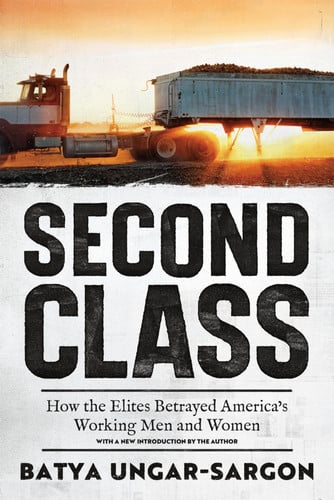
Second class: how the elite betrayed America's working men and women

Ungar-Sargon, Batya
A personal, journalistic ethnography of the modern American working class, based on the travels and interactions of the author through the American heartland. " Second Class is the most important book you will read all year. A political realignment is coming, and it's my hope that the end result will work in favor of our all-too-neglected American working class. When that realignment comes, Batya and her book will help lead the way." --Greg Lukianoff, CEO of the Foundation for Individual Rights in Education, and co-author of The Coddling of the American Mind Who is the American working class? Do they still have a fair shot at the American Dream? What do they think about their chances to secure the hallmarks of a middle-class life? While writing this book, Batya Ungar-Sargon visited states across the nation to speak with members of the American working class who are fighting tooth and nail to survive. In Second Class , working-class Americans of all races, political orientations, and occupations share their stories--cleaning ladies, health care aides, cops, truck drivers, fast food workers, electricians, and more. In their own words, these working-class Americans explain the struggles and triumphs of their increasingly precarious lives--as well as what policies they think would improve them. Second Class combines deep reporting with a look at the data and expert opinions on America's emergent class divide, in which the most basic elements of a secure and stable life are increasingly out of reach for those without a college education. America has broken its contract with its laboring class. So, how do we get back to the American Dream? How do we once again become the land of opportunity, the promised land, where hard work and commitment to family are enough to protect you from poverty? It's not that hard actually. All it would take, as this book illustrates, is for those in power to once again respect the dignity of work--and the American worker.
Encounter Books 2025 248 pages

SNCC: The New Abolitionists

Howard Zinn
Howard Zinn tells the story of one of the most important political groups in American history. SNCC: The New Abolitionists influenced a generation of activists struggling for civil rights and seeking to learn from the successes and failures of those who built the fantastically influential Student Nonviolent Coordinating Committee. It is considered an indispensable study of the organization, of the 1960s, and of the process of social change. Includes a new introduction by the author.
Beacon Press 1965 286 pages

Drone Warfare: Killing by Remote Control

Medea Benjamin
The CIA chief, Leon Panetta, calls drones the ‘only game in town’. The figures bear him out. Between 2004 and 2012, the US reportedly conducted over 350 drone strikes in Pakistan, killing between 2,600 and 3,400 people. Drone strikes have killed more than 200 children alone in Pakistan and Yemen. In 2000, the Americans had fewer than fifty aerial drones; ten years later, it had a fleet of nearly 7,500, and the US Air Force now trains more drone ‘pilots’ than bomber and fighter pilots combined. Drones are already a $ 5 billion business in the US alone. American activist Medea Benjamin, a co-founder of the peace group CODEPINK and the international human rights organization Global Exchange, provides the first extensive analysis of who is producing the drones, where they are being used, who controls these unmanned places, and what are the legal and moral implications of their use. Benjamin also looks at what activists, lawyers, and scientists across the globe are doing to ground these weapons.
Daily Star Books 2013 241 pages