37 results for "American History"

The Identity Trap

Mounk, Yascha
Named a Best Book of the Year by The Economist , Financial Times , Inc. , Prospect Magazine , and The Conversation “The most comprehensive and reasonable story of this shift that has yet been attempted . . . Mounk has told the story of the Great Awokening better than any other writer who has attempted to make sense of it.” — The Washington Post “An intellectual tour de force about the origins of identity politics and the threat it presents to genuine, honest, old-fashioned liberalism.” — Bret Stephens, The New York Times “Among the most insightful and important books written in the last decade on American democracy and its current torments, because it also shows us a way out of the trap.” —Jonathan Haidt, author of The Righteous Mind , and coauthor of The Coddling of the American Mind “Outstanding.” — David Brooks, The New York Times A fascinating account of the origins of “wokeness”—and a trenchant explanation for why the noble goals of identity politics are doomed to fail For much of history, societies have violently oppressed ethnic, religious, and sexual minorities. It is no surprise that many came to believe that members of mar­ginalized groups need to take pride in their identity to resist injustice. But over the past decades, a healthy appreciation for the culture and heritage of minority groups transformed into our contemporary form of identity politics, a counterproductive obsession with group identity. This new ideology denies that members of different groups can truly understand each other and insists that the way governments treat their citizens should depend on the color of their skin. This, Yascha Mounk argues, is the identity trap. Those who battle for these ideas are often full of good intentions. But they ultimately stand in the way of the genuine equality we desperately need. Mounk was one of the first to warn of the risks that right-wing populists pose to American democracy, a danger that remains as serious as ever. But as he shows here, the identitarian left and the populist right actually reinforce each other; to vanquish one, it is necessary to oppose both. In The Identity Trap , Mounk provides the most ambitious and comprehensive account to date of the origins, consequences, and limitations of “wokeness.” He shows how postmodernism, postcolonialism, and critical race theory conquered many college campuses and forged an “identity synthesis” that gained tremendous influence in business, media, and government by 2020. Finally, Mounk makes a nuanced philosophical case for why these ideas are so counterproductive—and why universal, humanist values can best serve the vital goal of true equality. The Identity Trap provides truth and clarity where they are needed most.
Penguin USA 2025-09-23 432 pages

Beyond the Melting Pot The Negroes, Puerto Ricans, Jews, Italians, and Irish of New York City

Nathan Glazer,Daniel Patrick Moynihan
About the Book Books about Ethnic Studies consider issues relating to the history of race and ethnicity within broader "mainstream" populations. Titles include: Anglo-Israel; Or, The British Nation the Lost Tribes of Israel, Irish Emigration to the United States: What It Has Been, and What It Is, Les Français au Canada. La jeunesse de Bougainville et la guerre de sept ans, Scotch-Irish in New England, The Czecho-Slovaks in America, The Greeks in America, The Polish Peasant in Europe and America; Monograph of an Immigrant Group, The Russian immigrant, and Wilson's Naturalization Laws of the United States, Showing how to Become an American Citizen. About us Trieste Publishing's aim is to provide readers with the highest quality reproductions of fiction and non-fiction literature that has stood the test of time. Our titles are produced from scans of the original books and as a result may sometimes have imperfections. To ensure a high-quality product we have: thoroughly reviewed every page of all the books in the catalog repaired some of the text in some cases, and rejected titles that are not of the highest quality. You can look up "Trieste Publishing" in categories that interest you to find other titles in our large collection. Come home to the books that made a difference!
Trieste Publishing Pty Limited 2017-09-27 378 pages

The jazzmen: how Duke Ellington, Louis Armstrong, and Count Basie transformed America

Tye, Larry
"This is the story of three revolutionary American musicians, the maestro jazzmen who orchestrated the chords that throb at the soul of twentieth-century America. Duke Ellington [...], Louis Daniel Armstrong [...], William James Basie [...]. What is far less known about these groundbreakers is that they were bound not just by their music or even the discrimination that they, like nearly all Black performers of their day, routinely encountered. Each defied and ultimately overcame racial boundaries by opening America's eyes and souls to the magnificence of their music. In the process they wrote the soundtrack for the civil rights movement. Based on more than 250 interviews, this exhaustively researched book brings alive the history of Black America in the early- to mid-1900s through the singular lens of the country's most gifted, engaging, and enduring African American musicians." -Från bokens baksida.
Mariner Books 2025-05-13 393 pages

100 people who are screwing up America

Goldberg, Bernard
The number one New York Times bestselling author of Bias delivers another bombshell—this time aimed at . . . 100 People Who Are Screwing Up America No preaching. No pontificating. Just some uncommon sense about the things that have made this country great—and the culprits who are screwing it up. Bernard Goldberg takes dead aim at the America Bashers (the cultural elites who look down their snobby noses at "ordinary" Americans) . . . the Hollywood Blowhards (incredibly ditzy celebrities who think they're smart just because they're famous) . . . the TV Schlockmeisters (including the one whose show has been compared to a churning mass of maggots devouring rotten meat) . . . the Intellectual Thugs (bigwigs at some of our best colleges, whose views run the gamut from left wing to far left wing) . . . and many more. Goldberg names names, counting down the villains in his rogues' gallery from 100 all the way to 1—and, yes, you-know-who is number 37. Some supposedly "serious" journalists also made the list, including the journalist-diva who sold out her integrity and hosted one of the dumbest hours in the history of network television news. And there are those famous miscreants who have made America a nastier place than it ought to be—a far more selfish, vulgar, and cynical place. But Goldberg doesn't just round up the usual suspects we have come to know and detest. He also exposes some of the people who operate away from the limelight but still manage to pull a lot of strings and do all sorts of harm to our culture. Most of all, 100 People Who Are Screwing Up America is about a country where as long as anything goes, as one of the good guys in the book puts it, sooner or later everything will go. This is serious stuff for sure. But Goldberg will also make you laugh as he harpoons scoundrels like the congresswoman who thinks there aren't enough hurricanes named after black people, and the environmentalist to the stars who yells at total strangers driving SUVs—even though she tools around the country in a gas-guzzling private jet. With Bias, Bernard Goldberg took us behind the scenes and exposed the way Big Journalism distorts the news. Now he has written a book that goes even further. This time he casts his eye on American culture at large—and the result is a book that is sure to become the voice of all those Americans who feel that no one is speaking for them on perhaps the most vital issue of all: the kind of country in which we want to live.
HarperCollins 2005-07-05 305 pages

Stone age economics

Sahlins, Marshall David
Stone Age Economics is a classic study of anthropological economics, first published in 1974. As Marshall Sahlins stated in the first edition, "It has been inspired by the possibility of 'anthropological economics,' a perspective indebted rather to the nature of the primitive economies than to the categories of a bourgeois science." Ambitiously tackling the nature of economic life and how to study it comparatively, the book includes six studies which reflect the author's ideas on revising traditional views of the hunter-gatherer and so-called primitive societies, revealing them to be the original affluent society. The book examines notions of production, distribution and exchange in early communities and examines the link between economics and cultural and social factors. It consists of a set of detailed and closely related studies of tribal economies, of domestic production for livelihood, and of the submission of domestic production to the material and political demands of society at large. Marshall Sahlins is one of the most prominent American anthropologists of our time. He holds the title of Charles F. Grey Distinguished Service Professor of Anthropology at the University of Chicago. His most recent book is How Natives Think: About Captain Cook, for Example.
Transaction Publishers 2011 348 pages

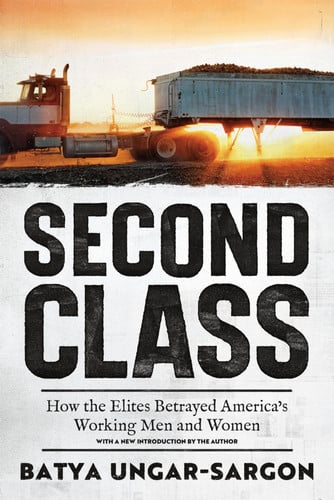
Second class: how the elite betrayed America's working men and women

Ungar-Sargon, Batya
A personal, journalistic ethnography of the modern American working class, based on the travels and interactions of the author through the American heartland. " Second Class is the most important book you will read all year. A political realignment is coming, and it's my hope that the end result will work in favor of our all-too-neglected American working class. When that realignment comes, Batya and her book will help lead the way." --Greg Lukianoff, CEO of the Foundation for Individual Rights in Education, and co-author of The Coddling of the American Mind Who is the American working class? Do they still have a fair shot at the American Dream? What do they think about their chances to secure the hallmarks of a middle-class life? While writing this book, Batya Ungar-Sargon visited states across the nation to speak with members of the American working class who are fighting tooth and nail to survive. In Second Class , working-class Americans of all races, political orientations, and occupations share their stories--cleaning ladies, health care aides, cops, truck drivers, fast food workers, electricians, and more. In their own words, these working-class Americans explain the struggles and triumphs of their increasingly precarious lives--as well as what policies they think would improve them. Second Class combines deep reporting with a look at the data and expert opinions on America's emergent class divide, in which the most basic elements of a secure and stable life are increasingly out of reach for those without a college education. America has broken its contract with its laboring class. So, how do we get back to the American Dream? How do we once again become the land of opportunity, the promised land, where hard work and commitment to family are enough to protect you from poverty? It's not that hard actually. All it would take, as this book illustrates, is for those in power to once again respect the dignity of work--and the American worker.
Encounter Books 2025 248 pages

Last best hope: America in crisis and renewal

Packer, George
2020: A ruthless pandemic, an inept and malign government response, polarizing protests, and an election marred by conspiracy theories left many citizens in despair about their country and its democratic experiment. Packer explores four narratives that now dominate American life: Free America, which imagines a nation of separate individuals and serves the interests of corporations and the wealthy; Smart America, the world view of Silicon Valley and the professional elite; Real America, the white Christian nationalism of the heartland; and Just America, which sees citizens as members of identity groups that inflict or suffer oppression. He shows that none of these narratives can sustain a democracy: we must look for a common American identity and find it in the passion for equality that Americans of diverse persuasions have held for centuries. -- adapted from jacket
Farrar, Straus and Giroux 2021-06-15 226 pages

American Jewish women's history: a reader

Pamela S. Nadell
“It gives me a secret pleasure to observe the fair character our family has in the place by Jews & Christians,“Abigail Levy Franks wrote to her son from New York City in 1733. Abigail was part of a tiny community of Jews living in the new world. In the centuries that followed, as that community swelled to several millions, women came to occupy diverse and changing roles. American Jewish Women’s History , an anthology covering colonial times to the present, illuminates that historical diversity. It shows women shaping Judaism and their American Jewish communities as they engaged in volunteer activities and political crusades, battled stereotypes, and constructed relationships with their Christian neighbors. It ranges from Rebecca Gratz’s development of the Jewish Sunday School in Philadelphia in 1838 to protest the rising prices of kosher meat at the turn of the century, to the shaping of southern Jewish women's cultural identity through food. There is currently no other reader conveying the breadth of the historical experiences of American Jewish women available. The reader is divided into four sections complete with detailed introductions. The contributors include: Joyce Antler, Joan Jacobs Brumberg, Alice Kessler-Harris, Paula E. Hyman, Riv-Ellen Prell, and Jonathan D. Sarna.
New York University Press 2003-04-05 326 pages

The newly born woman

Cixous, Hélène
"Published in France as La jeune née in 1975, and now translated for the first time into English, The Newly Born Woman seeks to uncover the veiled structures of language and society that have situated women in the position called "woman's place." Through their readings of historical, literary, and psychoanalytic accounts, Hélène Cixous and Catherine Clément explore what is hidden and repressed in culture, revealing the unconscious of history. Their work is set within the context of American feminism in Sandra M. Gilbert's introduction, and translator, Betsy Wing's glossary provides the special vocabulary necessary for English-language readers."--
Manchester University Press 1986 168 pages

Cinema of outsiders: the rise of American independent film

Levy, Emanuel
A deep dive into the emergence and success of independent filmmaking in America A Los Angeles Times Bestseller The most important development in American culture of the last two decades is the emergence of independent cinema as a viable alternative to Hollywood. Indeed, while Hollywood's studios devote much of their time and energy to churning out big-budget, star-studded event movies, a renegade independent cinema that challenges mainstream fare continues to flourish with strong critical support and loyal audiences. Cinema of Outsiders is the first and only comprehensive chronicle of contemporary independent movies from the late 1970s up to the present. From the hip, audacious early works of maverick David Lynch, Jim Jarmusch, and Spike Lee, to the contemporary Oscar-winning success of indie dynamos, such as the Coen brothers ( Fargo ), Quentin Tarentino ( Pulp Fiction ), and Billy Bob Thornton ( Sling Blade ), Levy describes in a lucid and accessible manner the innovation and diversity of American indies in theme, sensibility, and style. Documenting the socio-economic, political and artistic forces that led to the rise of American independent film, Cinema of Outsiders depicts the pivotal role of indie guru Robert Redford and his Sundance Film Festival in creating a showcase for indies, the function of film schools in supplying talent, and the continuous tension between indies and Hollywood as two distinct industries with their own structure, finance, talent and audience. Levy describes the major cycles in the indie film movement: regional cinema, the New York school of film, African-American, Asian American, gay and lesbian, and movies made by women. Based on exhaustive research of over 1,000 movies made between 1977 and 1999, Levy evaluates some 200 quintessential indies, including Choose Me , Stranger Than Paradise , Blood Simple , Blue Velvet , Desperately Seeking Susan , Slacker , Poison , Reservoir Dogs , Gas Food Lodging , Menace II Society , Clerks , In the Company of Men , Chasing Amy , The Apostle , The Opposite of Sex , and Happiness . Cinema of Outsiders reveals the artistic and political impact of bold and provocative independent movies in displaying the cinema of "outsiders"-the cinema of the "other America."
New York University Press 1999-09-01 601 pages

If I Am Not for Myself: The Liberal Betrayal of the Jews

Wisse, Ruth R.
Scholar and critic Ruth R. Wisse warns that the failure of liberals to stand up for Jews facing resurgent antisemitism signals the collapse of liberal democratic values. “Ruth R. Wisse is a writer of passion and precision, who has extraordinary polemical powers. All these enviable qualities are beautifully engaged in If I Am Not for Myself, an immensely impressive book on a subject of universal importance.” —Joseph Epstein, author of Never Say You’ve Had a Lucky Life: Especially If You’ve Had a Lucky Life, and recipient of the National Humanities Award “You don’t have to be Jewish to be moved and instructed by this brilliant critique of liberalisms that do not reciprocate the devotions of their adherents. Ruth R. Wisse joins literary grace to analytical rigor in a book that should generate necessary debates for a long time to come.” —Rev. Richard John Neuhaus, founder of the Institute for Religion and Public Life and First Things: A Monthly Journal of Religion and Public Life “The Jews have enemies, as this book urges us to recognize in its passionately felt and powerfully reasoned argument. Ruth R. Wisse mounts a resolve defense of basic Jewish rights and offers a determined challenge to all who would deny them. Her analysis of the psychological and political sources of anti-Jewish hostility is as formidable as it is provocative and deserves the most serious reflection.” —Alvin H. Rosenfeld, professor, and Director of the Center for the Study of Contemporary Antisemitism, Indiana University “Wisse’s book is a timely and appropriate response to the ‘Woody Allen syndrome,’ typical of American Jews who charge Israel with betraying their own liberal legacy through its supposed suppression of Palestinian rights. What she charges in return is nothing less than the betrayal of the Jewish heritage itself by well-meaning, assimilated American Jews. Whether or not one agrees with all of her assertions, her book is mandatory reading for those who reject the platitudes of both Left and Right—which coincide in blaming Jews for the aggressions waged against them.” —Ronald Radosh, professor, and coauthor of The Rosenburg File: A Search for the Truth “This is a wonderful book, passionate, wise, and original. Wisse shows how liberalism has led the Jews into the worst betrayal of all—self-betrayal.” —Rael Jean Isaac, coauthor of The Coercive Utopians and Madness in the Streets
Wicked Son 2026-04-14 200 pages

Meir Kahane: the public life and political thought of an American Jewish radical

Magid, Shaul
The life and politics of an American Jewish activist who preached radical and violent means to Jewish survival Meir Kahane came of age amid the radical politics of the counterculture, becoming a militant voice of protest against Jewish liberalism. Kahane founded the Jewish Defense League in 1968, declaring that Jews must protect themselves by any means necessary. He immigrated to Israel in 1971, where he founded KACH, an ultranationalist and racist political party. He would die by assassination in 1990. Shaul Magid provides an in-depth look at this controversial figure, showing how the postwar American experience shaped his life and political thought. Magid sheds new light on Kahane’s radical political views, his critique of liberalism, and his use of the “grammar of race” as a tool to promote Jewish pride. He discusses Kahane’s theory of violence as a mechanism to assure Jewish safety, and traces how his Zionism evolved from a fervent support of Israel to a belief that the Zionist project had failed. Magid examines how tradition and classical Jewish texts profoundly influenced Kahane’s thought later in life, and argues that Kahane’s enduring legacy lies not in his Israeli career but in the challenge he posed to the liberalism and assimilatory project of the postwar American Jewish establishment. This incisive book shows how Kahane was a quintessentially American figure, one who adopted the radicalism of the militant Left as a tenet of Jewish survival.
Princeton University Press 2023-08-08 276 pages

The Man Who Robbed the Pierre

Berkow, Ira
Bobby Comfort wanted to be a good something. He turned out to be a great criminal.January 2nd, 1972: Men in tuxedos rob the Pierre, a New York hotel. They get away with $11 million worth of cash and jewelry. The police are baffled by how large-scale a heist could go off so smoothly.The answer was in the leader of the thieves, a man by the name of Bobby Comfort.Comfort took to crime from a young age, card sharping, petty theft, and eventually robbery. Taking money from the rich, though, was where he excelled. Like Robin Hood (only keeping the loot himself), Comfort masterminded what was, at the time, the most lucrative heist in history.Pulitzer Prize-winning journalist Ira Berkow chronicles the crime, using first-hand accounts to weave together a ripping cops-and-robbers yarn, and a portrait of a truly American rogue.
Lion Books

A little love in big Manhattan

Wisse, Ruth R.
In the early decades of this century, the wave of immigration that brought nearly two million Jews from the Pale of Settlement to the United States included an extraordinary group of gifted Yiddish poets and writers, who came to be called Di Yunge (The Young). A Little Love in Big Manhattan tells the story of two of the Young’s most prominent figures―Mani Leib, a lyric poet intent on refining the hard facts of his life into works of enduring beauty, and Moishe Leib Halpern, for whom poetry had to be the expression of coarse and shattering reality. Through a dual biography of these opposing personalities, Ruth Wisse describes the rich and vital cultural movement that embraced them both. She tells of the burst of creative energy exhibited by the young poets and intellectuals who, after a long day of manual labor, would congregate in the cafes of the Lower East Side for badinage, debate, and literary talk. They started literary journals and compiled anthologies of their writings, which found their way overseas and had a rejuvenating influence on Yiddish poetry abroad. Ironically, their achievement coincided with the decline of the language in which they wrote, so that Yiddish poetry came into its own in America at a time when the next generation could scarcely read it; there were no literary heirs. Ruth Wisse presents modern Jews with a part of their lost inheritance, and also claims for the Yiddish poets a place in the American canon. The first book to present these poets as part of the history of immigrant Jews in America, A Little Love in Big Manhattan (the title is from a poem of Halpern’s) will appeal to readers of poetry and to people interested in facets of the intellectual and artistic atmosphere of the interwar period.
Harvard University Press 1988-07-27 279 pages

Kings or people: Power and the mandate to rule..

Bendix, Reinhard
From the Preface: The world in which we live has its roots far back in history, and as a world power America must come to terms with countries which were formed in their present mold long before the American, revolution. All those to whom an exploration of this historical background will appeal probably share with me an immediate empathy with the anguish of nation-building around the world. This book is a study of what that anguish meant in times past when countries were first developing their political institutions and when they turned more recently from royal authority to a popular mandate. The problems of developing such institutions are formidable, then as well as now. A scholarly concern with these problems must touch on many subjects in social stratification, religion, political sociology, and the history of ideas, and the book treats these and related themes in their specific historical contexts. This interpretive work is addressed not only to students of political development but also to the general reader who is interested in a large view of history. That reader is provided with sufficient detail and annotation so that the many diverse contexts with which this study deals can be understood. A thematic outline of the book is presented on the first pages of the introduction, which deals as well with the reasons for my approach to historical sociology.
University of California Press 1980-04-08 692 pages

Protestant, Catholic, Jew: an essay in American religious sociology

Herberg, Will
"The most honored discussion of American religion in mid-twentieth century times is Will Herberg's Protestant-Catholic-Jew . . . . [It] spoke precisely to the mid-century condition and speaks in still applicable ways to the American condition and, at its best, the human condition."—Martin E. Marty, from the Introduction "In Protestant-Catholic-Jew Will Herberg has written the most fascinating essay on the religious sociology of America that has appeared in decades. He has digested all the relevant historical, sociological and other analytical studies, but the product is no mere summary of previous findings. He has made these findings the basis of a new and creative approach to the American scene. It throws as much light on American society as a whole as it does on the peculiarly religious aspects of American life. Mr. Herberg. . . illumines many facets of the American reality, and each chapter presents surprising, and yet very compelling, theses about the religious life of this country. Of all these perhaps the most telling is his thesis that America is not so much a melting pot as three fairly separate melting pots."—Reinhold Niebuhr, New Yorks Times Book Review
University of Chicago Press 1983-10-15 309 pages

The language war

Lakoff, Robin Tolmach
Robin Lakoff gets to the heart of one of the most fascinating and pressing issues in American society today: who holds power and how they use it, keep it, or lose it. In a brilliant and vastly entertaining discussion of news events that have occupied an enormous amount of media space--political correctness, the Anita Hill/Clarence Thomas hearings, Hillary Rodham Clinton as First Lady, O. J. Simpson's murder trial, the Ebonics controversy, and the Clinton sex scandal--Lakoff shows that the struggle for power and status at the end of the century is being played out as a war over language. Controlling language is a basis for all power, she says, and therefore it is worth fighting for. As a result, newly emergent groups, especially blacks and women, are contending with middle- to upper-class white men for a share in "language rights." Lakoff's introduction to linguistic theories and the philosophy of language lays the groundwork for an exploration of news stories that meet what she calls the UAT (Undue Attention Test). As the stories became the subject of talk-show debates, late-night comedy routines, Web sites, and magazine articles, they were embroidered with additional meanings, depending on who was telling the story. Race, gender, or both are at the heart of these stories, and each one is about the right to construct meanings from languagein short, to possess power. Because language tells us how we are connected to one another, who has power and who does not, the stories reflect the language war. We use language to analyze what we call "reality," the author argues, but we mistrust how language is used today--witness the "politics of personal destruction" following the Clinton impeachment. Yet Lakoff sees in the struggle over language a positive goal: equality in the creation of our national discourse. Her writing is accessible and witty, and her excerpts from the media are used to great effect.
University of California Press 2000 322 pages