5 results for "American History"

God's Harvard A Christian College on a Mission to Save America

Hanna Rosin
Since 2000, America s most ambitious young evangelicals have been making their way to Patrick Henry College, a small Christian school just outside the nation s capital. Most of them are homeschoolers whose idealism and discipline put the average American teenager to shame. At "God s Harvard" they are groomed to become tomorrow s elite. Diplomas in hand, they are dispatched to the front lines of politics, entertainment, and science, where they will lead the battle to take back a godless nation. Hanna Rosin spent a year and a half embedded at the college, following students from the campus to the White House, Congress, conservative think tanks, Hollywood, and other centers of influence. Her account captures this nerve center of the evangelical movement at a moment of maximum influence and also of crisis, as it struggles to avoid the temptations of modern life and still remake the world in its own image. "
HarperCollins Publishers 2008-09-08 312 pages

A Hallucinogenic Tea, Laced with Controversy Ayahuasca in the Amazon and the United States

Marlene Dobkin de Rios,Peg Thoms,James Fairbank,Roger Rumrrill
One country's sacrament is another's illicit drug, as officials in South America and the United States are well aware. For centuries, a hallucinogenic tea made from a giant vine native to the Amazonian rainforest has been taken as a religious sacrament across several cultures in South America. Many spiritual leaders, shamans, and their followers consider the tea and its main component - ayahuasca - to be both enlightening and healing. In fact, ayahuasca (pronounced a-ja-was-ka) loosely translated means spirit vine. In this book, de Rios and Rumrrill take us inside the history and realm of, as well as the raging arguments about, the substance that seems a sacrament to some and a scourge to others. Their book includes text from the United Nations Convention on Psychotropic Substances and interviews with shamans in the Amazon. One country's sacrament is another's illicit drug, as officials in South America and the United States are well aware. For centuries, a hallucinogenic tea made from a giant vine native to the Amazonian rainforest has been taken as a religious sacrament across several cultures in South America. Many spiritual leaders, shamans, and their followers consider the tea and its main component - ayahuasca - to be both enlightening and healing. In fact, ayahuasca (pronounced a-ja-was-ka) loosely translated means spirit vine. Ayahuasca has moved into the United States, causing legal battles in the Supreme Court and rulings from the United Nations. Some U.S. church groups are using the hallucinogen in their ceremonies and have fought for government approval to do so. The sacrament has also drawn American drug tourists to South America to partake, say authors de Rios and Rumrrill. But they warn that these tourists are being put at risk by charlatans who are not true shamans or religious figures, just profiteers. In this book, de Rios and Rumrrill take us inside the history and realm of, as well as the raging arguments about, the substance that seems a sacrament to some and a scourge to others. Opponents fight its use even as U.S. scientists and psychologists continue investigations of whether ayahuasca has healing properties that might be put to conventional use for physical and mental health. This book includes text from the United Nations Convention on Psychotropic Substances and interviews with shamans in the Amazon.
Bloomsbury Academic 2008-08-30 168 pages

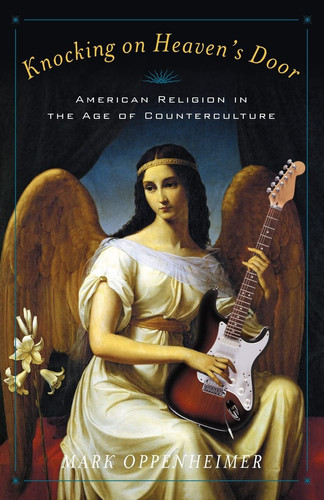
Knocking on Heaven's Door American Religion in the Age of Counterculture

Mark Oppenheimer
A witty and provocative reappraisal of the impact of the cultural upheavals of the sixties on American religious life What happened to American religion during the cultural revolution of the 1960s and early 1970s? The era has long been associated with the ascendancy of Eastern religions and fringe cults. But in this provocative book, Mark Oppenheimer demonstrates that contrary to conventional wisdom, most Americans did not turn on, tune in, and drop out of mainstream religious groups during the Age of Aquarius. Instead, many Americans brought the counterculture with them to their churches and temples, changing the face of American religion. Introducing us to America's first gay ministers and first female priests, to hippie Jews and folk-singing Catholics, Oppenheimer demonstrates that this was an era of extraordinary religious vitality. Drawing on a rich range of archival material as well as interviews with many of the protagonists, Knocking on Heaven's Door offersa wry and iconoclastic reappraisal of the ways in which the upheavals of the sixties changed America's relationship with God.
Yale University Press 2003 284 pages

From Suburb to Shtetl The Jews of Boro Park

Egon Mayer,William B. Helmreich
"From Suburb to Shtetl" is an outstanding ethnography that moves beyond simple demographics. Mayer weaves an intricate tapestry of how family, school, and community leaders influence each other. Whether discussing the role of the rebbe or the matchmaker, those who know these communities will find what he says as relevant today as it was when first penned. This is hardly surprising, for the ultra-Orthodox community takes great pride in not changing, in maintaining itself as it was in Europe despite the allure of modern American society. His discussion of synagogue life is particularly informative and evocative. Those in charge of helping immigrants adopted the path of least resistance, allowing and even encouraging them to retain their identities except for those few aspects that might threaten the country's national interests. The American Orthodox community was tremendously augmented by the arrival from Europe, after World War Two, of thousands of Orthodox Jews who remained devoted to that way of life. Egon Mayer was himself part of a smaller, but significant group of Jews who came to the U.S. and settled mostly in Boro Park in the wake of the 1956 Hungarian Revolution. The interaction between the Hasidim and their less fervent Orthodox counterparts described and analyzed in this volume tells us a great deal about how people negotiate their beliefs, values, and norms when forced into close contact with each other in an urban setting within the larger American culture. By exploring these and many other related issues Mayer has given us the chance to assess and forecast the future of American Jewish life as a whole.
Taylor & Francis Group 2017-10-12 214 pages

Explorers in Eden Pueblo Indians and the Promised Land

Jerold S. Auerbach
Beginning in the late nineteenth century, the pueblos of the Southwest frequently inspired Anglo-American visitors to express their sense of wonder and enchantment in biblical references. Frank Hamilton Cushing's first account of Zuni pueblo described a setting that looked like "The Pools of Palestine." Drawn to the Southwest, Mabel Dodge imagined "a garden of Eden, inhabited by an unfallen tribe of men and women." There she was attracted to Tony Luhan, a Taos Indian who looked "like a Biblical figure." When historian Jerold Auerbach first saw Edward S. Curtis's early twentieth-century photograph Taos Water Girls , he realized that "here, indeed, was the biblical Rebecca, relocated to New Mexico from ancient Haran, where Abraham's faithful servant had journeyed to find a suitable wife for Isaac. Rebecca with her water pitcher is as familiar a biblical icon as Noah and his ark or Moses with the stone tablets. Curtis had recast her as the archetypal Pueblo maiden." Explorers in Eden uncovers an intriguing array of diaries, letters, memoirs, photographs, paintings, postcards, advertisements, anthropological field studies, and scholarly monographs. They reveal how Anglo-Americans disenchanted with modern urban industrial society developed a deep and rich fascination with pueblo culture through their biblical associations.
UNM Press 2008-03-16 213 pages