57 results for "Ancient Civilizations"

After 1177 B. C.: the survival of civilizations

Cline, Eric H.
"In this gripping sequel to his bestselling 1177 B.C., Eric Cline tells the story of what happened after the Bronze Age collapsed-why some civilizations endured, why some gave way to new ones, and why some disappeared foreverAt the end of the acclaimed history 1177 B.C., many of the Late Bronze Age civilizations of the Aegean and Eastern Mediterranean lay in ruins, undone by invasion, revolt, natural disasters, famine, and the demise of international trade. An interconnected world that had boasted major empires and societies, relative peace, robust commerce, and monumental architecture was lost and the so-called First Dark Age had begun. Now, in After 1177 B.C., Eric Cline tells the compelling story of what happened next, over four centuries, across the Aegean and Eastern Mediterranean world. It is a story of resilience, transformation, and success, as well as failures, in an age of chaos and reconfiguration.After 1177 B.C. tells how the collapse of powerful Late Bronze Age civilizations created new circumstances to which people and societies had to adapt. Those that failed to adjust disappeared from the world stage, while others transformed themselves, resulting in a new world order that included Phoenicians, Philistines, Israelites, Neo-Hittites, Neo-Assyrians, and Neo-Babylonians. Taking the story up to the resurgence of Greece marked by the first Olympic Games in 776 B.C., the book also describes how world-changing innovations such as the use of iron and the alphabet emerged amid the chaos. Filled with lessons for today about why some societies survive massive shocks while others do not, After 1177 B.C. reveals why this period, far from being the First Dark Age, was a new age with new inventions and new opportunities"--
Princeton University Press 2024-04-16 314 pages

Rome and Jerusalem: the clash of ancient civilizations

Goodman, Martin
A magisterial history of the titanic struggle between the Roman and Jewish worlds that led to the destruction of Jerusalem. Martin Goodman—equally renowned in Jewish and in Roman studies—examines this conflict, its causes, and its consequences with unprecedented authority and thoroughness. He delineates the incompatibility between the cultural, political, and religious beliefs and practices of the two peoples and explains how Rome's interests were served by a policy of brutality against the Jews. At the same time, Christians began to distance themselves from their origins, becoming increasingly hostile toward Jews as Christian influence spread within the empire. This is the authoritative work of how these two great civilizations collided and how the reverberations are felt to this day.
Vintage Books 2008-11-11 598 pages

Jerusalem: the biography

Sebag-Montefiore, Simon
Jerusalem is the universal city, the capital of two peoples, the shrine of three faiths; it is the prize of empires, the site of Judgment Day and the battlefield of today's clash of civilizations. From King David to Barack Obama, from the birth of Judaism, Christianity and Islam to the Israel-Palestine conflict, this is the epic history of three thousand years of faith, slaughter, fanaticism and coexistence. How did this small, remote town become the Holy City, the "center of the world" and now the key to peace in the Middle East? In a gripping narrative, Simon Sebag Montefiore reveals this ever-changing city in its many incarnations, bringing every epoch and character blazingly to life. Jerusalem's biography is told through the wars, love affairs and revelations of the men and women -- kings, empresses, prophets, poets, saints, conquerors and whores -- who created, destroyed, chronicled and believed in Jerusalem. As well as the many ordinary Jerusalemites who have left their mark on the city, its cast varies from Solomon, Saladin and Suleiman the Magnificent to Cleopatra, Caligula and Churchill; from Abraham to Jesus and Muhammad; from the ancient world of Jezebel, Nebuchadnezzar, Herod and Nero to the modern times of the Kaiser, Disraeli, Mark Twain, Lincoln, Rasputin, Lawrence of Arabia and Moshe Dayan. Drawing on new archives, current scholarship, his own family papers and a lifetime's study, Montefiore illuminates the essence of sanctity and mysticism, identity and empire in a unique chronicle of the city that many believe will be the setting for the Apocalypse. This is how Jerusalem became Jerusalem, and the only city that exists twice - in heaven and on earth--Publisher
A.A. Knopf 2011 650 pages

Jerusalem: the biography

Sebag Montefiore, Simon
Jerusalem is the universal city, the capital of two peoples, the shrine of three faiths; it is the prize of empires, the site of Judgement Day and the battlefield of today's clash of civilizations. From King David to Barack Obama, from the birth of Judaism, Christianity and Islam to the Israel-Palestine conflict, this is the epic history of three thousand years of faith, slaughter, fanaticism and coexistence. How did this small, remote town become the Holy City, the "center of the world" and now the key to peace in the Middle East? In a gripping narrative, Simon Sebag Montefiore reveals this ever-changing city in its many incarnations, bringing every epoch and character blazingly to life. Jerusalem's biography is told through the wars, love affairs and revelations of the men and women -- kings, empresses, prophets, poets, saints, conquerors and whores -- who created, destroyed, chronicled and believed in Jerusalem. As well as the many ordinary Jerusalemites who have left their mark on the city, its cast varies from Solomon, Saladin and Suleiman the Magnificent to Cleopatra, Caligula and Churchill; from Abraham to Jesus and Muhammad; from the ancient world of Jezebel, Nebuchadnezzar, Herod and Nero to the modern times of the Kaiser, Disraeli, Mark Twain, Lincoln, Rasputin, Lawrence of Arabia and Moshe Dayan. Drawing on new archives, current scholarship, his own family papers and a lifetime's study, Montefiore illuminates the essence of sanctity and mysticism, identity and empire in a unique chronicle of the city that many believe will be the setting for the Apocalypse. This is how Jerusalem became Jerusalem, and the only city that exists twice -- in heaven and on earth. - Publisher.
Weidenfeld & Nicolson 2011 638 pages

Small numbers, big presence: Jews in Poland after World War II

Krajewski, Stanisław
"In the post-war era Jews have been incomparably less numerous than before and often deeply assimilated. Still, their presence's felt as big. The book is scholarly and also deeply personal. Most of the events and processes described here have a strong connection to the author's life, particularly the post-1968 mini-renaissance of Jewish life, especially in its religious variety, and advances in the realm of Jewish-Christian relations and particularly of Jewish-Christian dialogue. In addition to an account of the history of Jews in Poland after 1945, Jewish-Christian dialogue in that period, including meeting with the Polish pope, the chapters treat the concept of de-assimilation used as a key to understand the most recent phase of the story, analyze how Jewish were Jewish Communists, ponder what were the assumptions behind the post-war section of the core exhibition in POLIN, and offer an original proposal why the Holocaust is widely considered as unique"--
Peter Lang 2024 241 pages

The Anunnaki Chronicles: a Zecharia Sitchin Reader

Sitchin, Zecharia
"An insider's look into the decades of research behind Zecharia Sitchin's books as well as an in-depth overview of his theories and discoveries. Includes carefully selected chapters from the Earth Chronicles series as well as never-before-published letters, articles, and lectures. Each piece includes an introduction, offering context and insight into Sitchin's passionate work and revealing the man behind the theories. Explains the genesis of The 12th Planet, the Anunnaki influences on the Sumerian civilization, the orbit of Nibiru, the prehistory of the Americas, the extraterrestrial origins of modern man, and much more [...] -- provided by publisher
Bear & Company 2015-09-28 375 pages

Love, war, and diplomacy: the discovery of the amarna letters and the bronze age world they revealed

Cline, Eric H.
"In 1887, an Egyptian woman made an astonishing discovery among the ruins of the heretic king Akhenaten's capital city, a site now known as Amarna. She found a cache of cuneiform tablets, nearly four hundred in all, that included correspondence between the pharaohs and the mightiest powers of the day, such as the Hittites, Babylonians, and Assyrians. Love, War, and Diplomacy tells the story of the Amarna Letters and the dramatic world of the Bronze Age they revealed. Blending scholarly expertise with painstaking detective work, Eric Cline describes the spectacular discovery, the fierce competition among dealers and museums to acquire the tablets, and the race by British and German scholars to translate them. Dating to the middle of the fourteenth century BCE and the time of Tutankhamun's immediate predecessors, Amenhotep III and his son Akhenaten, the Amarna Letters are the only royal archive from New Kingdom Egypt known to exist. In them, we learn of royal marriages, diplomatic negotiations, gift-giving, intrigue, and declarations of brotherly love between powerful rulers as well as demands made by the petty kings in Canaan who owed allegiance to Egypt's pharaohs. A monumental achievement, Love, War, and Diplomacy transports readers to the glorious age of the Amarna Letters and the colonial era that brought them to light and reveals how the politics, posturing, and international intrigues of the ancient Near East are not so unlike today's." -- Provided by publisher.
Princeton University Press 2025 252 pages

Stories of the Babylonian Talmud

Rubenstein, Jeffrey L.
Jeffrey L. Rubenstein continues his grand exploration of the ancient rabbinic tradition of the Talmudic sages, offering deep and complex analysis of eight stories from the Babylonian Talmud to reconstruct the cultural and religious world of the Babylonian rabbinic academy. Rubenstein combines a close textual and literary examination of each story with a careful comparison to earlier versions from other rabbinic compilations. This unique approach provides insight not only into the meaning and content of the current forms of the stories but also into how redactors reworked those earlier versions to address contemporary moral and religious issues. Rubenstein's analysis uncovers the literary methods used to compose the Talmud and sheds light on the cultural and theological perspectives of the Stammaim — the anonymous editor-redactors of the Babylonian Talmud. Rubenstein also uses these stories as a window into understanding more broadly the culture of the late Babylonian rabbinic academy, a hierarchically organized and competitive institution where sages studied the Torah. Several of the stories Rubenstein studies here describe the dynamics of life in the academy: master-disciple relationships, collegiality and rivalry, and the struggle for leadership positions. Others elucidate the worldview of the Stammaim, including their perspectives on astrology, theodicy, and revelation.
Johns Hopkins University Press 2010-07-12 316 pages

Evolution and Culture

Marshall David Sahlins,Thomas G. Harding
About the Book Books about Civilization are concerned with the development of structured societies that grow to require urban planning, develop social and cultural elites, and forms of writing for record keeping, complex organization and transfer of ideas. Almost invariably, the process of civilization results in the growth of empires, and subjugation of less civilized peoples. Titles include: Ancient Man: The Beginning of Civilizations, Syllabus: Introduction to the History of European Civilization, Evolution and Culture, The Pivot of Civilization, The Western Hemisphere Idea: Its Rise and Decline, The decay of capitalist civilisation, and The fate of empires; being an inquiry into the stability of civilisation. About us Trieste Publishing's aim is to provide readers with the highest quality reproductions of fiction and non-fiction literature that has stood the test of time. Our titles are produced from scans of the original books and as a result may sometimes have imperfections. To ensure a high-quality product we have: thoroughly reviewed every page of all the books in the catalog repaired some of the text in some cases, and rejected titles that are not of the highest quality. You can look up "Trieste Publishing" in categories that interest you to find other titles in our large collection. Come home to the books that made a difference
Trieste Publishing Pty Limited 2017-09-26 156 pages

Ancient Mesopotamia: portrait of a dead civilisation

Oppenheim, A. Leo
"Ancient Mesopotamia - the area now called Iraq - has received less attention than Ancient Egypt and other long-extinct and more spectacular civilizations. But numerous small clay tablets buried in the desert soil for thousands of years make it possible for us to know more about the people of ancient Mesopotamia than any other land in the early Near East. Professor Oppenheim, who has studied these tablets for more than thirty years, has used his intimate knowledge of long-dead languages to put together a distinctively personal picture of the Mesopotamians of some three thousand years ago. He outlines Babylonian and Assyrian history; discusses the social structure and psychology of the Mesopotamian people; describes their daily life, religion, literature, technology, and scientific tradition. This precise and unbiased presentation focuses on those unique cultural features of the ancient land that enabled the Mesopotamian civilization to last for more than three millennia. The result is a deft "portrait," a candid appraisal of the very essence of ancient Mesopotamia." --
The University of Chicago press 1964-04 433 pages

The Mesopotamian riddle: an archaeologist, a soldier, a clergyman, and the race to decipher the world's oldest writing

Hammer, Joshua
"It was one of history's great vanishing acts. As early as 3500 BCE, scribes in the mud-walled city-state of Sumer used a reed stylus to press tiny wedge-shaped symbols into clay. For three thousand years, the script chronicled the military conquests, scientific discoveries, and epic literature of the grand kingdoms of Mesopotamia - Assyria, Babylon, the mighty Achaemenid Empire - along with precious minutia about everyday life so long ago. But as the palaces of these once great kingdoms sank beneath the desert sands, the meaning of these characters was lost. London, 1857. Colossal sculptures of winged bulls and alabaster bas-reliefs depicting cities under siege and vassals bearing tributes to Biblical kings lined the halls of the British Museum. In the Victorian era's obsession with the triumph of human progress, the mysterious kingdoms of ancient Mesopotamia - the very cradle of civilization - had captured the public imagination. Yet Europe's best philologists struggled to decipher the strange characters. Cuneiform seemed to have thousands of symbols - with some scholars claiming each could be pronounced in up to eight, nine, even ten different ways. Others insisted they'd cracked the code and deciphered inscriptions that corresponded precisely to the Old Testament - proving the veracity of the Word of God. Was it all a hoax? A delusion? A rollicking adventure through the golden age of archaeology, The Writing on the Wall tracks the decades-long race to decipher the oldest script in the world. It's the story of a swashbuckling young archeologist, a suave British military officer, and a curmudgeonly Irish rector, all vying for glory - from the ruins of Persepolis to the opulence of Ottoman-era Baghdad - in a quest to unearth the relics of lost civilizations and unlock the secrets of humanity's past"--
Simon & Schuster 2025 380 pages

The new science of the enchanted universe: an anthropology of most of humanity

Sahlins, Marshall
From the perspective of Western modernity, humanity inhabits a disenchanted cosmos. Gods, spirits, and ancestors have left us for a transcendent beyond, no longer living in our midst and being involved in all matters of everyday life from the trivial to the dire. Yet the vast majority of cultures throughout human history treat spirits as very real persons, members of a cosmic society who interact with humans and control their fate. In most cultures, even today, people are but a small part of an enchanted universe misconstrued by the transcendent categories of “religion” and the “supernatural.” The New Science of the Enchanted Universe shows how anthropologists and other social scientists must rethink these cultures of immanence and study them by their own lights. In this, his last, revelatory book, Marshall Sahlins announces a new method and sets an exciting agenda for the field. He takes readers around the world, from Inuit of the Arctic Circle to pastoral Dinka of East Africa, from Araweté swidden gardeners of Amazonia to Trobriand Island horticulturalists. In the process, Sahlins sheds new light on classical and contemporary ethnographies that describe these cultures of immanence and reveals how even the apparently mundane, all-too-human spheres of “economics” and “politics” emerge as people negotiate with, and ultimately usurp, the powers of the gods.
Princeton University Press 2023-12-05 208 pages

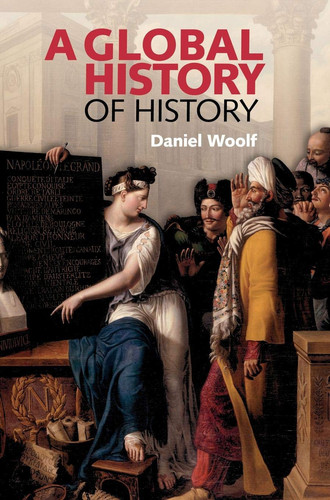
A global history of history

Woolf, D. R.
A global history of historical writing, thought and the development of the historical discipline from the ancient world to the present. This is a definitive guide to human efforts to recover, understand and represent the past, bringing together different historical traditions and their social, economic, political and cultural contexts. Daniel Woolf offers clear definitions of different genres and forms of history and addresses key themes such as the interactions between West and East, the conflict of oral, pictographic, and written accounts of the past and the place of history in society and in politics. Numerous textual extracts and illustrations in every chapter capture the historical cultures of past civilizations and demonstrate the different forms that historical consciousness has taken around the world. The book offers unique insights into the interconnections between different historical cultures over 3000 years and relates the rise of history to key themes in world history. --
Cambridge University Press 2011-02-17 568 pages