106 results for "Artificial Intelligence"

The Singularity Is Nearer

Kurzweil, Ray
"This successor volume to The Singularity Is Near explores how technology will refashion the human race in the decades to come. In this entirely new book, Ray Kurzweil brings a fresh perspective to advances in the singularity-assessing the progress of many of his predictions and examining the novel advancements that, in the near future, will bring a revolution in knowledge and an expansion of human potential. Among the topics he discusses are rebuilding the world atom by atom with devices like nanobots; radical life extension beyond the current age limit of 120; reinventing intelligence by expanding biological capacity with nonbiological intelligence in the cloud; how life is improving with declines in poverty and violence; and the growth of technologies that can be applied to everything from clothes to building materials to growing human organs. He also considers the potential perils of biotechnology, nanotechnology, and artificial intelligence, including such topics as how AI will impact unemployment and the safety of autonomous cars, and "After Life" technology, which will reanimate people who have passed away through a combination of data and DNA"--
Penguin USA 2025-06-03 432 pages

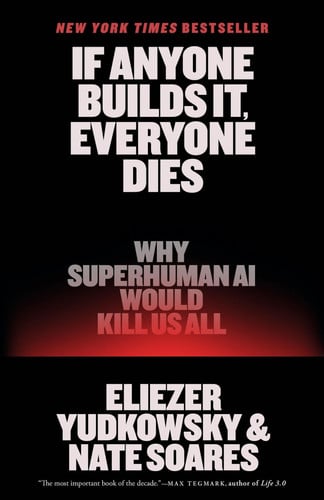
If anyone builds it, everyone dies: why superhuman AI would kill us all

Yudkowsky, Eliezer
"In 2023, hundreds of AI luminaries signed an open letter warning that artificial intelligence poses a serious risk of human extinction. Since then, the AI race has only intensified. Companies and countries are rushing to build machines that will be smarter than any person. And the world is devastatingly unprepared for what would come next. For decades, two signatories of that letter - Eliezer Yudkowsky and Nate Soares - have studied how smarter-than-human intelligences will think, behave, and pursue their objectives. Their research says that sufficiently smart AIs will develop goals of their own that put them in conflict with us - and that if it comes to conflict, an artificial superintelligence would crush us. The contest wouldn't even be close. How could a machine superintelligence wipe out our entire species? Why would it want to? Would it want anything at all? In this urgent book, Yudkowsky and Soares walk through the theory and the evidence, present one possible extinction scenario, and explain what it would take for humanity to survive. The world is racing to build something truly new under the sun. And if anyone builds it, everyone dies"-- Provided by publisher.
Little, Brown and Company 2025-09 259 pages

What Is ChatGPT Doing ... and Why Does It Work?

Stephen Wolfram
Nobody expected this-not even its creators: ChatGPT has burst onto the scene as an AI capable of writing at a convincingly human level. But how does it really work? What's going on inside its "AI mind"? In this short book, prominent scientist and computation pioneer Stephen Wolfram provides a readable and engaging explanation that draws on his decades-long unique experience at the frontiers of science and technology. Find out how the success of ChatGPT brings together the latest neural net technology with foundational questions about language and human thought posed by Aristotle more than two thousand years ago.
Repro India Limited 2023-05-24 112 pages

Deep thinking: where machine intelligence ends and human creativity begins

Kasparov, G. K.
In May 1997, the world watched as Garry Kasparov, the greatest chess player in the world, was defeated for the first time by the IBM supercomputer Deep Blue. It was a watershed moment in the history of technology: machine intelligence had arrived at the point where it could best human intellect. It wasn't a coincidence that Kasparov became the symbol of man's fight against the machines. Chess has long been the fulcrum in development of machine intelligence; the hoax automaton 'The Turk' in the 18th century and Alan Turing's first chess program in 1952 were two early examples of the quest for machines to think like humans -- a talent we measured by their ability to beat their creators at chess. As the pre-eminent chessmaster of the 80s and 90s, it was Kasparov's blessing and his curse to play against each generation's strongest computer champions, contributing to their development and advancing the field. Like all passionate competitors, Kasparov has taken his defeat and learned from it. He has devoted much energy to devising ways in which humans can partner with machines in order to produce results better than either can achieve alone. During the twenty years since playing Deep Blue, he's played both with and against machines, learning a great deal about our vital relationship with our most remarkable creations. Ultimately, he's become convinced that by embracing the competition between human and machine intelligence, we can spend less time worrying about being replaced and more thinking of new challenges to conquer. In this breakthrough book, Kasparov tells his side of the story of Deep Blue for the first time -- what it was like to strategize against an implacable, untiring opponent -- the mistakes he made and the reasons the odds were against him. But more than that, he tells his story of AI more generally, and how he's evolved to embrace it, taking part in an urgent debate with philosophers worried about human values, programmers creating self-learning neural networks, and engineers of cutting edge robotics.
John Murray 2017-06 287 pages

How to create a mind: the secret of human thought revealed

Kurzweil, Ray
This book presents a provocative exploration of the most important project in human-machine civilization: reverse-engineering the brain to understand precisely how it works and using that knowledge to create even more intelligent machines. Kurzweil discusses how the brain functions, how the mind emerges, brain computer interfaces, and the implications of vastly increasing the powers of our intelligence to address the world's problems.
Penguin Books 2013-08-27 336 pages

The age of AI: and our human future

Kissinger, Henry,Schmidt, Eric,Huttenlocher, Daniel P.
"Artificial Intelligence (AI) is transforming human society in fundamental and profound ways. Not since the Age of Reason have we changed how we approach security, economics, order, and even knowledge itself. In the Age of AI, three deep and accomplished thinkers come together to consider what AI will mean for us all."
Back Bay Books, Little, Brown and Company 2022 266 pages

What It Takes

Schwarzman, Stephen A.
From Blackstone chairman, CEO, and co-founder Stephen A. Schwarzman, a long-awaited book that uses impactful episodes from Schwarzman's life to show readers how to build, transform, and lead thriving organizations. Whether you are a student, entrepreneur, philanthropist, executive, or simply someone looking for ways to maximize your potential, the same lessons apply. People know who Stephen Schwarzman is—at least they think they do. He’s the man who took $400,000 and co-founded Blackstone, the investment firm that manages over $500 billion (as of January 2019). He’s the CEO whose views are sought by heads of state. He’s the billionaire philanthropist who founded Schwarzman Scholars, this century’s version of the Rhodes Scholarship, in China. But behind these achievements is a man who has spent his life learning and reflecting on what it takes to achieve excellence, make an impact, and live a life of consequence. Folding handkerchiefs in his father’s linen shop, Schwarzman dreamed of a larger life, filled with purpose and adventure. His grades and athleticism got him into Yale. After starting his career in finance with a short stint at a financial firm called DLJ, Schwarzman began working at Lehman Brothers where he ascended to run the mergers and acquisitions practice. He eventually partnered with his mentor and friend Pete Peterson to found Blackstone, vowing to create a new and different kind of financial institution. Building Blackstone into the leading global financial institution it is today didn’t come easy. Schwarzman focused intensely on culture, hiring great talent, and establishing processes that allow the firm to systematically analyze and evaluate risk. Schwarzman’s simple mantra “don’t lose money” has helped Blackstone become a leading private equity and real estate investor, and manager of alternative assets for institutional investors globally. Both he and the firm are known for the rigor of their investment process, their innovative approach to deal making, the diversification of their business lines, and a conviction to be the best at everything they do. Schwarzman is also an active philanthropist, having given away more than a billion dollars. In philanthropy, as in business, he is drawn to situations where his capital and energy can be applied to drive transformative solutions and change paradigms, notably in education. He uses the skills learned over a lifetime in finance to design, establish, and support impactful and innovative organizations and initiatives. His gifts have ranged from creating a new College of Computing at MIT for the study of artificial intelligence, to establishing a first-of-its-kind student and performing arts center at Yale, to enabling the renovation of the iconic New York Public Library, to founding the Schwarzman Scholars fellowship program at Tsinghua University in Beijing—the single largest philanthropic effort in China’s history from international donors. Schwarzman’s story is an empowering, entertaining, and informative guide for anyone striving for greater personal impact. From deal making to investing, leadership to entrepreneurship, philanthropy to diplomacy, Schwarzman has lessons for how to think about ambition and scale, risk and opportunities, and how to achieve success through the relentless pursuit of excellence. Schwarzman not only offers readers a thoughtful reflection on all his own experiences, but in doing so provides a practical blueprint for success.
SIMON & SCHUSTER 2019-09-17 384 pages

Hackers

Levy, Steven
This 25th anniversary edition of Steven Levy's classic book traces the exploits of the computer revolution's original hackers -- those brilliant and eccentric nerds from the late 1950s through the early '80s who took risks, bent the rules, and pushed the world in a radical new direction. With updated material from noteworthy hackers such as Bill Gates, Mark Zuckerberg, Richard Stallman, and Steve Wozniak, Hackers is a fascinating story that begins in early computer research labs and leads to the first home computers. Levy profiles the imaginative brainiacs who found clever and unorthodox solutions to computer engineering problems. They had a shared sense of values, known as "the hacker ethic," that still thrives today. Hackers captures a seminal period in recent history when underground activities blazed a trail for today's digital world, from MIT students finagling access to clunky computer-card machines to the DIY culture that spawned the Altair and the Apple II.
O'Reilly Media 2010-06-29 499 pages

Tony Stark, Iron Man

Slott, Dan,Whitley, Jeremy
Dan Slott gives Tony Stark a fresh upgrade - and unleashes the long-awaited Iron Man of 2020! Iron Man... is an idea. Always changing. Always evolving. Now, the ultimate self-made hero is reaching new heights of inventiveness! But Tony has been holding back an enormous secret since his return, and it will change everything! Stark's new virtual world, the eScape, seems like a paradise - but who controls the eScape? And who controls Iron Man? Artificial intelligence takes the focus as Jocasta and Machine Man join the cast and Tony questions his very identity - but when an AI uprising begins, Iron Man is not the invincible hero the world needs. 2020 is here. Arno Stark's time has come. And a robot revolution is about to transform the world! Collecting: Tony Stark: Iron Man (2018) 1-19, Iron Man 2020 (2020) 1-6, Iron Man (1998) 25
Marvel Worldwide, Inc 2021-03-16 576 pages

Genesis: artificial intelligence, hope, and the human spirit

Kissinger, Henry,Mundie, Craig,Schmidt, Eric,Runde, Eleanor
"As it absorbs data, gains agency, and intermediates between humans and reality, AI (artificial intelligence) will help us to address enormous crises, from climate change to geopolitical conflicts to income inequality. It might well solve some of the greatest mysteries of our universe and elevate the human spirit to unimaginable heights. But it will also pose challenges on a scale and of an intensity that we have never seen--usurping our power of independent judgment and action, testing our relationship with the divine, and perhaps even spurring a new phase in human evolution. The last book of elder statesman Henry Kissinger, written with technologists Craig Mundie and Eric Schmidt, 'Genesis' charts a course between blind faith and unjustified fear as it outlines an effective strategy for navigating the age of AI."--
Little, Brown and Company 2024-11-19 249 pages

It's Alive! It's Alive! (Goosebumps SlappyWorld #7)

R. L. Stine
Goosebumps now on Disney+! Livvy and Jayden are the stars of their school's robotics team. Livvy is especially enthusiastic because her own mother works in a robotics lab and experiments with Artificial Intelligence. To impress her mom, Livvy and Jayden build a robot. Livvy wants to name their robot "Francine," but Jayden thinks that's too silly for their creation. Desperate to win, Livvy and Jayden "borrow" an Artificial Intelligence module. They soon realize they've made a terrible mistake. Francine has too much brain power. She's alive! And using this newly gained brain power to dream up a deadly contest!
Scholastic Incorporated 2019 160 pages

Incognito: the secret lives of the brain

Eagleman, David
"In this sparkling and provocative new book, renowned neuroscientist David Eagleman navigates the depths of the subconscious brain to illuminate surprising mysteries: Why can your foot move halfway to the brake pedal before you become consciously aware of danger ahead? Why do you notice when your name is mentioned in a conversation that you didn't think you were listening to? Why are people whose name begins with J more likely to marry other people whose name begins with J? Why is it so difficult to keep a secret? And how is it possible to get angry at yourself: who, exactly, is mad at whom? Taking in brain damage, plane spotting, dating, drugs, beauty, infidelity, synaesthesia, criminal law, artificial intelligence and visual illusions, Incognito is a thrilling subsurface exploration of the mind and all its contradictions"--Publisher description.
Canongate 2012 290 pages

Summa technologiae

Lem, Stanisław
The Polish writer Stanislaw Lem is best known to English-speaking readers as the author of the 1961 science fiction novel Solaris , adapted into a meditative film by Andrei Tarkovsky in 1972 and remade in 2002 by Steven Soderbergh. Throughout his writings, comprising dozens of science fiction novels and short stories, Lem offered deeply philosophical and bitingly satirical reflections on the limitations of both science and humanity. In Summa Technologiae --his major work of nonfiction, first published in 1964 and now available in English for the first time--Lem produced an engaging and caustically logical philosophical treatise about human and nonhuman life in its past, present, and future forms. After five decades Summa Technologiae has lost none of its intellectual or critical significance. Indeed, many of Lem's conjectures about future technologies have now come true: from artificial intelligence, bionics, and nanotechnology to the dangers of information overload, the concept underlying Internet search engines, and the idea of virtual reality. More important for its continued relevance, however, is Lem's rigorous investigation into the parallel development of biological and technical evolution and his conclusion that technology will outlive humanity. Preceding Richard Dawkins's understanding of evolution as a blind watchmaker by more than two decades, Lem posits evolution as opportunistic, shortsighted, extravagant, and illogical. Strikingly original and still timely, Summa Technologiae resonates with a wide range of contemporary debates about information and new media, the life sciences, and the emerging relationship between technology and humanity.
University of Minnesota Press 2010 409 pages

A New Kind of Science and a New Kind of Science Explorer

Stephen Wolfram
Physics and computer science genius Stephen Wolfram, whose Mathematica computer language launched a multimillion-dollar company, now sets his sights on a more daunting goal: understanding the universe. Wolfram lets the world see his work in A New Kind of Science , a gorgeous, 1,280-page tome more than a decade in the making. With patience, insight, and self-confidence to spare, Wolfram outlines a fundamental new way of modeling complex systems. On the frontier of complexity science since he was a boy, Wolfram is a champion of cellular automata--256 "programs" governed by simple nonmathematical rules. He points out that even the most complex equations fail to accurately model biological systems, but the simplest cellular automata can produce results straight out of nature--tree branches, stream eddies, and leopard spots, for instance. The graphics in A New Kind of Science show striking resemblance to the patterns we see in nature every day. Wolfram wrote the book in a distinct style meant to make it easy to read, even for nontechies; a basic familiarity with logic is helpful but not essential. Readers will find themselves swept away by the elegant simplicity of Wolfram's ideas and the accidental artistry of the cellular automaton models. Whether or not Wolfram's revolution ultimately gives us the keys to the universe, his new science is absolutely awe-inspiring. --Therese Littleton
Wolfram Media, Incorporated 2002-05 1197 pages

THE EMPEROR'S NEW MIND: Concerning Computers, Minds, and the Laws of Physics

Penrose, Roger
For decades, proponents of artificial intelligence have argued that computers will soon be doing everything that a human mind can do. Admittedly, computers now play chess at the grandmaster level, but do they understand the game as we do? Can a computer eventually do everything a human mind can do? In this absorbing and frequently contentious book, Roger Penrose--eminent physicist and winner, with Stephen Hawking, of the prestigious Wolf prize--puts forward his view that there are some facets of human thinking that can never be emulated by a machine. Penrose examines what physics and mathematics can tell us about how the mind works, what they can't, and what we need to know to understand the physical processes of consciousness. He is among a growing number of physicists who think Einstein wasn't being stubborn when he said his "little finger" told him that quantum mechanics is incomplete, and he concludes that laws even deeper than quantum mechanics are essential for the operation of a mind. To support this contention, Penrose takes the reader on a dazzling tour that covers such topics as complex numbers, Turing machines, complexity theory, quantum mechanics, formal systems, Godel undecidability, phase spaces, Hilbert spaces, black holes, white holes, Hawking radiation, entropy, quasicrystals, the structure of the brain, and scores of other subjects. The Emperor's New Mind will appeal to anyone with a serious interest in modern physics and its relation to philosophical issues, as well as to physicists, mathematicians, philosophers and those on either side of the AI debate.
Oxford University Press 1990 466 pages

Age of Ultron

Bendis, Brian Michael
Henry Pym has played a significant role in shaping a brighter future for mankind. As the Avenger known as Ant-Man, Giant-Man, Goliath and Yellowjacket he fought valiantly alongside Earth's Mightiest Heroes for years, battling the greatest threats the world has ever known. Yet Pym's legacy will forever be defined by a single mistake - the creation of the homicidal artificial intelligence Ultron. The age of Ultron is upon us... submit or perish .
Panini 2013 240 pages

Causality

Pearl, Judea
Written by one of the preeminent researchers in the field, this book provides a comprehensive exposition of modern analysis of causation. It shows how causality has grown from a nebulous concept into a mathematical theory with significant applications in the fields of statistics, artificial intelligence, economics, philosophy, cognitive science, and the health and social sciences. Judea Pearl presents and unifies the probabilistic, manipulative, counterfactual, and structural approaches to causation and devises simple mathematical tools for studying the relationships between causal connections and statistical associations. The book will open the way for including causal analysis in the standard curricula of statistics, artificial intelligence, business, epidemiology, social sciences, and economics. Students in these fields will find natural models, simple inferential procedures, and precise mathematical definitions of causal concepts that traditional texts have evaded or made unduly complicated. The first edition of Causality has led to a paradigmatic change in the way that causality is treated in statistics, philosophy, computer science, social science, and economics. Cited in more than 5,000 scientific publications, it continues to liberate scientists from the traditional molds of statistical thinking. In this revised edition, Judea Pearl elucidates thorny issues, answers readers’ questions, and offers a panoramic view of recent advances in this field of research. Causality will be of interests to students and professionals in a wide variety of fields. Anyone who wishes to elucidate meaningful relationships from data, predict effects of actions and policies, assess explanations of reported events, or form theories of causal understanding and causal speech will find this book stimulating and invaluable.
Cambridge University Press 2009