42 results for "Artificial Intelligence"

The Singularity Is Nearer

Kurzweil, Ray
"This successor volume to The Singularity Is Near explores how technology will refashion the human race in the decades to come. In this entirely new book, Ray Kurzweil brings a fresh perspective to advances in the singularity-assessing the progress of many of his predictions and examining the novel advancements that, in the near future, will bring a revolution in knowledge and an expansion of human potential. Among the topics he discusses are rebuilding the world atom by atom with devices like nanobots; radical life extension beyond the current age limit of 120; reinventing intelligence by expanding biological capacity with nonbiological intelligence in the cloud; how life is improving with declines in poverty and violence; and the growth of technologies that can be applied to everything from clothes to building materials to growing human organs. He also considers the potential perils of biotechnology, nanotechnology, and artificial intelligence, including such topics as how AI will impact unemployment and the safety of autonomous cars, and "After Life" technology, which will reanimate people who have passed away through a combination of data and DNA"--
Penguin USA 2025-06-03 432 pages

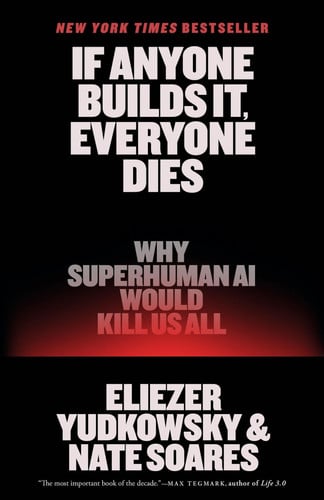
If anyone builds it, everyone dies: why superhuman AI would kill us all

Yudkowsky, Eliezer
"In 2023, hundreds of AI luminaries signed an open letter warning that artificial intelligence poses a serious risk of human extinction. Since then, the AI race has only intensified. Companies and countries are rushing to build machines that will be smarter than any person. And the world is devastatingly unprepared for what would come next. For decades, two signatories of that letter - Eliezer Yudkowsky and Nate Soares - have studied how smarter-than-human intelligences will think, behave, and pursue their objectives. Their research says that sufficiently smart AIs will develop goals of their own that put them in conflict with us - and that if it comes to conflict, an artificial superintelligence would crush us. The contest wouldn't even be close. How could a machine superintelligence wipe out our entire species? Why would it want to? Would it want anything at all? In this urgent book, Yudkowsky and Soares walk through the theory and the evidence, present one possible extinction scenario, and explain what it would take for humanity to survive. The world is racing to build something truly new under the sun. And if anyone builds it, everyone dies"-- Provided by publisher.
Little, Brown and Company 2025-09 259 pages

What Is ChatGPT Doing ... and Why Does It Work?

Stephen Wolfram
Nobody expected this-not even its creators: ChatGPT has burst onto the scene as an AI capable of writing at a convincingly human level. But how does it really work? What's going on inside its "AI mind"? In this short book, prominent scientist and computation pioneer Stephen Wolfram provides a readable and engaging explanation that draws on his decades-long unique experience at the frontiers of science and technology. Find out how the success of ChatGPT brings together the latest neural net technology with foundational questions about language and human thought posed by Aristotle more than two thousand years ago.
Repro India Limited 2023-05-24 112 pages

Deep thinking: where machine intelligence ends and human creativity begins

Kasparov, G. K.
In May 1997, the world watched as Garry Kasparov, the greatest chess player in the world, was defeated for the first time by the IBM supercomputer Deep Blue. It was a watershed moment in the history of technology: machine intelligence had arrived at the point where it could best human intellect. It wasn't a coincidence that Kasparov became the symbol of man's fight against the machines. Chess has long been the fulcrum in development of machine intelligence; the hoax automaton 'The Turk' in the 18th century and Alan Turing's first chess program in 1952 were two early examples of the quest for machines to think like humans -- a talent we measured by their ability to beat their creators at chess. As the pre-eminent chessmaster of the 80s and 90s, it was Kasparov's blessing and his curse to play against each generation's strongest computer champions, contributing to their development and advancing the field. Like all passionate competitors, Kasparov has taken his defeat and learned from it. He has devoted much energy to devising ways in which humans can partner with machines in order to produce results better than either can achieve alone. During the twenty years since playing Deep Blue, he's played both with and against machines, learning a great deal about our vital relationship with our most remarkable creations. Ultimately, he's become convinced that by embracing the competition between human and machine intelligence, we can spend less time worrying about being replaced and more thinking of new challenges to conquer. In this breakthrough book, Kasparov tells his side of the story of Deep Blue for the first time -- what it was like to strategize against an implacable, untiring opponent -- the mistakes he made and the reasons the odds were against him. But more than that, he tells his story of AI more generally, and how he's evolved to embrace it, taking part in an urgent debate with philosophers worried about human values, programmers creating self-learning neural networks, and engineers of cutting edge robotics.
John Murray 2017-06 287 pages

How to create a mind: the secret of human thought revealed

Kurzweil, Ray
This book presents a provocative exploration of the most important project in human-machine civilization: reverse-engineering the brain to understand precisely how it works and using that knowledge to create even more intelligent machines. Kurzweil discusses how the brain functions, how the mind emerges, brain computer interfaces, and the implications of vastly increasing the powers of our intelligence to address the world's problems.
Penguin Books 2013-08-27 336 pages

The age of AI: and our human future

Kissinger, Henry,Schmidt, Eric,Huttenlocher, Daniel P.
"Artificial Intelligence (AI) is transforming human society in fundamental and profound ways. Not since the Age of Reason have we changed how we approach security, economics, order, and even knowledge itself. In the Age of AI, three deep and accomplished thinkers come together to consider what AI will mean for us all."
Back Bay Books, Little, Brown and Company 2022 266 pages

Hackers

Levy, Steven
This 25th anniversary edition of Steven Levy's classic book traces the exploits of the computer revolution's original hackers -- those brilliant and eccentric nerds from the late 1950s through the early '80s who took risks, bent the rules, and pushed the world in a radical new direction. With updated material from noteworthy hackers such as Bill Gates, Mark Zuckerberg, Richard Stallman, and Steve Wozniak, Hackers is a fascinating story that begins in early computer research labs and leads to the first home computers. Levy profiles the imaginative brainiacs who found clever and unorthodox solutions to computer engineering problems. They had a shared sense of values, known as "the hacker ethic," that still thrives today. Hackers captures a seminal period in recent history when underground activities blazed a trail for today's digital world, from MIT students finagling access to clunky computer-card machines to the DIY culture that spawned the Altair and the Apple II.
O'Reilly Media 2010-06-29 499 pages

A New Kind of Science and a New Kind of Science Explorer

Stephen Wolfram
Physics and computer science genius Stephen Wolfram, whose Mathematica computer language launched a multimillion-dollar company, now sets his sights on a more daunting goal: understanding the universe. Wolfram lets the world see his work in A New Kind of Science , a gorgeous, 1,280-page tome more than a decade in the making. With patience, insight, and self-confidence to spare, Wolfram outlines a fundamental new way of modeling complex systems. On the frontier of complexity science since he was a boy, Wolfram is a champion of cellular automata--256 "programs" governed by simple nonmathematical rules. He points out that even the most complex equations fail to accurately model biological systems, but the simplest cellular automata can produce results straight out of nature--tree branches, stream eddies, and leopard spots, for instance. The graphics in A New Kind of Science show striking resemblance to the patterns we see in nature every day. Wolfram wrote the book in a distinct style meant to make it easy to read, even for nontechies; a basic familiarity with logic is helpful but not essential. Readers will find themselves swept away by the elegant simplicity of Wolfram's ideas and the accidental artistry of the cellular automaton models. Whether or not Wolfram's revolution ultimately gives us the keys to the universe, his new science is absolutely awe-inspiring. --Therese Littleton
Wolfram Media, Incorporated 2002-05 1197 pages

The age of intelligent machines

Kurzweil, Ray
Winner, 1990, category of Computer Science, Professional/Scholarly Publishing Annual Awards Competition presented by the Association of American Publishers, Inc. In The Age of Intelligent Machines, inventor and visionary computer scientist Raymond Kurzweil probes the past, present, and future of artificial intelligence, from its earliest philosophical and mathematical roots to tantalizing glimpses of 21st-century machines with superior intelligence and truly prodigious speed and memory. Generously illustrated and easily accessible to the nonspecialist, this book provides the background needed for a full understanding of the enormous scientific potential represented by intelligent machines as well as their equally profound philosophic, economic, and social implications. Running alongside Kurzweil's historical and scientific narrative are 23 articles examining contemporary issues in artificial intelligence. Raymond Kurzweil is the founder and chairman of Kurzweil Applied Intelligence and the Kurzweil Reading Machine division of Xerox. He was the principal developer of the first print-to-speech reading machine for the blind and other significant advances in artificial intelligence technology. Articles by: Charles Ames. Margaret A. Boden. Harold Cohen. Daniel C. Dennett. Edward A. Feigenbaum. K. Fuchi. George Gilder. Douglas R. Hofstadter. Michael Lebowitz. Margaret Litven. Blaine Mathieu. Marvin Minsky. Allen Newell. Brian W. Oakley. Seymour Papert. Jeff Pepper. Roger Schank and Christopher Owens. Sherry Turkle. Mitchell Waldrop.
MIT Press 1992 565 pages

The big nine: how the tech titans and their thinking machines could warp humanity

Webb, Amy
In this book, Amy Webb reveals the pervasive, invisible ways in which the foundations of AI - the people working on the system, their motivations, the technology itself - is broken. Within our lifetimes, AI will, by design, begin to behave unpredictably, thinking and acting in ways which defy human logic. The big nine corporations may be inadvertently building and enabling vast arrays of intelligent systems that don't share our motivations, desires, or hopes for the future of humanity.
PublicAffairs 2020-03-03 324 pages

Genetic algorithms in search, optimization, and machine learning

Goldberg, David E.
This book brings together - in an informal and tutorial fashion - the computer techniques, mathematical tools, and research results that will enable both students and practitioners to apply genetic algorithms to problems in many fields. Major concepts are illustrated with running examples, and major algorithms are illustrated by Pascal computer programs. No prior knowledge of GAs or genetics is assumed, and only a minimum of computer programming and mathematics background is required. 0201157675B07092001
Addison-Wesley 1989 412 pages

Understanding computers and cognition: a new foundation for design

Winograd, Terry
Understanding Computers and Cognition presents an important and controversial new approach to understanding what computers do and how their functioning is related to human language, thought, and action. While it is a book about computers, Understanding Computers and Cognition goes beyond the specific issues of what computers can or can't do. It is a broad-ranging discussion exploring the background of understanding in which the discourse about computers and technology takes place. Understanding Computers and Cognition is written for a wide audience, not just those professionals involved in computer design or artificial intelligence. It represents an important contribution to the ongoing discussion about what it means to be a machine, and what it means to be human. Book jacket.
Ablex 1986 207 pages

Artificial general intelligence

Ben Goertzel,Cassio Pennachin
“Only a small community has concentratedon general intelligence. No one has tried to make a thinking machine . . . The bottom line is that we really haven’t progressed too far toward a truly intelligent machine. We have collections of dumb specialists in small domains; the true majesty of general intelligence still awaits our attack. . . . We have got to get back to the deepest questions of AI and general intelligence. . . ” –MarvinMinsky as interviewed in Hal’s Legacy, edited by David Stork, 2000. Our goal in creating this edited volume has been to ?ll an apparent gap in the scienti?c literature, by providing a coherent presentation of a body of contemporary research that, in spite of its integral importance, has hitherto kept a very low pro?le within the scienti?c and intellectual community. This body of work has not been given a name before; in this book we christen it “Arti?cial General Intelligence” (AGI). What distinguishes AGI work from run-of-the-mill “arti?cial intelligence” research is that it is explicitly focused on engineering general intelligence in the short term. We have been active researchers in the AGI ?eld for many years, and it has been a pleasure to gather together papers from our colleagues working on related ideas from their own perspectives. In the Introduction we give a conceptual overview of the AGI ?eld, and also summarize and interrelate the key ideas of the papers in the subsequent chapters.
Springer 2011 509 pages

Virtually human: the promise - and the peril - of digital immortality

Rothblatt, Martine Aliana
"Virtually Human explores what the not-too-distant future will look like when cyberconsciousness--simulation of the human brain via software and computer technology--becomes part of our daily lives. Meet Bina48, the world's most sentient robot, commissioned by Martine Rothblatt and created by Hanson Robotics. Bina48 is a nascent Mindclone of Martine's wife that can engage in conversation, answer questions, and even have spontaneous thoughts that are derived from multimedia data in a Mindfile created by the real Bina. If you're active on Twitter or Facebook, share photos through Instagram, or blogging regularly, you're already on your way to creating a Mindfile--a digital database of your thoughts, memories, feelings, and opinions that is essentially a back-up copy of your mind. Soon, this Mindfile can be made conscious with special software--Mindware--that mimics the way human brains organize information, create emotions and achieve self-awareness. This may sound like science-fiction, but the nascent technology already exists. Thousands of software engineers across the globe are working to create cyberconsciousness based on human consciousness and the Obama administration recently announced plans to invest in a decade-long Brain Activity Map project. Virtually Human is the only book to examine the ethical issues relating to cyberconsciousness and Rothblatt, with a Ph. D. in medical ethics, is uniquely qualified to lead the dialogue"--
Picador 2015-10-06 350 pages

Artificial Life

Steven Levy
This enthralling book alerts us to nothing less than the existence of new varieties of life. Some of these species can move and eat, see, reproduce, and die. Some behave like birds or ants. One such life form may turn out to be our best weapon in the war against AIDS. What these species have in common is that they exist inside computers, their DNA is digital, and they have come into being not through God's agency but through the efforts of a generation of scientists who seek to create life in silico. But even as it introduces us to these brilliant heretics and unravels the intricacies of their work. Artificial Life examines its subject's dizzying philosophical implications: Is a self-replicating computer program any less alive than a flu virus? Are carbon-and-water-based entities merely part of the continuum of living things? And is it possible that one day "a-life" will look back at human beings and dismiss us as an evolutionary way station -- or, worse still, a dead end? "From the Trade Paperback edition.
Random House Value Publishing 1994-05-29

Ways of thinking: the limits of rational thought and artificial intelligence

Mérő, László
This book goes right into the the causes and reasons of the diversity of ways of thinking. It is about the tricks of how our thinking works and about the efforts and failures of artificial intelligence. It discusses what can and cannot be expected of intelligent' computers, and provides an insight into the deeper layers of the mechanism of our thinking.-An enjoyable piece of reading, this thought-provoking book is also an exciting mental adventure for those with little or no computer competence at all.
World Scientific 1990 252 pages