
9 results for "Artificial Intelligence"

If anyone builds it, everyone dies: why superhuman AI would kill us all

Yudkowsky, Eliezer
"In 2023, hundreds of AI luminaries signed an open letter warning that artificial intelligence poses a serious risk of human extinction. Since then, the AI race has only intensified. Companies and countries are rushing to build machines that will be smarter than any person. And the world is devastatingly unprepared for what would come next. For decades, two signatories of that letter - Eliezer Yudkowsky and Nate Soares - have studied how smarter-than-human intelligences will think, behave, and pursue their objectives. Their research says that sufficiently smart AIs will develop goals of their own that put them in conflict with us - and that if it comes to conflict, an artificial superintelligence would crush us. The contest wouldn't even be close. How could a machine superintelligence wipe out our entire species? Why would it want to? Would it want anything at all? In this urgent book, Yudkowsky and Soares walk through the theory and the evidence, present one possible extinction scenario, and explain what it would take for humanity to survive. The world is racing to build something truly new under the sun. And if anyone builds it, everyone dies"-- Provided by publisher.
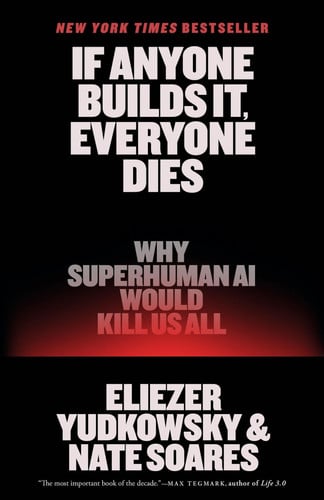
Little, Brown and Company 2025-09 259 pages

The age of AI: and our human future

Kissinger, Henry,Schmidt, Eric,Huttenlocher, Daniel P.
"Artificial Intelligence (AI) is transforming human society in fundamental and profound ways. Not since the Age of Reason have we changed how we approach security, economics, order, and even knowledge itself. In the Age of AI, three deep and accomplished thinkers come together to consider what AI will mean for us all."
Back Bay Books, Little, Brown and Company 2022 266 pages

Genesis: artificial intelligence, hope, and the human spirit

Kissinger, Henry,Mundie, Craig,Schmidt, Eric,Runde, Eleanor
"As it absorbs data, gains agency, and intermediates between humans and reality, AI (artificial intelligence) will help us to address enormous crises, from climate change to geopolitical conflicts to income inequality. It might well solve some of the greatest mysteries of our universe and elevate the human spirit to unimaginable heights. But it will also pose challenges on a scale and of an intensity that we have never seen--usurping our power of independent judgment and action, testing our relationship with the divine, and perhaps even spurring a new phase in human evolution. The last book of elder statesman Henry Kissinger, written with technologists Craig Mundie and Eric Schmidt, 'Genesis' charts a course between blind faith and unjustified fear as it outlines an effective strategy for navigating the age of AI."--
Little, Brown and Company 2024-11-19 249 pages

The big nine: how the tech titans and their thinking machines could warp humanity

Webb, Amy
In this book, Amy Webb reveals the pervasive, invisible ways in which the foundations of AI - the people working on the system, their motivations, the technology itself - is broken. Within our lifetimes, AI will, by design, begin to behave unpredictably, thinking and acting in ways which defy human logic. The big nine corporations may be inadvertently building and enabling vast arrays of intelligent systems that don't share our motivations, desires, or hopes for the future of humanity.
PublicAffairs 2020-03-03 324 pages

Understanding computers and cognition: a new foundation for design

Winograd, Terry
Understanding Computers and Cognition presents an important and controversial new approach to understanding what computers do and how their functioning is related to human language, thought, and action. While it is a book about computers, Understanding Computers and Cognition goes beyond the specific issues of what computers can or can't do. It is a broad-ranging discussion exploring the background of understanding in which the discourse about computers and technology takes place. Understanding Computers and Cognition is written for a wide audience, not just those professionals involved in computer design or artificial intelligence. It represents an important contribution to the ongoing discussion about what it means to be a machine, and what it means to be human. Book jacket.
Ablex 1986 207 pages

Work mate marry love: how machines shape our human destiny

Spar, Debora L.
A crucial guide to life before—and after—Tinder, IVF, and robots. What will happen to our notions of marriage and parenthood as reproductive technologies increasingly allow for newfangled ways of creating babies? What will happen to our understanding of gender as medical advances enable individuals to transition from one set of sexual characteristics to another, or to remain happily perched in between? What will happen to love and sex and romance as our relationships migrate from the real world to the Internet? Can people fall in love with robots? Will they? In short, what will happen to our most basic notions of humanity as we entangle our lives and emotions with the machines we have created? In Work Mate Marry Love , Harvard Business School professor and former Barnard College president Debora L. Spar offers an incisive and provocative account of how technology has transformed our intimate lives in the past, and how it will do so again in the future. Surveying the course of history, she shows how marriage as we understand it resulted from the rise of agriculture, and that the nuclear family emerged with the industrial revolution. In their day, the street light, the car, and later the pill all upended courtship and sex. Now, as we enter an era of artificial intelligence and robots, how will our deepest feelings and attachments evolve? In the past, the prevailing modes of production produced a world dominated by heterosexual, mostly-monogamous, two-parent families. In the future, however, these patterns are almost certain to be reshaped, creating entirely new norms for sex and romance, and for the construction of families and the raising of children. Steering clear of both techno-euphoria and alarmism, Spar offers a bold and inclusive vision of how our lives might be changed for the better.
Farrar, Straus and Giroux 2021-08-17 384 pages

Future imperfect: technology and freedom in an uncertain world

Friedman, David D.
Future Imperfect describes and discusses a variety of technological revolutions that might happen over the next few decades, their implications, and how to deal with them. Topics range from encryption and surveillance through biotechnology and nanotechnology to life extension, mind drugs, virtual reality, and artificial intelligence. One theme of the book is that the future is radically uncertain. Technological changes already begun could lead to more or less privacy than we have ever known, freedom or slavery, effective immortality or the elimination of our species, and radical changes in life, marriage, law, medicine, work, and play. We do not know which future will arrive, but it is unlikely to be much like the past. It is worth starting to think about it now.
Cambridge University Press 2008-07-21 351 pages