9 results for "Banking"

The courage to act: a memoir of a crisis and its aftermath

Bernanke, Ben
In 2006, Ben S. Bernanke was appointed chair of the Federal Reserve, capping a meteoric trajectory from a rural South Carolina childhood to professorships at Stanford and Princeton, to public service in Washington's halls of power. There would be no time to celebrate, however -- the burst of the housing bubble in 2007 set off a domino effect that would bring the global financial system to the brink of meltdown. Here, Ben Bernanke pulls back the curtain on the tireless and ultimately successful efforts to prevent a mass economic failure. Working with two U.S. presidents and two Treasury secretaries, Dr. Bernanke and his colleagues used every Fed capability, no matter how arcane, to keep the U.S. economy afloat. From his arrival in Washington in 2002 and his experiences before the crisis, to the intense days and weeks of the crisis itself, and through the Great Recession that followed, Dr. Bernanke gives readers a unique perspective on the American economy.
W.W. Norton & Company 2015-10-06 610 pages

Firefighting: the financial crisis and its lessons

Bernanke, Ben,Geithner, Timothy F.,Paulson, Henry M.
"From the three primary architects of the American policy response to the worst economic catastrophe since the Great Depression, a magnificent big-picture synthesis--from why it happened to where we are now In 2018, Ben Bernanke, Tim Geithner, and Hank Paulson came together to reflect on the lessons of the 2008 financial crisis ten years on. Recognizing that, as Ben put it, "the enemy is forgetting," they examine the causes of the crisis, why it was so damaging, and what it ultimately took to prevent a second Great Depression. And they provide to their successors in the United States and the finance ministers and central bank governors of other countries a valuable playbook for reducing the damage from future financial crises. Firefighting provides a candid and powerful account of the choices they and their teams made during the crisis, working under two presidents and with the leaders of Congress"--
Profile Books 2019 230 pages

The Federal Reserve and the financial crisis

Bernanke, Ben
Ben Bernanke's history of the Federal Reserve and its response to the 2008 financial crisis In 2012, Ben Bernanke, chairman of the U.S. Federal Reserve, gave a series of lectures about the Federal Reserve and the 2008 financial crisis, as part of a course at George Washington University on the role of the Federal Reserve in the economy. In this unusual event, Bernanke revealed important background and insights into the central bank's crucial actions during the worst financial crisis since the Great Depression. Taken directly from these historic talks, The Federal Reserve and the Financial Crisis offers insight into the guiding principles behind the Fed's activities and the lessons to be learned from its handling of recent economic challenges. Bernanke traces the origins of the Federal Reserve, from its inception in 1914 through the Second World War, and he looks at the Fed post-1945, when it began operating independently from other governmental departments such as the Treasury. During this time the Fed grappled with episodes of high inflation, finally tamed by then-chairman Paul Volcker. Bernanke also explores the period under his predecessor, Alan Greenspan, known as the Great Moderation. Bernanke then delves into the Fed's reaction to the recent financial crisis, focusing on the central bank's role as the lender of last resort and discussing efforts that injected liquidity into the banking system. Bernanke points out that monetary policies alone cannot revive the economy, and he describes ongoing structural and regulatory problems that need to be addressed. Providing first-hand knowledge of how problems in the financial system were handled, The Federal Reserve and the Financial Crisis will long be studied by those interested in this critical moment in history.
Princeton University Press 2013-02-24 134 pages

The optimum quantity of money

Friedman, Milton
This classic set of essays by Nobel Laureate and leading monetary theorist Milton Friedman presents a coherent view of the role of money, focusing on specific topics related to the empirical analysis of monetary phenomena and policy. The early chapters cover factors determining the real quantity of money held in a community and the welfare implications of policies that affect the quantity held. The following chapters formally restate why quantity analysis has become central to the science of economics. Friedman's presidential address to the American Economic Association, included here, provides a general summary of his views on the role of monetary policy, with an emphasis on its limitations and its possibilities. This theoretical framework is used in examining a number of empirical problems: the demand for money, the explanation of price changes in wartime periods, and the role of money in business cycles. These essays summarize some of the most important results of Friedman's extensive research over the course of his lifetime. The chapters on policy that follow survey the positions of earlier economists and deal with the importance of lags and the implications of destabilizing speculation in foreign markets. Taken as a whole, The Optimum Quantity of Money provides a comprehensive view of the body of monetary theory developed in leading centers of monetary analysis. This work is essential reading for economists and graduate students in the field. The volume will be no less important for practicing business and banking personnel as well. The new statement by Michael Bordo, a student of Friedman's and an expert in the field, provides a sense of where the field now stands in the economy and academy. Milton Friedman is a senior fellow at the Hoover Institution of Stanford University. Before that, he was Distinguished Service Professor of Economics at the University of Chicago. He has also taught at Columbia University, the University of Wisconsin, the University of Minnesota, and Cambridge University. Among his many books are Essays in Positive Economics , A Program for Monetary Stability , Capitalism and Freedom , and A Monetary History of the United States . Michael D. Bordo is professor of economics at Rutgers, The State University of New Jersey, and author, with Lars Jonung, of, among other works, Demand for Money .
Aldine Transaction 2006 296 pages

The crunch: how greed and incompetence sparked the credit crisis

Brummer, Alex
On 9 August 2007 France's largest bank announced that it had had to suspend trading in two huge investment funds it controlled. The same day three German banks revealed that they were close to collapse. A few days later came the first run on a British bank since the 1860s as vast queues of worried investors besieged Northern Rock. Within weeks, the Government were being forced to bail out this previously little-known bank to the tune of e30 billion, share prices in other mortgage lenders were plummeting, and alarming news about the state of several of the biggest US banks was crossing the Atlantic. What lay behind this series of crippling disasters? In The Crunch , award-winning journalist Alex Brummer painstakingly traces the course of the crisis from its origins in the US 'subprime' market to its explosion on to the international scene. It's a story of greed, mismanagement and dithering in which bankers seeking to make a quick buck, regulators engaged in turf wars and blame-avoidance, and governments paralysed by the sheer scale of the problem all conspired to bring the banking system almost to its knees. It's also a story of victims- the millions of people in the US who have already been thrown out of their houses, the entire population of the UK who have been co-opted to guarantee Northern Rock with e30 billion of public money, borrowers everywhere who are now finding credit more expensive and harder to get. And, as Alex Brummer convincingly argues, now that recession looms, this is only the beginning.
Random House Business Books 2009 272 pages

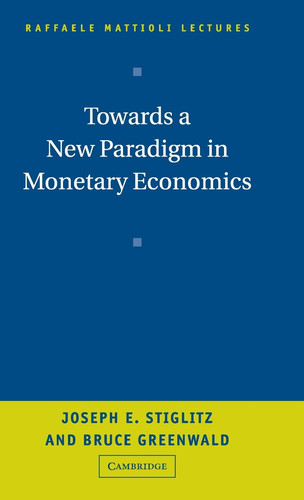
Towards a new paradigm in monetary economics

Stiglitz, Joseph E.
Expanding upon the literature of new institutional economics, the first part of this study stresses the significance of imperfections in information, bankruptcy and banks. The second part examines the policy implications of the new paradigm emphasizing loanable fund demand and supply, and demonstrates its relevance to our understanding of two recent historical episodes--the East Asian financial crisis and the 1991 U.S. recession and subsequent recovery and boom.
Cambridge University Press 2003-09-04 327 pages

Central banking after the Great Recession: lessons learned, challenges ahead

David Wessel
The global financial crisis is largely behind us, but the challenges it poses to the future stability of the world’s economic system affects everyone from American families to Main Street businesses to Wall Street financial powerhouses. It has provoked controversy over the best way to reduce the risk of a repeat of what proved to be the worst financial crisis since the Great Depression. To describe those challenges—and the lessons learned—the Hutchins Center on Fiscal and Monetary Policy at Brookings turned to frontline policymakers and some of their most prominent critics. Central Banking after the Great Recession contains the resulting research, leading off with a telling interview between Ben Bernanke, then in his final weeks as Federal Reserve chairman, and Liaquat Ahamed, author of the Pulitzer Prize–winning Lords of Finance. Insightful chapters by John Williams of the San Francisco Federal Reserve Bank, Paul Tucker of Harvard University, and Donald Kohn of Brookings discuss unconventional monetary policy, financial regulation, the impact of the crisis on the independence of the Federal Reserve. Each chapter is followed by a lively debate.
Brookings Institution Press 2014-04-28 113 pages