12 results for "Biography"

Alex's wake: a voyage of betrayal and a journey of remembrance

Goldsmith, Martin
On May 13, 1939, the luxury liner SS St. Louis sailed away from Hamburg, Germany, bound for Havana, Cuba. On board were more than 900 Jewish refugees fleeing persecution in Nazi Germany. After being denied landing rights in Havana, the refugees were turned away by the United States and Canada and forced to sail back to Europe, where the gathering storm of the Holocaust awaited them. Two of those refugees were Alex Goldschmidt, a sixty-year-old veteran of World War I, and his seventeen-year-old son Klaus Helmut Goldschmidt. After their trans-Atlantic voyage, they landed in France. They would spend the next three years in one French camp after another before being shipped to Auschwitz in 1942. Sixty-nine years later, Martin Goldsmith, Alex's grandson and Helmut's nephew, retraced their sad journey. The book offers a compelling history of the voyage of the St. Louis, including testimony from those on board, a tale of espionage, and the brave resolve of Captain Gustav Schroeder. It also offers a harrowing chronicle of the vast network of camps in France, many of which were organized by the French themselves with little or no encouragement from the Germans.
Da CapoPress, a member of the Perseus Books Group 2014-04-08 344 pages

Alex's wake: a voyage of betrayal and a journey of remembrance

Goldsmith, Martin
On May 13, 1939, the luxury liner SS St. Louis sailed away from Hamburg, Germany, bound for Havana, Cuba. On board were more than 900 Jewish refugees fleeing persecution in Nazi Germany. After being denied landing rights in Havana, the refugees were turned away by the United States and Canada and forced to sail back to Europe, where the gathering storm of the Holocaust awaited them. Two of those refugees were Alex Goldschmidt, a sixty-year-old veteran of World War I, and his seventeen-year-old son Klaus Helmut Goldschmidt. After their trans-Atlantic voyage, they landed in France. They would spend the next three years in one French camp after another before being shipped to Auschwitz in 1942. Sixty-nine years later, Martin Goldsmith, Alex's grandson and Helmut's nephew, retraced their sad journey. The book offers a compelling history of the voyage of the St. Louis, including testimony from those on board, a tale of espionage, and the brave resolve of Captain Gustav Schroeder. It also offers a harrowing chronicle of the vast network of camps in France, many of which were organized by the French themselves with little or no encouragement from the Germans.
Da CapoPress, a member of the Perseus Books Group 2014 344 pages

True believer: Stalin's last American spy

Marton, Kati
“Relevant...fascinating...vividly reconstructed.” — The New York Times Book Review “Riveting reading...a mesmerizing look at Cold War espionage.” — USA TODAY This astonishing real-life spy thriller, filled with danger, misplaced loyalties, betrayal, treachery, and pure evil, with a plot twist worthy of John le Carré, is relevant today as a tale of fanaticism and the lengths it takes us to. True Believer reveals the life of Noel Field, an American who betrayed his country and crushed his family. Field, once a well-meaning and privileged American, spied for Stalin during the 1930s and '40s. Then, a pawn in Stalin’s sinister master strategy, Field was kidnapped and tortured by the KGB and forced to testify against his own Communist comrades. How does an Ivy League-educated, US State Department employee, deeply rooted in American culture and history, become a hardcore Stalinist? The 1930s, when Noel Field joined the secret underground of the International Communist Movement, were a time of national collapse: ten million Americans unemployed, rampant racism, retreat from the world just as fascism was gaining ground, and Washington—pre FDR—parched of fresh ideas. Communism promised the righting of social and political wrongs and many in Field’s generation were seduced by its siren song. Few, however, went as far as Noel Field in betraying their own country. With a reporter’s eye for detail, and a historian’s grasp of the cataclysmic events of the twentieth century, Kati Marton captures Field’s riveting quest for a life of meaning that went horribly wrong. True Believer is supported by unprecedented access to Field family correspondence, Soviet Secret Police records, and reporting on key players from Alger Hiss, CIA Director Allen Dulles, and World War II spy master, “Wild Bill” Donovan—to the most sinister of all: Josef Stalin. A story of another time, this is a tale relevant for all times.
Simon & Schuster 2016-09-06 289 pages

The man with the miraculous hands

Kessel, Joseph
This amazing story of World War 2 chronicles the carrer of Dr Felix Kersten, physicain to the high-demon of the Third Reich, Heinrich Himmler. Kersten, an alternative medicine specialist, could alleviate Himmler's severe stomach pains with his hands, using massage and manipulation. In return, Kersten bargained with Himmler to order the release of innocent prisoners condemned to die. By war's end, thanks to Kersten, thousands of jews and other prisoners had eluded the fate of the concentration camp. This is a memorable account of a little-known miracle of World War 2.
Burford Books 2004 235 pages

Generation exodus: the fate of young Jewish refugees from Nazi Germany

Laqueur, Walter
Relates the multiple ways adopted by young German Jews (born mainly between 1914-28) to escape from Nazi Germany. Their destinations included Palestine, Great Britain, the USA, South America, and China. Dwells on the routes of escape - sometimes dangerous, and on the organizational framework of the escape - sometimes part of a political underground. Some young persons managed to survive in Germany. Many Jews, both those who escaped and those who remained in Germany, joined the anti-Nazi struggle in multiple forms - from the underground in Berlin to joining up with the Red Army. Many countries of destination were reluctant to accept the refugees, in part due to antisemitism. Other possible frameworks (e.g. communists) were also not eager to help Jews. The majority of the émigrés did not return to Germany after the war.
Brandeis University Press, Published by University Press of New England 2001 345 pages

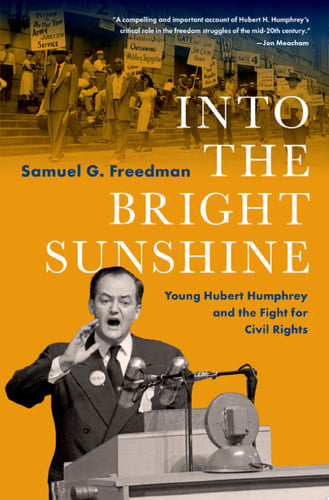
Into the bright sunshine: young Hubert Humphrey and the fight for civil rights

Freedman, Samuel G.
"Hubert Humphrey, a fallen hero and a dying man, rose on rickety legs to approach the podium of the Philadelphia Convention Hall, his pulpit for the commencement address at the University of Pennsylvania. He clutched a sheaf of paper with his speech for the occasion, typed and double-spaced by an assistant from his extemporaneous dictation, and then marked up in pencil by Humphrey himself. A note on the first page, circled to draw particular attention, read simply, "30 years ago--Here." In this place, at that time, twenty-nine years earlier to be precise, he had made history. From the dais now, Humphrey beheld five thousand impending graduates, an ebony sea of gowns and mortarboards, broken by one iconoclast in a homemade crown, two in ribboned bonnets, and another whose headgear bore the masking-tape message HI MA PA. In the horseshoe curve of the arena's double balcony loomed eight thousand parents and siblings, children, and friends. Wearing shirtsleeves and cotton shifts amid the stale heat, they looked like pale confetti from where Humphrey stood, and their flash cameras flickered away, a constellation of pinpricks"--
Oxford University Press 2023 488 pages

The La Follettes of Wisconsin: love and politics in progressive America

Weisberger, Bernard A.
The La Follettes of Wisconsin—Robert, Belle, and their children, Bob Jr., Phil, Fola, and Mary—are vividly brought to life in this collective biography of an American political family. As governor of Wisconsin (1901–06) and U.S. Senator (1906–25), "Fighting Bob" battled relentlessly for his Progressive vision of democracy—an idealistic mixture of informed citizenry and enlightened egalitarianism. By contrast, the private man suffered from intense, isolated periods of depression and relied heavily on his family for survival. Together, "Old Bob" and his beloved wife, Belle Case La Follette—a lawyer, journalist, and Progressive leader in her own right—raised their children in the distinctly uncompromising La Follette tradition of challenging social and political ills. Fola became a campaigner for women's suffrage, Phil was governor of Wisconsin, and "Young Bob" became a U.S. senator.
University of Wisconsin Press 2013-12-19 364 pages

Between the yeshiva world and modern orthodoxy: the life and works of Rabbi Jehiel Jacob Weinberg

Shapiro, Marc B.
A biography of the leading halakhic authority Jehiel Jacob Weinberg, born in Ciechanowiecz, Poland. He was the last rector of the Berlin Rabbinical Seminary. Ch. 5 (pp. 110-134), "Response to the New Nazi Government (1933-1934), " characterizes the early reaction of Weinberg to the Nazis as naive and apologetic. Weinberg helped the Orthodox Jews deal with problems of daily life under the Nazis (e.g. the ban on ritual slaughter). Ch. 6 (pp. 135-171), "The Nazi Era (1933-1945), " notes that Orthodox German Jews first adopted a policy of appeasement with the regime. With Jews excluded from general education and other aspects of German life, the role of the Seminary became more important. Weinberg had opposed Jewish emigration, and the "Kristallnacht" pogrom came as a tremendous shock to him; the Seminary was closed and most of the students and faculty emigrated. At the outbreak of the war he was in Warsaw, where he helped with communal affairs. As a Soviet citizen, Weinberg suffered less than others; in October 1941 he was transferred from the Warsaw ghetto to a detention camp in Wuelzburg, Germany, possibly in order to trade him for German citizens held captive in the USSR. He remained there until April 1945. Most of his family was murdered in the Holocaust. After the war he became head of a yeshiva in Montreux, Switzerland.
Littman Library 1999 283 pages