84 results for "Biography"

A Picture Book of Davy Crockett

David A. Adler
Separating truth from tall tales, this easy-to-read biography details the life of a great American frontiersman. Legends say Davy Crockett weighed two hundred pounds when he was born, and leapt right out of his cradle ready to fight. Though those stories are an exagerration, Crockett's life was anything but boring. Farmer, soldier, sharp-shooter and politician, he was a well-known figure in the early 1800s—and even after his death, his reputation as an American folk hero grew and grew. In this illustrated biography, David Adler retells the true story of David Crockett's life—from his birth in Tennessee to his death at the Alamo. Using contemporary primary sources, Adler distinguishes between fact and legend, providing details about Crockett's family life and political career, as well as a note about the historical origins of many of the famed tall tales. A timeline of important dates is included. For almost thirty years, David Adler’s Picture Book Biography series has profiled famous people who changed the world. Colorful, kid-friendly illustrations combine with Adler’s “expert mixtures of facts and personality” (Booklist) to introduce young readers to history through compelling biographies of presidents, heroes, inventors, explorers, and adventurers. These books are ideal for first and second graders interested in history or who need reliable sources for school book reports.
Candlewick Press 1996-01-01 32 pages

The kidnapping of Edgardo Mortara

Kertzer, David I.
Discusses the cause célèbre of Edgardo Mortara, who in 1858, at the age of six, was taken by force from his Jewish home in Bologna by the pontifical police on the grounds that he had been baptized as an infant by a family servant. Despite the efforts of his family, Jews in Italy and abroad, and foreign ambassadors and rulers, he was never returned to his family. Pope Pius IX defended the Church's policy of remaining true to its salvationist ideology, and refused to surrender the boy. Edgardo ultimately chose not to return to Judaism but to become a priest. (He died in a Belgian abbey in March 1940.) The case is shown to be pivotal in terms of the unification of Italy and the loss of papal power. Describes the various ways Jews attempted, unsuccessfully, to free Mortara: quiet diplomacy, legal means, the involvement of influential Jews, the Jewish and non-Jewish press, and self-defense organizations (the Alliance Israélite Universelle was founded in reaction to the kidnapping). Reveals much about Christian-Jewish relations on the political and social level, one aspect of which was relations between Jewish employers and Christian servants.
Alfred Knopf 1997 350 pages

The Lincoln Conspiracy The Secret Plot to Kill America's 16th President--and Why It Failed

Brad Meltzer,Josh Mensch
Brad Meltzer and Josh Mensch, the bestselling authors of The First Conspiracy, which covers the secret plot against George Washington, now turn their attention to a little-known, but true story about a failed assassination attempt on the sixteenth president in The Lincoln Conspiracy . Everyone knows the story of Abraham Lincoln’s assassination in 1865, but few are aware of the original conspiracy to kill him four years earlier in 1861, literally on his way to Washington, D.C., for his first inauguration. The conspirators were part of a white supremacist secret society that didn’t want an abolitionist in the White House. They planned an elaborate scheme to assassinate the President-elect in Baltimore as Lincoln’s inauguration train passed through, en route to the nation's capital. The plot was investigated by famed detective Allan Pinkerton, who infiltrated the group with undercover agents, including Kate Warne, one of the first female private detectives in America. Had the assassination succeeded, there would have been no Lincoln Presidency and the course of the Civil War and American history would have forever been altered.
Flatiron Books 2021-05-04 448 pages

The impossible presidency: the rise and fall of America's highest office

Suri, Jeremi
Why have recent presidents failed to create the change they promised? Should we blame the individual men, all flawed in their own ways? Or are there fundamental reasons why modern presidents fail to deliver, time and time again? In The Impossible Presidency, historian Jeremi Suri charts the long rise and quick fall of the world's most important job, from the 1790s to the present day. As he shows, early presidents greatly expanded the power of the office beyond the limited role envisioned by the founders. Suri argues that the immense accomplishments of Washington, Jackson, Lincoln and FDR left their successors with outsized and unrealistic expectations. John F. Kennedy, Lyndon B. Johnson and Ronald Reagan lost control of their agendas as they were buffeted by the onrush of events and threats their predecessors never had to face. Clinton and Obama were propelled to the presidency by their personal stories but hamstrung by prurient, partisan, and prejudiced criticisms of their leadership. Contemporary presidents must react to a truly globalized world and a rapid twenty-four-our news cycle. There is little room left for bold, strategic thinking. Suri traces our disenchantment with recent presidents to the current mismatch between presidential promises and the limitations of the office.
Basic Books 2017-09-12 343 pages

Sarah: the life of Sarah Bernhardt

Gottlieb, Robert
Everything about Sarah Bernhardt is fascinating, from her obscure birth to her glorious career--redefining the very nature of her art--to her amazing (and highly public) romantic life, to her indomitable spirit. Well into her seventies, after the amputation of her leg, she was performing under bombardment for soldiers during World War I and toured America for the ninth time. Though the Bernhardt literature is vast, this is the first English-language biography to appear in decades, tracking the trajectory through which an illegitimate--and scandalous--daughter of a Jewish courtesan transformed herself into the most famous actress who ever lived, and into a national icon, a symbol of France.--From publisher description.
Yale University Press 2010 233 pages

Our Lincoln: new perspectives on Lincoln and his world

Eric Foner
"These eloquent, compelling essays show why Lincoln was a man of his time and a man for all time. There is no better introduction to the complexities of his life and to why he still holds a spell over America and the world."-Library Journal Among these original essays by prize-winning historians, James M. McPherson examines Lincoln's deft navigation of the crosscurrents of politics and wartime strategy. Sean Wilentz elegantly explores Lincoln's debt to the democratic political tradition of Jefferson and Jackson. Eric Foner examines Lincoln's controversial position on the movement to colonize emancipated slaves outside the United States. James Oakes explores Lincoln's views on the rights of African Americans. There are also brilliant essays on Lincoln and civil liberties, and on his literary style, religious beliefs, and family life.
W. W. Norton 2009 336 pages

Capitol men: the epic story of Reconstruction through the lives of the first Black congressmen

Dray, Philip
Pulitzer Prize finalist Philip Dray shines a light on a little known group of men: the nation's first black members of Congress. These men played a critical role in pushing for much-needed reforms in the wake of a traumatic civil war, including public education for all children, equal rights, and protection from Klan violence. But they have been either neglected or maligned by most historians--their "glorious failure" chalked up to corruption and "ill-preparedness."--From publisher description.
Houghton Mifflin Co 2008 463 pages

Pioneers of modern design: from William Morris to Walter Gropius

Pevsner, Nikolaus
One of the most widely read books on modern design, Nikolaus Pevsner’s landmark work today remains as stimulating as it was when first published in 1936. This expanded edition of Pioneers of Modern Design provides Pevsner’s original text along with significant new and updated information, enhancing Pevsner’s illuminating account of the roots of Modernism. The book now offers many beautiful color illustrations; biographies and bibliographies of all major figures; illustrated short essays on key themes, movements, and individuals; a critique of Pevsner’s analysis from today’s perspective; examples of works after 1914 (where the original study ended); a biography detailing Pevsner’s life and achievements; and much more. Pevsner saw Modernism as a synthesis of three main sources: William Morris and his followers, the work of nineteenth-century engineers, and Art Nouveau. The author considers the role of these sources in the work of early Modernists and looks at such masters of the movement as C.F.A. Voysey and Charles Rennie Mackintosh in Britain, Louis Sullivan and Frank Lloyd Wright in America, and Adolf Loos and Otto Wagner in Vienna. The account concludes with a discussion of the radical break with the past represented by the design work of Walter Gropius and his future Bauhaus colleagues.
Yale University Press 2005-01-01 192 pages

A Preface to Politics

Walter Lippmann
Walter Lippmann (September 23, 1889 - December 14, 1974) was an American writer, reporter, and political commentator famous for being among the first to introduce the concept of Cold War, coining the term "stereotype" in the modern psychological meaning, and critiquing media and democracy in his newspaper column and several books, most notably his 1922 book Public Opinion.
CreateSpace Independent Publishing Platform 2016-03-07 120 pages

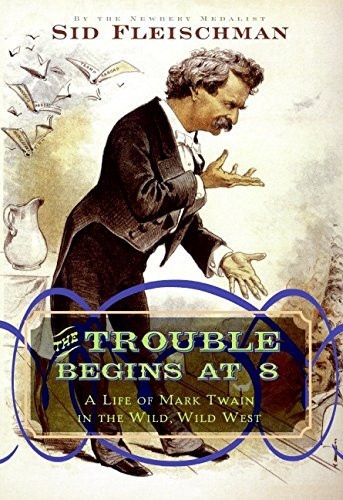
The trouble begins at 8: a life of Mark Twain in the wild, wild West

Fleischman, Sid
"Mark Twain was born fully grown, with a cheap cigar clamped between his teeth." So begins Sid Fleischman's ramble-scramble biography of the great American author and wit, who started life in a Missouri village as a barefoot boy named Samuel Clemens. Abandoning a career as a young steamboat pilot on the Mississippi River, Sam took a bumpy stagecoach to the Far West. In the gold and silver fields, he expected to get rich quick. Instead, he got poor fast, digging in the wrong places. His stint as a sagebrush newspaperman led to a duel with pistols. Had he not survived, the world would never have heard of Tom Sawyer or Huckleberry Finn—or red-headed Mark Twain. Samuel Clemens adopted his pen name in a hotel room in San Francisco and promptly made a jumping frog (and himself) famous. His celebrated novels followed at a leisurely pace; his quips at jet speed. "Don't let schooling interfere with your education," he wrote. Here, in high style, is the story of a wisecracking adventurer who came of age in the untamed West; an ink-stained rebel who surprised himself by becoming the most famous American of his time. Bountifully illustrated.
Greenwillow Books 2008 224 pages