8 results for "Biography"

Clouds of glory: the life and legend of Robert E. Lee

Korda, Michael
"Portrait of Lee as a brilliant general, a devoted family man, and principled gentleman who disliked slavery and disagreed with secession, yet who refused command of the Union Army in 1861 because he could not "draw his sword" against his beloved Virginia. Well-rounded and realistic, Clouds of Glory analyzes Lee's command during the Civil War and explores his responsibility for the fatal stalemate at Antietam, his defeat at Gettysburg (as well the many troubling controversies still surrounding it) and ultimately, his failed strategy for winning the war. As Korda shows, Lee's dignity, courage, leadership, and modesty made him a hero on both sides of the Mason-Dixon Line and a revered American icon who is recognized today as the nation's preeminent military leader" --
Harper 2014-05-13 785 pages

Patton: legendary commander

Blumenson, Martin
Shortly after World War II, when the Allies interrogated Field Marshal Gerd von Rundstedt, the senior commander who opposed the Allied invasion of France, they asked him to rate the skills of his opponents. He is reputed to have said, "Patton, he was your best." Praise for his performance was precisely what George Smith Patton, Jr., had sought all his life. As a cadet at the Virginia Military Institute and West Point, he was already searching for what he called "the undefinable difference" that distinguished a great general from the good ones. He led a mechanized attack in Mexico and a tank battalion during World War I. In World War II he turned American fortunes around in North Africa, chased the Germans out of Sicily, and sparked the breakout and liberation of France. When the Germans attacked the American First Army in the Battle of the Bulge, Patton turned his army north and smashed the German salient. He then drove into the heart of Germany and reached Czechoslovakia by war's end. Brilliant yet flawed, Patton's leadership style drove himself and his men to acts of bravery and victory. Half uncouth, provincial cowboy and half cultured sophisticate, the man behind the warrior mask was a complex and paradoxical person. He became an icon of the American military leader and the uncompromising individual.
Potomac Books 2008 117 pages

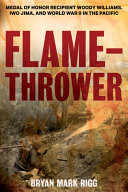
Flamethrower: Medal of Honor recipient Woody Williams, Iwo Jima, and World War II in the Pacific

Rigg, Bryan Mark
"Imagine strapping on a highly flammable 70-pound pack and entering combat as a surefire walking target-and you'd only begin to understand the job, and the horror, of Marine Corps flamethrower man. That's precisely what Hershel "Woody" Williams did in World War II, most importantly in February 1945 on Iwo Jima, one of the Pacific War's toughest battles. A few days into the battle, Marines were fighting hard for an airfield, and his captain asked Woody if he could do anything. He responded, "I'll try"-and for the next four hours, he virtually singlehandedly took on and ultimately destroyed seven enemy pillboxes and helped secure the airfield. Accomplished military historian Bryan Mark Rigg reconstructs Williams' remarkable story, from his youth in West Virginia to his experiences on Guadalcanal, Saipan, Guam, and most significantly Iwo Jima. In Rigg's telling, Williams's Medal of Honor action is not "just" a brave deed, but one of only a few strategically significant brave deeds-one that secured a strategic objective during a major campaign. Rigg tells Williams' story vividly, and objectively, and places it in the context of the broader Pacific theater of World War II."--
Stackpole Books 2020 544 pages

Memoirs of war, 1914-15

Bloch, Marc
Great historians have seldom described the notable events in which they themselves participated. Marc Bloch - author of Feudal Society, the classic study of medieval social systems and co-founder of the influential French historical journal Annales - is an exception, In his powerful memoir The Strange Defeat, he analysed the fall of France in 1940 from the viewpoint of combatant as well as historian. And in his Memoirs of War, 1914-15, here in its first English translation (originally published in hard covers in 1980 by Cornell University Press), Bloch left a keen and affecting account of his earliest experience of war. Carole Fink's introduction includes a brief biography of Bloch, discusses the effect of the war upon his intellectual development, and assesses his achievements as a historian. Though Bloch survived the savage trench warfare of the First World War, he was shot by a Gestapo firing squad in 1944 for his participation in the Resistance. Trenchant, inspiring, and tersely written, Memoirs of War, 1914-15 is a monument to a great scholar and fierce patriot.
Cambridge University Press 1988 180 pages

Old Ironsides: the military biography of Oliver Cromwell

Kitson, Frank
Whether viewed as a brave crusader or a power-mad villain, Oliver Cromwell (1599--1658) is irrefutably a key figure in one of the most troubled periods of British history. By examining his performance as a military commander in the widest sense, this intriguing volume offers a new perspective on an intensely religious man who used both soldiering and politics to achieve his underlying goals, as well as insight into the world in which he lived. Whether viewed as a brave crusader or a power-mad villain, Oliver Cromwell (1599--1658) is irrefutably a key figure in one of the most troubled periods of British history. By examining his performance as a military commander in the widest sense, this intriguing volume offers a new perspective on an intensely religious man who used both soldiering and politics to achieve his underlying goals, as well as insight into the world in which he lived.
Weidenfeld & Nicolson 2004 239 pages