27 results for "Biography"

Hands on the freedom plow: personal accounts by women in SNCC

Faith S. Holsaert
In Hands on the Freedom Plow, fifty-two women--northern and southern, young and old, urban and rural, black, white, and Latina--share their courageous personal stories of working for the Student Nonviolent Coordinating Committee (SNCC) on the front lines of the Civil Rights Movement. The testimonies gathered here present a sweeping personal history of SNCC: early sit-ins, voter registration campaigns, and freedom rides; the 1963 March on Washington, the Mississippi Freedom Summer, and the movements in Alabama and Maryland; and Black Power and antiwar activism. Since the women spent time in the Deep South, many also describe risking their lives through beatings and arrests and witnessing unspeakable violence. These intense stories depict women, many very young, dealing with extreme fear and finding the remarkable strength to survive. The women in SNCC acquired new skills, experienced personal growth, sustained one another, and even had fun in the midst of serious struggle. Readers are privy to their analyses of the Movement, its tactics, strategies, and underlying philosophies. The contributors revisit central debates of the struggle including the role of nonviolence and self-defense, the role of white people in a black-led movement, and the role of women within the Movement and the society at large. Each story reveals how the struggle for social change was formed, supported, and maintained by the women who kept their "hands on the freedom plow." As the editors write in the introduction, "Though the voices are different, they all tell the same story--of women bursting out of constraints, leaving school, leaving their hometowns, meeting new people, talking into the night, laughing, going to jail, being afraid, teaching in Freedom Schools, working in the field, dancing at the Elks Hall, working the WATS line to relay horror story after horror story, telling the press, telling the story, telling the word. And making a difference in this world."
University of Illinois Press 2010-09-30 616 pages

Memories of the Southern civil rights movement

Lyon, Danny
In the summer of 1962, 20-year-old Danny Lyon packed his cameras and hitchhiked south. Within a week he was in jail in Georgia, looking through the bars at another prisoner, Dr. Martin Luther King, Jr. Lyon's photos and text are more just a record of marches, jailings, and protests, they take us behind the scenes to chronicle the southern Civil Rights movement firsthand.
Published for the Center for Documentary Studies, Duke University, by the University of North Carolina Press 1992 192 pages

Shcharansky, hero of our time

Gilbert, Martin
Biography of the Russian dissident whose campaigns in the Soviet Union on behalf of his fellow Jews resulted in his arrest and imprisonment in 1978. Reconstructing Shcharansky's nine-year ordeal against the Soviet system, the story illuminates his faith and determination as well as the unflagging efforts of his family and friends to secure his release and bring the plight of Russian Jews to world attention.
Viking 1986 467 pages

Freedom's Detective The Secret Service, the Ku Klux Klan and the Man Who Masterminded America's First War on Terror

Charles Lane
Chronicles the story of the Reconstruction-era Secret Service and its battle against the KKK's effort to suppress the emancipated African-American vote, sharing particular insights into the career of controversial Secret Service chief, Hiram C. Whitley. In the years following the Civil War, a new battle began. Newly freed African American men had gained their voting rights and would soon have a chance to transform Southern politics. Former Confederates and other white supremacists mobilized to stop them. Thus, the KKK was born. After the first political assassination carried out by the Klan, Washington power brokers looked for help in breaking the growing movement. They found it in Hiram C. Whitley. He became head of the Secret Service, which had previously focused on catching counterfeiters and was at the time the government's only intelligence organization. Whitley and his agents led the covert war against the nascent KKK and were the first to use undercover work in mass crime--what we now call terrorism--investigations. Like many spymasters before and since, Whitley also had a dark side. His penchant for skulduggery and dirty tricks ultimately led to his involvement in a conspiracy that would bring an end to his career and transform the Secret Service. Populated by intriguing historical characters--from President Grant to brave Southerners, both black and white, who stood up to the Klan--and told in a brisk narrative style, Freedom's Detective reveals the story of this complex hero and his central role in a long-lost chapter of American history.
Hanover Square Press 2021-03-02 352 pages

No Snowflake in an Avalanche The Military Religious Freedom Foundation, Its Battle to Defend the Constitution and One Family's Courageous War Against Religious Extremism in High Places

Michael L. Weinstein
No Snowflake in an Avalanche goes deep inside the world of religious extremism in America s military and political infrastructure from the perspective of Michael L. Mikey Weinstein proud Academy graduate and father of graduates who single-handedly brought to light the Evangelicals' utter disregard of the constitutional principle of separation of church and state that is so essential to the nations military mission. Weinsteins war pits him and his small band of fellow graduates, cadets, and concerned citizens of varying religious backgrounds against a program of Christian fundamentalist indoctrination that could transform our fighting men and women into right-thinking warriors more befitting a theocracy than a democracy.
Rare Bird Books 2012-02 224 pages

Making constitutional law: Thurgood Marshall and the Supreme Court, 1961-1991

Tushnet, Mark V.
Making Constitutional Law: Thurgood Marshall and the Supreme Court, 1961-1991 focuses on the second half of a brilliant and unique career. When tapped by LBJ in 1967 to ascend to the High Court, the seasoned Marshall - as the first African-American Justice - brought desegregation to the bench in word, thought, and deed. But as Mark V. Tushnet illustrates in this book, Marshall, a Great Society liberal, brought many other progressive concepts and convictions.
Oxford University Press 1997 246 pages

Remembering America A Voice from the Sixties

Richard N. Goodwin
From the speechwriter and top adviser to presidents Kennedy and Johnson: A behind-the-scenes history of the most momentous decade in American politics. Richard N. Goodwin entered public service in 1958 as a law clerk for Supreme Court Associate Justice Felix Frankfurter. He left politics ten years later in the aftermath of Senator Robert F. Kennedy's assassination. Over the course of one extraordinary decade, Goodwin orchestrated some of the noblest achievements in the history of the US government and bore witness to two of its greatest tragedies. His eloquent and inspirational memoir is one of the most captivating chronicles of those turbulent years ever published. From the Twenty-One quiz-show scandal to the heady days of John F. Kennedy's presidential campaign to President Lyndon Johnson's heroic vote wrangling on behalf of civil rights legislation, Remembering America brings to life the most fascinating figures and events of the era. As a member of the Kennedy administration, Goodwin charted a new course for US relations with Latin America and met in secret with Che Guevara in Uruguay. He wrote Johnson's historic civil rights speech, "We Shall Overcome," in support of the Voting Rights Act of 1965 and formulated the concept of the Great Society and its programs, which sought to eradicate poverty and racial injustice. After breaking with Johnson over the president's commitment to the Vietnam War, Goodwin played a pivotal role in bringing antiwar candidate Eugene McCarthy to within a few hundred votes of victory in the 1968 New Hampshire primary. Three months later, he was with his good friend Robert F. Kennedy in Los Angeles the night that the young senator's life--and the progressive movement that had rapidly brought about such significant change--came to a devastating end. Throughout this critical decade, Goodwin held steadfast to the passions and principles that had first led him to public service. Remembering America is a thrilling account of the breathtaking victories and heartbreaking disappointments of the 1960s, and a rousing call to action for readers committed to justice today.
Open Road Integrated Media, Incorporated 2014-09-30 828 pages

Wrestling with the Angel of Democracy On Being an American Citizen

Susan Griffin
What does is it mean to be a citizen of the United States? Susan Griffin’s provocative investigation of that question takes us from the Declaration of Independence to the Iraq War, with many stops in between. Her conclusion: democracy is nothing less than a revolution of consciousness, and the revolution has just begun.
Shambhala Publications, Incorporated 2009-11-10 291 pages

And Then I Danced Traveling the Road to LGBT Equality

Mark Segal
"[A] swiftly written debut memoir...[Segal] vividly describes his firsthand experience as a teenager inside the Stonewall bar during the historic riots, his participation with the Gay Liberation Front, and amusing encounters with Elton John and Patti LaBelle . . . A jovial yet passionately delivered self-portrait inspiring awareness about LGBT history from one of the movement's true pioneers." --Kirkus Reviews "With great verve and spirit, Segal has rendered a lively and dramatic memoir of the early days of the gay rights struggle; the infighting over strategies and objectives; the long, hard road of progress; and a look at the challenges still ahead." --Booklist On December 11, 1973, Mark Segal disrupted a live broadcast of the CBS Evening News when he sat on the desk directly between the camera and news anchor Walter Cronkite, yelling, "Gays protest CBS prejudice!" He was wrestled to the studio floor by the stagehands on live national television, thus ending LGBT invisibility. But this one victory left many more battles to fight, and creativity was required to find a way to challenge stereotypes surrounding the LGBT community. Mark Segal's job, as he saw it, was to show the nation who gay people are: our sons, daughters, fathers, and mothers. Because of activists like Mark Segal, whose life work is dramatically detailed in this poignant and important memoir, today there are openly LGBT people working in the White House and throughout corporate America. An entire community of gay world citizens is now finding the voice that they need to become visible.
Open Lens 2015 302 pages

Getting Haiti right this time: the U.S. and the coup

Chomsky, Noam
Did Aristide leave Haiti voluntarily? Why did the U.S. want him out? What does the regime change mean for the health of Haitians? Did Aristide “overstay his welcome,” in the words of Vice President Dick Cheney, who never had a welcome in his own country to overstay? After 35 coups, what does the double entendre mean to get Haiti “right” this time? From Noam Chomsky, author of the 100,000 copy cloth best seller, Hegemony and Survival, from Paul Farmer, subject of the New York Times biography by Tracy Kidder Mountains Beyond Mountains, from Jean-Bertrand Aristide, president of Haiti and first lady Mildred Aristide, from Democracy Now! host Amy Goodman, come the answers the world has been waiting for.
Common Courage Press 2004 180 pages

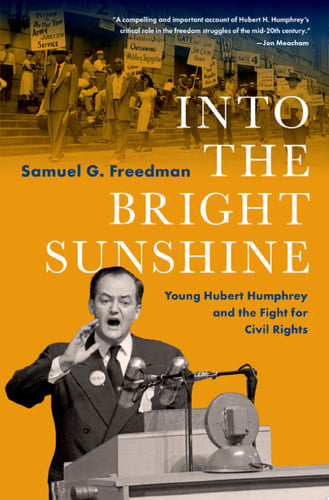
Into the bright sunshine: young Hubert Humphrey and the fight for civil rights

Freedman, Samuel G.
"Hubert Humphrey, a fallen hero and a dying man, rose on rickety legs to approach the podium of the Philadelphia Convention Hall, his pulpit for the commencement address at the University of Pennsylvania. He clutched a sheaf of paper with his speech for the occasion, typed and double-spaced by an assistant from his extemporaneous dictation, and then marked up in pencil by Humphrey himself. A note on the first page, circled to draw particular attention, read simply, "30 years ago--Here." In this place, at that time, twenty-nine years earlier to be precise, he had made history. From the dais now, Humphrey beheld five thousand impending graduates, an ebony sea of gowns and mortarboards, broken by one iconoclast in a homemade crown, two in ribboned bonnets, and another whose headgear bore the masking-tape message HI MA PA. In the horseshoe curve of the arena's double balcony loomed eight thousand parents and siblings, children, and friends. Wearing shirtsleeves and cotton shifts amid the stale heat, they looked like pale confetti from where Humphrey stood, and their flash cameras flickered away, a constellation of pinpricks"--
Oxford University Press 2023 488 pages

Autobiography of an ex-white man: learning a new master narrative for America

Wolff, Robert Paul
Autobiography of an Ex-White Man is an intensely personal meditation on the nature of America by a White Philosopher who joined a Black Studies Department and found his understanding of the world transformed by the experience. The book begins with an autobiographical narrative of the events leading up to Wolff's transfer from a Philosophy Department to the W. E. B. Du Bois Department of Afro-American Studies at the University of Massachusetts, and his experiences in the Department with his new colleagues, all of whom had come to Academia from the Civil Rights Movement of the 1960s. Wolff discovered that the apparently simple act of moving across campus to a new Department in a new building worked a startling change in the way he saw himself, his university, and his country. Reading as widely as possible to bring himself up to speed in his new field of academic responsibility, Wolff realized after a bit that his picture of American history and culture was undergoing an irreversible metamorphosis. America, he realized, has from its inception been a land both of Freedom and of Bondage: Freedom for the few, and then for those who are White; Bondage at first for the many, and then for those who are not White. Slavery is thus not an aberration, an accident, a Peculiar Institution -- it is the essence and core of the American experience. Wolff's optimistic outlook leads him to express the hope that our acknowledging the realities of America's racial history and present will begin to tear down the formidable barrier to change. He sees this refashioning of the American story as a first step toward the crafting of a truly liberatory project. Robert Paul Wolff is Professor of Afro-American Studies at the University of Massachusetts-Amherst and the author of numerous books, including Introductory Philosophy and In Defense of Anarchism.
University of Rochester Press 2005 136 pages

The hands of peace

Ingram, Marione,Henderson, Thelton E.
"Born in Hamburg in the 1930s, Marione Ingram survived the Holocaust in Nazi Germany, only to find when she came to the United States that racism was as pervasive in the American South as anti-Semitism was in Europe. Moving first to New York and then to Washington, DC, Marione joined the burgeoning civil rights movement, protesting discrimination in housing, employment, education, and other aspects of life in the nation's capital, including the denial of voting rights. She was a volunteer in the legendary March on Washington, where Martin Luther King Jr. gave his iconic "I Have a Dream" speech, and she was an organizer of an extended sit-in to support the Mississippi Freedom Party. In 1964, at the urging of civil rights leader Fannie Lou Hamer, Marione went south to Mississippi. There, she worked for the Student Nonviolent Coordinating Committee and taught African American youth at one of the country's controversial freedom schools. With her boldness came threats--white supremacists made ominous calls and left a blazing cross in front of her school--and an arrest and conviction. She narrowly escaped a three-month prison sentence. As a white woman and a Holocaust escapee, Marione was perhaps the most unlikely of heroes in the American civil rights movement; and yet, her core belief in the equality of all people, regardless of race or religion, did not waver and she refused to be quieted, refused to accept bigotry. This empowering, true story offers a rare up close view of the civil rights movement. It is a story of conviction and courage--a reminder of how far the rights movement has come and the progress that still needs to be made."--Page 2 of book jacket.
Skyhorse Publishing 2015 177 pages

To life: the story of a Chicago lawyer

Gertz, Elmer
Elmer Gertz has defended famous people--including Henry Miller, Nathan Leopold, and Jack Ruby--and he has become famous in his own right through his struggle for civil liberties and personal rights. Gertz has taken on a lengthy list of cases and causes over the six decades of his legal career. He fought successfully against the censorship of Henry Miller's book Tropic of Cancer , which had been banned in Chicago for obscenity. He got Nathan Leopold released from prison after Leopold had served 34 years for his part in the death of 14-year-old Bobby Franks. An ardent foe of the death penalty, Gertz labored for years as part of a national team of lawyers that was finally able to overturn Jack Ruby's death sentence for the murder of Lee Harvey Oswald. Gertz's cases have helped make libel law in the nation. For this edition, Gertz adds an afterword that covers the 15 years since the book's first publication. Gertz talks of Henry Miller's last days and his travels to the USSR on behalf of the Refuseniks.
Southern Illinois University Press 1990 308 pages