10 results for "Biography"

The worldly philosophers: the lives, times, and ideas of the great economic thinkers

Heilbroner, Robert L.
The bestselling classic that examines the history of economic thought from Adam Smith to Karl Marx—“all the economic lore most general readers conceivably could want to know, served up with a flourish” ( The New York Times ). The Worldly Philosophers not only enables us to see more deeply into our history but helps us better understand our own times. In this seventh edition, Robert L. Heilbroner provides a new theme that connects thinkers as diverse as Adam Smith and Karl Marx. The theme is the common focus of their highly varied ideas—namely, the search to understand how a capitalist society works. It is a focus never more needed than in this age of confusing economic headlines. In a bold new concluding chapter entitled “The End of the Worldly Philosophy?” Heilbroner reminds us that the word “end” refers to both the purpose and limits of economics. This chapter conveys a concern that today’s increasingly “scientific” economics may overlook fundamental social and political issues that are central to economics. Thus, unlike its predecessors, this new edition provides not just an indispensable illumination of our past but a call to action for our future.
Simon & Schuster 1999 365 pages

Inside the economist's mind: conversations with eminent economists

Paul A. Samuelson,William A. Barnett
By focusing on the human side as well as the intellectual dimensions of how economists work and think, this collection of interviews with top economists of the 20th century becomes a startling and lively introduction to the modern world of macroeconomics. A fun read! For more information, frequent updates, and to comment on the forthcoming book, visit William A. Barnett's weblog at http://economistmind.blogspot.com/. Acclaim for Inside the Economist's Mind "In candid interviews, these great economists prove to be fabulous story tellers of their lives and times. Unendingly gripping for insiders, this book should also help non-specialists understand how economists think." Professor Julio Rotemberg, Harvard University Business School, and Editor, Review of Economics and Statistics. "Economics used to be called the 'dismal science'. It will be impossible for anybody to hold that view anymore ... This is science with flesh and blood, and a lot of fascinating stories that you will find nowhere else." Dr. Jean-Pascal Bénassy, Paris-Jourdan Sciences Économiques, Paris, France "This book provides a rare and intriguing view of the personal and professional lives of leading economists ... It is like A Beautiful Mind , scaled by a factor of 16 [the number of interviews in the book]." Professor Lee Ohanian, University of California at Los Angeles " ... if you want an insider view of how economics has been developing in the last decades, this is the (only) book for you." Professor Giancarlo Gandolfo, University of Rome ‘La Sapienza,’ Rome "Here we see the HUMAN side of path-breaking research, the personalities and pitfalls, the DRAMA behind the science." Professor Francis X. Diebold, University of Pennsylvania, Philadelphia
Blackwell Pub 2007 419 pages

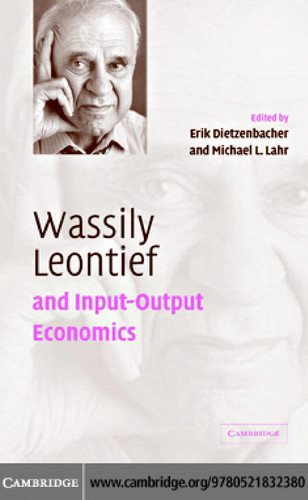
Wassily Leontief and input-output economics

Wassily Leontief,Erik Dietzenbacher,Michael L. Lahr
Wassily Leontief (1905–1999) was the founding father of input-output economics, for which he received the Nobel Prize in 1973. This book offers a collection of papers in memory of Leontief by his students and close colleagues. The first part, 'Reflections on Input-Output Economics', focuses upon Leontief as a person and scholar as well as his personal contributions to economics. It includes contributions by Nobel Laureate Paul A. Samuelson who shares his memories of a young Professor Leontief at Harvard and ends with the last joint interview with Wassily and his wife, to date previously unpublished. The second part, 'Perspectives of Input-Output Economics', includes theoretical and empirical research inspired by Leontief's work and offers a wide-ranging sample of the state of interindustry economics, a field Leontief founded. This is a strong collection likely to appeal to a wide range of professionals in universities, government, industry and international organizations.
Cambridge University Press 2004-03-25 396 pages

The collected papers of Franco Modigliani. Vol. 6

Modigliani, Franco
Articles and essays by the late Nobel Prize-winning economist on the life-cycle hypothesis, unemployment and monetary policy in the European Union, and other topics. This volume of papers, articles, and essays by the late Nobel Prize-winning economist Franco Modigliani contains writings published during the last decade of his life as well as three seminal earlier papers on the life-cycle hypothesis. As in the previous Collected Papers, the writings are organized by topic; within each topic, the order is chronological. Part I treats the life-cycle hypothesis. Beginning with his important essay from 1954 (written with Richard Brumberg), which laid down the foundation of the life-cycle model, and ending with the last paper Modigliani completed before his death in September 2003, this section presents his research on this topic as a coherent whole. Part II deals with unemployment and monetary policy in the European Union during the last decade of the twentieth century and includes a manifesto on EU unemployment written with six other economists. Part III contains essays on a variety of topics, among them inflation, financial risk, legal institutions, and unemployment. This section includes "The Keynesian Gospel According to Modigliani," which revisits the topic of the general theory of employment, interest, and money and its implications for mass unemployment sixty years after his first ground-breaking paper on the topic. Many of the articles in volume 6 are the product of collaboration; coauthors include Richard Brumberg, Albert Ando, Shi Larry Cao, Jean Paul Fitoussi, Tullio Jappelli, Beniamino Moro, Denis Snower, Robert Solow, Alfred Steinherr, Paolo Sylos Labinia, and Modigliani's granddaughter Leah Modigliani. The volume concludes with an interview of Modigliani by William A. Barnett and Robert Solow from 2000.
MIT Press 2005-09-02 401 pages

The Works of David Ricardo

David Ricardo,John Ramsay McCulloch
David Ricardo [1772-1823] has been called ".the principle founder of what has been called the classical school of political economy" (Dictionary of National Biography) and "first 'scientific' economist" (Printing and the Mind of Man 277). Here McCulloch's authoritative Life and Writings of Mr. Ricardo prefaces this collection of Ricardo's pamphlets and other works, including his influential treatise on the distribution of wealth, The Principles of Political Economy and Taxation.
University Press of the Pacific 2002-11-30 620 pages

Anticipations of the General Theory? And Other Essays on Keynes

Don Patinkin
This book examines the much-debated question of whether John Maynard Keynes' greatest work— The General Theory of Employment Interest and Money —was an instance of Mertonian simultaneous scientific discovery. In part I of this study, Don Patinkin argues for Keynes' originality, rejecting the claims of the Stockholm school and the Polish economist Michal Kalecki. Patinkin shows that the theoretical problems to which the Stockholm school and Kalecki devoted their attention largely differed from those of the General Theory and that, even when the problem addressed was similar, the treatment they accorded it was not part of their central messages. In the remaining parts of the book Patinkin presents a critique of Keynes' theory of effective demand and discusses Keynes' monetary theory and policy thinking, as well as the relationship between the respective developments of Keynesian theory and national income accounting in the 1930s.
University of Chicago Press 1984-11 308 pages

The master of Seventh Avenue: David Dubinsky and the American labor movement

Parmet, Robert D.
"The Master of Seventh Avenue is the definitive biography of David Dubinsky (1892-1982), one of the most controversial and influential labor leaders in 20th-century America. A 'character' in the truest sense of the word, Dubinsky was both revered and reviled, but never dull, conformist, or bound by convention. A Jewish labor radical, Dubinsky fled czarist Poland in 1910 and began his career as a garment worker and union agitator in New York City. He quickly rose through the ranks of the International Ladies' Garment Workers' Union (ILGWU) and became its president in 1932. Dubinsky led the ILGWU for thirty-four years, where he championed 'social unionism, ' which offered workers benefits ranging from health care to housing. Moving beyond the realm of the ILGWU, Dubinsky also played a leading role in the American Federation of Labor (AFL), particularly during World War II. A staunch anti-communist, Dubinsky worked tirelessly to rid the American labor movement of communists and fellow-travelers. Robert D. Parmet also chronicles Dubinsky's influential role in local, national, and international politics. An extraordinary personality whose life and times present a fascinating lens into the American labor movement, Dubinsky leaps off the pages of this meticulously researched and vividly detailed biography"--Publisher description
New York University Press 2005-07-01 436 pages

The Ultimate Foundation of Economic Science An Essay on Method

Ludwig von Mises
2012 Reprint of 1962 Edition. Exact facsimile of the original edition, not reproduced with Optical Recognition Software. If Mises has an unheralded masterpiece, "The Ultimate Foundation of Economic Science" is it. There are two senses in which this book is indeed ultimate: it deals with the very core of economics as a science, and it is the last book that he wrote. For that reason, it is a real milestone in the history of his work. In this volume, Mises argued that economics is a science because human action is a natural order of life and that it is the actions of humans that determine markets and capital decisions. Since Mises believed these links could be proven scientifically, he concluded that economics, with its basis on that human action, is indeed a science in its own right and not an ideology or a metaphysical doctrine.
Martino Publishing 2012-07 162 pages