7 results for "Biography"

Things that make white people uncomfortable

Bennett, Michael,Zirin, Dave
"Defensive lineman Michael Bennett adds his voice to discussions of racism and police violence, Black athletes and their relationship to powerful institutions like the NCAA and the NFL, the role of protest in history, and the responsibilities of athletes as role models to speak out against injustice. Following in the footsteps of activist-athletes from Muhammad Ali to Colin Kaepernick, Bennett demonstrates his outspoken leadership both on and off the field."--Provided by publisher.
Haymarket Books 2018 220 pages

Finish strong: a father's code and a son's path

Ebner, Nate,Daugherty, Paul
"The inspiring story of Nate Ebner's bond with his unconventional father, which still remains unbroken years after his father's tragic death--and which has led Ebner to success as an Olympic rugby player and a New England Patriot with three Super Bowl rings Nate Ebner and his father were inseparable. From an early age, they worked side-by-side in the family junk yard, where part of the job was dispensing citizen's justice to would-be robbers, and worked out side-by-side in their grungy homemade gym. So tight were father and son that even though Nate was a great peewee football player, in football-mad Ohio, he followed his father's passion, and started playing for the same men's rugby club when he was only twelve years old. Nate skipped high school football entirely to devote himself to rugby, a decision that was validated when he was selected a member of the U.S. junior national team at only sixteen. But even after winning a college national championship in rugby at Ohio State, Nate had to face the fact that he was nearing a dead end--there was no way to make a living as a professional in rugby in this country. So Nate gave his dad the news that he planned to quit rugby and go out for the football team at Ohio State with an eye toward making the NFL. As a goal for someone who hadn't even played high school football, this was completely insane. Without blinking, his father told him that if he gave up what he had built in rugby, he had to see it through, to matter how rough the path. This was the last conversation they ever had--the next day, his father was brutally murdered at work by a would-be robber. Nate went on to make the Ohio State team and play in every game for three years, becoming a hero to his teammates along the way, and when NFL draft day came, he was selected by the New England Patriots. Three Super Bowl rings later, his legacy in the sport is secure. But he got another unexpected chance to honor his father's legacy when the Olympics admitted rugby as a sport for the 2016 Games. Nate hadn't played the game in six years, but he asked the Patriots for a leave to pursue what he knew would have been his father's ultimate dream. Against long odds, he made this team too, and competed in Rio in the sport he and his father loved above all others. An astonishing story of what a father will do for a son, and what a son will do for a father, Finish Strong offers us a powerful reminder that the lessons parents embody for their children continue to bear fruit long after they are gone"--
Penguin Press 2021 268 pages

Relentless: a memoir

Edelman, Julian,Curran, Tom E.
Bill Belichick: "Julian is the epitome of competitiveness, toughness, and the great things that are possible when someone is determined to achieve their goals." Tom Brady: "It's a privilege for me to play with someone as special as Julian." The Super Bowl champion wide receiver for the New England Patriots shares his inspiring story of an underdog kid who was always doubted to becoming one of the most reliable and inspiring players in the NFL.
Hachette Books 2017-10-24 260 pages

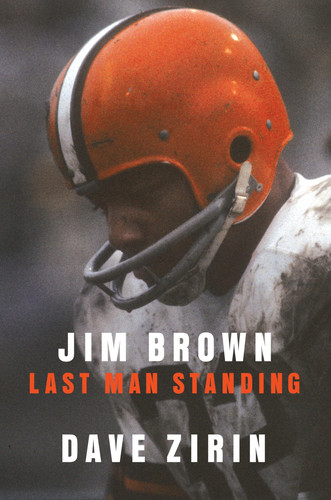
Jim Brown: last man standing

Zirin, Dave
A unique biography of Jim Brown—football legend, Hollywood star, and controversial activist—written by acclaimed sports journalist Dave Zirin. Jim Brown is recognized as perhaps the greatest football player to ever live. But his phenomenal nine-year career with the Cleveland Browns is only part of his remarkable story, the opening salvo to a much more sprawling epic. Brown parlayed his athletic fame into stardom in Hollywood, where it was thought that he could become “the black John Wayne.” He was an outspoken Black Power icon in the 1960s, and he formed Black Economic Unions to challenge racism in the business world. For this and for his decades of work as a truce negotiator with street gangs, Brown—along with such figures as Muhammad Ali, Bill Russell, and Billie Jean King—is revered as a socially conscious athlete. On the most hypermasculine cultural canvases of the United States—NFL football, the Black Power movement, Hollywood's blaxploitation films, gang intervention both inside and outside prison walls—Jim Brown has made his mark. Yet in the landscape of the most toxic expression of “what makes a man”—numerous accusations of violence against women—he has left a jagged mark as well. Dave Zirin's book redefines an American icon, and not always in a flattering light. At eighty-one years old, Brown continues to speak out and look for fights. His recent public support of Donald Trump and criticism of Colin Kaepernick are just the latest examples of someone who seems restless if he is not in conflict. Jim Brown is a raw and thrilling account of Brown's remarkable life and a must-read for sports fans and students of the black freedom struggle.
Blue Rider Press 2018-05-15 320 pages

Eat my Schwartz: our story of NFL football, food, family, and faith

Schwartz, Geoff,Schwartz, Mitch
"Geoff and Mitchell Schwartz are the NFL's most improbable pair of offensive linemen. They started their football careers late, not playing a down of organized football until they joined their low-key high school program. Despite all that, they wound up at top-tier college program and became the first Jewish brothers in the league since 1923. In Eat My Schwartz, Geoff and Mitch talk about the things that have made them the extraordinary people that they are: their close-knit and supportive family, their Jewish faith and traditions, their love of the game and drive for excellence and, last but not least, the food they love to eat, whether at home or on the road. Theirs is an inspiring story not just for every football fan but for everybody wanting to figure out what it takes for dreams to come true--and how to stay well-fed throughout the process"--
St. Martin's Press 2016-09-06 270 pages

Jack Kemp: the bleeding-heart conservative who changed America

Kondracke, Morton,Barnes, Fred
"THE PURPOSE OF POLITICS IS NOT TO DEFEAT YOUR OPPONENT AS MUCH AS IT IS TO PROVIDE SUPERIOR LEADERSHIP AND BETTER IDEAS THAN THE OPPOSITION." --JACK KEMP The late 1970s were miserable for America. It was the post-Vietnam, post-Watergate era, a time of high unemployment, ruinous inflation, gasoline lines, Communist advances, and bottomed-out U.S. morale. In the 1980s, it all turned around: "stagflation" ended and nearly two decades of prosperity ensued. The Soviet Union retreated, then collapsed. America again believed in itself. And around the world, democratic capitalism was deemed "the end of history." Ronald Reagan's policies sparked the American renaissance, but the Gipper's leadership is only part of the story. The economic theory that underpinned America's success was pioneered by a star professional quarterback turned self-taught intellectual and "bleeding-heart conservative": Jack Kemp. Kemp's role in a pivotal period in American history is at last illuminated in this first-ever biography, which also has lessons for the politics of today. Kemp was the congressional champion of supply-side economics--the idea that lowering taxes would foster growth. Even today, almost no one advocates a return to a top income tax rate of 70 percent. Kemp didn't just challenge the Democratic establishment. He also encouraged his fellow Republicans to be growth (not austerity) minded, open their tent to minorities and blue-collar workers, battle poverty and discrimination, and once again become "the party of Lincoln." Kemp approached politics the same way he played quarterback for the Buffalo Bills: with a refusal to accept defeat. Yet he also was incapable of personal attack, arguing always on the level of ideas. He regarded opponents as adversaries, not enemies, and often cooperated with them to get things done. Despite many ups and downs, including failed presidential and vice-presidential bids, he represented a positive, idealistic, compassionate Republicanism. Drawing on never-published papers and more than one hundred Kemp Oral History Project interviews, noted journalists Morton Kondracke and Fred Barnes trace Kemp's life, from his childhood through his pro football career to his influential years as a congressman and cabinet secretary. As the American Dream seems to be waning and polarized politics stifles Washington, Kemp is a model for what politics ought to be. The Republican party and the nation are in desperate need of another Kemp.
Sentinel 2015 390 pages