24 results for "Biography"

Orwell's roses

Solnit, Rebecca
"A fresh take on George Orwell as a far more nature-loving figure than is often portrayed, and a dazzlingly rich meditation on roses, gardens, and the value and use of beauty and pleasure in the face of brutality and horror. "In the spring of 1936 a man planted roses." That man was George Orwell, shortly before he went off to fight against fascism in Spain. Today, those rosebushes are still thriving. This is the starting point for Rebecca Solnit's new book, which presents another side of Orwell, a neglected arcadian Orwell who took enormous pleasure in the natural world and found great meaning and value in it. Orwell's planting of the roses is an axle from which Solnit's chapters radiate out like spokes as she brilliantly explores its various contexts, perspectives, and meanings, following the contours of Orwell's life and tracking how deeply enmeshed the love of nature is in all his writing. Journeying to the cottage in Wallingford where Orwell lived in 1936, she examines his desire to be agrarian and settled, how gardening restored him, and how planting something can be an act of fidelity and faith. Probing at the beauty and meaning of roses, she draws in the revolutionary photography and politics of Tina Modotti and makes a clandestine visit to a Columbian rose factory, where 80% of America's roses for sale are grown. She tracks the history of gardening, showing how the desire to garden is culturally determined and often rooted in class, recounts the immense battles over breeding and genetics in Russia during Stalin's time, and probes into the colonialist roots of Orwell's forebears, who worked in opium production in India and profiteered from sugar and slavery in Jamaica. Solnit shows how these points of intersection illuminate Orwell's work, and how that illumination shines forth on larger questions about beauty, pleasure, meaning, relationship, and hope. Her book establishes that "Orwellian" could stand for something more than ominous, corrupt, and sinister"--
Viking 2021 308 pages

Hitler, my neighbor: memories of a Jewish childhood

Feuchtwanger, E. J.
"An eminent historian recounts the Nazi rise to power from his unique perspective as a young Jewish boy in Munich, living with Adolf Hitler as his neighbor. Watching events unfold from his window, Edgar bore witness to the Night of the Long Knives, the Anschluss, and Kristallnacht. Jews were arrested; his father was imprisoned at Dachau. In 1939 Edgar was sent on his own to England, where he would make a new life, a career, have a family, and strive to forget the nightmare of his past--a past that came rushing back when he decided, at the age of eighty-eight, to tell the story of his buried childhood and his infamous neighbor"--Provided by publisher.
Other Press 2017-11-07 209 pages

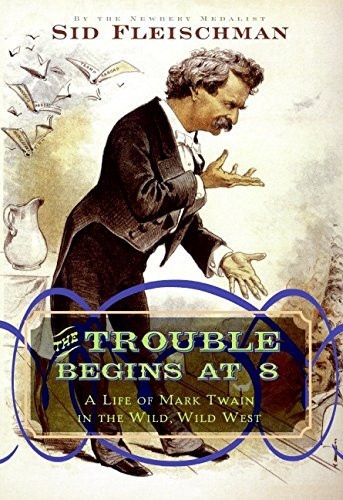
The trouble begins at 8: a life of Mark Twain in the wild, wild West

Fleischman, Sid
"Mark Twain was born fully grown, with a cheap cigar clamped between his teeth." So begins Sid Fleischman's ramble-scramble biography of the great American author and wit, who started life in a Missouri village as a barefoot boy named Samuel Clemens. Abandoning a career as a young steamboat pilot on the Mississippi River, Sam took a bumpy stagecoach to the Far West. In the gold and silver fields, he expected to get rich quick. Instead, he got poor fast, digging in the wrong places. His stint as a sagebrush newspaperman led to a duel with pistols. Had he not survived, the world would never have heard of Tom Sawyer or Huckleberry Finn—or red-headed Mark Twain. Samuel Clemens adopted his pen name in a hotel room in San Francisco and promptly made a jumping frog (and himself) famous. His celebrated novels followed at a leisurely pace; his quips at jet speed. "Don't let schooling interfere with your education," he wrote. Here, in high style, is the story of a wisecracking adventurer who came of age in the untamed West; an ink-stained rebel who surprised himself by becoming the most famous American of his time. Bountifully illustrated.
Greenwillow Books 2008 224 pages

Growing: seven years in Ceylon

Woolf, Leonard
Growing is a portrait of a young man sent straight out from university to help govern Ceylon. It is doubtful that any Empire at any time has been served by such an intelligent, dutiful, hardworking and incorruptible civil servant as the young Leonard Woolf. He was determined to do what was good but discovered for himself that colonial rule, be it ever so high-minded, is fated to do wrong. Growing is also a deeply affectionate account of the mystery, magic and savage beauty of Ceylon at the turn of the century, an island whose diverse beliefs and cultures Woolf had the time and wit to explore in detail.
Eland 2015 206 pages

The dream: a memoir

Bernstein, Harry
During the hard and bitter years of his youth in England, Harry Bernstein’s selfless mother never stops dreaming of a better life in America, no matter how unlikely. Then, one miraculous day when Harry is twelve years old, steamship tickets arrive in the mail, sent by an anonymous benefactor. Suddenly, a new life full of the promise of prosperity seems possible–and the family sets sail for America, meeting relatives in Chicago. For a time, they get a taste of the good life: electric lights, a bathtub, a telephone. But soon the harsh realities of the Great Depression envelop them. Skeletons in the family closet come to light, mafiosi darken their doorstep, family members are lost, and dreams are shattered. In the face of so much loss, Harry and his mother must make a fateful decision–one that will change their lives forever. And though he has struggled for so long, there is an incredible bounty waiting for Harry in New York: his future wife, Ruby. It is their romance that will finally bring the peace and happiness that Harry’s mother always dreamed was possible.
Ballantine Books 2009-04-07 279 pages

Balzac's Paris: the city as human comedy

Hazan, Éric
"Eric Hazan follows in Balzac's footsteps, criss-crossing the city in the novelist's outsize boots, running between printers, publishers, coffee merchants, mistresses and friends, stopping for a moment, struck by a detail that would be fixed in Balzac's photographic memory. More than a tour of the city, this is an attempt to measure the soul of a city as recovered in its finest literature"--
Verso 2024-06-25 200 pages

Bronx boy: a memoir

Charyn, Jerome
Jerome Charyn's three-part memoir of his boyhood in the Bronx has all the imagery and color of an enchanting and entertaining novel -- someone has said that it captures the author's world so accurately that it can't possibly be true. Bronx Boy , like The Dark Lady of Belorusse and The Black Swan , both selected by The New York Times as Notable Books of the Year, is a tour de force of memory and imagination. In this third and final installment, the higher truths of a masterly writer's art render moot the question of exactly where the real world ends and Charyn's imagined world begins. Still known as "Baby" although a younger brother has come along, young Charyn makes pocket money delivering eggs, belongs to a group of 12-year-old wannabe gangsters that meet in a soda shop run by an ex-con, and spends afternoons telling stories to the adoring wife of a wealthy Russian émigré. He becomes famous for his black-and-tans -- a concoction of coffee ice cream, seltzer, milk, chocolate sauce, crushed pecans -- and "a touch of bitterness that may have been the Bronx." So famous, indeed, that he walks away the winner of an annual black-and-tan contest sponsored by the real-life top gangster called "The Little Man" -- Meyer Lansky. In Charyn's hands, the often ridiculed Bronx is a magic place, as full of odd and wonderful characters as a three-ring circus. And at the center of it all, young "Baby," not as lucky in love as he would like to be, drinking it all in, putting his own extraordinary take on it. Charyn looks back at this with his singular vision, and records it all for us with the skill of the fine writer he is. This is a delightful and often moving story of a childhood that could only have been lived in New York in the fifties, a New York experience that could only have taken place in the Bronx of those days, a growing-up saga that could only have been captured by this singular author.
Thomas Dunne Books/St. Martin's Press 2002-04-11 184 pages

A political education: coming of age in Paris and New York

Schiffrin, André
"Schiffrin evokes the bittersweet tang of emigre life in New York." --The New York Times Book Review Andre Schiffrin was born the son of one of France's most esteemed publishers, in a world peopled by some of the day's leading writers and intellectuals, such as Andre Gide, Jean-Paul Sartre, and Antoine de Saint-Exupery. But this world was torn apart when the Nazis marched into Paris on young Andre's fifth birthday. Beginning with the family's dramatic escape to Casablanca--thanks to the help of the legendary Varian Fry--and eventually New York, A Political Education recounts the surprising twists and turns of a life that saw Schiffrin become, himself, one of the world's most respected publishers. Emerging from the emigre community of wartime New York (a community that included his father's friends Hannah Arendt and Helen and Kurt Wolff), he would go on to develop an insatiable appetite for literature and politics: heading a national student group he renamed the Students for a Democratic Society--the SDS. leading student groups at European conferences, once, as an unwitting front man for the CIA. and eventually being appointed by Random House chief Bennett Cerf to head the very imprint cofounded by his father--Pantheon. There, he would discover and publish some of the world's leading writers, including Noam Chomsky, Michel Foucault, Art Spiegelman, Studs Terkel, and Marguerite Duras. But in a move that would make headlines, Schiffrin would ultimately rebel at corporate ownership and form his own publishing house--The New Press--where he would go on to set a new standard for independent publishing. A Political Education is a fascinating intellectual memoir that tells not only the story of a unique and important figure, but of the tumultuous political times that shaped him. From the Hardcover edition"--
Melville House 2014 281 pages

For solo violin: a Jewish childhood in fascist Italy : a memoir

Zargani, Aldo
" For Solo Violin is a gracefully written, elegiac memoir of childhood."— The Los Angeles Times "An eloquent tribute to [and] a moving account of those who, despite the cruelty of so many around them, found ways to rejoice and trust in the kindness of a few. One is instantly reminded of Life Is Beautiful ."—André Aciman, author of Out of Egypt In an extraordinary literary debut, Aldo Zargani reconstructs the lost world of his Jewish childhood during the perilous years 1938–45 when he and his family fled from Fascists and Nazis in northern Italy. His haunting memoir acquires a cinematic intensity as he crosscuts from the blood-red stone spires of Basel, where his father failed to find refuge for his family in 1939, to fiery scenes of the Allied bombing of Turin in 1942, to the freezing winter of 1943–44, which Zargani and his brother spent hidden in a Catholic boarding school deep in the countryside. For Solo Violin is filled with colorful portraits of Italian aristocrats and peasants, priests and soldiers, teachers and students, informers and partisans. At its heart is Zargani's vivid depiction of his father, a concert violinist forced to give up his career when the Fascists came to power. In this time of persecution, the Zargani family survived through their own resourcefulness and through the efforts of the many Italians who came to their aid, from the young doctor who helped them escape from Turin to the shepherd who supplied them with milk during the last year of the war, when they lived among the partisans in a remote Piedmont valley. Looking back over a distance of fifty years, Zargani rediscovers the enchantment of childhood shining in "fable-like constellations" even amidst the inferno of war. Lullabies and school games, fairy tales and family jokes are interwoven with the events of terror and oppression. Lyrical, humorous, tender, and wise, For Solo Violin is a testament to resilience and hope during the darkest period in human history. "A broad panorama of Italian-Jewish history in [the last] century. Elegant in its style and, however tragic, also rich with understatement, irony, and wit, For Solo Violin counts among the great, enduring works of art."— Focus Magazine , Germany "A tragic, deeply engaging, delicious book—yes delicious, too. (Reading it makes you smile.) It's a miracle…It makes one think of the wit of Kafka!"— L'Espresso , Italy "Zargani depicts a wealth of sad, despairing, but often also incredibly funny episodes…But vibrating along with the humor is always the sense of threat, and behind it opens the abyss of terror."— Neue Zürcher Zeitung , Switzerland
Paul Dry Books 2002 326 pages

Yom Kippur a go-go

Roth, Matthue
Yom Kippur A Go-Go is a mind-blowing meeting of pop culture, Orthodox faith, and hipster poetics. Matthue Roth is an American original: an Orthodox Jew who cites Outkast and Michelle Tea among his influences, who won’t touch a light switch on Shabbos but mimics a screaming orgasm onstage while reading his paean to Orthodox girls. From the World Bank riots (what can you do when the revolution starts on Shabbos?) to Thursday night tranny basketball in San Francisco’s Dolores Park, Matthue takes readers on a journey among the queer and hip streets of urban America in his exuberant memoir, Yom Kippur a Go-Go. With humor and insight, Roth describes the tension between contemporary life and the demands of faith. He falls in love and in lust with a panoply of girls, both strictly kosher and determinedly secular, to the accompaniment of MP3 rabbinical lectures on modesty ("Boys are nothing but perverts and filthy animals!”).
Cleis Press 2005 268 pages

The Vienna paradox: a memoir

Perloff, Marjorie
The Vienna Paradox is Marjorie Perloff's memoir of growing up in pre-World War II Vienna, her escape to America in 1938 with her upper-middle-class, highly cultured, and largely assimilated Jewish family, and her self-transformation from the German-speaking Gabriele Mintz to the English-speaking Marjorie--who also happened to be the granddaughter of Richard Schüller, the Austrian foreign minister under Chancellor Dollfuss and a special delegate to the League of Nations. Compelling as the story is, this is hardly a conventional memoir. Rather, it interweaves biographical anecdote and family history with speculations on the historical development of early 20th-century Vienna as it was experienced by her parents' generation, and how the loss of their "high" culture affected the lives of these cultivated refugees in a democratic United States that was, and remains, deeply suspicious of perceived "elitism." This is, in other words, an intellectual memoir, both elegant and heartfelt, by one of America's leading critics, a narrative in which literary and philosophical reference is as central as the personal.
New Directions Books 2004 283 pages

So close

Cixous, Hélène
In So Close , the internationally renowned writer Hélène Cixous recounts a return to her native Algeria after a more than thirty-year absence. Before she can decide to go, she must sift through large parts of her past in a land where she never felt at home and, from a young age, knew she must leave. Above all, she must confront the depths of her mother’s rejection of the country that had rejected her despite years of devotion to the poor women of Algiers. As she is struggling with this decision, she receives a message from Zohra Drif, with whom she has had no contact since their school days, which was just before Zohra joined the Algerian FLN and become a heroine in the uprising against French rule in her homeland. They meet in Paris for the first time in more than fifty years and soon afterward the narrator departs for Algiers. The latter part of the narrative brings a rush of sensations, impressions, memories, and new encounters as the narrator revisits sites from her past in Algiers and especially in Oran, the city of her birth, the city of the family’s happiness before her father’s death when she was a young girl. The quest to find his grave again in the overgrown Jewish cemetery of Algiers leads to a startlingly moving scene that closes the voyage and the book.
Polity 2009 163 pages

Impossible city: Paris in the 21st century

Kuper, Simon
"An entertaining and openhearted tale of a naïf eventually getting to understand a complex, glittering, beautiful and often cruel society - at least a little. When Simon Kuper left London for Paris in his early thirties, he wasn't planning to make a permanent move. Paris, however, had other plans. Kuper has grown middle-aged there, eaten the croissants, seen his American wife through life-threatening cancer, taken his children to countless football matches on freezing Saturday mornings in the city's notorious banlieues, and in 2015 lived through two terrorist attacks on their neighborhood. Over two decades of becoming something of a cantankerous Parisian himself, Kuper has watched the city change. This century, it has globalized, gentrified, and been shocked into realizing its role as the crucible of civilizational conflict. Sometimes it's a multicultural paradise, and sometimes it isn't. This decade, Parisians have lived through a sequence of shocks: terrorist attacks, record floods and heatwaves, the burning of Notre Dame, the storming of the city by gilets jaunes, and then the pandemic. Now, as the Olympics come to town, France is busy executing the "Grand Paris" project: the most serious attempt yet to knit together the bejewelled city with its neglected suburbs. This is a captivating memoir of the Paris of today, without the Parisian cliches"--
PublicAffairs 2024 258 pages

Florence, a delicate case

Leavitt, David
David Leavitt brings the wonders and mysteries of Florence alive, illuminating why it is, and always has been, one of the most popular tourist destinations in the world. The third in the critically-acclaimed Writer and the City Series-in which some of the world's finest novelists reveal the secrets of the cities they know best- Florence is a lively account of expatriate life in the 'city of the lily'. Why has Florence always drawn so many English and American visitors? (At the turn of the century, the Anglo-American population numbered more than thirty thousand.) Why have men and women fleeing sex scandals traditionally settled here? What is it about Florence that has made it so fascinating-and so repellent-to artists and writers over the years? Moving fleetly between present and past and exploring characters both real and fictional, Leavitt's narrative limns the history of the foreign colony from its origins in the middle of the nineteenth century until its demise under Mussolini, and considers the appeal of Florence to figures as diverse as Tchaikovsky, E.M. Forster, Ronald Firbank, and Mary McCarthy. Lesser-known episodes in Florentine history-the moving of Michelangelo's David , and the construction of temporary bridges by black American soldiers in the wake of the Second World War-are contrasted with images of Florence today (its vast pizza parlors and tourist culture). Leavitt also examines the city's portrayal in such novels and films as A Room with a View , The Portrait of a Lady and Tea with Mussolini .
Bloomsbury 2002-06-01 176 pages