69 results for "Biography"

Edith Wharton

Lee, Hermione
Biographer Lee gives us a new Edith Wharton--tough, startlingly modern, as brilliant and complex as her fiction. Born in 1862, Wharton escaped the suffocating fate of the well-born female, traveled adventurously in Europe and eventually settled in France. She developed a forceful literary professionalism and thrived in a luminous society that included Bernard Berenson, Aldous Huxley and most famously Henry James, who here emerges more as peer than as master. Wharton's life was fed by nonliterary enthusiasms as well: houses and gardens, relief efforts during the Great War, and the culture of the Old World, which she never tired of absorbing. Yet intimacy eluded her: unhappily married and childless, her one brush with passion came and went in midlife, an affair intimately recounted here. Lee interweaves Wharton's life with the evolution of her writing, the full scope of which shows her to be far more daring than her stereotype as lapidarian chronicler of the Gilded Age.--From publisher description.
Alfred A. Knopf 2007 869 pages

P.S.: further thoughts from a lifetime of listening

Terkel, Studs
Millions of Studs Terkel fans have come to know the prizewinning oral historian through his landmark books—“The Good War”, Hard Times, Working, Will the Circle Be Unbroken?, and many others. Few people realize, however, that much of Studs’s best work was not collected into these thematic volumes and has, in fact, never been published. P.S. brings together these significant and deeply enjoyable writings for the first time. The pieces in P.S. reflect Studs’s wide-ranging interests and travels, as well as his abiding connection to his hometown, Chicago. Here we have a fascinating conversation with James Baldwin, possibly Studs’s finest interview with an author; pieces on the colorful history and culture of Chicago; vivid portraits of Studs’s heroes and cohorts (including an insightful and still timely interview with songwriter Yip Harburg, known for his “Brother, Can You Spare a Dime”); and the transcript of Studs’s famous broadcast on the Depression, the very moving essence of what was to become Hard Times. A fitting postscript to a lifetime of listening, P.S. is a truly Terkelesque display of Studs’s extraordinary range of talent and the amazing people he found to talk to.
New Press 2008-11-11 230 pages

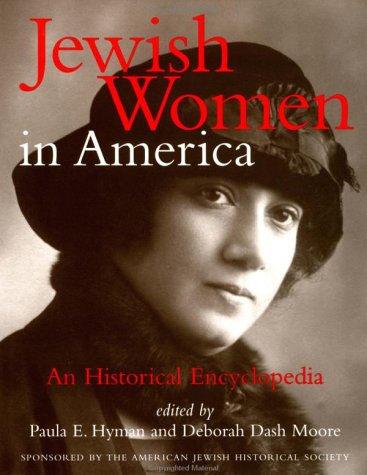
Jewish women in America: an historical encyclopedia

Paula Hyman,Deborah Dash Moore,Phyllis Holman Weisbard,American Jewish Historical Society
This encyclopedia provides the first standard reference work on the lives, history and activities of Jewish women in the United States. Covering a period which extends from the arrival of the first Jewish women in North America in 1654 to the present, this two-volume set presents the most comprehensive and detailed portrait of American Jewish women ever published, and brings together for the first time the wealth of recent scholarship on this subject. Includes: * Biographical entries on over 800 individual women. * 128 topical articles on organizations such as Hadassah, the National Council of Jewish Women, Mizrachi, and the Ladies' Garment Workers' Union. * Major essays on Jewish women's participation in the movement for women's suffrage, social reform, civil rights, and the recent women's movement. * The activities of Jewish women in politics, business, education, the arts, and religion. * A readable, inviting format with over 500 large photographs. * Bibliographies at the end of each entry which include overviews of major scholarship in the field, complete citations of more general works and citations of additional bibliographical and reference sources. * The comprehensive index includes citations to every substantive discussion in the entries as well as all proper names appearing in the text, such as organizations, book, song and film titles, schools, and individuals. The "Encyclopedia" provides information on American Jewish women in all fields of endeavor, and pays special attention to the work of women in the arts, academics, law, the labor movement, education, science, medicine, journalism and publishing, and on the lives of ordinary Jewish women during all time periods and in all regions of the United States.
Routledge 1997 1770 pages

God, faith & identity from the ashes: reflections of children and grandchildren of Holocaust survivors

Menachem Z. Rosensaft
Almost ninety children and grandchildren of Holocaust survivors--theologians, scholars, spiritual leaders, authors, artists, political and community leaders and media personalities--from sixteen countries on six continents reflect on how the memories transmitted to them have affected their lives.--Publisher information.
Jewish Lights Publishing, a division of LongHill Partners, Inc 2014-11-04 309 pages

No modernism without lesbians

Souhami, Diana
A Sunday Times Book of the Year Winner of the Polari Prize 'A book about love, identity, acceptance and the freedom to write, paint, compose and wear corduroy breeches with gaiters. To swear, kiss, publish and be damned. It is vastly entertaining and often moving... There isn't a page without an entertaining vignette' The Times . The extraordinary story of how a singular group of women in a pivotal time and place – Paris, Between the Wars – fostered the birth of the Modernist movement. Sylvia Beach, Bryher, Natalie Barney, and Gertrude Stein. A trailblazing publisher; a patron of artists; a society hostess; a groundbreaking writer. They were all women who loved women. They rejected the patriarchy and made lives of their own – forming a community around them in Paris. Each of these four central women interacted with a myriad of others, some of the most influential, most entertaining, most shocking and most brilliant figures of the age. Diana Souhami weaves their stories into those of the four central women to create a vivid moving tapestry of life among the Modernists in pre-War Paris. 'One of the best books I've read this year.' James Bridle
Head of Zeus Ltd 2020 456 pages

Stars of David: Prominent Jews talk about being Jewish

Pogrebin, Abigail
Sixty-two of the most accomplished Jews in America speak intimately—most for the first time—about how they feel about being Jewish. In unusually candid interviews conducted by former 60 Minutes producer Abigail Pogrebin, celebrities ranging from Sarah Jessica Parker to Supreme Court Justice Ruth Bader Ginsburg, from Larry King to Mike Nichols, reveal how resonant, crucial or incidental being Jewish is in their lives. The connections they have to their Jewish heritage range from hours in synagogue to bagels and lox; but every person speaks to the weight and pride of their Jewish history, the burdens and pleasures of observance, the moments they’ve felt most Jewish (or not). This book of vivid, personal conversations uncovers how being Jewish fits into a public life, and also how the author’s evolving religious identity was changed by what she heard.
Broadway books 2005 385 pages

New York Jew

Kazin, Alfred
In this book, Alfred Kazin, who for more than 30 years has been one of the central figures of America's intellectual life, takes us into his own life and times. His autobiography encompasses a personal story openly told; an inside look at New York's innermost intellectual circles; strong and intimate revelations of many of the most important writers of the century; and brilliantly astute observations of the literary accomplishments, atmosphere, and fads of the 1940s, 50s, and 60s in the context of America's shifting political gales.
Syracuse University Press 1996-08-01 307 pages

Rahel Varnhagen: the life of a Jewish woman

Arendt, Hannah
"Rahel Varnhagen: The Life of a Jewish Woman was Hannah Arendt's first book, largely completed when she went into exile from Germany in 1933, though it would not be published until the 1950s. It is the biography of a remarkable, complicated, troubled, passionate woman, an important figure in German romanticism, the person who in a sense founded the Goethe cult that would become central to German cutural life in the nineteenth century, as well as someone who confronted and bore the burden of being both a woman in a man's world and an assimilated Jew in Germany with unusual determination. Rahel Levin Varnhagen, was, Hannah Arendt writes, "neither beautiful nor attractive... and possessed no talents with which to employ her extraordinary intelligence and passionate originality." Arendt sets out to tell the story of Rahel's life as Rahel might have told it and, in doing so, to reveal the way in which intellectual and social assimilation works out in one person's destiny. On her deathbed Rahel is reported to have said, "The thing which all my life seemed to me the greatest shame, which was the misery and misfortune of my life--having been born a Jewess--this I should on no account now wish to have missed." Only because she had remained both a Jew and a pariah, Hannah Arendt observes, "did she find a place in the history of European humanity.""--
New York Review Books 2021 236 pages

Ex-friends

Podhoretz, Norman
Allen Ginsberg, Lionel and Diana Trilling, Lillian Hellman, Hannah Arendt, and Norman Mailer -- all are ex-friends of Norman Podhoretz, the renowned editor and critic and leading member of the group of New York intellectuals who came to be known as "the Family." As only a family member could, Podhoretz tells the story of these friendships, once central to his life, and shows how the political and cultural struggles of the past fifty years made them impossible to sustain. With wit, piercing insight, and startling honesty, we are introduced as never before to a type of person for whom ideas were often matters of life and death, and whose passing from the scene has left so large a gap in American culture. Podhoretz was the trailblazer of the now-famous journey of a number of his fellow intellectuals from radicalism to conservatism -- a journey through which they came to exercise both cultural and political influence far beyond their number. With this fascinating account of his once happy and finally troubled relations with these cultural icons, Podhoretz helps us understand why that journey was undertaken and just how consequential it became. In the process we get a brilliantly illuminating picture of the writers and intellectuals who have done so much to shape our world. Combining a personal memoir with literary, social, and political history, this unique gallery of stern and affectionate portraits is as entertaining as a novel and at the same time more instructive about postwar American culture than a formal scholarly study. Interwoven with these tales of some of the most quixotic and scintillating of contemporary American thinkers are themes that are introduced, developed, and redeveloped in a variety of contexts, with each appearance enriching the others, like a fugue in music. It is all here: the perversity of brilliance; the misuse of the mind; the benightedness of people usually considered especially enlightened; their human foibles and olympian detachment; the rigors to be endured and the prizes to be won and the prices to be paid for the reflective life. Most people live their lives in a very different way, and at one point, in a defiantly provocative defense of the indifference shown to the things by which intellectuals are obsessed, Norman Podhoretz says that Socrates' assertion that the unexamined life was not worth living was one of the biggest lies ever propagated by a philosopher. And yet, one comes away from Ex-Friends feeling wistful for a day when ideas really mattered and when there were people around who cared more deeply about them than about anything else. Reading of a time when the finest minds of a generation regularly gathered in New York living rooms to debate one another with an articulateness, a passion, and a level of erudition almost extinct, we come to realize how enviable it can be to live a life as poignantly and purposefully examined as Norman Podhoretz's is in Ex-Friends.
Free Press 1999-02-21 244 pages

The worlds of Lincoln Kirstein

Duberman, Martin B.
Finalist, 2008 Pulitzer Prize Lincoln Kirstein was a tireless champion of the arts in America. Working behind the scenes to provide artists with money, space, audiences, and, at times, emotional support, he helped found such landmark cultural institutions as the New York City Ballet, the School of American Ballet, New York’s Lincoln Center and Stratford's American Shakespeare Festival. Duberman's biography sheds light on this lamentably neglected cultural figure. Though best known as a benefactor of the arts, Kirstein was also an adept critic, poet and novelist who published some fifteen books in his lifetime. From his undergraduate years at Harvard, where he established the influential literary magazine Hound and Horn , as well as the Harvard Society for Contemporary Art (precursor to the Modern Museum of Art), to his complex and historically significant relationship with George Balanchine, Kirstein's contributions were indespensible to the development of the arts in America. Authoritative and elegant, Duberman's biography utilizes previously unavailable documents, including Kirstein's diaries, to reveal the keen eye, incessant self-doubt, and enormous ambition that drove Kirstein's relentless advocacy. The Worlds of Lincoln Kirstein brings attention to an important, but until-now unappreciated figure whose individual contribution to the arts was one of the greatest of the twentieth century.
Alfred A. Knopf 2007 723 pages

My futurist years

Jakobson, Roman
An important collection of writings and memoirs on the Russian Futurist movement from one of America's pre-eminent linguists and literary theorists. Born in Moscow in 1896, Roman Jakobson brought an extraordinary rare poet's sensibility to his exploration of language. This volume, which fills a major gap in the literature of the Russian avant-garde, is a lively collection of letters, memoirs, poetry, prose, and essays. It includes recollections of Mayakovsky, Khlebnikow and others.
Marsilio 1997 371 pages

Artists' SoHo: 49 episodes of intimate history

Kostelanetz, Richard
How a little-known industrial neighborhood in New York unintentionally became a nexus of creative activity for a brief burst of time. During the 1960s and 1970s in New York City, young artists exploited an industrial wasteland to create spacious studios where they lived and worked, redefining the Manhattan area just south of Houston Street. Its use fueled not by city planning schemes but by word-of-mouth recommendations, the area soon grew to become a world-class center for artistic creation indeed, the largest urban artists' colony ever in America--let alone the world. Richard Kostelanetz's Artists' SoHo not only examines why the artists came and how they accomplished what they did but also delves into the lives and works of some of the most creative personalities who lived there during that period, including Nam June Paik, Robert Wilson, Meredith Monk, Richard Foreman, Hannah Wilke, George Macuinas, and Alan Suicide. Gallerists followed the artists in fashioning themselves, their homes, their buildings, and even their streets into transiently prominent exhibition and performance spaces. SoHo pioneer Richard Kostelanetz's extensively researched intimate history is framed within a personal memoir that unearths myriad perspectives: social and cultural history, the changing rules for residency and ownership, the ethos of the community, the physical layouts of the lofts, the types of art produced, venues that opened and closed, the daily rhythm, and the gradual invasion of "new people." Artists' SoHo also explores how and why this fertile bohemia couldn't last forever. As wealthier people paid higher prices, galleries left, younger artists settled elsewhere, and the neighborhood became a "SoHo Mall" of trendy stores and restaurants. Compelling and often humorous, Artists' SoHo provides an analysis of a remarkable neighborhood that transformed the art and culture of New York City over the past five decades.
Empire State Editions, an imprint of Fordham University Press 2015 272 pages

Balzac's Paris: the city as human comedy

Hazan, Éric
"Eric Hazan follows in Balzac's footsteps, criss-crossing the city in the novelist's outsize boots, running between printers, publishers, coffee merchants, mistresses and friends, stopping for a moment, struck by a detail that would be fixed in Balzac's photographic memory. More than a tour of the city, this is an attempt to measure the soul of a city as recovered in its finest literature"--
Verso 2024-06-25 200 pages