23 results for "Biography"

Things that make white people uncomfortable

Bennett, Michael,Zirin, Dave
"Defensive lineman Michael Bennett adds his voice to discussions of racism and police violence, Black athletes and their relationship to powerful institutions like the NCAA and the NFL, the role of protest in history, and the responsibilities of athletes as role models to speak out against injustice. Following in the footsteps of activist-athletes from Muhammad Ali to Colin Kaepernick, Bennett demonstrates his outspoken leadership both on and off the field."--Provided by publisher.
Haymarket Books 2018 220 pages

Hands on the freedom plow: personal accounts by women in SNCC

Faith S. Holsaert
In Hands on the Freedom Plow, fifty-two women--northern and southern, young and old, urban and rural, black, white, and Latina--share their courageous personal stories of working for the Student Nonviolent Coordinating Committee (SNCC) on the front lines of the Civil Rights Movement. The testimonies gathered here present a sweeping personal history of SNCC: early sit-ins, voter registration campaigns, and freedom rides; the 1963 March on Washington, the Mississippi Freedom Summer, and the movements in Alabama and Maryland; and Black Power and antiwar activism. Since the women spent time in the Deep South, many also describe risking their lives through beatings and arrests and witnessing unspeakable violence. These intense stories depict women, many very young, dealing with extreme fear and finding the remarkable strength to survive. The women in SNCC acquired new skills, experienced personal growth, sustained one another, and even had fun in the midst of serious struggle. Readers are privy to their analyses of the Movement, its tactics, strategies, and underlying philosophies. The contributors revisit central debates of the struggle including the role of nonviolence and self-defense, the role of white people in a black-led movement, and the role of women within the Movement and the society at large. Each story reveals how the struggle for social change was formed, supported, and maintained by the women who kept their "hands on the freedom plow." As the editors write in the introduction, "Though the voices are different, they all tell the same story--of women bursting out of constraints, leaving school, leaving their hometowns, meeting new people, talking into the night, laughing, going to jail, being afraid, teaching in Freedom Schools, working in the field, dancing at the Elks Hall, working the WATS line to relay horror story after horror story, telling the press, telling the story, telling the word. And making a difference in this world."
University of Illinois Press 2010-09-30 616 pages

Memories of the Southern civil rights movement

Lyon, Danny
In the summer of 1962, 20-year-old Danny Lyon packed his cameras and hitchhiked south. Within a week he was in jail in Georgia, looking through the bars at another prisoner, Dr. Martin Luther King, Jr. Lyon's photos and text are more just a record of marches, jailings, and protests, they take us behind the scenes to chronicle the southern Civil Rights movement firsthand.
Published for the Center for Documentary Studies, Duke University, by the University of North Carolina Press 1992 192 pages

Capitol men: the epic story of Reconstruction through the lives of the first Black congressmen

Dray, Philip
Pulitzer Prize finalist Philip Dray shines a light on a little known group of men: the nation's first black members of Congress. These men played a critical role in pushing for much-needed reforms in the wake of a traumatic civil war, including public education for all children, equal rights, and protection from Klan violence. But they have been either neglected or maligned by most historians--their "glorious failure" chalked up to corruption and "ill-preparedness."--From publisher description.
Houghton Mifflin Co 2008 463 pages

A boy from Georgia: coming of age in the segregated South

Jordan, Hamilton
When Hamilton Jordan died of peritoneal mesothelioma in 2008, he left behind a mostly finished memoir, a book on which he had been working for the last decade. Jordan's daughter, Kathleen - with the help of her brothers and mother - took up the task of editing and completing the book. A Boy from Georgia - the result of this posthumous father-daughter collaboration - chronicles Hamilton Jordan's childhood in Albany, Georgia, charting his moral and intellectual development as he gradually discovers the complicated legacies of racism, religious intolerance, and southern politics, and affords his readers an intimate view of the state's wheelers and dealers. Jordan's middle-class childhood was bucolic in some ways and traumatizing in others. As Georgia politicians battled civil rights leaders, a young Hamilton straddled the uncomfortable line between the southern establishment to which he belonged and the movement in which he believed. Fortunate enough to grow up in a family that had considerable political clout within Georgia, Jordan went into politics to put his ideals to work. Eventually he became a key aide to Jimmy Carter and was the architect of Carter's stunning victory in the presidential campaign of 1976; Jordan later served as Carter's chief of staff. Clear eyed about the triumphs and tragedies of Jordan's beloved home state and region, A Boy from Georgia tells the childhood story of a remarkable life in a voice that is witty, vivid, and honest. -- from dust jacket.
University of Georgia Press 2015 228 pages

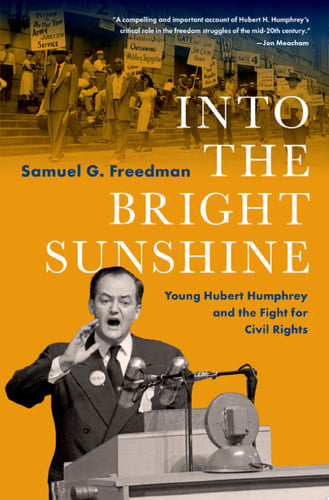
Into the bright sunshine: young Hubert Humphrey and the fight for civil rights

Freedman, Samuel G.
"Hubert Humphrey, a fallen hero and a dying man, rose on rickety legs to approach the podium of the Philadelphia Convention Hall, his pulpit for the commencement address at the University of Pennsylvania. He clutched a sheaf of paper with his speech for the occasion, typed and double-spaced by an assistant from his extemporaneous dictation, and then marked up in pencil by Humphrey himself. A note on the first page, circled to draw particular attention, read simply, "30 years ago--Here." In this place, at that time, twenty-nine years earlier to be precise, he had made history. From the dais now, Humphrey beheld five thousand impending graduates, an ebony sea of gowns and mortarboards, broken by one iconoclast in a homemade crown, two in ribboned bonnets, and another whose headgear bore the masking-tape message HI MA PA. In the horseshoe curve of the arena's double balcony loomed eight thousand parents and siblings, children, and friends. Wearing shirtsleeves and cotton shifts amid the stale heat, they looked like pale confetti from where Humphrey stood, and their flash cameras flickered away, a constellation of pinpricks"--
Oxford University Press 2023 488 pages

White boy: a memoir

Naison, Mark
How does a Jewish boy who spent the bulk of his childhood on the basketball courts of Brooklyn wind up teaching in one of the city's pioneering black studies departments? Naison's odyssey begins as Brooklyn public schools respond to a new wave of Black migrants and Caribbean immigrants, and established residents flee to virtually all-white parts of the city or suburbs. Already alienated by his parents' stance on race issues and their ambitions for him, he has started on a separate ideological path by the time he enters Columbia College. Once he embarks on a long-term interracial relationship, becomes a member of SDS, focuses his historical work on black activists, and organizes community groups in the Bronx, his immersion in the radical politics of the 1960s has emerged as the center of his life. Determined to keep his ties to the Black community, even when the New Left splits along racial lines, Naison joined the fledgling African American studies program at Fordham, remarkable then as now for its commitment to interracial education.This memoir offers more than a participant's account of the New Left's racial dynamics; it eloquently speaks to the ways in which political commitments emerge from and are infused with the personal choices we all make.
Temple University Press 2002-03-08 225 pages

A legacy of liberation: Thabo Mbeki and the future of the South African dream

Gevisser, Mark
In this gripping social history of South Africa, award-winning journalist Mark Gevisser follows the family of former South African President Thabo Mbeki to make sense of his legacy and understand the future of the country under new President Jacob Zuma. With unparalleled access to Mbeki and Zuma, as well as other key players in the ANC, Gevisser presents an intimate yet accessible account of South Africa's past, present and future. With his stunning account of the Mbeki family's history as a backdrop, Gevisser fleshes out a monumental period in world history that will continue to shape African politics for years to come.
Palgrave Macmillan 2010-06-08 376 pages

Autobiography of an ex-white man: learning a new master narrative for America

Wolff, Robert Paul
Autobiography of an Ex-White Man is an intensely personal meditation on the nature of America by a White Philosopher who joined a Black Studies Department and found his understanding of the world transformed by the experience. The book begins with an autobiographical narrative of the events leading up to Wolff's transfer from a Philosophy Department to the W. E. B. Du Bois Department of Afro-American Studies at the University of Massachusetts, and his experiences in the Department with his new colleagues, all of whom had come to Academia from the Civil Rights Movement of the 1960s. Wolff discovered that the apparently simple act of moving across campus to a new Department in a new building worked a startling change in the way he saw himself, his university, and his country. Reading as widely as possible to bring himself up to speed in his new field of academic responsibility, Wolff realized after a bit that his picture of American history and culture was undergoing an irreversible metamorphosis. America, he realized, has from its inception been a land both of Freedom and of Bondage: Freedom for the few, and then for those who are White; Bondage at first for the many, and then for those who are not White. Slavery is thus not an aberration, an accident, a Peculiar Institution -- it is the essence and core of the American experience. Wolff's optimistic outlook leads him to express the hope that our acknowledging the realities of America's racial history and present will begin to tear down the formidable barrier to change. He sees this refashioning of the American story as a first step toward the crafting of a truly liberatory project. Robert Paul Wolff is Professor of Afro-American Studies at the University of Massachusetts-Amherst and the author of numerous books, including Introductory Philosophy and In Defense of Anarchism.
University of Rochester Press 2005 136 pages

Love in black and white: a memoir of race, religion, and romance

Cohen, William S.
Streaming Video on Love In Black & White now available at Expandedbooks.com Most Americans regard the World War II period as belonging to the "greatest generation," but it was also a time when religious intolerance and racial violence flourished. Shamefully, it was commonplace to see signs that read "Whites Only" or "Jews Not Allowed." It is within this world that this compelling memoir is set. William Cohen, born in Bangor, Maine, was the eldest son of a Jewish father and a Protestant Irish mother. Janet Langhart, an African-American, was raised in Indianapolis, Indiana by her single parent mother, a Southern Baptist. The book draws fascinating parallels between the histories of two people from different regions, races, and religions, as both are witnesses to and targets of the social tensions of the day. Throughout Love in Black and White, readers accompany Bill and Janet in their struggle to overcome to the barriers of ethnic and racial bigotry and hatred. The stories are rich and profound. At times they are amusing. Other times, harrowing. Against impossible odds, Bill would be elected to serve his country as a U.S. Congressman and Senator, and Janet would become a prominent television personality, activist, and highly respected businesswoman and author. Opposites in so many ways―in color, faith and culture―seemingly a bundle of contradictions, they meet in 1974, become friends, and eventually fall in love. They decide to marry on Valentine's Day 1996 in the very place that once harbored some of the nation's most prominent racists-the U.S. Capitol. They receive the surprise of a lifetime when Bill is asked by President Bill Clinton to serve as the nation's 20th Secretary of Defense. It is a calling that proves to be life transforming for both him and Janet, as they lead, inspire and bring comfort to the men and women who defend our nation. It is at the Pentagon where they witness just how powerful our nation ca
Rowman & Littlefield Publishers 2007 373 pages

Life out of context: which includes a proposal for the non-violent takeover of the House of Representatives

Mosley, Walter
Life Out of Context begins as a powerful, brooding and humorously honest examination of Mosley's own sense of cultural dislocation as an African American writer. But due to a series of serendipitous events -- the screening of a documentary about Africa, an encounter with Harry Belafonte and Hugh Masakela -- Mosley, rather like the protagonist in one of his mystery novels, has a series of epiphanies on the role of a black intellectual in America. He asks: What can we do to fight injustice, poverty, exploitation, and racism? What is globalization doing to us? Through these late night meditations, Mosley attempts to transcend his earlier feelings of living a "life out of context" and seeks instead to find a political context. He ends with a call to arms, proposing that African Americans have to break their historic ties with the Democrat Party, and form a party of their own.
Nation Books 2006 103 pages

Nothing like sunshine: a story in the aftermath of the MLK assassination

Kamin, Ben
Rabbi Ben Kamin has written a definitive personal expression about race, coming of age in the 1960s, a forbidden friendship, and his personal love for Dr. Martin Luther King Jr. This is a story that spans a four-decade search for a lost high school chum, a deep misunderstanding, and a coming to terms with an America painfully evolving from the blood of MLK to the promise of Barack Obama. The book is a remembrance of Kamin's life at Cincinnati's notorious Woodward High School, a microcosm of the 1960s and of America itself.
Michigan State University Press 2010 138 pages

Race, class and power: Harold Wolpe and the radical critique of apartheid

Friedman, Steven
Over four decades ago, radical scholars began to suggest a new way of looking at South African society - one that blamed the economic power of those who owned property for the racial bondage of the black majority. Their work, and the debates it triggered, are mostly forgotten, but they and their critics have much to say that sheds lights on today's South African realities. Harold Wolpe was arguably the most influential theorist of this generation. His writings played a major role in a revolution in thought, and his celebrated escape from prison in the 1960s made him a symbol of alternative action. Race, Class and Power clearly and insightfully examines Wolpe's work in the political, intellectual, and social contexts in which it was developed and to which it gave form. Drawing on interviews with those who Wolpe worked with, disagreed with, and inspired, the book also maps his influence on ideas and the culture that emerged in anti-apartheid circles in the 1970s. Harold Wolpe's writings are a prism through which South African society can be viewed, and this book is an intellectual biography both of Wolpe and of South Africa's left. It also assesses and engages with the ongoing impact of Wolpe's ideas into the post-apartheid present. Moreover, it suggests how Wolpe's work can move us towards a way of thinking about and acting upon South Africa's realities differently.
University of KwaZulu-Natal Press 2015 368 pages

The assassination of Hole in the Day

Treuer, Anton
On June 27, 1868, Hole in the Day (Bagonegiizhig) the Younger left Crow Wing, Minnesota, for Washington, DC, to fight the planned removal of the Mississippi Ojibwe to a reservation at White Earth. Several miles from his home, the self-styled leader of all the Ojibwe was stopped by at least twelve Ojibwe men and fatally shot. Hole in the Day's death was national news, and rumors of its cause were many: personal jealousy, retribution for his claiming to be head chief of the Ojibwe, retaliation for the attacks he fomented in 1862, or retribution for his attempts to keep mixed-blood Ojibwe off the White Earth Reservation. Still later, investigators found evidence of a more disturbing plot involving some of his closest colleagues: the business elite at Crow Wing. While most historians concentrate on the Ojibwe relationship with whites to explain this story, Anton Treuer focuses on interactions with other tribes, the role of Ojibwe culture and tradition, and interviews with more than fifty elders to further explain the events leading up to the death of Hole in the Day. The Assassination of Hole in the Day is not only the biography of a powerful leader but an extraordinarily insightful analysis of a pivotal time in the history of the Ojibwe people. " An essential study of nineteenth-century Ojibwe leadership and an important contribution to the field of American Indian Studies by an author of extraordinary knowledge and talent. Treuer's work is infused with a powerful command over Ojibwe culture and linguistics." --Ned Blackhawk, author of Violence Over the Land: Indians and Empires in the Early American West "The Assassination of Hole in the Day is a masterful history, and more. Anton Treuer illuminates the character of a controversial and charismatic Ojibwe leader from within Ojibwe culture, and tells a powerful story of loss that reverberates in the present." --Louise Erdrich "This is more than a murder mystery. It provides insights into the evolution of clan structure, tribal governance and relations with the Dakota and other tribes since the time a century and a half ago when white pressure, the declining fur trade and other factors led to the cession of great tracts of land and the people's removal to reservations." --Star Tribune "This highly recommended work provides insights into the challenges faced by native peoples during an era when they were under intense pressure by the federal government to move to reservations." --Library Journal "Treuer explores the life and death of this brash young leader, and delves into tribal history and the intricate machinations of Ojibwa politics." --Booklist Anton Treuer, professor of Ojibwe at Bemidji State University, is the author of Ojibwe in Minnesota and several books on the Ojibwe language. He is also the editor of Oshkaabewis Native Journal, the only academic journal of the Ojibwe language.
Borealis Books 2011 295 pages