4 results for "Biography"

Nine Essential Things I've Learned About Life

Harold S. Kushner
From the #1 national bestselling author of When Bad Things Happen to Good People— “a lifetime of wisdom from someone who has studied, suffered, celebrated, and through it all, taught an entire generation" (Rabbi David Wolpe, author of Why Faith Matters). In this compassionate and deeply personal work, Rabbi Harold S. Kushner distills his experiences as a twenty-first-century rabbi into nine essential takeaways. Offering readers a lifetime’s worth of spiritual food for thought, pragmatic advice, and strength for trying times, he gives fresh, vital insight into belief, conscience, mercy, and more. Grounded in Kushner’s brilliant readings of scripture, history, and popular culture, Nine Essential Things I’ve Learned About Life is practical, illuminating, and compulsory advice for living a good life.
Knopf Doubleday Publishing Group 2016-09-06 192 pages

Why I Am A Jew

Edmond Fleg
This work has been selected by scholars as being culturally important, and is part of the knowledge base of civilization as we know it. This work is in the "public domain in the United States of America, and possibly other nations. Within the United States, you may freely copy and distribute this work, as no entity (individual or corporate) has a copyright on the body of the work. Scholars believe, and we concur, that this work is important enough to be preserved, reproduced, and made generally available to the public. We appreciate your support of the preservation process, and thank you for being an important part of keeping this knowledge alive and relevant.
Creative Media Partners, LLC 2022-10-26 128 pages

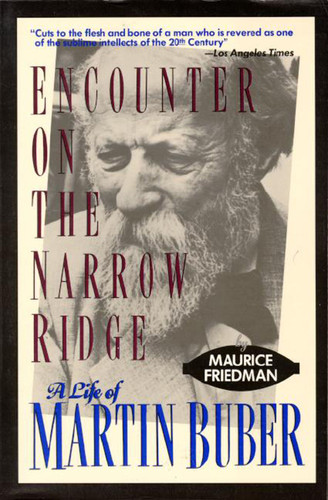
Encounter on the Narrow Ridge A Life of Martin Buber

Maurice Friedman
Martin Buber's stature as the most significant Jewish religious philosopher of the twentieth century is reinforced by his accomplishments and renown in areas as diverse as Hasidism, psychotherapy, education, folklore, and politics. His classic, I and Thou, is known and studied all over the world. In this complete and masterful biography, Maurice Friedman traces the interweaving of Buber's wholehearted engagement with world events and crises and the evolution of his unique and influential philosophy. We see the impact of World War I on the young thinker; his work in education, community, and politics between the wars; his leadership of the spiritual resistance to the Nazis in Hitler's Germany; and his more than forty years of fighting for Jewish-Arab understanding. In addition, we see Buber interact with Heidegger, Sartre, Jung, Ben Gurion, Hesse, Rosenzweig, and Hammarskjold. Through his close relationship with Buber and recent access to forty-five thousand unpublished letters, Maurice Friedman recreates Buber's vitality, his philosophy of dialogue, and his spirituality based on a personal relationship with God. Encounter on the Narrow Ridge delivers the essential spontaneity of a great man who saw in every encounter a focal point for human growth.
Paragon House 1998-06-15 496 pages

Judaism and Story The Evidence of the Fathers According to Rabbi Nathan

Jacob Neusner
In this close analysis of 'The Fathers According to Rabbi Nathan', a sixth-century commentary on the Mishnah-tractyate 'The Fathers' (Avot), Jacob Neusner considers the way in which the story, as a distinctive type of narrative, entered the canonical writings of Judaism. The final installment in Neusner's cycle of analyses of the major texts of the Judaic canon, 'Judaism and Story' shows that stories about sages exist in far greater proportion in 'The Fathers According to Rabbi Nathan' than in any of the other principal writings in the canon of Judaism of late antiquity. Neusner's detailed comparison of 'The Fathers' and 'The Fathers According to Rabbi Nathan' demonstrates the transmission and elaboration of these stories and shows how these processes incorporated the newer view of the sage as a supernatural figure and of the eschatological character of Judaic teleology. These distinctions, as Neusner describes them, mark a shift in Jewish orientation to world history. 'Judaism and Story' documents a chapter of rabbinic tradition that explored the possibility of historical orientation by means of stories. As Neusner demonstrates, this experiment with narrative went beyond argumentation focused on the explication of the Torah. The sage story moved in the direction of biography, but without allowing biography to emerge. This development, in Neusner's account, parallels the movement from epistle to Gospel in early Christianity and thus has broad implications for the history of religions.
Wipf and Stock Publishers 2003-09-26 264 pages