4 results for "Biology"

Mind, body and Judaism: the interaction of Jewish law with psychology and biology

David Shatz,Joel B. Wolowelsky
Sovereignty over the Temple Mount in Jerusalem is one of the most difficult problems in the ongoing Israeli-Palestinian conflict. Although it is a present-day bone of contention, its roots go back into the distant past. Israelites, Christians, and Muslims had fought over this holy site, and built on it a succession of shrines. The book leads the reader into the intricate history, geography, and politics of this unique site. It relates the roots of its holiness, describes the succession of temples built on it, and explains how in the twentieth century its sanctity become interwined with the national aspirations of both Jews and Arabs. It explains why the Temple Mount is considered the holiest site for the Jews, and how it became holy also to the Muslims. The book also explores the role of evangelical Christians, who, alongside a segment of the Jewish population, see the Temple Mount as the center of messianic aspirations, fed by the myriad of Jewish, Christian, and Muslim legends and myths which evolved around it. The book is richly illustrated with photographs, sketches, maps, and plans.
Michael Scharf Publication Trust of Yeshiva University Press 2004 257 pages

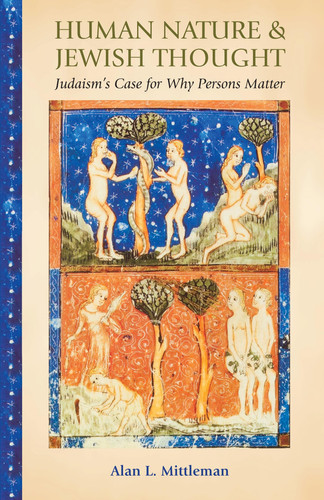
Human nature & Jewish thought: Judaism's case for why persons matter

Mittleman, Alan
This book explores one of the great questions of our time: How can we preserve our sense of what it means to be a person while at the same time accepting what science tells us to be true-namely, that human nature is continuous with the rest of nature? What, in other words, does it mean to be a person in a world of things? Alan Mittleman shows how the Jewish tradition provides rich ways of understanding human nature and personhood that preserve human dignity and distinction in a world of neuroscience, evolutionary biology, biotechnology, and pervasive scientism. These ancient resources can speak to Jewish, non-Jewish, and secular readers alike. Science may tell us what we are, Mittleman says, but it cannot tell us who we are, how we should live, or why we matter. Traditional Jewish thought, in open-minded dialogue with contemporary scientific perspectives, can help us answer these questions. Mittleman shows how, using sources ranging across the Jewish tradition, from the Hebrew Bible and the Talmud to more than a millennium of Jewish philosophy. Among the many subjects the book addresses are sexuality, birth and death, violence and evil, moral agency, and politics and economics. Throughout, Mittleman demonstrates how Jewish tradition brings new perspectives to-and challenges many current assumptions about-these central aspects of human nature. A study of human nature in Jewish thought and an original contribution to Jewish philosophy, this is a book for anyone interested in what it means to be human in a scientific age.
Princeton University Press 2015 215 pages

Open Secret Postmessianic Messianism and the Mystical Revision of Menahem Mendel Schneerson

Elliot R. Wolfson
Menaḥem Mendel Schneerson (1902-1994) was the seventh and seemingly last Rebbe of the Habad-Lubavitch dynasty. Marked by conflicting tendencies, Schneerson was a radical messianic visionary who promoted a conservative political agenda, a reclusive contemplative who built a hasidic sect into an international movement, and a man dedicated to the exposition of mysteries who nevertheless harbored many secrets. Schneerson astutely masked views that might be deemed heterodox by the canons of orthodoxy while engineering a fundamentalist ideology that could subvert traditional gender hierarchy, the halakhic distinction between permissible and forbidden, and the social-anthropological division between Jew and Gentile. While most literature on the Rebbe focuses on whether or not he identified with the role of Messiah, Elliot R. Wolfson, a leading scholar of Jewish mysticism and the phenomenology of religious experience, concentrates instead on Schneerson's apocalyptic sensibility and his promotion of a mystical consciousness that undermines all discrimination. For Schneerson, the ploy of secrecy is crucial to the dissemination of the messianic secret. To be enlightened messianically is to be delivered from all conceptual limitations, even the very notion of becoming emancipated from limitation. The ultimate liberation, or true and complete redemption, fuses the believer into an infinite essence beyond all duality, even the duality of being emancipated and not emancipated--an emancipation, in other words, that emancipates one from the bind of emancipation. At its deepest level, Schneerson's eschatological orientation discerned that a spiritual master, if he be true, must dispose of the mask of mastery. Situating Habad's thought within the evolution of kabbalistic mysticism, the history of Western philosophy, and Mahayana Buddhism, Wolfson articulates Schneerson's rich theology and profound philosophy, concentrating on the nature of apophatic embodiment, semiotic materiality, hypernomian transvaluation, nondifferentiated alterity, and atemporal temporality.
Columbia University Press 2012 452 pages