
2 results for "Biology"

Bright air, brilliant fire: on the matter of the mind

Edelman, Gerald Maurice
We are on the brink of understanding ancient mysteries: how we know, what governs our nature, what makes a person different from a thing. In the last decade, more than twenty disciplines dealing with every aspect of the brain have contributed to a revolution in the neurosciences--a revolution as significant, in the view of many observers, as the Galilean and Copernican revolutions in mathematics and physics or the Darwinian revolution in biology. In this book, one of the world's foremost brain scientists gives us a glimpse into the workings of the human brain--the most complex material object in the universe. A match head's worth of the brain contains about a billion connections that can combine in ways which can only be described as hyperastronomical--on the order of ten followed by millions of zeros (there are only about ten followed by eighty zeros' worth of positively charged particles in the whole known universe).^
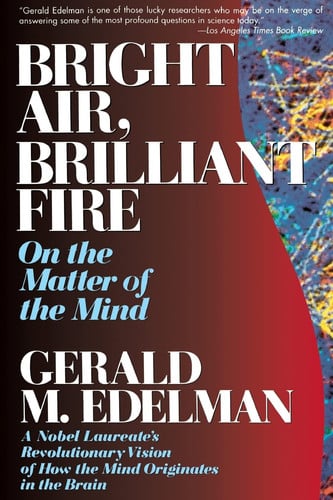
BasicBooks 1992 280 pages

Learning and memory

Eric R. Kandel,Yadin Dudai,Mark R. Mayford
We learn and remember information by modifying synaptic connections in the neuronal networks of our brain. Depending on the type of information being stored, these changes occur in different regions and different circuits of the brain. The underlying circuit mechanisms are beginning to be understood. These mechanisms are capable of storing or reconstructing memories for periods ranging up to a lifetime, but they are also error-prone, as memories can be distorted or lost. Written and edited by experts in the field, this collection from Cold Spring Harbor Perspectives in Biology examines important aspects of the neurobiology of learning and memory. Contributors review the various types of memory and the anatomical architectures and specialized cells involved. The induction of synaptic and cell-wide changes during memory encoding, the transcriptional and translational programs required for memory stabilization, the molecular signals that actively maintain memories, and the activation of neural ensembles during memory retrieval are comprehensively covered. The authors also discuss the model organisms and state-of-the-art technologies used to elucidate these processes. This volume will serve as a valuable reference for all neurobiologists and biomedical scientists as well as for cognitive and computational neuroscientists wishing to explore the remarkable phenomena of learning and memory.
Cold Spring Harbor laboratory press 2016 389 pages