21 results for "Biology"

Why is the Penis Shaped Like That? And Other Reflections on Being Human

Jesse Bering
"Titillating and provocative essays from one of the freshest voices in science today -- Why do testicles hang the way they do? Is there an adaptive function to the female orgasm? What does it feel like to want to kill yourself? Does "free will" really exist? And why is the penis shaped like that anyway? In Why Is the Penis Shaped Like That?, the research psychologist and award-winning columnist Jesse Bering features more than thirty of his most popular essays from Scientific American and Slate, as well as two new pieces, that take readers on a bold and captivating journey through some of the most taboo issues related to evolution and human behavior. Exploring the history of cannibalism, the neurology of people who are sexually attracted to animals, the evolution of human body fluids, the science of homosexuality, and serious questions about life and death, Bering astutely covers a generous expanse of our kaleidoscope of quirks and origins. With his characteristic irreverence and trademark cheekiness, Bering leaves no topic unturned or curiosity unexamined, and he does it all with an audaciously original voice. Whether you are interested in the psychological history behind the many facets of sexual desire or the evolutionary patterns that have dictated our current mystique and phallic physique, Why Is the Penis Shaped Like That? is bound to create lively discussion and debate for years to come"--
Transworld Publishers Limited 2012 320 pages

Emotional

Mlodinow, Leonard
You make hundreds of decisions every day, from what to eat for breakfast to how you should invest, and not one of those decisions would be possible without emotion. It has long been said that thinking and feeling are separate and opposing forces in our behavior. But as Leonard Mlodinow, the best-selling author of Subliminal, tells us, extraordinary advances in psychology and neuroscience have proven that emotions are as critical to our well-being as thinking. How can you connect better with others? How can you make sense of your frustration, fear, and anxiety? What can you do to live a happier life? The answers lie in understanding your emotions. Journeying from the labs of pioneering scientists to real-world scenarios that have flirted with disaster, Mlodinow shows us how our emotions can help, why they sometimes hurt, and what we can learn in both instances. Using deep insights into our evolution and biology, Mlodinow gives us the tools to understand our emotions better and to maximize their benefits. Told with his characteristic clarity and fascinating stories, Emotional explores the new science of feelings and offers us an essential guide to making the most of one of nature's greatest gifts.[Bokinfo]
Random House US 2023-02-14 272 pages

Totem and Taboo

Sigmund Freud
"Totem and Taboo" is a collection of four essays by Sigmund Freud that were published together in German in 1913. Freud sought to apply his theories of psychoanalysis to the study of anthropology and early human history. The four essays cover a wide range of topics. In "The Horror of Incest", Freud examines the varied and common rules in primitive cultures that limit contact between members of the same family. In "Taboo and Emotional Ambivalence," Freud posits that primitive cultures and their attitudes about magical objects are similar to the behavior of people with neurotic psychological conditions in the modern world. In "Animism, Magic and the Omnipotence of Thought," Freud draws comparisons between the primitive belief in magic and magical animals to obsessive and compulsive disorders. Finally, in "The Return of Totemism in Childhood," Freud, influenced by one of Charles Darwin's theories about the male-dominated arrangement of early human societies, looks for parallels with his own Oedipus complex theory in the structure of primitive cultures. A classic and influential work of early psychoanalysis, "Totem and Taboo" is an important read for students of both psychology and social anthropology.
Lulu.com 2022-10-24 172 pages

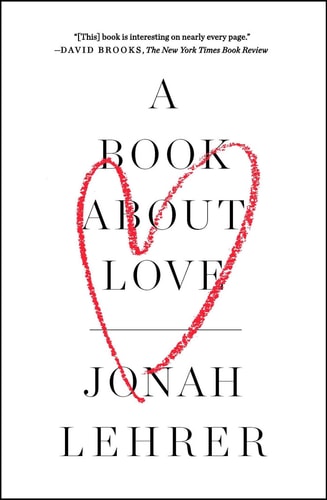
A Book About Love

Jonah Lehrer
Number one bestselling science writer Jonah Lehrer explores the “only happiness that lasts”—love—in a book that “is interesting on nearly every page” (David Brooks, The New York Times Book Review ). Weaving together scientific studies from clinical psychologists, longitudinal studies of health and happiness, historical accounts and literary depictions, child-rearing manuals, and the language of online dating sites, Jonah Lehrer’s A Book About Love plumbs the most mysterious, most formative, most important impulse governing our lives. Love confuses and compels us—and it can destroy and define us. It has inspired our greatest poetry, defined our societies and our beliefs, and governs our biology. From the way infants attach to their parents, to the way we fall in love with another person, to the way some find a love for God or their pets, to the way we remember and mourn love after it expires, this book focuses on research that attempts, even in glancing ways, to deal with the long-term and the everyday. The most dangerous myth of love is that it’s easy, that we fall into the feeling and then the feeling takes care of itself. While we can easily measure the dopamine that causes the initial feelings of “falling” in love, the partnerships and devotions that last decades or longer remain a mystery. “Lehrer uses scores of detailed vignettes to traverse a complicated intellectual landscape, eventually arriving at modern theories of love…He is a talent” ( USA TODAY ), and A Book About Love decodes the set of skills necessary to cultivate a lifetime of love. Love, Lehrer argues, is not built solely on overwhelming passion, but, fascinatingly, on a set of skills to be cultivated over a lifetime.
Simon and Schuster 2017-07-25 304 pages

Not in our genes: biology, ideology, and human nature

Lewontin, Richard,Rose, Steven P. R.,Kamin, Leon J.
In this classic work, three eminent scientists expose and dismantle the claims that class, race, and gender inequalities are the products of our biological and genetic inheritances. Not in Our Genes provides a bold and biting critique of biological determinism and sociobiology. In refuting the claim that what individuals can and cannot do is fixed, in essence, by their genetic makeup, the authors offer an important reply to an argument raging far beyond the scientific world and widely affecting our society and our lives. This edition features a new introduction by the authors.
Haymarket Books 2017 322 pages

Seeing Voices

Oliver Sacks
Like The Man Who Mistook His Wife for a Hat , this is a fascinating voyage into a strange and wonderful land, a provocative meditation on communication, biology, adaptation, and culture. In Seeing Voices , Oliver Sacks turns his attention to the subject of deafness, and the result is a deeply felt portrait of a minority struggling for recognition and respect — a minority with its own rich, sometimes astonishing, culture and unique visual language, an extraordinary mode of communication that tells us much about the basis of language in hearing people as well. Seeing Voices is, as Studs Terkel has written, "an exquisite, as well as revelatory, work."
National Geographic Books 2008-11-13 240 pages

Affect Imagery Consciousness Volume I: The Positive Affects

Silvan Tomkins
Tomkins' magnum opus, Affect, Imagery, Consciousness , was published by Springer Publishing Company in four volumes over 30 years. When Tomkins began writing the book in the 1950's, American psychology was dominated by psychoanalytic and behaviorist theories - neither of which placed much importance on the role of basic emotions in everyday human behavior. Tomkins challenged the status quo by developing - over the span of nearly 2,000 pages -- a theory of consciousness and motivation that placed emotion at the core of the human experience. Because so few psychologists were studying emotion at that time, Tomkins drew liberally from other academic disciplines to help formulate his ideas and support his arguments: evolutionary biology, ethology, cybernetics, literature, philosophy, psychoanalysis, and neurophysiology, among others. In the process, Tomkins practically invented the field of "nonverbal behavior" through close observation of emotional expressions in people, including his own infant son. His work was a brilliantly eccentric pastiche of ideas that adhered to no strict disciplinary or ideological boundaries. In time, however, AIC came to prominence through the research of his disciples, notably Paul Ekman and Carroll Izzard, who went on to become major researchers in the psychology of emotion. Today, Tomkins's book is influential not just in psychology but in philosophy, sociology, communication studies, even in "affective computing. Springer Publishing Company is pleased to continue to offer this magisterial work in four volumes.
Springer Publishing Company 1962-01-15 536 pages

The Prolongation Of Life

Elie Metchnikoff
This work has been selected by scholars as being culturally important, and is part of the knowledge base of civilization as we know it. This work is in the "public domain in the United States of America, and possibly other nations. Within the United States, you may freely copy and distribute this work, as no entity (individual or corporate) has a copyright on the body of the work. Scholars believe, and we concur, that this work is important enough to be preserved, reproduced, and made generally available to the public. We appreciate your support of the preservation process, and thank you for being an important part of keeping this knowledge alive and relevant.
Creative Media Partners, LLC 2022-10-26 380 pages

Methods in neuronal modeling

Christof Koch,Idan Segev
Methods in Neuronal Modeling is the first technical handbook on computational neuroscience. Written for researchers and theoreticians alike, it outlines methods and techniques used for simulating on digital computers the functional properties of single neurons from synapses, dendrites, single cells; and small invertebrate networks to large scale neural networks in the mammalian nervous system. The use of new experimental tools such as selective staining methods, membrane patch electrodes, voltage and calcium-dependent dyes, and multielectrode recordings, together with the, advent of universally available powerful computing, makes it possible to construct detailed and realistic models of neuronal systems. Methods in Neuronal Modeling addresses such questions as what can and should be simulated and what techniques should be used; what experimental parameters are crucial for such simulations, and whether these models may be verified experimentally. Chapters cover simulation of passive dendritic trees, compartmental models of single cells including neurons with a number of different ionic channels, calcium current dynamics, simulations of small invertebrate networks, simulations of the mammalian cortex, connectionists' models, and the use of parallel computers in modeling neural networks. Although the chapters were written by several authors, they are uniform in structure and notation. Detailed examples are given to clarify the different approaches. Each chapter concludes with a description of the model discussed and the details of its implementation on the computer. Christof Koch is an Assistant Professor of Computation and Neural Systems at the California Institute of Technology. Idan Segev is a Lecturer in Neurobiology at the Institute of Life Science, Hebrew University of Jerusalem. Methods in Neuronal Modeling inaugurates the new series in Computational Neuroscience, edited by Terrence J. Sejnowski and Tomaso Poggio. A Bradford Book.
MIT Press 1989-01 524 pages

Psychology and the Soul

Otto Rank
2011 Reprint of 1950 Translation by William Turner. Full facsimile of the original edition, not reproduced with Optical Recognition Software. Recommended, both as a fascinating and little-known document in the history of psychology and as a provocative reading of the history of psychology. (Religious Studies Review). Will interest many students of the history of psychoanalysis... Rank's conclusions contribute to present-day controversies about the status of psychoanalysis as a science. (Psychiatric Times ) The first complete English translation of a work that Rank published in 1930. It draws on anthropology, sociology, mythology, religion, philosophy, history, and literature to chart the development of the human psyche... The book's antimaterialistic passion makes it a compelling counterpoint to the stern biology of our own age, and the bounds it sets to what psychoanalysis can claim are justly drawn. (Wilson Quarterly ) Unquestionably Rank's most important work... This new translation is an effort to create a Rank for our millennium... [and it] reads elegantly and comfortably in English... The argument is complex and intricate, consisting of a long historical/ethnographic sweep that takes us from a 'primitive' state, via animism through the Christian or sexual era to the scientific era and modern development of psychology... Along the way we find traces of many of Rank's other brilliant psychological surveys -- the double, Don Juan, heroes' birth myths, the theme of incest -- woven into this massive canvas and viewed on the largest scale... Throughout this book, the grand tapestry is set with some remarkable gems of observation. (Naomi Segal Psychoanalysis and History ) This is the first complete translation of Otto Rank's fascinating text on the nature and history of the concept of the Soul and Will in the psychological history of humankind... a tour de force in vigour, scope and application to many contemporary issues such as sexual behaviors, the nature of dreaming, incest prohibitions and narcissism, to name but a few. (L.R. Edgar Journal of the Royal Anthropological Society ) In his last years, Otto Rank turned his lifetime of thought and learning toward two of the most difficult topics in human history: religion and the soul. The result was this now-classic work, available in this new, very accessible English translation. Unlike many other intellectuals of the twentieth century, Rank maintains a place for the soul rather than dismissing it as a fantasy. The soul and the beliefs about it, he argues, set forth the foundation for psychology, with its complex analyses of consciousness, self-consciousness, and personality. Rank's commentary is not limited to beliefs about individual souls but includes ideas about group souls, sometimes encompassing nations or generations. Rank suggests that it is in expression of group beliefs that the idea of the soul attains its greatest power. What is the soul? Otto Rank treats it as a universal and essential belief for individuals and their societies, constant in function but evolving in form through millennia. To borrow a post-Rankian metaphor, the soul was created in the big bang of irresistible psychological force colliding with immutable biological fact-our will to live forever against death. The collision creates a spark in our individual and social consciousness which through history has become both consolation and inspiration: the immortal soul. All ideologies reflect this phenomenon and modify its expression to suit the era. Otto Rank wrote before the atom bomb or television, both of which alter our perception of death without changing the fact. Rank's introduction of the soul as an essential part of contemporary psychology helps explain a number of perplexing, irrational phenomena in contemporary life.
Martino Fine Books 2011 206 pages

Pleasure: A Creative Approach to Life

Alexander Lowen
In Pleasure: A Creative Approach to Life , Alexander Lowen shows how the experience of pleasure or pain determines our emotions, thinking, and behavior. Examining the psychology and the biology of pleasure, Alexander Lowen explores its roots in the nature of the body and shows that emotional health means that we are in a state of pleasure - that is, we feel good in our bodies.
Alexander Lowen Foundation 2013-02-01 262 pages

On Giving Up

Adam Phillips
One of The New York Times Critics' Picks of the Year From acclaimed psychoanalyst Adam Phillips, a meditation on what we must give up to feel more alive. To give up or not to give up? The question can feel inescapable but the answer is never simple. Giving up our supposed vices is one thing; giving up on life itself is quite another. One form of self-sacrifice feels positive, something to admire and aspire to, while the other is profoundly unsettling, if not actively undesirable. There are always, it turns out, both good and bad sacrifices, but it is not always clear beforehand which is which. We give something up because we believe we can no longer go on as we are. In this sense, giving up is a critical moment—an attempt to make a different future. In On Giving Up , the acclaimed psychoanalyst Adam Phillips illuminates both the gaps and the connections between the many ways of giving up and helps us to address the central question: What must we give up in order to feel more alive?
Picador 2025-03-25 160 pages

Wider than the sky: the phenomenal gift of consciousness

Edelman, Gerald M.
A neuroscientist demystifies the subject of consciousness in this up-to-date discussion of mind-body connections. How does the firing of neurons give rise to subjective sensations, thoughts, and emotions? How can the disparate domains of mind and body be reconciled? The quest for a scientifically based understanding of consciousness has attracted study and speculation across the ages. In this direct and non-technical discussion of consciousness, Dr. Gerald M. Edelman draws on a lifetime of scientific inquiry into the workings of the brain to formulate answers to the mind-body questions that intrigue every thinking person. Concise and understandable, the book explains pertinent findings of modern neuroscience and describes how consciousness arises in complex brains. Edelman explores the relation of consciousness to causation, to evolution, to the development of the self, and to the origins of feelings, learning, and memory. His analysis of the brain activities underlying consciousness is based on recent remarkable advances in biochemistry, immunology, medical imaging, neuroscience, and evolutionary biology, yet the implications of his book extend farther--beyond the worlds of science and medicine into virtually every area of human inquiry.
Yale University Press 2004-01-01 201 pages

The Meaning of Dreams

Isador H. Coriat
THE new psychology of dreams, as elaborated by Freud, represents one of the greatest advances ever made in our knowledge pf the human mind and of human motives. For abnormal psychology, dream-analysis can be compared only in importance with the discovery of the origin of species and of the factors of organic evolution in the field of biology. The analysis of dreams is not only of great theoretical value in the understanding of the unconscious but has its practical side as well, in giving medicine the most potent instrument which it has ever possessed in the treatment of certain functional nervous disturbances.This volume is written along purely psycho-analytic lines, and every dream therein has been personally analyzed by the author. Its aim is to give the general reader an outline of the meaning of dreams as elaborated by the psycho-analytic school, with its applications to medical science, in particular to that method of psychotherapy known as psycho-analysis. Because of the great difficulties inherent in the subject of dream-analysis, only the basic principles have been given, the details being left for the special treatises and journals on the subject.ISADOR H. CORIAT.Boston, February, 1915.
CreateSpace Independent Publishing Platform 2017-09-06 78 pages

The organism

Goldstein, Kurt
In this remarkable book by one of the great psychologists and neurologists of the early twentieth century, Kurt Goldstein presents a summation of his “holistic” theory of the human organism. In the course of his studies on brain-damaged soldiers during the First World War, Goldstein became aware of the failure of contemporary biology and medicine to genuinely understand both the impact of such injuries and the astonishing adjustments that patients made to them. He challenged reductivist approaches that dealt with “localized” symptoms, insisting instead that an organism be analyzed in terms of the totality of its behavior and interaction with its surrounding milieu. He was especially concerned with the breakdown of organization and the failure of central cerebral controls that take place in catastrophic responses to situations such as physical or mental illness. But Goldstein was equally attuned to the amazing powers of the organism to readjust to such devastating losses, if only by withdrawal to a more limited range of activity that it could manage by a redistribution of its reduced energies, thus reclaiming as much wholeness as new circumstances allowed. Goldstein’s concepts in The Organism have had a major impact on philosophical and psychological thought throughout this century, as can be seen in the work of Maurice Merleau-Ponty, Georges Canguilhem, Ernst Cassirer, Ludwig Binswanger, and Roman Jakobson, not to mention the wide-ranging field of Gestalt psychology.
Zone 2000-04-04 424 pages

Decision Theory and Decision Behaviour

A. Rapoport
The book treats two approaches to decision theory: (1) the normative, purporting to determine how a 'perfectly rational' actor ought to choose among available alternatives; (2) the descriptive, based on observations of how people actually choose in real life and in laboratory experiments. The mathematical tools used in the normative approach range from elementary algebra to matrix and differential equations. Sections on different levels can be studied independently. Special emphasis is made on 'offshoots' of both theories to cognitive psychology, theoretical biology, and philosophy.
Palgrave Macmillan UK 1998-01-28 469 pages

Human nature explored

Mandler, George
What exactly is "human nature"? Are we correct in accepting ourselves as unchangeable, determined by biology, or is this idea an obstacle to our cognitive, emotional, and evolutionary development? George Mandler explores these questions from a fresh evolutionary and social perspective. He examines the burgeoning field of evolutionary psychology and suggests a mid-course correction. Topics are approached from a variety of backgrounds, drawing on relevant literature and Mandler's own research. He begins with what we know about evolution and gene expression, then moves on to the complex phenomena of consciuosness and emotion. The constraints of both nature and nurture are discussed as limiting forces on human development, and natural selection is considered in the context of our social fabric, which draws on both psychological and anthropological knowledge. Mandler considers human difference, particularly in regard to intelligence and gender, and discusses the nature of human values, including our need for morality and freedom. The book concludes with an appraisal of human cognition and language.
Oxford University Press 1997-09-04 208 pages

Clocking the Mind: Mental Chronometry and Individual Differences

Jensen, Arthur R.
Mental Chronometry (MC) comprises a variety of techniques for measuring the speed with which the brain processes information. First developed in mid-1800, MC was subsequently eclipsed by more complex and practically useful types of psychometric tests stemming from Alfred Binet. This class of mental tests, however, has no true metric relating the test scores to any specific properties of the brain per se. The scores merely represent an ordinal scale, only ranking individuals according to their overall performance on a variety of complex mental tasks. The resulting scores represent no more than ranks rather than being a true metrical scale of any specific dimension of brain function. Such an ordinal scale, which merely ranks individuals in some defined population, possesses no true scale properties, possessing neither a true zero or equal intervals throughout the scale. This deficiency obstructs the development of a true natural science of mental ability. The present burgeoning interest in understanding individual differences in mental abilities in terms of the natural sciences, biology and the brain sciences in particular, demands direct measures that functionally link brain and behavior. One such natural ratio scale is time itself - the time it takes the brain to perform some elementary cognitive task, measured in milliseconds. After more than 25 years researching MC, Jensen here presents results on an absolute scale showing times for intake of visual and auditory information, for accessing short-term and long-term memory, and other cognitive skills, as a function of age, at yearly intervals from 3 to 80 years. The possible uses of MC in neurological diagnosis and the monitoring of drug effects on cognition, the chronometric study of special time-sensitive talents such as musical performance, and presents a theory of general intelligence, or g, as a function of the rate of oscillation of neural action potentials as
Elsevier Science 2014-08-16 292 pages

Biological Memory

Rignano, Eugenio
First published in 1999. This is Volume XVI of twenty-one of a series on Cognitive Psychology. Written in 1926, considered from a philosophic viewpoint, this is an English translation of Professor Rignano's work, Biological Memory," which gives an exhaustive analysis of the differences which distinguish living from non-living substance and his attempts to account for these differences as the manifold effects of a single quality.
Routledge 2014-12-02 260 pages