5 results for "Business"

Think Like a Freak The Authors of Freakonomics Offer to Retrain Your Brain

Steven D. Levitt,Stephen J. Dubner
Now in Paperback—the New York Times bestseller—and follow up to the revolutionary bestsellers Freakonomics and SuperFreakonomics—with a new author Q&A. With their trademark blend of captivating storytelling and unconventional analysis, Steven D. Levitt and Stephen J. Dubner take us inside their thought process and teach us all how to think a bit more productively, more creatively, more rationally. In Think Like A Freak, they offer a blueprint for an entirely new way to solve problems, whether your interest lies in minor lifehacks or major global reforms. The topics range from business to philanthropy to sports to politics, all with the goal of retraining your brain. Along the way, you’ll learn the secrets of a Japanese hot-dog-eating champion, the reason an Australian doctor swallowed a batch of dangerous bacteria, and why Nigerian e-mail scammers make a point of saying they’re from Nigeria. Levitt and Dubner plainly see the world like no one else. Now you can too. Never before have such iconoclastic thinkers been so revealing—and so much fun to read.
HarperCollins 2015-07-07 304 pages

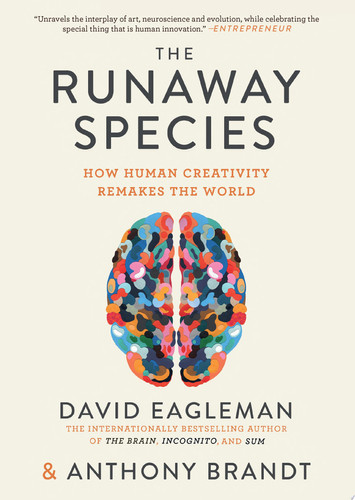
The Runaway Species How Human Creativity Remakes the World

David Eagleman,Anthony Brandt
This enlightening examination of creativity looks “at art and science together to examine how innovations . . . build on what already exists and rely on three brain operations: bending, breaking and blending” ( The Wall Street Journal ) The Runaway Species is a deep dive into the creative mind, a celebration of the human spirit, and a vision of how we can improve our future by understanding and embracing our ability to innovate. David Eagleman and Anthony Brandt seek to answer the question: what lies at the heart of humanity’s ability—and drive—to create? Our ability to remake our world is unique among all living things. But where does our creativity come from, how does it work, and how can we harness it to improve our lives, schools, businesses, and institutions? Eagleman and Brandt examine hundreds of examples of human creativity through dramatic storytelling and stunning images in this beautiful, full–color volume. By drawing out what creative acts have in common and viewing them through the lens of cutting–edge neuroscience, they uncover the essential elements of this critical human ability, and encourage a more creative future for all of us. “ The Runaway Species approach[es] creativity scientifically but sensitively, feeling its roots without pulling them out.” — The Economist
Catapult 2018-06-19 304 pages

The creativity conundrum: a propulsion model of kinds of creative contributions

Sternberg, Robert J.
People tend to think of creativity as a trait-a single attribute with which we are born that is relatively fixed in quantity. Many people also think of creativity as something that only very gifted people possess. This book challenges all of these notions. The basic idea is that there are multiple kinds of creativity, and that everyone can develop at least some of these kinds of creativity. The book considers the various kinds of creativity as they apply in domains such as science, literature, the arts, government, business, and sports. The most common kind of creativity may be conceptual replication, whereby someone produces a minor variant of work that has been produced before. This kind of creativity represents a "limiting case" of creative thought. Most successful inventions and scientific discoveries represent "forward incrementations," which basically take existing ideas and move them to the next step in the direction the field is already going. Often more radical are redirections, which take a field in a new direction, and reinitiations, which represent essentially a "starting over" of how people think about a given problem. The book discusses 8 kinds of creativity, and how they are similar to and different from each other. It is illustrated with many examples, and describes why it is necessary to distinguish among the kinds of creativity. --From publisher's description.
Psychology Press 2002 141 pages

Let the elephants run: unlock your creativity and change everything

David Usher
"Award-winning musician and founder of CloudID Creativity Lab David Usher believes we just need the right tools to help us reconnect with our imaginations in our day-to-day lives whether in the head office, the home office, or the artist's studio. Usher empowers readers to achieve more 'aha' moments through two cornerstone principles of creativity: freedom and structure. Using a mix of personal anecdotes and professional examples from the worlds of industry, technology, science, music, and art, he shows us that creativity is not magic; it is a learnable skill that any person or business can master. The dynamic full-colour design includes photographs, artwork and illustrations, as well as action pages to help readers start cultivating the habit of documenting their ideas for future execution."--Provided by publisher.
Anansi 2016 227 pages