6 results for "Business"

Steven Spielberg: interviews

Spielberg, Steven
Steven Spielberg has become a brand name and a force that extends far beyond the movie screen. Phrases like "phone home" and the music score from Jaws are now part of our cultural script, appearing in commercials, comedy routines, and common conversation. Yet few scholars have devoted time to studying Spielberg's vast output of popular films despite the director's financial and aesthetic achievements. Spanning twenty-five years of Spielberg's career, Steven Spielberg: Interviews explores the issues, the themes, and the financial considerations surrounding his work. The blockbuster creator of E.T., Jaws, and Schindler's List talks about dreams and the almighty dollar. "I'm not really interested in making money," he says. "That's always come as the result of success, but it's not been my goal, and I've had a tough time proving that to people." Ranging from Spielberg's twenties to his mid-fifties, the interviews chart his evolution from a brash young filmmaker trying to make his way in Hollywood, to his spectacular blockbuster triumphs, to his maturation as a director seeking to inspire the imagination with meaningful subjects. The Steven Spielberg who emerges in these talks is a complex mix of businessman and artist, of arrogance and insecurity, of shallowness and substance. Often interviewers will uncover the director's human side, noting how changes in Spielberg's personal life -- marriage, divorce, fatherhood, remarriage -- affect his movies. But always the interviewers find keys to the story-telling and filmmaking talent that have made Spielberg's characters and themes shape our times and inhabit our dreams. "Every time I go to a movie, it's magic, no matter what the movie's about," he says. "Whether you watch eight hours of Shoah or whether it's Ghostbusters, when the lights go down in the theater and the movie fades in, it's magic." Lester D. Friedman teaches medical humanities and bioethics at Upstate Medical University and cinema studies in the College of Visual and Performing Arts at Syracuse University. Brent Notbohm of Spring Green, Wisconsin, is a freelance instructor of film production and media studies. He has written and directed several films and videos independently and as a graduate student at Syracuse University's College of Visual and Performing Arts.
University Press of Mississippi 2000 250 pages

Inside the economist's mind: conversations with eminent economists

Paul A. Samuelson,William A. Barnett
By focusing on the human side as well as the intellectual dimensions of how economists work and think, this collection of interviews with top economists of the 20th century becomes a startling and lively introduction to the modern world of macroeconomics. A fun read! For more information, frequent updates, and to comment on the forthcoming book, visit William A. Barnett's weblog at http://economistmind.blogspot.com/. Acclaim for Inside the Economist's Mind "In candid interviews, these great economists prove to be fabulous story tellers of their lives and times. Unendingly gripping for insiders, this book should also help non-specialists understand how economists think." Professor Julio Rotemberg, Harvard University Business School, and Editor, Review of Economics and Statistics. "Economics used to be called the 'dismal science'. It will be impossible for anybody to hold that view anymore ... This is science with flesh and blood, and a lot of fascinating stories that you will find nowhere else." Dr. Jean-Pascal Bénassy, Paris-Jourdan Sciences Économiques, Paris, France "This book provides a rare and intriguing view of the personal and professional lives of leading economists ... It is like A Beautiful Mind , scaled by a factor of 16 [the number of interviews in the book]." Professor Lee Ohanian, University of California at Los Angeles " ... if you want an insider view of how economics has been developing in the last decades, this is the (only) book for you." Professor Giancarlo Gandolfo, University of Rome ‘La Sapienza,’ Rome "Here we see the HUMAN side of path-breaking research, the personalities and pitfalls, the DRAMA behind the science." Professor Francis X. Diebold, University of Pennsylvania, Philadelphia
Blackwell Pub 2007 419 pages

Makin' toons: inside the most popular animated TV shows and movies

Neuwirth, Allan
From the first drawing board sketch to wriggling TV character, Makin’ Toons illustrates the thrills and challenges of making animated cartoon movies as told by the industry’s most successful creators. Cartoon lovers everywhere will be treated to 47 personal interviews with animation artists and industry leaders ranging from Shrek director Andrew Adamson to Rugrats producer Gabor Csupo. These and dozens of other fascinating firsthand accounts chronicle the behind-the-scene antics and commercial dynamics behind such blockbusters as The Simpsons, South Park, Beauty and the Beast, and Dragon Tales, to name just a few. Author Allan Neuwirth—an accomplished animation artist and writer himself—spices the book with insightful comments, hilarious anecdotes, and a true “toon artist’s” sense of humor. He also includes 75 never-before-published concept drawings, character designs, storyboards, and much more. Allworth Press, an imprint of Skyhorse Publishing, publishes a broad range of books on the visual and performing arts, with emphasis on the business of art. Our titles cover subjects such as graphic design, theater, branding, fine art, photography, interior design, writing, acting, film, how to start careers, business and legal forms, business practices, and more. While we don't aspire to publish a New York Times bestseller or a national bestseller, we are deeply committed to quality books that help creative professionals succeed and thrive. We often publish in areas overlooked by other publishers and welcome the author whose expertise can help our audience of readers.
Allworth Press 2003-04-01 272 pages

Nichols and May: interviews

Nichols, Mike,May, Elaine
"In the late 1950s, Mike Nichols (1931-2014) and Elaine May (b. 1932) soared to superstar status as a sketch comedy duo in live shows and television. After their 1962 breakup, both went on to long and distinguished careers in other areas of show business-mostly separately, but sporadically together again. In Nichols and May: Interviews, twenty-seven interviews and profiles ranging over more than five decades tell their stories in their own words. Nichols quickly became an A-list stage and film director, while May, like many women in her field, often found herself thwarted in her attempts to make her distinctive voice heard in projects she could control herself. Yet, in recent years, Nichols's work as a filmmaker has been perhaps unfairly devalued, while May's accomplishments, particularly as a screenwriter and director, have become more appreciated, leading to her present widespread acceptance as a groundbreaking female artist and a creative genius of and for our time. Nichols gave numerous interviews during his career, and editor Robert E. Kapsis culled hundreds of potential selections to include in this volume the most revealing and those that focus on his filmmaking career. May, however, was a reluctant interview subject at best. She often subverted the whole interview process, producing instead a hilarious parody or even a comedy sketch-with or without the cooperation of the sometimes-oblivious interviewer. With its contrasting selection of interviews conventional and oddball, this volume is an important contribution to the study of the careers of Nichols and May"--
University Press of Mississippi 2020 267 pages

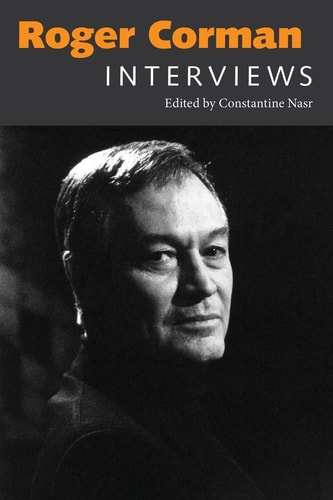
Roger Corman: interviews

Corman, Roger
Roger Corman (b. 1926) is known by many names-craftsman, artist, maverick, schlock-meister, mini-mogul, mentor, cheapskate, and King of the B's. Yet his commitment to filmmaking remains inspired. He learned his craft at the end of the studio system, only to rebel against Hollywood and define himself as the true independent. And the list of directors and producers who learned under his tutelage--Francis Ford Coppola, Martin Scorsese, James Cameron, Jonathan Demme, and many more--is astonishing. Collected here are many of the most honest and revealing interviews of his epic career, several of which have never been seen in print. Roger Corman: Interviews brings into focus a life committed to the entertaining art of motion pictures. Corman's rare talent combined artistic drive with business savvy, ensuring a successful career that was constantly in motion. At a remarkable pace more akin to silent movies than modern Hollywood, he directed over fifty films in less than fifteen years, some entertaining ( Not of This Earth ), trendsetting ( The Wild Angels ), daring ( The Intruder ), workmanlike ( Apache Woman ), stylized ( The Masque of the Red Death ) and even profound ( X: The Man with the X-Ray Eyes ). In a single year, Corman famously shot a cult classic in two and a half days ( The Little Shop of Horrors ), reinvigorated the American horror film with a dash of Poe and Price ( House of Usher )--and still turned out a few more films shot across the globe. Recently awarded an honorary Oscar for his lifetime contribution to cinema, the self-made Corman has created a legacy as a defining filmmaker.
University Press of Mississippi 2011 228 pages

Israel and Europe: an expanding abyss?

Gerstenfeld, Manfred.
Product Description Israel and Europe: An Expanding Abyss? Explores the complex, tense, and historically loaded relationship between Europe and Israel. Over the years a fissure has developed between their political views. Many believe that it continues to widen and has become an abyss. The introductory essay and the following interviews combine together as a reconnaissance mission into the essence of European-Israeli political relations. In the essay, the author illustrates how Israel and often European Jewry have been made to pay for Europe’s major strategic mistakes in defense, energy, and immigration policies. Europe has acted against Israel through voting for one-sided UN resolutions, political statements from the EU and member countries, and EU financing of NGOs hostile to Israel. Israelis and Europeans should not, however, give up hope for better understanding. Israel should take the initiative to see how the damage can be limited without endangering its vital interests or remaining silent about European injustice toward it. In the second part of the book, fourteen interviewees from Europe, Israel, and the United States discuss major aspects of the European-Israeli relationship About the Author Dr. Manfred Gerstenfeld is Chairman of the Board of Fellows of the Jerusalem Center for Public Affairs, editor of the Jewish Political Studies Review, and co-publisher of Post-Holocaust and Anti-Semitism, Jerusalem Viewpoints, and Jewish Environmental Perspective serial publications. He has been an international business strategist for 40 years. His background is in chemistry, economics, environmental studies, and Jewish studies. Gerstenfeld is a former director in a consultancy whose other shareholders included four of the world’s largest banks. He has also been a board member of several public companies including a large investment company. The first of his previous nine books, which have been published in five languages, was the Italian bestseller Revaluing Italy. His other books are: Environment and Confusion; Israel’s New Future: Interviews; The State as a Business: Do-It-Yourself Political Forecasting; Judaism Environmentalism and the Environment; The Environment in the Jewish Tradition: A Sustainable World; Europe’s Crumbling Myths: The Post-Holocaust Origins of Today’s Anti-Semitism; The New Cloths of European Anti-Semitism; and American Jewry’s Challenge: Conversations Confronting the 21st Century.
Jerusalem Center for Public Affairs 2005 227 pages