30 results for "Business"

Think Like a Freak The Authors of Freakonomics Offer to Retrain Your Brain

Steven D. Levitt,Stephen J. Dubner
Now in Paperback—the New York Times bestseller—and follow up to the revolutionary bestsellers Freakonomics and SuperFreakonomics—with a new author Q&A. With their trademark blend of captivating storytelling and unconventional analysis, Steven D. Levitt and Stephen J. Dubner take us inside their thought process and teach us all how to think a bit more productively, more creatively, more rationally. In Think Like A Freak, they offer a blueprint for an entirely new way to solve problems, whether your interest lies in minor lifehacks or major global reforms. The topics range from business to philanthropy to sports to politics, all with the goal of retraining your brain. Along the way, you’ll learn the secrets of a Japanese hot-dog-eating champion, the reason an Australian doctor swallowed a batch of dangerous bacteria, and why Nigerian e-mail scammers make a point of saying they’re from Nigeria. Levitt and Dubner plainly see the world like no one else. Now you can too. Never before have such iconoclastic thinkers been so revealing—and so much fun to read.
HarperCollins 2015-07-07 304 pages

Making Sense Conversations on Consciousness, Morality, and the Future of Humanity

Sam Harris
A New York Times New and Noteworthy Book From the bestselling author of Waking Up and The End of Faith, an adaptation of his wildly popular, often controversial podcast "Civilization rests on a series of successful conversations." --Sam Harris Sam Harris--neuroscientist, philosopher, and bestselling author--has been exploring some of the most important questions about the human mind, society, and current events on his podcast, Making Sense. With over one million downloads per episode, these discussions have clearly hit a nerve, frequently walking a tightrope where either host or guest--and sometimes both--lose their footing, but always in search of a greater understanding of the world in which we live. For Harris, honest conversation, no matter how difficult or controversial, represents the only path to moral and intellectual progress. This book includes a dozen of the best conversations from Making Sense, including talks with Daniel Kahneman, Timothy Snyder, Nick Bostrom, and Glenn Loury, on topics that range from the nature of consciousness and free will, to politics and extremism, to living ethically. Together they shine a light on what it means to "make sense" in the modern world.
HarperCollins Publishers 2021-08-17 464 pages

Misbehaving: the making of behavioral economics

Thaler, Richard H.
"Coupling recent discoveries in human psychology with a practical understanding of incentives and market behavior, Thaler enlightens readers about how to make smarter decisions in an increasingly mystifying world. He reveals how behavioral economic analysis opens up new ways to look at everything from household finance to assigning faculty offices in a new building, to TV game shows, the NFL draft, and businesses like Uber"--Amazon.
W. W. Norton 2016-06-28 415 pages

Focus: The Hidden Driver of Excellence

Goleman, Daniel
In Focus, psychologist and journalist Daniel Goleman delves into the science of attention in all its varieties, presenting a long-overdue discussion of this little-noticed and underrated mental asset that matters enormously for how we navigate life. Attention works much like a muscle: use it poorly and it can wither; work it well and it grows. In an era of unstoppable distractions, Goleman persuasively argues that now more than ever we must learn to sharpen focus if we are to contend with, let alone thrive in, a complex world. Goleman analyzes attention research as a threesome: inner, other, and outer focus. He shows why high-performers need all three kinds of focus, as demonstrated by rich case studies from fields as diverse as competitive sports, education, the arts, and business. Those who excel rely on what Goleman calls smart practice that helps them improve habits, add new skills, and sustain excellence. Combining cutting-edge research with practical findings, Focus reveals what distinguishes experts from amateurs and stars from average performers.
HARPER PAPERBACKS 2015-05-05 320 pages

The Rise of Superman Decoding the Science of Ultimate Human Performance

Steven Kotler
A Wall Street Journal bestseller. In this groundbreaking book, New York Times bestselling author Steven Kotler decodes the mystery of ultimate human performance. Drawing on over a decade of research and firsthand reporting with dozens of top action and adventure sports athletes like big wave legend Laird Hamilton, big mountain snowboarder Jeremy Jones, and skateboarding pioneer Danny Way, Kotler explores the frontier science of "flow," an optimal state of consciousness in which we perform and feel our best. Building a bridge between the extreme and the mainstream, The Rise of Superman explains how these athletes are using flow to do the impossible and how we can use this information to radically accelerate performance in our own lives. At its core, this is a book about profound possibility; about what is actually possible for our species; about where--if anywhere--our limits lie.
Amazon Publishing 2021-09-07 254 pages

The third act: reinventing your next chapter

Sapan, Joshua
"There's an entirely new way to think about what you do later in life. The third act profiles sixty people who are doing it differently. From names you'll know to those you'll discover for the first time, these life stories and beautiful photographic portraits encourage you to bring your passion and capabilities to redefine and reframe the conventional idea of retirement. Read how well-known celebrities like Alan Alda, Rita Moreno, Gloria Steinem, Jane Fonda, James E. Clyburn, Robert Redford, and Norman Lear took on new challenges at an age when some people choose to slow down. Be inspired by the stories of lesser-known figures like Donzella Washington, who became the oldest graduate of Alabama A&M University at eighty; Andrea Peterson, who fulfilled a lifelong dream of becoming a firefighter at fifty; Paul Dillon, who started an incubator for marine veterans after his business career; Hope Harley, who founded the Bronx Children's Museum after a career at telecommunications company; and many more"--Back cover.
Princeton Architectural Press 2022 159 pages

How to Actually Change Your Mind

Eliezer Yudkowsky
“I believe that it is right and proper for me, as a human being, to have an interest in the future, and what human civilization becomes in the future. One of those interests is the human pursuit of truth, which has strengthened slowly over the generations (for there was not always science). I wish to strengthen that pursuit further, in this generation. That is a wish of mine, for the Future. For we are all of us players upon that vast gameboard, whether we accept the responsibility or not. “And that makes your rationality my business. “Is this a dangerous idea? Yes, and not just pleasantly edgy 'dangerous.' People have been burned to death because some priest decided that they didn’t think the way they should. Deciding to burn people to death because they ‘don’t think properly’—that’s a revolting kind of reasoning, isn’t it? You wouldn’t want people to think that way, why, it’s disgusting. People who think like that, well, we’ll have to do something about them...“I agree! Here’s my Let’s argue against bad ideas but not set their bearers on fire.” Human intelligence is a an amazing capacity that has single-handedly put humans in a dominant position on Earth. When human intelligence defeats itself and goes off the rails, the fallout therefore tends to be a uniquely big deal. In How to Actually Change Your Mind , decision theorist Eliezer Yudkowsky asks how we can better identify and sort out our biases, integrate new evidence, and achieve lucidity in our daily lives. Because it really seems as though we should be able to do better— —and a three-pound all-purpose superweapon is a terrible thing to waste.
Machine Intelligence Research Institute 2017-02-11 310 pages

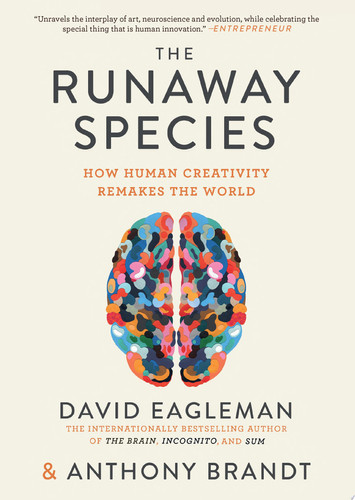
The Runaway Species How Human Creativity Remakes the World

David Eagleman,Anthony Brandt
This enlightening examination of creativity looks “at art and science together to examine how innovations . . . build on what already exists and rely on three brain operations: bending, breaking and blending” ( The Wall Street Journal ) The Runaway Species is a deep dive into the creative mind, a celebration of the human spirit, and a vision of how we can improve our future by understanding and embracing our ability to innovate. David Eagleman and Anthony Brandt seek to answer the question: what lies at the heart of humanity’s ability—and drive—to create? Our ability to remake our world is unique among all living things. But where does our creativity come from, how does it work, and how can we harness it to improve our lives, schools, businesses, and institutions? Eagleman and Brandt examine hundreds of examples of human creativity through dramatic storytelling and stunning images in this beautiful, full–color volume. By drawing out what creative acts have in common and viewing them through the lens of cutting–edge neuroscience, they uncover the essential elements of this critical human ability, and encourage a more creative future for all of us. “ The Runaway Species approach[es] creativity scientifically but sensitively, feeling its roots without pulling them out.” — The Economist
Catapult 2018-06-19 304 pages

Moral Calculations Game Theory, Logic, and Human Frailty

Laszlo Mero
Are people ever rational? Consider this: You auction off a one-dollar bill to the highest bidder, but you set the rules so that the second highest bidder also has to pay the amount of his last bid, even though he gets nothing. Would people ever enter such an auction? Not only do they, but according to Martin Shubik, the game's inventor, the average winning bid (for a dollar, remember) is $3.40. Many winners report that they bid so high only because their opponent "went completely crazy." This game lies at the intersection of three subjects of eternal fascination: human psychology, morality, and John von Neumann's game theory. Hungarian game-theorist Laszlo Mero introduces us to the basics of game theory, including such concepts as zero-sum games, Prisoner's Dilemma and the origins of altruism; shows how game theory is applicable to fields ranging from physics to politics; and explores the role of rational thinking in the context of many different kinds of thinking. This fascinating, urbane book will interest everyone who wonders what mathematics can tell us about the human condition.
Springer New York 2012-10-17 276 pages

The Leaders We Need And What Makes Us Follow

Michael Maccoby,Tim Scudder
There is one irrefutable definition of a leader: someone with followers. Without followers, there is no leader. But people follow a leader in different ways and for different reasons. Leadership is a relationship between leaders and followers. This relationship depends on the qualities of both leaders and followers in a particular context. Someone can be a leader in one context but not in another. In this revised edition of The Leaders We Need and What Makes Us Follow Michael Maccoby with Tim Scudder show how leadership relationships can improve organizations and societies and be developmental for both leaders and followers. The book delves deeply into the dynamics of followership, answering questions such as the following. Why do people follow a leader? Why do we sometimes follow bad leaders? Why do we sometimes turn against leaders we once admired? How have the values of followers been changing? To collaborate more productively, both leaders and followers need to develop their Personality Intelligence. The more complex and interdependent work becomes, the more organizations need people who are engaged in their work. Personality Intelligence as it is described in this book equips us to understand each other, our drives, values, fears, hopes, and dreams. It combines intellectual and emotional intelligence, both head and heart. It is aided by personality assessments, such as the Strength Development Inventory (SDI) that give leaders and followers a shared language that helps in avoiding conflict and developing strengths. Based on the authors' extensive experience, this book provides examples from many different organizations in different countries of how Personality Intelligence has improved relationships at work. Although the myth of the single leader persists, most organizations need a leadership team, including three types of leaders: Strategic, Operational, and Networking. They typically have different personalities, but they are most effective if they develop and practice a leadership philosophy that describes their organizational purpose, the practical values essential to accomplish that purpose, the moral basis for decisions, and the definition of results. Increasingly the Millennial generation who share an Interactive social character want to work at organizations with a purpose and values that improve society. This book is not a quick-fix or a list of steps to success, but it will make you think more deeply about why people will or will not follow you and how you can become the kind of leader your followers need.
Personal Strengths Publishing, Incorporated 2017-05 198 pages

Brain Imaging - An Illustrated Guide to the Future of Neuroscience

Moran Cerf
Can we download our consciousness, and if so where should the backup be stored? Why is it that we can drive tired, but not drunk (when sleepiness has caused many more accidents)? What senses would we want to add if we could expand our perception? What types of crimes might we face in an era of neural implants? What would learning look like if humans could transmit thoughts across brains? How can we improve (/ruin) relationships, sex, and intimacy using cross-brain communication? And what can the business world do as it prepares for a world of mind reading? Those and other issues that are at the forefront of current neuroscience research are addressed in a sequence of comical and thought-provoking illustrations by Moran Cerf, professor of neuroscience and business. This graphical visualization of our future makes readers of all ages - kids and adults alike - laugh, and then think.
Mindcraft 2025-05-20 84 pages

Knowledge as desire: an essay on Freud and Piaget

Furth, Hans Gerald
From Library Journal "What is the meaning of the infant having to build a distorted symbolic world that in the end has to be discarded and repressed?" The present work seeks to provide a "Freudian-Piagetian synthesis" that shows how this symbol-bound world of free libidinal impulses and object relations is not discarded, but becomes a precondition, a symbolic investment, for interpersonal drives and knowledge acquisition. To Furth (Psychology, Catholic Univ. of America), "the objects of knowledge are objects of intense desire," as shown in the theories of Piaget and in the metapsychology of Freud. This clearly written synthesis will be cited in future references to theories of a knowledge-id connection, and the biological drive theory of human sociability and morality. For academic collections. William Abrams, Portland State Univ. Lib., Ore.Copyright 1987 Reed Business Information, Inc.
Columbia University Press 1987 179 pages

The Things They Say behind Your Back: Stereotypes and the Myths Behind Them

Helmreich, William B.
Cover -- Half Title -- Title Page -- Copyright Page -- Contents -- Acknowledgments -- One: All About Stereotypes -- Two: Jews -- The Jewish Mother -- Internationalists Plotting to Take Over the World -- Shrewd Businessmen -- Have Horns -- The Chosen People -- Killed Jesus Christ -- Smarter -- Cheap -- Control Wall Street and the Banks -- Rich and Ostentatious -- Pushy and Aggressive -- Control the Media -- Have Big Noses -- Three: Italians -- "Mangia! Mangia!"--Stupid, Ignorant, Suspicious of Education -- Family-Oriented, Clannish, Distrustful of Outsiders -- Great Singers -- Talk with Their Hands -- Belong to the Mafia -- Cowards in Battle -- Violent and Quick-Tempered -- Great Shoemakers -- Four: Blacks -- Hypersensitive -- Sexual Prowess -- Physically Powerful, Great Athletes -- Dirty and Slovenly -- Stupid -- Musically Gifted, Great Rhythm, Terrific Entertainers -- Lazy and Shiftless -- Big Cadillacs and Flashy Clothes -- Violent Criminals -- Five: Japanese -- Chauvinistic -- Hardworking, Ambitious, and Competitive -- Highly Educated and Intelligent -- Japanese Women are Servile and Obedient -- The Sneaky Jap -- Strong Family Ties -- Great Imitators -- Law-Abiding -- Six: Chinese -- Sly, Sinister, and Deceitful -- No Tickee, No Washee -- Inscrutable -- The Best Food in the World -- Learned and Wise -- Love to Gamble -- Cruel -- Strong Family Ties -- Quiet, Polite, and Deferential -- Seven: Irish -- Heavy Drinkers -- Good at Politics -- Sexually Repressed -- Very Religious -- Highly Nationalistic -- Literary, Witty, and Gregarious -- The "Fighting Irish"--Eight: Poles -- Dumb -- Dirty -- Racists and Bigots -- Uneducated -- Boorish and Uncultured, Low Class -- Nine: WASPs -- Honorable -- Hardworking, Industrious, and Thrifty -- Cold and Insensitive -- Well-Mannered, Polite, Genteel -- Snobbish
[distributor] Taylor & Francis, c/o Bookpoint 2017-10-27 276 pages

The Art Of Thinking

Dagobert D. Runes
The Art of Thinking by Dagobert D. Runes is a comprehensive guide to developing critical thinking skills. The book covers a wide range of topics, including logic, reasoning, problem-solving, decision-making, and creativity. Runes explores the importance of clear and concise communication, and provides practical techniques for improving one's ability to express ideas effectively.The Art of Thinking is divided into three main sections. The first section focuses on the foundations of critical thinking, including the nature of thought and the principles of logic. The second section delves into specific thinking skills, such as analysis, synthesis, and evaluation. The final section explores the practical applications of critical thinking in various contexts, including business, education, and personal relationships.Throughout the book, Runes provides numerous examples and exercises to help readers develop and apply their critical thinking skills. He also emphasizes the importance of self-reflection and continuous learning, encouraging readers to regularly evaluate their own thinking processes and seek out new information and perspectives.Overall, The Art of Thinking is a valuable resource for anyone looking to improve their critical thinking skills and become a more effective and thoughtful communicator.This scarce antiquarian book is a facsimile reprint of the old original and may contain some imperfections such as library marks and notations. Because we believe this work is culturally important, we have made it available as part of our commitment for protecting, preserving, and promoting the world's literature in affordable, high quality, modern editions, that are true to their original work.
Literary Licensing, LLC 2011-05 96 pages

Psychology and Social Sanity

Hugo Münsterberg
Hugo Munsterberg (1863-1916) was a German-American psychologist. He was one of the pioneers in applied psychology, extending his research and theories to Industrial / Organizational (I/O), legal, medical, clinical, educational and business settings. He encountered immense turmoil with the outbreak of the First World War. Torn between his loyalty to America and his homeland, he often defended Germany's actions, attracting criticism. He believed that mental illness had a psychological basis and made diagnoses based on behavioral observations, an interview and answers received by the patients whom he interviewed. These studies led him to publish the book, Psychotherapy (1909). In 1908, he published his controversial book, On the Witness Stand (1908), which talked about psychological factors that can affect a trial's outcome. In 1913, he wrote the book Psychology and Industrial Efficiency which looked at problems with monotony, attention and fatigue, physical and social influences on the working power, the effects of advertising and the future development of economic psychology. His other works include: Psychology and Social Sanity (1914), The War and America (1914) and The Photoplay: A Psychological Study (1916).
Dodo Press 2008-04 156 pages

Single-case research designs

Alan E. Kazdin,A. Hussain Tuma
Single-case research has played an important role in developing and evaluating interventions that are designed to alter a particular facet of human functioning. Now thoroughly updated in its second edition, acclaimed author Alan E. Kazdin's Single-Case Research Designs provides a notable contrast to the quantitative methodology approach that pervades the biological and social sciences. While focusing on widely applicable methodologies for evaluating interventions--such as treatment or psychotherapy using applied behavior analysis--this revised edition also encompasses a broader range of research areas that utilize single-case designs, demonstrating the pertinence of this methodology in various disciplines, from psychology and medicine to business and industry. This well-written, clear, and thoroughly updated text is ideal for practitioners, instructors, and students alike.
Jossey-Bass Publishers 1982 93 pages

DECISION TIME! Better Decisions for a Better Life

Richard Davidson
Where you are in life today is the result of all of the past decisions which you have made or which have been made for you in response to the various situations and events, both expected and unexpected, that have impacted your life. The decisions that you will make from this point forward will determine the degree to which your future will be positive or negative. "Decision Time!" describes the subjective and multi-variable nature of real life decisions and demonstrates techniques for making complex decisions with ease and insight. "Decision Time!" provides guidance for many different decision-making situations with both personal and business aspects. Topics with examples from life include games, negotiation, the challenge of financing a college education, starting a small business, purchasing/shopping, family relationships, getting the government to listen to you, investments, and many more. "Decision Time!" gives you insight into the decision-making process as applied to both small and large choices you will face. It includes dynamic aspects, cultural effects, and morality as applied to decision-making for individuals, teams, and societies. "Decision Time!" prepares you to face the continuous impact of decision situations confidently and without hesitation.
Richard Davidson 2007-08 176 pages