7 results for "Business"

Making Sense Conversations on Consciousness, Morality, and the Future of Humanity

Sam Harris
A New York Times New and Noteworthy Book From the bestselling author of Waking Up and The End of Faith, an adaptation of his wildly popular, often controversial podcast "Civilization rests on a series of successful conversations." --Sam Harris Sam Harris--neuroscientist, philosopher, and bestselling author--has been exploring some of the most important questions about the human mind, society, and current events on his podcast, Making Sense. With over one million downloads per episode, these discussions have clearly hit a nerve, frequently walking a tightrope where either host or guest--and sometimes both--lose their footing, but always in search of a greater understanding of the world in which we live. For Harris, honest conversation, no matter how difficult or controversial, represents the only path to moral and intellectual progress. This book includes a dozen of the best conversations from Making Sense, including talks with Daniel Kahneman, Timothy Snyder, Nick Bostrom, and Glenn Loury, on topics that range from the nature of consciousness and free will, to politics and extremism, to living ethically. Together they shine a light on what it means to "make sense" in the modern world.
HarperCollins Publishers 2021-08-17 464 pages

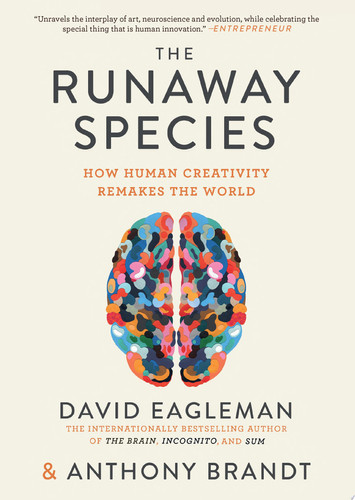
The Runaway Species How Human Creativity Remakes the World

David Eagleman,Anthony Brandt
This enlightening examination of creativity looks “at art and science together to examine how innovations . . . build on what already exists and rely on three brain operations: bending, breaking and blending” ( The Wall Street Journal ) The Runaway Species is a deep dive into the creative mind, a celebration of the human spirit, and a vision of how we can improve our future by understanding and embracing our ability to innovate. David Eagleman and Anthony Brandt seek to answer the question: what lies at the heart of humanity’s ability—and drive—to create? Our ability to remake our world is unique among all living things. But where does our creativity come from, how does it work, and how can we harness it to improve our lives, schools, businesses, and institutions? Eagleman and Brandt examine hundreds of examples of human creativity through dramatic storytelling and stunning images in this beautiful, full–color volume. By drawing out what creative acts have in common and viewing them through the lens of cutting–edge neuroscience, they uncover the essential elements of this critical human ability, and encourage a more creative future for all of us. “ The Runaway Species approach[es] creativity scientifically but sensitively, feeling its roots without pulling them out.” — The Economist
Catapult 2018-06-19 304 pages

What Americans really want--really: the truth about our hopes, dreams, and fears

Luntz, Frank I.
No one in America has done more observing of more people than Dr. Frank I. Luntz. From Bill O'Reilly to Bill Maher, America's leading pundits, prognosticators, and CEOs turn to Luntz to explain the present and to predict the future. With all the upheavals of recent events, the plans and priorities of the American people have undergone a seismic shift. Businesses everywhere are trying to market products and services during this turbulent time, but only one man really understands the needs and desires of the New America. From restaurant booths to voting booths, Luntz has watched and assessed our private habits, our public interests, and our hopes and fears. What are the five things Americans want the most? What do they really want in their daily lives? In their jobs? From their government? For their families? And how does understanding what Americans want allow businesses to thrive? Luntz disassembles the preconceived notions we have about one another and lays all the pieces of the American condition out in front of us, openly and honestly, then puts the pieces back together in a way that reflects the society in which we live. What Americans Really Want...Really is a real, if sometimes scary, discussion of Americans' secret hopes, fears, wants, and needs. The research in this book represents a decade of face-to-face interviews with twenty-five thousand people and telephone polls with one million more, as well as the exclusive, first-ever "What Americans Really Want" survey. What Luntz offers is a glimpse into the American psyche, along with analysis that will rock assumptions and right business judgment. He proves that success in virtually any profession demands that we either understand what Americans really want, or suffer the consequences. Praise for Frank Luntz: "When Frank Luntz invites you to talk to his focus group, you talk to his focus group." --President Barack Obama, spoken on June 28, 2007, to a PBS-sponsored focus group following the Democratic presidential debate at Howard University "Frank Luntz understands the American people better than anyone I know." --Newt Gingrich, former Speaker of the House "The Nostradamus of pollsters." --Sir David Frost "America's top companies listen to Frank Luntz because he understands what customers want and what employees think. He has a keen sense of the American psyche and an outstanding command of language that empowers and persuades." --Thomas J. Donohue, President & CEO, U.S. Chamber of Commerce
Hyperion 2010-09-14 336 pages

The Things They Say behind Your Back: Stereotypes and the Myths Behind Them

Helmreich, William B.
Cover -- Half Title -- Title Page -- Copyright Page -- Contents -- Acknowledgments -- One: All About Stereotypes -- Two: Jews -- The Jewish Mother -- Internationalists Plotting to Take Over the World -- Shrewd Businessmen -- Have Horns -- The Chosen People -- Killed Jesus Christ -- Smarter -- Cheap -- Control Wall Street and the Banks -- Rich and Ostentatious -- Pushy and Aggressive -- Control the Media -- Have Big Noses -- Three: Italians -- "Mangia! Mangia!"--Stupid, Ignorant, Suspicious of Education -- Family-Oriented, Clannish, Distrustful of Outsiders -- Great Singers -- Talk with Their Hands -- Belong to the Mafia -- Cowards in Battle -- Violent and Quick-Tempered -- Great Shoemakers -- Four: Blacks -- Hypersensitive -- Sexual Prowess -- Physically Powerful, Great Athletes -- Dirty and Slovenly -- Stupid -- Musically Gifted, Great Rhythm, Terrific Entertainers -- Lazy and Shiftless -- Big Cadillacs and Flashy Clothes -- Violent Criminals -- Five: Japanese -- Chauvinistic -- Hardworking, Ambitious, and Competitive -- Highly Educated and Intelligent -- Japanese Women are Servile and Obedient -- The Sneaky Jap -- Strong Family Ties -- Great Imitators -- Law-Abiding -- Six: Chinese -- Sly, Sinister, and Deceitful -- No Tickee, No Washee -- Inscrutable -- The Best Food in the World -- Learned and Wise -- Love to Gamble -- Cruel -- Strong Family Ties -- Quiet, Polite, and Deferential -- Seven: Irish -- Heavy Drinkers -- Good at Politics -- Sexually Repressed -- Very Religious -- Highly Nationalistic -- Literary, Witty, and Gregarious -- The "Fighting Irish"--Eight: Poles -- Dumb -- Dirty -- Racists and Bigots -- Uneducated -- Boorish and Uncultured, Low Class -- Nine: WASPs -- Honorable -- Hardworking, Industrious, and Thrifty -- Cold and Insensitive -- Well-Mannered, Polite, Genteel -- Snobbish
[distributor] Taylor & Francis, c/o Bookpoint 2017-10-27 276 pages

Psychology and Social Sanity

Hugo Münsterberg
Hugo Munsterberg (1863-1916) was a German-American psychologist. He was one of the pioneers in applied psychology, extending his research and theories to Industrial / Organizational (I/O), legal, medical, clinical, educational and business settings. He encountered immense turmoil with the outbreak of the First World War. Torn between his loyalty to America and his homeland, he often defended Germany's actions, attracting criticism. He believed that mental illness had a psychological basis and made diagnoses based on behavioral observations, an interview and answers received by the patients whom he interviewed. These studies led him to publish the book, Psychotherapy (1909). In 1908, he published his controversial book, On the Witness Stand (1908), which talked about psychological factors that can affect a trial's outcome. In 1913, he wrote the book Psychology and Industrial Efficiency which looked at problems with monotony, attention and fatigue, physical and social influences on the working power, the effects of advertising and the future development of economic psychology. His other works include: Psychology and Social Sanity (1914), The War and America (1914) and The Photoplay: A Psychological Study (1916).
Dodo Press 2008-04 156 pages