47 results for "Business"

Making Sense Conversations on Consciousness, Morality, and the Future of Humanity

Sam Harris
A New York Times New and Noteworthy Book From the bestselling author of Waking Up and The End of Faith, an adaptation of his wildly popular, often controversial podcast "Civilization rests on a series of successful conversations." --Sam Harris Sam Harris--neuroscientist, philosopher, and bestselling author--has been exploring some of the most important questions about the human mind, society, and current events on his podcast, Making Sense. With over one million downloads per episode, these discussions have clearly hit a nerve, frequently walking a tightrope where either host or guest--and sometimes both--lose their footing, but always in search of a greater understanding of the world in which we live. For Harris, honest conversation, no matter how difficult or controversial, represents the only path to moral and intellectual progress. This book includes a dozen of the best conversations from Making Sense, including talks with Daniel Kahneman, Timothy Snyder, Nick Bostrom, and Glenn Loury, on topics that range from the nature of consciousness and free will, to politics and extremism, to living ethically. Together they shine a light on what it means to "make sense" in the modern world.
HarperCollins Publishers 2021-08-17 464 pages

The Identity Trap

Mounk, Yascha
Named a Best Book of the Year by The Economist , Financial Times , Inc. , Prospect Magazine , and The Conversation “The most comprehensive and reasonable story of this shift that has yet been attempted . . . Mounk has told the story of the Great Awokening better than any other writer who has attempted to make sense of it.” — The Washington Post “An intellectual tour de force about the origins of identity politics and the threat it presents to genuine, honest, old-fashioned liberalism.” — Bret Stephens, The New York Times “Among the most insightful and important books written in the last decade on American democracy and its current torments, because it also shows us a way out of the trap.” —Jonathan Haidt, author of The Righteous Mind , and coauthor of The Coddling of the American Mind “Outstanding.” — David Brooks, The New York Times A fascinating account of the origins of “wokeness”—and a trenchant explanation for why the noble goals of identity politics are doomed to fail For much of history, societies have violently oppressed ethnic, religious, and sexual minorities. It is no surprise that many came to believe that members of mar­ginalized groups need to take pride in their identity to resist injustice. But over the past decades, a healthy appreciation for the culture and heritage of minority groups transformed into our contemporary form of identity politics, a counterproductive obsession with group identity. This new ideology denies that members of different groups can truly understand each other and insists that the way governments treat their citizens should depend on the color of their skin. This, Yascha Mounk argues, is the identity trap. Those who battle for these ideas are often full of good intentions. But they ultimately stand in the way of the genuine equality we desperately need. Mounk was one of the first to warn of the risks that right-wing populists pose to American democracy, a danger that remains as serious as ever. But as he shows here, the identitarian left and the populist right actually reinforce each other; to vanquish one, it is necessary to oppose both. In The Identity Trap , Mounk provides the most ambitious and comprehensive account to date of the origins, consequences, and limitations of “wokeness.” He shows how postmodernism, postcolonialism, and critical race theory conquered many college campuses and forged an “identity synthesis” that gained tremendous influence in business, media, and government by 2020. Finally, Mounk makes a nuanced philosophical case for why these ideas are so counterproductive—and why universal, humanist values can best serve the vital goal of true equality. The Identity Trap provides truth and clarity where they are needed most.
Penguin USA 2025-09-23 432 pages

How Soccer Explains the World

Foer, Franklin
“Step aside Tom Friedman, Sam Huntington, and Amy Chua. Franklin Foer’s dark and witty tale of the soccer world reveals the meaning of globalization in all its joys and horrors.”—Robert Kagan Just in time for the 2026 World Cup in North America—a reissue of the bestselling sports classic, featuring a new preface from the author. With the 2026 World Cup in all three nations of North America, the power and scope of soccer has truly become global. In this remarkably insightful, wide-ranging work, Franklin Foer argues that soccer is much more than a game, or even a way of life. It is a unique window into the crosscurrents of modern globalization, with all of its benefits and pitfalls. Soccer clubs don’t represent geographic areas; they stand for social classes and political ideologies. Unlike baseball or tennis, soccer is freighted with ancient hatreds and history. It’s a sport with real stakes—a catalyst capable of ruining regimes and launching liberation movements. Foer takes us on a surprising tour through the world of soccer, shattering myths and dire predictions. Instead of destroying local cultures, as the left warned, globalization has revived tribalism. Far from the triumph of capitalism that the right anticipated, it has entrenched corruption. From Brazil to Bosnia, Italy to Iraq, How Soccer Explains the World is an eye-opening chronicle of how a beautiful sport and its fanatical followers can illuminate the fault lines of a society, whether it’s terrorism, poverty, anti-Semitism, authoritarianism, or radical Islam—issues that continue to affect all of us. At a time when globalization is under attack and many Americans yearn for retrenchment and retreat from the world, this remarkable book—filled with blazing intelligence, colorful characters, wry humor, and an equal passion for soccer and humanity—continues to make sense of our troubled times.
HarperCollins Publishers LLC 2026-04-07 288 pages

The New Society: The Anatomy of Industrial Order

Drucker, Péter
In The New Society, Peter Drucker extended his previous works The Future of Industrial Man and The Concept of the Corporation into a systematic, organized analysis of the industrial society that emerged out of World War II. He analyzes large business enterprises, governments, labor unions, and the place of the individual within the social context of these institutions. Although written when the industrial society he describes was at its peak of productivity, Drucker's basic conceptual frame has well stood the test of time. Following publication of the first printing of The New Society, George G. Higgins wrote in Commonweal that "Drucker has analyzed, as brilliantly as any modem writer, the problems of industrial relations in the individual company or 'enterprise.' He is thoroughly at home in economics, political science, industrial psychology, and industrial sociology, and has succeeded admirably in harmonizing the findings of all four disciplines and applying them meaningfully to the practical problems of the 'enterprise.'" This well expresses contemporary critical opinion. Peter Drucker's new introduction places The New Society in a contemporary perspective and affirms its continual relevance to industry in the mid-1990s. Economists, political scientists, psychologists, and professionals in management and industry will find this seminal work a useful tool for understanding industry and society at large.
[distributor] Taylor & Francis, c/o Bookpoint 2017 362 pages

Understanding socialism

Wolff, Richard D.
"Understanding Socialism is a plainspoken text that disarms false narratives, confronts past failures, and offers a path to a fresh and modern understanding of socialism, by outlining what democracy in the workplace could look like. Wolff not only explains what socialism is and has meant to its various proponents, he also looks at the transition from feudalism to capitalism as a model to help us visualize an evolution from our current socioeconomic state. Understanding Socialism explores how socialist theory was used and applied to help shape the histories of countries such as Russia and China, and beyond. Wolff also analyzes the successes and defeats of those countries, the world's reactions to them, and how they offer important lessons for the building of a democratic, worker-controlled 21st-century socialism."--Publisher description.
Haymarket Books 2025-12-09 156 pages

A functioning society

Peter F. Drucker
Peter F. Drucker may be best known as a writer on business and management, but these subjects were not his foremost intellectual concern. Drucker's primary concerns were community, in which the individual has status, and society, in which the individual has function. Here he has assembled selections from his vast writings on these subjects. This collection presents the full range of Drucker's thought on community, society, and political structure and constitutes an ideal introduction to his ideas. The volume is divided into seven parts. The selections in parts 1 and 2 were mostly written during World War Two and in the wake of the Great Depression. Part 3 deals with the limits of governmental competence in the social and economic realm. It contains some of Drucker's most influential writings concerned with the difference between big government and effective government. The chapters in part 4 explore autonomous centers of power outside government and within society. Part 5 contains chapters from Drucker's path-breaking work on the corporation as a social organization rather than merely an economic one. The rise of the so-called "knowledge industries" forms the background for part 6. The concluding part 7 is devoted entirely to Drucker's long essay "The Next Society." Drucker examines the emergence of new institutions and new theories arising from the information revolution and the social changes they are helping to bring about. In organizing these representative writings, Drucker chose to be topical rather than chronological, with each excerpt presenting a basic theme of his life's work. As is characteristic of his efforts, A Functioning Society appeals both the general reader as well as a cross-disciplinary scholarly readership.
Transaction Publishers 2011-02 242 pages

New Power

Jeremy Heimans,Henry Timms
Shortlisted for the Financial Times and McKinsey Business Book of the Year Award 2018"This book will inform and inspire all those wanting to make change . . . and achieve a goal against all odds." Jane Goodall, founder of the Jane Goodall Institute and a UN Messenger of Peace In this indispensable guide to navigating the 21st century, two visionary thinkers reveal the unexpected ways power is changing - and how 'new power' is reshaping politics, business and life. Why do some leap ahead while others fall behind in today's chaotic, connected age? In New Power, Australian Jeremy Heimans and Brit Henry Timms confront the biggest stories of our time - the rise of mega-platforms like Facebook and Uber; the out-of-nowhere victories or Presidents Barack Obama and Donald Trump; the unexpected emergence of movements like #BlackLivesMatter and #MeToo; and the erruption of darker forces such as ISIS. For most of human history, the rules of power were clear: power was something to be seized and jealously guarded. This 'old power' was inaccessible to the vast majority of people. But widespread connectivity has made possible a different kind of power. 'New power' is made by the many rather than the few. It is open, participatory, and peer-driven. It works like a current, not a currency - and like water or electricity, it is most forceful when it surges. In a world increasingly shaped by new power, this revelatory book gives each of us a new way to understand the world and our role in it. SHORTLISTED FOR THE FINANCIAL TIMES & MCKINSEY BOOK OF THE YEAR 2018 PRAISE FOR NEW POWER" If you want to understand how the world is changing, what's really happening and how we can all find our way, this book could not becoming at a better time." Richard Branson"New Power is an essential and extremely insightful guide for anyone who wants to maximize the opportunities for progress and impact in today's new tightly connected world." Reid Hoffman, co-founder of LinkedIn and co-author of the #1 New York Times bestsellers The Alliance and The Startup of You "A must-read, New Power is a gift to our movements. It's not just about going viral-it's about connecting millions of people to roll up our sleeves and create the changes we long for." Alicia Garza, co-founder of Black Lives Matter
Pan Macmillan Australia Pty, Limited 2018-03-27 336 pages

Supercapitalism The Transformation of Business, Democracy, and Everyday Life

Robert B. Reich
Mid-twentieth-century capitalism has turned into global capitalism, and global capitalism - turbocharged, Web-based, and able to find and make almost anything just about anywhere - has turned into supercapitalism. But as Robert B. Reich makes clear in this eye-opening book, while supercapitalism is working wonderfully well to enlarge the economic pie, democracy - charged with caring for all citizens - is becoming less and less effective under its influence. Reich explains how widening inequalities of income and wealth, heightened job insecurity, and the spreading effects of global warming are the logical outcomes of supercapitalism. He shows us why companies, fighting harder than ever to maintain their competitive positions, have become even more deeply involved in politics; and how average citizens, seeking great deals and invested in the stock market to an unprecedented degree, are increasingly loath to stand by their values if it means biting the hands that feed them. As one of America's most influential voices, Reich sets out a clear course to a vibrant capitalism and a concurrent, equally vibrant democracy.
Scribe Publications 2008 272 pages

Microtrends The Small Forces Behind Tomorrow's Big Changes

Mark Penn
The adviser to Senator Hillary Clinton, Bill Gates, and President Bill Clinton proves that small is big by identifying 75 hidden-in-plain-sight trends that are moving America, revealing that the nation is no longer a melting pot but a collection of communities with many individual tastes and lifestyles. "The ideas in his book will help you see the world in a new way." --Bill Clinton "Mark Penn has a keen mind and a fascinating sense of what makes America tick, and you see it on every page of Microtrends ." --Bill Gates In 1982, readers discovered Megatrends . In 2000, The Tipping Point entered the lexicon. Now, in Microtrends , one of the most respected and sought-after analysts in the world articulates a new way of understanding how we live. Mark Penn, the man who identified "Soccer Moms" as a crucial constituency in President Clinton's 1996 reelection campaign, is known for his ability to detect relatively small patterns of behavior in our culture-microtrends that are wielding great influence on business, politics, and our personal lives. Only one percent of the public, or three million people, is enough to launch a business or social movement. Relying on some of the best data available, Penn identifies more than 70 microtrends in religion, leisure, politics, and family life that are changing the way we live. Among them: People are retiring but continuing to work. Teens are turning to knitting. Geeks are becoming the most sociable people around. Women are driving technology. Dads are older than ever and spending more time with their kids than in the past. You have to look at and interpret data to know what's going on, and that conventional wisdom is almost always wrong and outdated. The nation is no longer a melting pot. We are a collection of communities with many individual tastes and lifestyles. Those who recognize these emerging groups will prosper. Penn shows readers how to identify the microtrends that can transform a business enterprise, tip an election, spark a movement, or change your life. In today's world, small groups can have the biggest impact.
Grand Central Publishing 2007-09 448 pages

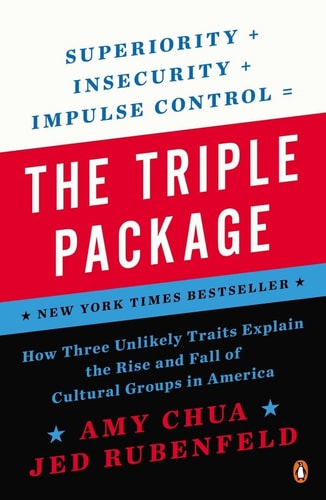
The Triple Package How Three Unlikely Traits Explain the Rise and Fall of Cultural Groups in America

Amy Chua,Jed Rubenfeld
"That certain groups do much better in America than others — as measured by income, occupational status, test scores, and so on — is difficult to talk about. In large part this is because the topic feels racially charged. The irony is that the facts actually debunk racial stereotypes. There are black and Hispanic subgroups in the United States far outperforming many white and Asian subgroups. Moreover, there’s a demonstrable arc to group success — in immigrant groups, it typically dissipates by the third generation — puncturing the notion of innate group differences and undermining the whole concept of 'model minorities.'" Mormons have recently risen to astonishing business success. Cubans in Miami climbed from poverty to prosperity in a generation. Nigerians earn doctorates at stunningly high rates. Indian and Chinese Americans have much higher incomes than other Americans; Jews may have the highest of all. Why do some groups rise? Drawing on groundbreaking original research and startling statistics, The Triple Package uncovers the secret to their success. A superiority complex, insecurity, impulse control—these are the elements of the Triple Package, the rare and potent cultural constellation that drives disproportionate group success. The Triple Package is open to anyone. America itself was once a Triple Package culture. It’s been losing that edge for a long time now. Even as headlines proclaim the death of upward mobility in America, the truth is that the old-fashioned American Dream is very much alive—but some groups have a cultural edge, which enables them to take advantage of opportunity far more than others. • Americans are taught that everyone is equal, that no group is superior to another. But remarkably, all of America’s most successful groups believe (even if they don’t say so aloud) that they’re exceptional, chosen, superior in some way. • Americans are taught that self-esteem—feeling good about yourself—is the key to a successful life. But in all of America’s most successful groups, people tend to feel insecure, inadequate, that they have to prove themselves. • America today spreads a message of immediate gratification, living for the moment. But all of America’s most successful groups cultivate heightened discipline and impulse control. But the Triple Package has a dark underside too. Each of its elements carries distinctive pathologies; when taken to an extreme, they can have truly toxic effects. Should people strive for the Triple Package? Should America? Ultimately, the authors conclude that the Triple Package is a ladder that should be climbed and then kicked away, drawing on its power but breaking free from its constraints. Provocative and profound, The Triple Package will transform the way we think about success and achievement.
Penguin 2015-01-27 352 pages

Manipulation: what it is, why it's bad, what to do about it

Sunstein, Cass R.
"New technologies are offering companies, politicians, and others unprecedented opportunity to manipulate us. Sometimes we are given the illusion of power - of freedom - through choice, yet the game is rigged, pushing us in specific directions that lead to less wealth, worse health, and weaker democracy. In, Manipulation, nudge theory pioneer and New York Times bestselling author, Cass Sunstein, offers a new definition of manipulation for the digital age, explains why it is wrong; and shows what we can do about it. He reveals how manipulation compromises freedom and personal agency, while threatening to reduce our well-being; he explains the difference between manipulation and unobjectionable forms of influence, including 'nudges'; and he lifts the lid on online manipulation and manipulation by artificial intelligence, algorithms, and generative AI, as well as threats posed by deepfakes, social media, and 'dark patterns,' which can trick people into giving up time and money. Drawing on decades of groundbreaking research in behavioral science, this landmark book outlines steps we can take to counteract manipulation in our daily lives and offers guidance to protect consumers, investors, and workers." --
Cambridge University Press 2025-08-28 219 pages

Inevitable surprises: thinking ahead in a time of turbulence

Peter Schwartz
The world we live in today is more volatile than ever. The security of free nations is threatened by rogue states, the global economy is in flux, and the rapid advance of technology forces constant reevaluation of our society. With so many powerful forces at work and seemingly unpredictable events occurring, to many the future seems dark, and its possibilities frightening. Peter Schwartz disagrees. A world-renowned visionary in the field of scenario planning, Schwartz’s startling—and accurate— predictions have been employed by government agencies and major corporations for more than twenty-five years. He argues that the future is foreseeable, and that by examining the dynamics at work today we can predict the “inevitable surprises” of tomorrow. Timely and thought-provoking, Inevitable Surprises is a book that no one with an interest in business—or the future of our society—can afford to miss.
Gotham Books 2004-05-24 247 pages

Minds wide shut: how the new fundamentalisms divide us

Morson, Gary Saul,Schapiro, Morton Owen
A timely exploration of intellectual dogmatism in politics, economics, religion, and literature—and what can be done to fight it Polarization may be pushing democracy to the breaking point. But few have explored the larger, interconnected forces that have set the stage for this crisis: namely, a rise in styles of thought, across a range of fields, that literary scholar Gary Saul Morson and economist Morton Schapiro call “fundamentalist.” In Minds Wide Shut , Morson and Schapiro examine how rigid adherence to ideological thinking has altered politics, economics, religion, and literature in ways that are mutually reinforcing and antithetical to the open-mindedness and readiness to compromise that animate democracy. In response, they propose alternatives that would again make serious dialogue possible. Fundamentalist thinking, Morson and Schapiro argue, is not limited to any one camp. It flourishes across the political spectrum, giving rise to dueling monologues of shouting and abuse between those who are certain that they can’t be wrong, that truth and justice are all on their side, and that there is nothing to learn from their opponents, who must be evil or deluded. But things don’t have to be this way. Drawing on thinkers and writers from across the humanities and social sciences, Morson and Schapiro show how we might begin to return to meaningful dialogue through case-based reasoning, objective analyses, lessons drawn from literature, and more. The result is a powerful invitation to leave behind simplification, rigidity, and extremism—and to move toward a future of greater open-mindedness, moderation, and, perhaps, even wisdom.
Princeton University Press 2023-01-31 307 pages

Voices from the Pandemic Americans Tell Their Stories of Crisis, Courage and Resilience

Eli Saslow
From Pulitzer Prize-winning Washington Post reporter Eli Saslow, a powerful portrait of a country grappling with the pandemic, told through voices of people from all across America The Covid-19 pandemic was a world-shattering event, affecting everyone in the nation. From its first ominous stirrings, renowned journalist Eli Saslow began interviewing a cross-section of Americans, capturing their experiences in real time: An exhausted and anguished EMT risking his life in New York City; a grocery store owner feeding his neighborhood for free in locked-down New Orleans; an overwhelmed coroner in Georgia; a Maryland restaurateur forced to close his family business after forty-six years; an Arizona teacher wrestling with her fears and her obligations to her students; rural citizens adamant that the whole thing is a hoax, and retail workers attacked for asking people to wear masks; patients struggling to breathe and doctors desperately trying to save them. Through Saslow's masterful, empathetic interviewing, we are given a kaleidoscopic picture of a people dealing with the unimaginable. These deeply personal accounts make for cathartic reading, as we see Americans at their worst, and at their resilient best.
Random House Large Print 2021 304 pages

Social mobility in industrial society

Lipset, Seymour Martin,Bendix, Reinhard
"Where else but in America," captains of industry are fond of saying, "could a penniless immigrant like Andrew Carnegie achieve so much?" "Any place else that has reached the same stage of industrial development," is the answer implicit in Social Mobility. The authors conclude, somewhat surprisingly, that is not noticeably easier to pull oneself up by the bootstraps in the "Land of Opportunity" than it is in a number of other countries. The very process of industrialization, with its growing demands for skilled management, prevents an elite in any nation form permanently establishing itself in a position of exclusive superiority. Even in states where neither political institutions nor official ideologies favor upward mobility, increasing industrialization requires a growing--and, consequently, a changing--elite class. The authors are concerned primarily with mobility in the total population, with movements into and out of the working class, though they report extensively on the social origins of business leaders in various countries. They deal, too, with the different values of different societies and with the motivation of the socially mobile. Solidly based on examination of studies in more than ten languages and of raw data from unpublished works, this is the first attempt in thirty years to bring together in one volume what is known of social mobility around the world. Here is the first systematic comparison of mobility patterns in such diverse countries as Sweden and Italy, Great Britain and Japan--a comparison backed by statistics and given added meaning by discussions of the causes and consequences of mobility. The authors analyze in detail the political implications of mobility and they explore the relationship between education and mobility. Their discussions of factors making for success or failure in school, of the role of intelligence in mobility, of the effects on children of growing up in various environments, and of the varying personalities of the mobile and non-mobile bring together the work of both psychologists and sociologists. This title is part of UC Press's Voices Revived program, which commemorates University of California Press’s mission to seek out and cultivate the brightest minds and give them voice, reach, and impact. Drawing on a backlist dating to 1893, Voices Revived makes high-quality, peer-reviewed scholarship accessible once again using print-on-demand technology. This title was originally published in 1959.
Univ of California Press 2018-10-23 332 pages

Work and Authority in Industry: Managerial Ideologies in the Course of Industrialization

Bendix, Reinhard
Work and Authority in Industry analyzes how the entrepreneurial class responded to the challenge of creating, and later managing, an industrial work force in widely differing types of industrial societies: the United States, England, and Russia. Bendix's penetrating re-examination of an aspect of economic history largely taken for granted was first published in 1965. It has become a classic. His central notion, that the behavior of the capitalist class may be more important than the behavior of the working class in determining the course of events, is now widely accepted. The book explores industrialization, management, and ideological appeals; entrepreneurial ideologies in England's early phase of industrialization; entrepreneurial ideologies in eighteenth- and nineteenth-century Russia; the bureaucratization of economic enterprises; and the American experience with -industrialization. This essential text will interest those in the fields of political science, industrial relations, management studies, as well as comparative sociologists and historians.
Routledge 2018 464 pages

The Jewish Woman in America

Charlotte Baum,Charlotte Brown,Paula Hyman,Sonya Michel
This encyclopedia provides the first standard reference work on the lives, history and activities of Jewish women in the United States. Covering a period which extends from the arrival of the first Jewish women in North America in 1654 to the present, this two-volume set presents the most comprehensive and detailed portrait of American Jewish women ever published, and brings together for the first time the wealth of recent scholarship on this subject. Includes: * Biographical entries on over 800 individual women. * 128 topical articles on organizations such as Hadassah, the National Council of Jewish Women, Mizrachi, and the Ladies' Garment Workers' Union. * Major essays on Jewish women's participation in the movement for women's suffrage, social reform, civil rights, and the recent women's movement. * The activities of Jewish women in politics, business, education, the arts, and religion. * A readable, inviting format with over 500 large photographs. * Bibliographies at the end of each entry which include overviews of major scholarship in the field, complete citations of more general works and citations of additional bibliographical and reference sources. * The comprehensive index includes citations to every substantive discussion in the entries as well as all proper names appearing in the text, such as organizations, book, song and film titles, schools, and individuals. The "Encyclopedia" provides information on American Jewish women in all fields of endeavor, and pays special attention to the work of women in the arts, academics, law, the labor movement, education, science, medicine, journalism and publishing, and on the lives of ordinary Jewish women during all time periods and in all regions of the United States.
New American Library 1977 290 pages

Letters to Camondo

Edmund de Waal
A tragic family history told in a collection of imaginary letters to a famed collector, Moïse de Camondo. 63 rue de Monceau, Paris Dear friend, As you may have guessed by now, I am not in your house by accident. I know your street rather well. Count Moïse de Camondo lived a few doors away from Edmund de Waal’s forebears, the Ephrussi, first encountered in his bestselling memoir, The Hare with Amber Eyes . Like the Ephrussi, the Camondos were part of belle epoque high society. They were also targets of antisemitism. Camondo created a spectacular house and filled it with the greatest private collection of French eighteenth-century art for his son, Nissim, to inherit. But when Nissim was killed in the First World War, it became a memorial and, upon the Count’s death, was bequeathed to France. The Musée Nissim de Camondo has remained unchanged since 1936. De Waal explores the lavish rooms and detailed archives and uncovers new layers to the family story. In a series of haunting letters addressed to the Count, he tells us what happened next.
Picador 2022-06-07 192 pages

The craftsman

Sennett, Richard
Defining craftsmanship far more broadly than "skilled manual labor," Richard Sennett maintains that the computer programmer, the doctor, the artist, and even the parent and citizen engage in a craftsman's work. Craftsmanship names the basic human impulse to do a job well for its own sake, says the author, and good craftsmanship involves developing skills and focusing on the work rather than ourselves. In this thought-provoking book, one of our most distinguished public intellectuals explores the work of craftsmen past and present, identifies deep connections between material consciousness and ethical values, and challenges received ideas about what constitutes good work in today's world. The Craftsman engages the many dimensions of skill--from the technical demands to the obsessive energy required to do good work. Craftsmanship leads Sennett across time and space, from ancient Roman brickmakers to Renaissance goldsmiths to the printing presses of Enlightenment Paris and the factories of industrial London; in the modern world he explores what experiences of good work are shared by computer programmers, nurses and doctors, musicians, glassblowers, and cooks. Unique in the scope of his thinking, Sennett expands previous notions of crafts and craftsmen and apprises us of the surprising extent to which we can learn about ourselves through the labor of making physical things --
Yale University Press 2008 326 pages

A Living Wage American Workers and the Making of Consumer Society

Lawrence B. Glickman
The fight for a "living wage" has a long and revealing history as documented here by Lawrence B. Glickman. The labor movement's response to wages shows how American workers negotiated the transition from artisan to consumer, opening up new political possibilities for organized workers and creating contradictions that continue to haunt the labor movement today. Nineteenth-century workers hoped to become self-employed artisans, rather than permanent "wage slaves." After the Civil War, however, unions redefined working-class identity in consumerist terms, and demanded a wage that would reward workers commensurate with their needs as consumers. This consumerist turn in labor ideology also led workers to struggle for shorter hours and union labels. First articulated in the 1870s, the demand for a living wage was voiced increasingly by labor leaders and reformers at the turn of the century. Glickman explores the racial, ethnic, and gender implications, as white male workers defined themselves in contrast to African Americans, women, Asians, and recent European immigrants. He shows how a historical perspective on the concept of a living wage can inform our understanding of current controversies.
Cornell University Press 1999-03-11 240 pages