6 results for "Business History"

The roaring nineties

Stiglitz, Joseph E.
The 1990s promised prosperity for the world: a new era of unprecedented economic growth, with capitalism American-style reigning supreme. So why did it all go wrong? As chairman of Clinton's Council of Economic Advisors and Chief Economist at the World Bank, Joseph Stiglitz was uniquely placed to watch first-hand as the '90s unfolded. This revealing book rewrites the history of the 1990s to show how a misplaced faith in free market ideology created problems that could cost us all dearly. But more than that, it lays out a blueprint for the future. The '90s, Stiglitz concludes, witnessed a misguided attempt to achieve growth on the cheap - and we must learn from our mistakes or pay the price for years to come.
Allen Lane 2003 389 pages

The return of depression economics

Krugman, Paul R.
Today, the tragedy of the Great Depression looks gratuitous and unnecessary: Our economists and policy makers simply have gained too much experience since then. It could never happen again. Or could it? Over the course of the last two years, six Asian economies have experienced an economic slump that bears an eerie resemblance to the Great Depression. Russia defaulted on its debt in 1998--an event that, halfway around the world, drove Brazilian interest rates through the roof and terrified the U.S. bond market. Some of the brightest financiers in the world, working for the Long-Term Capital Corporation, thought they had the market licked only to find themselves in a jam that had all the makings of the overleveraged positions that caused the 1929 stock market crash. Paul Krugman, one of the world's top economists, recounts these events and more: He points out that they raise significant questions for which policy makers may not have answers. This paperback edition features a brand-new preface by Krugman on the financial realities of the past year.
W.W. Norton 2000 176 pages

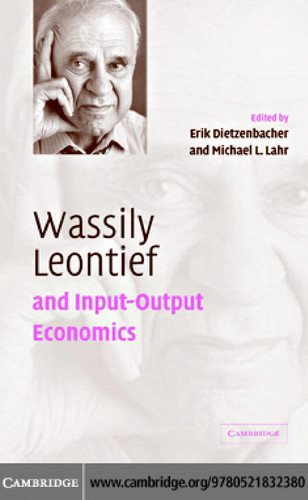
Wassily Leontief and input-output economics

Wassily Leontief,Erik Dietzenbacher,Michael L. Lahr
Wassily Leontief (1905–1999) was the founding father of input-output economics, for which he received the Nobel Prize in 1973. This book offers a collection of papers in memory of Leontief by his students and close colleagues. The first part, 'Reflections on Input-Output Economics', focuses upon Leontief as a person and scholar as well as his personal contributions to economics. It includes contributions by Nobel Laureate Paul A. Samuelson who shares his memories of a young Professor Leontief at Harvard and ends with the last joint interview with Wassily and his wife, to date previously unpublished. The second part, 'Perspectives of Input-Output Economics', includes theoretical and empirical research inspired by Leontief's work and offers a wide-ranging sample of the state of interindustry economics, a field Leontief founded. This is a strong collection likely to appeal to a wide range of professionals in universities, government, industry and international organizations.
Cambridge University Press 2004-03-25 396 pages

Long waves of capitalist development: a Marxist interpretation : based on the Marshall lectures given at the University of Cambridge

Mandel, Ernest
In this revised and expanded edition of Long Waves of Capitalist Development , Ernest Mandel seeks to explain the underlying determinants of the booms and slumps of the trade cycle. Mandel first establishes that there have indeed been twenty- to twenty-five-year-long waves of capitalist expansion and contraction—and that these have persisted in the period since World War II. He then assembles evidence to show that while broad tendencies in the rate of profit have been decisive in triggering downturns, the ingredients necessary for a new upswing are, by contrast, generally political and extra-economic in character. He thereby demonstrates the falsity of neo-liberal doctrines, according to which the free market will itself generate a new formula for balanced and sustainable expansion. Long Waves of Capitalist Development not only offers a penetrating analysis of the ills that have afflicted contemporary capitalist economies but also surveys, and takes forward, one of the classical debates of modern economic history.
Verso 1995-06-17 174 pages