106 results for "Business History"

Too Big to Fail

Andrew Ross Sorkin
A brilliantly reported true-life thriller that goes behind the scenes of the financial crisis on Wall Street and in Washington. In one of the most gripping financial narratives in decades, Andrew Ross Sorkin-a New York Times columnist and one of the country's most respected financial reporters-delivers the first definitive blow- by-blow account of the epochal economic crisis that brought the world to the brink. Through unprecedented access to the players involved, he re-creates all the drama and turmoil of these turbulent days, revealing never-before-disclosed details and recounting how, motivated as often by ego and greed as by fear and self-preservation, the most powerful men and women in finance and politics decided the fate of the world's economy.
Viking 2009 352 pages

The Theory of Money and Credit

Ludwig von Mises,Ludwig Von Mises
This must-read classic on currency and credit covers the three areas of key interest -- the nature of money, the value of money, and money and banking. Economist and philosopher Ludwig von Mises presents his "Theory of Money and Credit" by first looking at the nature and value of money, why there is a demand for money, and how it is used as currency. He goes on to explain the purchasing power of money and how it determines economic and monetary policy, often in a way that results in financial melt-downs. Never in modern history has there been a greater need for this book and others like it. All of its ideas and principles are coming true right before our eyes in today's economy and its problems.
Must Have Books 2021-03-08 166 pages

Working People Talk about what They Do All Day and how They Feel about what They Do

Studs Terkel
"When it was first published in 1974, Studs Terkel's oral history about "what people do all day and how they feel about it" became a best seller, was hailed as an instant classic, and eventually inspired a Broadway musical. Today, in this new edition with a foreword by the New York Times' Adam Cohen, it remains as relevant as ever: a masterpiece that reveals how "ordinary" Americans - that is, all of us - ceaselessly search for, but only sometimes find, satisfaction in our work."--Dust jacket back cover.
MJF Books 2004 589 pages

The great transformation: the political and economic origins of our time

Polanyi, Karl
"In this classic work of economic history and social theory, Karl Polanyi tracks the economic and social changes brought about by the "great transformation" of the Industrial Revolution. He pays particular attention to capitalism's rise and its role in fundamentally altering life after the Industrial Revolution. This seminal analysis explains not only the deficiencies of the self-regulating market, but the potentially dire social consequences of untempered market capitalism"-- Provided by publisher.
Beacon Press 2025-07-08 360 pages

Megathreats: ten dangerous trends that imperil our future, and how to survive them

Roubini, Nouriel
"Renowned economist Nouriel Roubini was nicknamed "Dr. Doom," until his prediction of the 2008 housing crisis and Great Recession came true--when it was too late. Now he is back with a much scarier prediction, one that we ignore at our peril. There are no fewer than ten overlapping, interconnected threats that are so serious, he calls them Megathreats. From the worst debt crisis the world has ever seen, to governments pumping out too much money, to borders that are blocked to workers and to many shipments of goods, to the rise of a new superpower competition between China and the U.S., to climate change that strikes directly at our most populated cities, we are facing not one, not two, but ten causes of disaster. There is a slight chance we can avoid them, if we come to our senses--but we must act now." --
Little, Brown and Company 2022 312 pages

Understanding Marxism

Richard D. Wolff
Why should we pay attention to the great social critics like Marx? If you want to understand capitalism in order to make society better, then understanding Marx’s analysis is fundamental in drawing your attention to capitalist production’s core conflict: class struggle. It is everywhere, and it influences everything and everyone in our society. Marx is the theoretician who first explained it systematically. He was a social critic for whom capitalism signified not the end of human history, but the latest phase that badly needed a transition to something better. Marxism displays a central, crucial focus on the class struggle that both haunts and drives capitalism. Nothing could be more relevant and useful here and now to help us understand and cope with the threatening global capitalism of our times. Indeed, Americans today confront serious questions and evidence that our capitalist system is in trouble and that it clearly serves the 1% far better than the vast mass of the people. We offer this introductory book now because of the power and usefulness today of Marx’s criticism of the capitalist economic system. This 2021 hardcover edition features a new introduction by author Richard D. Wolff, which strengthens the case for why Marxism is worth understanding. It explains and shares our excitement about the ways in which Marxism helps us to critically rethink capitalism today, and offers new directions for social development beyond and better than the capitalism we have.
Democracy at Work 2021 110 pages

The coming of post-industrial society: a venture in social forecasting

Bell, Daniel
In 1976, Daniel Bell€™s historical work predicted a vastly different society developing—one that will rely on the “economics of information€ rather than the “economics of goods.€ Bell argued that the new society would not displace the older one but rather overlie some of the previous layers just as the industrial society did not completely eradicate the agrarian sectors of our society. The post-industrial society€™s dimensions would include the spread of a knowledge class, the change from goods to services and the role of women. All of these would be dependent on the expansion of services in the economic sector and an increasing dependence on science as the means of innovating and organizing technological change.Bell prophetically stated in The Coming of the Post-Industrial Society that we should expect “ new premises and new powers, new constraints and new questions—with the difference that these are now on a scale that had
Basic Books 1973-07-12 507 pages

The three trillion dollar war: the true cost of the Iraq conflict

Stiglitz, Joseph E.
The true cost of the Iraq War is $3 trillion rather than the $50 billion projected by the White House. Apart from its tragic human toll, the Iraq War will be staggeringly expensive in financial terms. This sobering study by Nobel Prize winner Joseph E. Stiglitz and Harvard professor Linda J. Bilmes casts a spotlight on expense items that have been hidden from the U.S. taxpayer, including not only big-ticket items like replacing military equipment (being used up at six times the peacetime rate) but also the cost of caring for thousands of wounded veterans for the rest of their lives. Shifting to a global focus, the authors investigate the cost in lives and economic damage within Iraq and the region. Finally, with the chilling precision of an actuary, the authors measure what the U.S. taxpayer's money would have produced if instead it had been invested in the further growth of the U.S. economy. Written in language as simple as the details are disturbing, this book will forever change the way we think about the war.
W.W. Norton 2008-02-17 311 pages

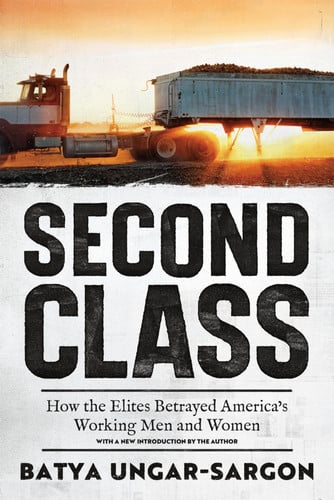
Second class: how the elite betrayed America's working men and women

Ungar-Sargon, Batya
A personal, journalistic ethnography of the modern American working class, based on the travels and interactions of the author through the American heartland. " Second Class is the most important book you will read all year. A political realignment is coming, and it's my hope that the end result will work in favor of our all-too-neglected American working class. When that realignment comes, Batya and her book will help lead the way." --Greg Lukianoff, CEO of the Foundation for Individual Rights in Education, and co-author of The Coddling of the American Mind Who is the American working class? Do they still have a fair shot at the American Dream? What do they think about their chances to secure the hallmarks of a middle-class life? While writing this book, Batya Ungar-Sargon visited states across the nation to speak with members of the American working class who are fighting tooth and nail to survive. In Second Class , working-class Americans of all races, political orientations, and occupations share their stories--cleaning ladies, health care aides, cops, truck drivers, fast food workers, electricians, and more. In their own words, these working-class Americans explain the struggles and triumphs of their increasingly precarious lives--as well as what policies they think would improve them. Second Class combines deep reporting with a look at the data and expert opinions on America's emergent class divide, in which the most basic elements of a secure and stable life are increasingly out of reach for those without a college education. America has broken its contract with its laboring class. So, how do we get back to the American Dream? How do we once again become the land of opportunity, the promised land, where hard work and commitment to family are enough to protect you from poverty? It's not that hard actually. All it would take, as this book illustrates, is for those in power to once again respect the dignity of work--and the American worker.
Encounter Books 2025 248 pages

The spirit of green: the economics of collisions and contagions in a crowded world

Nordhaus, William D.
"From a Nobel Prize-winning pioneer in environmental economics, an innovative account of how and why "green thinking" could cure many of the world's most serious problems-from global warming to pandemics Solving the world's biggest problems-from climate catastrophe and pandemics to wildfires and corporate malfeasance-requires, more than anything else, coming up with new ways to manage the powerful interactions that surround us. For carbon emissions and other environmental damage, this means ensuring that those responsible pay their full costs rather than continuing to pass them along to others, including future generations. In The Spirit of Green, Nobel Prize-winning economist William Nordhaus describes a new way of green thinking that would help us overcome our biggest challenges without sacrificing economic prosperity, in large part by accounting for the spillover costs of economic collisions. In a discussion that ranges from the history of the environmental movement to the Green New Deal, Nordhaus explains how the spirit of green thinking provides a compelling and hopeful new perspective on modern life. At the heart of green thinking is a recognition that the globalized world is shaped not by isolated individuals but rather by innumerable interactions inside and outside the economy. He shows how rethinking economic efficiency, sustainability, politics, profits, taxes, individual ethics, corporate social responsibility, finance, and more would improve the effectiveness and equity of our society. And he offers specific solutions-on how to price carbon, how to pursue low-carbon technologies, how to design an efficient tax system, and how to foster international cooperation through climate clubs. The result is a groundbreaking new vision of how we can have our environment and our economy too"--
Princeton University Press 2021-05-18 355 pages

Stone age economics

Sahlins, Marshall David
Stone Age Economics is a classic study of anthropological economics, first published in 1974. As Marshall Sahlins stated in the first edition, "It has been inspired by the possibility of 'anthropological economics,' a perspective indebted rather to the nature of the primitive economies than to the categories of a bourgeois science." Ambitiously tackling the nature of economic life and how to study it comparatively, the book includes six studies which reflect the author's ideas on revising traditional views of the hunter-gatherer and so-called primitive societies, revealing them to be the original affluent society. The book examines notions of production, distribution and exchange in early communities and examines the link between economics and cultural and social factors. It consists of a set of detailed and closely related studies of tribal economies, of domestic production for livelihood, and of the submission of domestic production to the material and political demands of society at large. Marshall Sahlins is one of the most prominent American anthropologists of our time. He holds the title of Charles F. Grey Distinguished Service Professor of Anthropology at the University of Chicago. His most recent book is How Natives Think: About Captain Cook, for Example.
Transaction Publishers 2011 348 pages

Football for a Buck The Crazy Rise and Crazier Demise of the USFL

Jeff Pearlman
From Jeff Pearlman--the New York Times best-selling author of Three Ring Circus--comes the rollicking, outrageous story of the USFL, full of larger-than-life characters and you-can't-make-this-up stories featuring some of the biggest celebrities and buffoons in the game. The United States Football League--known fondly to millions of sports fans as the USFL--did not merely challenge the NFL, but cause its owners and executives to collectively shudder. In its three seasons from 1983-85, it secured multiple television deals, drew millions of fans and launched the careers of legends such as Steve Young, Jim Kelly, Herschel Walker, and Reggie White. But then it died beneath the weight of a particularly egotistical and bombastic team owner--a New York businessman named Donald J. Trump. In Football for a Buck, Jeff Pearlman draws on more than four hundred interviews to unearth all the salty, untold stories of one of the craziest sports entities to have ever captivated America. From 1980s drug excess to airplane brawls and player-coach punch outs, to backroom business deals and some of the most enthralling and revolutionary football ever seen, Pearlman transports readers back in time to this crazy, boozy, audacious, unforgettable era of the game. He shows how fortunes were made and lost on the backs of professional athletes and how, forty years ago, Trump was already a scoundrel and a spoiler. For fans of Terry Pluto's Loose Balls or Jim Bouton's Ball Four and of course Pearlman's own stranger-than-fiction narratives, Football for a Buck is sports as high entertainment--and a cautionary tale of the dangers of ego and excess.
HarperCollins Publishers 2019-09-10 400 pages

The Idealist Jeffrey Sachs and the Quest to End Poverty

Nina Munk
A powerful portrayal of Jeffrey Sachs's ambitious quest to end extreme global poverty, now a Signal paperback. "The poor you will always have with you," according to Matthew 26:11. But Jeffrey Sachs, economics superstar, special advisor to the Secretary General of the UN and the author of The End of Poverty , vehemently disagrees. In his view, poverty -- especially the extreme deprivation of sub-Saharan Africa -- can easily be eradicated. The vast sums spent in foreign aid over the decades has not come close to alleviating the dire subsistence problems of Africans. Sachs believed he knew the reason: the developed world simply hadn't spent enough. In 2006, Sachs, backed by tens of millions of donor dollars, launched the five-year Millennium Villages Project. Sachs would test his theories in villages in different African countries, then, with each success, scale up until until the program was continent-wide. His first village "make-over" was a small community in Sauri, Kenya, and the immediate effect was encouraging. With that first inkling of success achieved, Sachs rolled out a dozen model Millennium villages in ten countries. For the past six years, Nina Munk has reported deeply on the Project, following Sachs on official trips and listening in on conversations with heads of states, rival organisations and potential donors. And she has immersed herself in the lives of people in two of the remote villages: Ruhiira, in southwest Uganda, and Dertu, in the arid borderland between Kenya and Somalia. Accepting hospitality from these camel herders and smallhold farmers, and sharing in their struggles, Munk came to understand the on-the-ground issues challenging Sachs' one-size-fits-all approach to global poverty. The Idealist is the profound and moving story of what happened when the abstract theories of a brilliant, driven man met messy human reality.
McClelland & Stewart 2014-10-07 288 pages

John Maynard Keynes

Minsky, Hyman P.
â Today, Mr. Minsky's view [of economics] is more relevant than ever.â - The New York Times â Indeed, the Minsky moment has become a fashionable catch phrase on Wall Street.â -The Wall Street Journal John Maynard Keynes offers a timely reconsideration of the work of the revered economics icon. Hyman Minsky argues that what most economists consider Keynesian economics is at odds with the major points of Keynes's The General Theory of Employment, Interest, and Money. Keynes and Minsky refuse to ignore pervasive uncertainty. Once uncertainty is given center stage, recurring episodes of financial system crises are all but inescapable. As Robert Barbera notes in a new preface, â Benign economic circumstancesâ ¦invite increasingly aggressive financial market wagers. Innovation in finance is a signature development in a capitalist economy. Once leveraged wagers are in place, small disappointments can have exaggerated consequences.â Thus for Minsky economic calm on Main Street engenders financial system fragility which, in turn, ensures a perpetuation of boom and bust cycles. Minsky colleagues Dimitri B. Papadimitriou and L. Randall Wray write in a new introduction, â We offer this new edition, in the hope that it will contribute to the reformation of economic theory so that it can address the world in which we actually live-the world that was always the topic of Minsky's analysis.â
Columbia University Press 1975 181 pages

In an uncertain world: tough choices from Wall Street to Washington

Rubin, Robert Edward
Publisher's description: Robert Rubin was sworn in as the seventieth U.S. Secretary of the Treasury in January 1995 in a brisk ceremony attended only by his wife and a few colleagues. As soon as the ceremony was over, he began an emergency meeting with President Bill Clinton on the financial crisis in Mexico. This was not only a harbinger of things to come during what would prove to be a rocky period in the global economy; it also captured the essence of Rubin himself--short on formality, quick to get into the nitty-gritty. From his early years in the storied arbitrage department at Goldman Sachs to his current position as chairman of the executive committee of Citigroup, Robert Rubin has been a major figure at the center of the American financial system. He was a key player in the longest economic expansion in U.S. history.
Random House 2003 427 pages

Money and Government The Past and Future of Economics

Robert Skidelsky
A critical examination of economics's past and future, and how it needs to change, by one of the most eminent political economists of our time The dominant view in economics is that money and government should play only a minor role in economic life. Economic outcomes, it is claimed, are best left to the "invisible hand" of the market. Yet these claims remain staunchly unsettled. The view taken in this important new book is that the omnipresence of uncertainty makes money and government essential features of any market economy. Since Adam Smith, classical economics has espoused nonintervention in markets. The Great Depression brought Keynesian economics to the fore, but stagflation in the 1970s brought a return to small-state orthodoxy. The 2008 global financial crash should have brought a reevaluation of that stance; instead the response has been punishing austerity and anemic recovery. This book aims to reintroduce Keynes's central insights to a new generation of economists, and embolden them to return money and government to the starring roles in the economic drama that they deserve.
Yale University Press 2018 491 pages

Finance capital: a study of the latest phase of capitalist development

Hilferding, Rudolf
This is the first English translation of one of the classical works of Marxist economic theory. When Rudolf Hilferding’s Finance Capitalwas first published in 1919 it was acclaimed by reviewers as a continuation of Marx’s Capital, and it has a major influence upon subsequent Marxist thought, especially in the analysis of imperialism where it provided some of the fundamental ideas for the theories of Bukharin and Lenin. But Hilferding’s work was much more than a study of imperialism, which was presented only in the last section of the book. It set out to examine the main tendencies in the development of the capitalist mode of production as a whole at the beginning of the twentieth century, beginning with an exposition of the theory of money (in which particular attention was paid to the growth of credit money), then analysing the increasingly important role of the banks in the mobilization of capital, along with the development of large corporations, cartels and trusts, and finally outlining a theory of economic crises. Hilferding’s book has, however, more than an historical interest. It is a model for any renewed attempt to understand the ‘latest phase of capitalist development’ in the closing decades of the twentieth century, and Hilferdin’s ideas still provide essential elements for the elaboration of theoretically enlightened and realistic policies in the socialist movement.
Routledge 2019 466 pages