6 results for "Business History"

How Google works

Schmidt, Eric,Rosenberg, Jonathan
Both Eric Schmidt and Jonathan Rosenberg came to Google as seasoned Silicon Valley business executives, but over the course of a decade they came to see the wisdom in Coach John Wooden's observation that 'it's what you learn after you know it all that counts'. As they helped grow Google from a young start-up to a global icon, they relearned everything they knew about management. How Google Works is the sum of those experiences distilled into a fun, easy-to-read primer on corporate culture, strategy, talent, decision-making, communication, innovation, and dealing with disruption. The authors explain how the confluence of three seismic changes - the internet, mobile, and cloud computing - has shifted the balance of power from companies to consumers. The companies that will thrive in this ever-changing landscape will be the ones that create superior products and attract a new breed of multifaceted employees whom the authors dub 'smart creatives'. The management maxims ('Consensus requires dissension', 'Exile knaves but fight for divas', 'Think 10X, not 10%') are illustrated with previously unreported anecdotes from Google's corporate history. 'Back in 2010, Eric and I created an internal class for Google managers,' says Rosenberg. 'The class slides all read 'Google confidential' until an employee suggested we uphold the spirit of openness and share them with the world. This book codifies the recipe for our secret sauce: how Google innovates and how it empowers employees to succeed.'
John Murray 2014-09-25 286 pages

The ride of a lifetime: lessons learned from 15 years as CEO of the Walt Disney Company

Iger, Robert
Robert Iger became CEO of The Walt Disney Company in 2005, during a difficult time. Competition was more intense than ever and technology was changing faster than at any time in the company's history. His vision came down to three clear ideas: Recommit to the concept that quality matters, embrace technology instead of fighting it, and think bigger -- think global -- and turn Disney into a stronger brand in international markets. Twelve years later, Disney is the largest, most respected media company in the world, counting Pixar, Marvel, Lucasfilm, and 21st Century Fox among its properties. Its value is nearly five times what it was when Iger took over. Now Iger shares the lessons he's learned while running Disney and leading its 200,000 employees, and he explores the principles that are necessary for true leadership.
Random House, an imprint and division of Penguin Random House LLC 2019-09-23 246 pages

First in Thirst How Gatorade Turned the Science of Sweat Into a Cultural Phenomenon

Darren Rovell
Gatorade is an enthralling story, brought to life in bright color and sharp detail in this book as journalist and author Darren Rovell chronicles every astonishing milestone of the company's history. With unprecedented access to the inventors, the marketers, the analysts and observers, and key company figures past and present, Rovell recounts the sweat-drenched University of Florida football practices, the first (unpalatable) prototypes, and the commercial and financial interest that quickly took hold following the drink's first on-field successes. Then came the advertising, sponsorships, product placements (many of them fortuitous), and finally the two milestones that cemented Gatorade's iconic status once and for all -- the ubiquitous Gatorade bath and the Michael Jordan "Be Like Mike" endorsement deal. With refreshing candor, First in Thirst also offers an inside look at all the aspects that went into building the brand, such as: negotiations, battles, lawsuits, mergers and acquisitions, product strategies, lucky breaks, and even the mishaps that have attended Gatorade's reign as the 800-pound gorilla of the sports-drink scene. First in Thirst identifies the nine Gatorade Rules, business principles that have helped Gatorade become one of the most dominant brands ever. By adhering to these principles, businesses in other industries may achieve greater brand recognition and market share. Long before America knew what "deep-down body thirst" was, a team of university scientists had already invented something to quench it. This book is the story of the product and the company, and of America's fascination with the one and only Gatorade.
American Management Association 2006 243 pages

Good for the money: my fight to pay back America

Benmosche, Bob
"In 2009, at the peak of the financial crisis, AIG - the American insurance behemoth - was sinking fast. It was the peg upon which the nation hung its ire and resentment during the financial crisis: the pinnacle of Wall Street arrogance and greed. When Bob Benmosche climbed aboard as CEO, it was widely assumed that he would go down with his ship. In mere months, he turned things around, pulling AIG from the brink of financial collapse and restoring its profitability. Before three years were up, AIG had fully repaid its staggering debt to the U.S. government - with interest.Good for the Money is an unyielding leader's memoir of a career spent fixing companies through thoughtful, unconventional strategy. With his brash, no-holds-barred approach to the job, Benmosche restored AIG's employee morale and good name. His is a story of perseverance, told with refreshing irreverence in unpretentious terms.Called "an American hero" by Andrew Ross Sorkin, author of Too Big to Fail, Benmosche was a self-made man who never forgot what life is like for the nation's 99-percent; again and again, he pushed back against obstinate colleagues to salvage American jobs and industry. Good for the Money affords you a front-row seat for Benmosche's heated battles with major players from Geithner to Obama to Cuomo, and offers incomparable lessons in leadership from the legendary CEO who changed the way Wall Street does business"--
St. Martin's Press 2016-04-12 271 pages

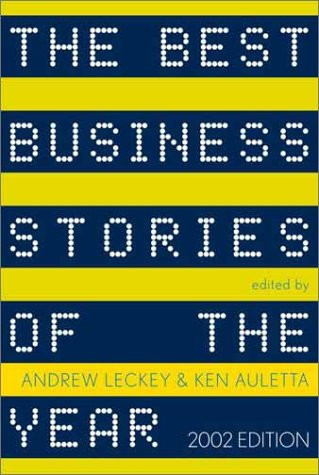
The Best Business Stories of the Year

Andrew Leckey,Ken Auletta
"[The editors] cast their net wide, picking up some excellent stories from nontraditional sources that even avid readers of the business press may have missed."-"USA Today," on the 2001 edition Series editor Andrew Leckey and guest editor Ken Auletta have scoured the print media, consulted with the editors of major business and general interest publications, and surveyed journalism school deans to find the best business stories from the last twelve months. Among those selected: Michael Lewis on teenage stock trader Jonathan Lebed, from "The New York Times Magazine"; James B. Stewart on the irrepressible Michael Milken, from "The New Yorker"; and many others from the pages of "The Wall Street Journal, Rolling Stone, Fortune, Rocky Mountain News, "and" Wired. " The second annual edition continues the excellence and comprehensive range of this fascinating anthology series.
Pantheon Books 2002 470 pages

Knowledge: Its Creation, Distribution and Economic Significance, Volume I Knowledge and Knowledge Production

Fritz Machlup
With this first of eight volumes, the eminent economist Fritz Machlup launches his monumental inquiry into the production of knowledge as an economic activity. Volume I presents the conceptual framework for this inquiry and falls into three parts: Types of Knowledge, Qualities of Knowledge, and Knowledge as a Product. Originally published in 1981. The Princeton Legacy Library uses the latest print-on-demand technology to again make available previously out-of-print books from the distinguished backlist of Princeton University Press. These editions preserve the original texts of these important books while presenting them in durable paperback and hardcover editions. The goal of the Princeton Legacy Library is to vastly increase access to the rich scholarly heritage found in the thousands of books published by Princeton University Press since its founding in 1905.
Princeton University Press 2016-04-19 304 pages