37 results for "Business History"

The Identity Trap

Mounk, Yascha
Named a Best Book of the Year by The Economist , Financial Times , Inc. , Prospect Magazine , and The Conversation “The most comprehensive and reasonable story of this shift that has yet been attempted . . . Mounk has told the story of the Great Awokening better than any other writer who has attempted to make sense of it.” — The Washington Post “An intellectual tour de force about the origins of identity politics and the threat it presents to genuine, honest, old-fashioned liberalism.” — Bret Stephens, The New York Times “Among the most insightful and important books written in the last decade on American democracy and its current torments, because it also shows us a way out of the trap.” —Jonathan Haidt, author of The Righteous Mind , and coauthor of The Coddling of the American Mind “Outstanding.” — David Brooks, The New York Times A fascinating account of the origins of “wokeness”—and a trenchant explanation for why the noble goals of identity politics are doomed to fail For much of history, societies have violently oppressed ethnic, religious, and sexual minorities. It is no surprise that many came to believe that members of mar­ginalized groups need to take pride in their identity to resist injustice. But over the past decades, a healthy appreciation for the culture and heritage of minority groups transformed into our contemporary form of identity politics, a counterproductive obsession with group identity. This new ideology denies that members of different groups can truly understand each other and insists that the way governments treat their citizens should depend on the color of their skin. This, Yascha Mounk argues, is the identity trap. Those who battle for these ideas are often full of good intentions. But they ultimately stand in the way of the genuine equality we desperately need. Mounk was one of the first to warn of the risks that right-wing populists pose to American democracy, a danger that remains as serious as ever. But as he shows here, the identitarian left and the populist right actually reinforce each other; to vanquish one, it is necessary to oppose both. In The Identity Trap , Mounk provides the most ambitious and comprehensive account to date of the origins, consequences, and limitations of “wokeness.” He shows how postmodernism, postcolonialism, and critical race theory conquered many college campuses and forged an “identity synthesis” that gained tremendous influence in business, media, and government by 2020. Finally, Mounk makes a nuanced philosophical case for why these ideas are so counterproductive—and why universal, humanist values can best serve the vital goal of true equality. The Identity Trap provides truth and clarity where they are needed most.
Penguin USA 2025-09-23 432 pages

The great transformation: the political and economic origins of our time

Polanyi, Karl
"In this classic work of economic history and social theory, Karl Polanyi tracks the economic and social changes brought about by the "great transformation" of the Industrial Revolution. He pays particular attention to capitalism's rise and its role in fundamentally altering life after the Industrial Revolution. This seminal analysis explains not only the deficiencies of the self-regulating market, but the potentially dire social consequences of untempered market capitalism"-- Provided by publisher.
Beacon Press 2025-07-08 360 pages

America's bitter pill: money, politics, backroom deals, and the fight to fix our broken healthcare

Brill, Steven
NEW YORK TIMES BESTSELLER • A NEW YORK TIMES NOTABLE BOOK • “A tour de force . . . a comprehensive and suitably furious guide to the political landscape of American healthcare . . . persuasive, shocking.” — The New York Times America’s Bitter Pill is Steven Brill’s acclaimed book on how the Affordable Care Act, or Obamacare, was written, how it is being implemented, and, most important, how it is changing—and failing to change—the rampant abuses in the healthcare industry. It’s a fly-on-the-wall account of the titanic fight to pass a 961-page law aimed at fixing America’s largest, most dysfunctional industry. It’s a penetrating chronicle of how the profiteering that Brill first identified in his trailblazing Time magazine cover story continues, despite Obamacare. And it is the first complete, inside account of how President Obama persevered to push through the law, but then failed to deal with the staff incompetence and turf wars that crippled its implementation. But by chance America’s Bitter Pill ends up being much more—because as Brill was completing this book, he had to undergo urgent open-heart surgery. Thus, this also becomes the story of how one patient who thinks he knows everything about healthcare “policy” rethinks it from a hospital gurney—and combines that insight with his brilliant reporting. The result: a surprising new vision of how we can fix American healthcare so that it stops draining the bank accounts of our families and our businesses, and the federal treasury. Praise for America’s Bitter Pill “An energetic, picaresque, narrative explanation of much of what has happened in the last seven years of health policy . . . [Brill] has pulled off something extraordinary.” —The New York Times Book Review “A thunderous indictment of what Brill refers to as the ‘toxicity of our profiteer-dominated healthcare system.’ ” — Los Angeles Times “A sweeping and spirited new book [that] chronicles the surprisingly juicy tale of reform.” — The Daily Beast “One of the most important books of our time.” —Walter Isaacson “Superb . . . Brill has achieved the seemingly impossible—written an exciting book about the American health system.” — The New York Review of Books
Random House 2015-08-18 528 pages

How Soccer Explains the World

Foer, Franklin
“Step aside Tom Friedman, Sam Huntington, and Amy Chua. Franklin Foer’s dark and witty tale of the soccer world reveals the meaning of globalization in all its joys and horrors.”—Robert Kagan Just in time for the 2026 World Cup in North America—a reissue of the bestselling sports classic, featuring a new preface from the author. With the 2026 World Cup in all three nations of North America, the power and scope of soccer has truly become global. In this remarkably insightful, wide-ranging work, Franklin Foer argues that soccer is much more than a game, or even a way of life. It is a unique window into the crosscurrents of modern globalization, with all of its benefits and pitfalls. Soccer clubs don’t represent geographic areas; they stand for social classes and political ideologies. Unlike baseball or tennis, soccer is freighted with ancient hatreds and history. It’s a sport with real stakes—a catalyst capable of ruining regimes and launching liberation movements. Foer takes us on a surprising tour through the world of soccer, shattering myths and dire predictions. Instead of destroying local cultures, as the left warned, globalization has revived tribalism. Far from the triumph of capitalism that the right anticipated, it has entrenched corruption. From Brazil to Bosnia, Italy to Iraq, How Soccer Explains the World is an eye-opening chronicle of how a beautiful sport and its fanatical followers can illuminate the fault lines of a society, whether it’s terrorism, poverty, anti-Semitism, authoritarianism, or radical Islam—issues that continue to affect all of us. At a time when globalization is under attack and many Americans yearn for retrenchment and retreat from the world, this remarkable book—filled with blazing intelligence, colorful characters, wry humor, and an equal passion for soccer and humanity—continues to make sense of our troubled times.
HarperCollins Publishers LLC 2026-04-07 288 pages

The coming of post-industrial society: a venture in social forecasting

Bell, Daniel
In 1976, Daniel Bell€™s historical work predicted a vastly different society developing—one that will rely on the “economics of information€ rather than the “economics of goods.€ Bell argued that the new society would not displace the older one but rather overlie some of the previous layers just as the industrial society did not completely eradicate the agrarian sectors of our society. The post-industrial society€™s dimensions would include the spread of a knowledge class, the change from goods to services and the role of women. All of these would be dependent on the expansion of services in the economic sector and an increasing dependence on science as the means of innovating and organizing technological change.Bell prophetically stated in The Coming of the Post-Industrial Society that we should expect “ new premises and new powers, new constraints and new questions—with the difference that these are now on a scale that had
Basic Books 1973-07-12 507 pages

The three trillion dollar war: the true cost of the Iraq conflict

Stiglitz, Joseph E.
The true cost of the Iraq War is $3 trillion rather than the $50 billion projected by the White House. Apart from its tragic human toll, the Iraq War will be staggeringly expensive in financial terms. This sobering study by Nobel Prize winner Joseph E. Stiglitz and Harvard professor Linda J. Bilmes casts a spotlight on expense items that have been hidden from the U.S. taxpayer, including not only big-ticket items like replacing military equipment (being used up at six times the peacetime rate) but also the cost of caring for thousands of wounded veterans for the rest of their lives. Shifting to a global focus, the authors investigate the cost in lives and economic damage within Iraq and the region. Finally, with the chilling precision of an actuary, the authors measure what the U.S. taxpayer's money would have produced if instead it had been invested in the further growth of the U.S. economy. Written in language as simple as the details are disturbing, this book will forever change the way we think about the war.
W.W. Norton 2008-02-17 311 pages

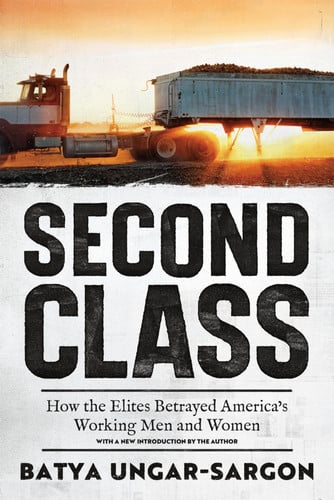
Second class: how the elite betrayed America's working men and women

Ungar-Sargon, Batya
A personal, journalistic ethnography of the modern American working class, based on the travels and interactions of the author through the American heartland. " Second Class is the most important book you will read all year. A political realignment is coming, and it's my hope that the end result will work in favor of our all-too-neglected American working class. When that realignment comes, Batya and her book will help lead the way." --Greg Lukianoff, CEO of the Foundation for Individual Rights in Education, and co-author of The Coddling of the American Mind Who is the American working class? Do they still have a fair shot at the American Dream? What do they think about their chances to secure the hallmarks of a middle-class life? While writing this book, Batya Ungar-Sargon visited states across the nation to speak with members of the American working class who are fighting tooth and nail to survive. In Second Class , working-class Americans of all races, political orientations, and occupations share their stories--cleaning ladies, health care aides, cops, truck drivers, fast food workers, electricians, and more. In their own words, these working-class Americans explain the struggles and triumphs of their increasingly precarious lives--as well as what policies they think would improve them. Second Class combines deep reporting with a look at the data and expert opinions on America's emergent class divide, in which the most basic elements of a secure and stable life are increasingly out of reach for those without a college education. America has broken its contract with its laboring class. So, how do we get back to the American Dream? How do we once again become the land of opportunity, the promised land, where hard work and commitment to family are enough to protect you from poverty? It's not that hard actually. All it would take, as this book illustrates, is for those in power to once again respect the dignity of work--and the American worker.
Encounter Books 2025 248 pages

The spirit of green: the economics of collisions and contagions in a crowded world

Nordhaus, William D.
"From a Nobel Prize-winning pioneer in environmental economics, an innovative account of how and why "green thinking" could cure many of the world's most serious problems-from global warming to pandemics Solving the world's biggest problems-from climate catastrophe and pandemics to wildfires and corporate malfeasance-requires, more than anything else, coming up with new ways to manage the powerful interactions that surround us. For carbon emissions and other environmental damage, this means ensuring that those responsible pay their full costs rather than continuing to pass them along to others, including future generations. In The Spirit of Green, Nobel Prize-winning economist William Nordhaus describes a new way of green thinking that would help us overcome our biggest challenges without sacrificing economic prosperity, in large part by accounting for the spillover costs of economic collisions. In a discussion that ranges from the history of the environmental movement to the Green New Deal, Nordhaus explains how the spirit of green thinking provides a compelling and hopeful new perspective on modern life. At the heart of green thinking is a recognition that the globalized world is shaped not by isolated individuals but rather by innumerable interactions inside and outside the economy. He shows how rethinking economic efficiency, sustainability, politics, profits, taxes, individual ethics, corporate social responsibility, finance, and more would improve the effectiveness and equity of our society. And he offers specific solutions-on how to price carbon, how to pursue low-carbon technologies, how to design an efficient tax system, and how to foster international cooperation through climate clubs. The result is a groundbreaking new vision of how we can have our environment and our economy too"--
Princeton University Press 2021-05-18 355 pages

The Idealist Jeffrey Sachs and the Quest to End Poverty

Nina Munk
A powerful portrayal of Jeffrey Sachs's ambitious quest to end extreme global poverty, now a Signal paperback. "The poor you will always have with you," according to Matthew 26:11. But Jeffrey Sachs, economics superstar, special advisor to the Secretary General of the UN and the author of The End of Poverty , vehemently disagrees. In his view, poverty -- especially the extreme deprivation of sub-Saharan Africa -- can easily be eradicated. The vast sums spent in foreign aid over the decades has not come close to alleviating the dire subsistence problems of Africans. Sachs believed he knew the reason: the developed world simply hadn't spent enough. In 2006, Sachs, backed by tens of millions of donor dollars, launched the five-year Millennium Villages Project. Sachs would test his theories in villages in different African countries, then, with each success, scale up until until the program was continent-wide. His first village "make-over" was a small community in Sauri, Kenya, and the immediate effect was encouraging. With that first inkling of success achieved, Sachs rolled out a dozen model Millennium villages in ten countries. For the past six years, Nina Munk has reported deeply on the Project, following Sachs on official trips and listening in on conversations with heads of states, rival organisations and potential donors. And she has immersed herself in the lives of people in two of the remote villages: Ruhiira, in southwest Uganda, and Dertu, in the arid borderland between Kenya and Somalia. Accepting hospitality from these camel herders and smallhold farmers, and sharing in their struggles, Munk came to understand the on-the-ground issues challenging Sachs' one-size-fits-all approach to global poverty. The Idealist is the profound and moving story of what happened when the abstract theories of a brilliant, driven man met messy human reality.
McClelland & Stewart 2014-10-07 288 pages

Drone Warfare: Killing by Remote Control

Medea Benjamin
The CIA chief, Leon Panetta, calls drones the ‘only game in town’. The figures bear him out. Between 2004 and 2012, the US reportedly conducted over 350 drone strikes in Pakistan, killing between 2,600 and 3,400 people. Drone strikes have killed more than 200 children alone in Pakistan and Yemen. In 2000, the Americans had fewer than fifty aerial drones; ten years later, it had a fleet of nearly 7,500, and the US Air Force now trains more drone ‘pilots’ than bomber and fighter pilots combined. Drones are already a $ 5 billion business in the US alone. American activist Medea Benjamin, a co-founder of the peace group CODEPINK and the international human rights organization Global Exchange, provides the first extensive analysis of who is producing the drones, where they are being used, who controls these unmanned places, and what are the legal and moral implications of their use. Benjamin also looks at what activists, lawyers, and scientists across the globe are doing to ground these weapons.
Daily Star Books 2013 241 pages

In an uncertain world: tough choices from Wall Street to Washington

Rubin, Robert Edward
Publisher's description: Robert Rubin was sworn in as the seventieth U.S. Secretary of the Treasury in January 1995 in a brisk ceremony attended only by his wife and a few colleagues. As soon as the ceremony was over, he began an emergency meeting with President Bill Clinton on the financial crisis in Mexico. This was not only a harbinger of things to come during what would prove to be a rocky period in the global economy; it also captured the essence of Rubin himself--short on formality, quick to get into the nitty-gritty. From his early years in the storied arbitrage department at Goldman Sachs to his current position as chairman of the executive committee of Citigroup, Robert Rubin has been a major figure at the center of the American financial system. He was a key player in the longest economic expansion in U.S. history.
Random House 2003 427 pages

Keynes for Our Times

Skidelsky, Robert
"John Maynard Keynes (1883-1946) was arguably the most important economist of the twentieth century; his ideas have fundamentally altered the way governments approach economic policy. Exploring the enduring relevance of his ideas, Robert Skidelsky emphasizes Keynes's conception of economics as a moral science. Keynes was deeply invested in the broader societal implications of economic policies, and this book highlights his belief in economics as a tool for achieving the good life. Skidelsky sheds new light on Keynes's views on capitalism, discusses his advocacy of low interest rates, and delves into his thoughts on economic instability. He also offers fresh insight into Keynes's ideas about money, his philosophical foundations, and his unique approach to uncertainty and probability. Ultimately, Skidelsky shows how Keynes's vision of an economic policy that prioritizes the common good can be adapted to help solve our current economic and political challenges"--
Yale University Press 2026-06-23 186 pages

National Power and the Structure of Foreign Trade

Albert Hirschman
This study begins with a brief survey of economic thought on the relationship between foreign trade and national power, from the Mercantilists on. Chapter II attempts a systematic theoretical approach to the subject. It first makes clear the fundamental basis of the possible use of foreign trade as an instrument of national power policy. Using well-known concepts of economic analysis, it proceeds to show under what conditions and by means of what policies this instrument is likely to attain its highest efficiency. The principles of power policy thus deduced theoretically are then compared with the actual practices followed by German trading methods in recent years. Toward the end of this chapter the reader will be carried into a detailed discussion of certain problems of the theory of international trade, which are touched upon earlier in the chapter. Chapter III is applied to the historical background of our problem. It gives a survey of the literature on "economic aggression" before and during World War I and brings out the importance of the Paris Economic Conference of the Allies in 1916 for the Versailles Treaty and postwar economic policies. In Chapter IV we review in the light of our theoretical and historical analyses certain safeguards or remedies which could be or have been proposed to prevent the use of foreign trade as an instrument of national power policies. Certain questions raised in Part 1 can be answered in quantitative terms. Part 2 consists, therefore, of an exposition of various trends of international trade in recent years disclosed by statistical analysis. In Chapter V we calculate an index number expressing the extent to which the trade of the large trading nations is or has been directed by preference toward the smaller trading countries. Chapter VI gives index numbers for the degree of concentration of their foreign trade on one or a few big markets or sources of supply. Finally, in Chapter VII we measure the extent to which world trade has been based primarily on an exchange of manufactures against raw materials and foodstuffs. This title is part of UC Press's Voices Revived program, which commemorates University of California Press’s mission to seek out and cultivate the brightest minds and give them voice, reach, and impact. Drawing on a backlist dating to 1893, Voices Revived makes high-quality, peer-reviewed scholarship accessible once again using print-on-demand technology. This title was originally published in 1945, with an expanded edition published in 1980.
Univ of California Press 2024-06-14 194 pages

The Art of Diplomacy How American Negotiators Reached Historic Agreements that Changed the World

Stuart E. Eizenstat
A riveting retelling of diplomatic history with praise from Bill Clinton, Hillary Clinton, Bertie Ahern (Ireland), Tony Blair (UK), Ehud Olmert (Israel), and more. “A magisterial tome on the international negotiations that shaped modern American history.... Grand in scope and grounded in decades of experience, The Art of Diplomacy is a compelling work of political history aimed at the diplomatic negotiators of tomorrow.” -Foreword Reviews Commended by Kirkus Reviews , which says Eizenstat writes with "authority and clarity of experience." Inside the greatest diplomatic negotiations of the past 50 years In one readable volume, diplomat and negotiator Stuart E. Eizenstat covers every major contemporary international agreement, from the treaty to end the Vietnam War to the Kyoto Protocols and the Iranian Nuclear Accord. Written from the perspective that only a participant in top level negotiations can bring, Eizenstat recounts the events that led up to the negotiation, the drama that took place around the table, and draws lessons from successful and unsuccessful strategies and tactics. Based on interviews with over 60 key figures in American diplomacy, including former presidents and secretaries of state, and major political figures abroad, Eizenstat provides an intimate view of diplomacy as today's history. The Art of Diplomacy will be an indispensable volume to understand American foreign policy and provide invaluable insights on the art of negotiation for anyone involved in government or business negotiations. The paperback edition adds a substantive afterword that presents the challenges and opportunities for the second Trump administration.
Bloomsbury Academic 2026-01-22 544 pages

The Making of Global Capitalism The Political Economy of American Empire

Sam Gindin,Leo Panitch
The all-encompassing embrace of world capitalism at the beginning of the twenty-first century was generally attributed to the superiority of competitive markets. Globalization had appeared to be the natural outcome of this unstoppable process. But today, with global markets roiling and increasingly reliant on state intervention to stay afloat, it has become clear that markets and states aren’t straightforwardly opposing forces. In this groundbreaking work, Leo Panitch and Sam Gindin demonstrate the intimate relationship between modern capitalism and the American state, including its role as an “informal empire” promoting free trade and capital movements. Through a powerful historical survey, they show how the US has superintended the restructuring of other states in favor of competitive markets and coordinated the management of increasingly frequent financial crises. The Making of Global Capitalism , through its highly original analysis of the first great economic crisis of the twenty-first century, identifies the centrality of the social conflicts that occur within states rather than between them. These emerging fault lines hold out the possibility of new political movements transforming nation states and transcending global markets.
Verso Books 2025-08-05 480 pages

The Adventures of the Communist Manifesto

Hal Draper
Few documents have had more of an impact on the course of history as has the Communist Manifesto. From its famous opening lines--"A specter is haunting Europe: the specter of Communism"--to its final rallying cry--"Workers of the world unite!"--the words of Marx and Engels have moved millions to join in the struggle against capitalism. But they have also inspired a legion of critics, detractors, and even a few despots to intentionally distort their meanings so as to sow confusion and justify untold horrors. According to Hal Draper, these mis-readings have, in part, been made possible by the enduring prevalence of translations from the original German that fail to accurately capture the intended meaning of certain key phrases. In this magisterial volume, Draper assembles the original German text, the first English translation, the officially authorized English translation--providing enlightening commentary throughout--as well as his own new translation of the pamphlet.
Haymarket Books 2019-12-03 366 pages