17 results for "Business History"

The Fords An American Epic

Peter Collier,David Horowitz
In The Fords: An American Epic, Peter Collier and David Horowitz tell the riveting story of three generations of Fords, a dramatic story of conflict between fathers and sons played out against the backdrop of America's greatest industrial empire. The story begins with the first Henry Ford, the mechanical wizard, tinkerer and "mad genius" who drove the automobile into the heart of American life he had become an embittered crank who so possessively loved the company he built that when his son, Edsel, tried to change it to suit the changing times, Henry destroyed him. It was left to Edsel's son Henry II to avenge him and save the Ford Motor Company in the postwar world.
Summit Books 1987 496 pages

The Identity Trap

Mounk, Yascha
Named a Best Book of the Year by The Economist , Financial Times , Inc. , Prospect Magazine , and The Conversation “The most comprehensive and reasonable story of this shift that has yet been attempted . . . Mounk has told the story of the Great Awokening better than any other writer who has attempted to make sense of it.” — The Washington Post “An intellectual tour de force about the origins of identity politics and the threat it presents to genuine, honest, old-fashioned liberalism.” — Bret Stephens, The New York Times “Among the most insightful and important books written in the last decade on American democracy and its current torments, because it also shows us a way out of the trap.” —Jonathan Haidt, author of The Righteous Mind , and coauthor of The Coddling of the American Mind “Outstanding.” — David Brooks, The New York Times A fascinating account of the origins of “wokeness”—and a trenchant explanation for why the noble goals of identity politics are doomed to fail For much of history, societies have violently oppressed ethnic, religious, and sexual minorities. It is no surprise that many came to believe that members of mar­ginalized groups need to take pride in their identity to resist injustice. But over the past decades, a healthy appreciation for the culture and heritage of minority groups transformed into our contemporary form of identity politics, a counterproductive obsession with group identity. This new ideology denies that members of different groups can truly understand each other and insists that the way governments treat their citizens should depend on the color of their skin. This, Yascha Mounk argues, is the identity trap. Those who battle for these ideas are often full of good intentions. But they ultimately stand in the way of the genuine equality we desperately need. Mounk was one of the first to warn of the risks that right-wing populists pose to American democracy, a danger that remains as serious as ever. But as he shows here, the identitarian left and the populist right actually reinforce each other; to vanquish one, it is necessary to oppose both. In The Identity Trap , Mounk provides the most ambitious and comprehensive account to date of the origins, consequences, and limitations of “wokeness.” He shows how postmodernism, postcolonialism, and critical race theory conquered many college campuses and forged an “identity synthesis” that gained tremendous influence in business, media, and government by 2020. Finally, Mounk makes a nuanced philosophical case for why these ideas are so counterproductive—and why universal, humanist values can best serve the vital goal of true equality. The Identity Trap provides truth and clarity where they are needed most.
Penguin USA 2025-09-23 432 pages

Bambi vs. Godzilla On the Nature, Purpose, and Practice of the Movie Business

David Mamet
From the Academy Award-nominated screenwriter and playwright: an exhilaratingly subversive inside look at Hollywood from a filmmaker who’s always played by his own rules. Who really reads the scripts at the film studios? How is a screenplay like a personals ad? Why are there so many producers listed in movie credits? And what on earth do those producers do anyway? Refreshingly unafraid to offend, Mamet provides hilarious, surprising, and refreshingly forthright answers to these and other questions about every aspect of filmmaking from concept to script to screen. A bracing, no-holds-barred examination of the strange contradictions of Tinseltown, Bambi vs. Godzilla dissects the movies with Mamet’s signature style and wit.
Knopf Doubleday Publishing Group 2008-02-12 272 pages

How Soccer Explains the World

Foer, Franklin
“Step aside Tom Friedman, Sam Huntington, and Amy Chua. Franklin Foer’s dark and witty tale of the soccer world reveals the meaning of globalization in all its joys and horrors.”—Robert Kagan Just in time for the 2026 World Cup in North America—a reissue of the bestselling sports classic, featuring a new preface from the author. With the 2026 World Cup in all three nations of North America, the power and scope of soccer has truly become global. In this remarkably insightful, wide-ranging work, Franklin Foer argues that soccer is much more than a game, or even a way of life. It is a unique window into the crosscurrents of modern globalization, with all of its benefits and pitfalls. Soccer clubs don’t represent geographic areas; they stand for social classes and political ideologies. Unlike baseball or tennis, soccer is freighted with ancient hatreds and history. It’s a sport with real stakes—a catalyst capable of ruining regimes and launching liberation movements. Foer takes us on a surprising tour through the world of soccer, shattering myths and dire predictions. Instead of destroying local cultures, as the left warned, globalization has revived tribalism. Far from the triumph of capitalism that the right anticipated, it has entrenched corruption. From Brazil to Bosnia, Italy to Iraq, How Soccer Explains the World is an eye-opening chronicle of how a beautiful sport and its fanatical followers can illuminate the fault lines of a society, whether it’s terrorism, poverty, anti-Semitism, authoritarianism, or radical Islam—issues that continue to affect all of us. At a time when globalization is under attack and many Americans yearn for retrenchment and retreat from the world, this remarkable book—filled with blazing intelligence, colorful characters, wry humor, and an equal passion for soccer and humanity—continues to make sense of our troubled times.
HarperCollins Publishers LLC 2026-04-07 288 pages

Minds wide shut: how the new fundamentalisms divide us

Morson, Gary Saul,Schapiro, Morton Owen
A timely exploration of intellectual dogmatism in politics, economics, religion, and literature—and what can be done to fight it Polarization may be pushing democracy to the breaking point. But few have explored the larger, interconnected forces that have set the stage for this crisis: namely, a rise in styles of thought, across a range of fields, that literary scholar Gary Saul Morson and economist Morton Schapiro call “fundamentalist.” In Minds Wide Shut , Morson and Schapiro examine how rigid adherence to ideological thinking has altered politics, economics, religion, and literature in ways that are mutually reinforcing and antithetical to the open-mindedness and readiness to compromise that animate democracy. In response, they propose alternatives that would again make serious dialogue possible. Fundamentalist thinking, Morson and Schapiro argue, is not limited to any one camp. It flourishes across the political spectrum, giving rise to dueling monologues of shouting and abuse between those who are certain that they can’t be wrong, that truth and justice are all on their side, and that there is nothing to learn from their opponents, who must be evil or deluded. But things don’t have to be this way. Drawing on thinkers and writers from across the humanities and social sciences, Morson and Schapiro show how we might begin to return to meaningful dialogue through case-based reasoning, objective analyses, lessons drawn from literature, and more. The result is a powerful invitation to leave behind simplification, rigidity, and extremism—and to move toward a future of greater open-mindedness, moderation, and, perhaps, even wisdom.
Princeton University Press 2023-01-31 307 pages

The Jewish Woman in America

Charlotte Baum,Charlotte Brown,Paula Hyman,Sonya Michel
This encyclopedia provides the first standard reference work on the lives, history and activities of Jewish women in the United States. Covering a period which extends from the arrival of the first Jewish women in North America in 1654 to the present, this two-volume set presents the most comprehensive and detailed portrait of American Jewish women ever published, and brings together for the first time the wealth of recent scholarship on this subject. Includes: * Biographical entries on over 800 individual women. * 128 topical articles on organizations such as Hadassah, the National Council of Jewish Women, Mizrachi, and the Ladies' Garment Workers' Union. * Major essays on Jewish women's participation in the movement for women's suffrage, social reform, civil rights, and the recent women's movement. * The activities of Jewish women in politics, business, education, the arts, and religion. * A readable, inviting format with over 500 large photographs. * Bibliographies at the end of each entry which include overviews of major scholarship in the field, complete citations of more general works and citations of additional bibliographical and reference sources. * The comprehensive index includes citations to every substantive discussion in the entries as well as all proper names appearing in the text, such as organizations, book, song and film titles, schools, and individuals. The "Encyclopedia" provides information on American Jewish women in all fields of endeavor, and pays special attention to the work of women in the arts, academics, law, the labor movement, education, science, medicine, journalism and publishing, and on the lives of ordinary Jewish women during all time periods and in all regions of the United States.
New American Library 1977 290 pages

The Making of Global Capitalism The Political Economy of American Empire

Sam Gindin,Leo Panitch
The all-encompassing embrace of world capitalism at the beginning of the twenty-first century was generally attributed to the superiority of competitive markets. Globalization had appeared to be the natural outcome of this unstoppable process. But today, with global markets roiling and increasingly reliant on state intervention to stay afloat, it has become clear that markets and states aren’t straightforwardly opposing forces. In this groundbreaking work, Leo Panitch and Sam Gindin demonstrate the intimate relationship between modern capitalism and the American state, including its role as an “informal empire” promoting free trade and capital movements. Through a powerful historical survey, they show how the US has superintended the restructuring of other states in favor of competitive markets and coordinated the management of increasingly frequent financial crises. The Making of Global Capitalism , through its highly original analysis of the first great economic crisis of the twenty-first century, identifies the centrality of the social conflicts that occur within states rather than between them. These emerging fault lines hold out the possibility of new political movements transforming nation states and transcending global markets.
Verso Books 2025-08-05 480 pages

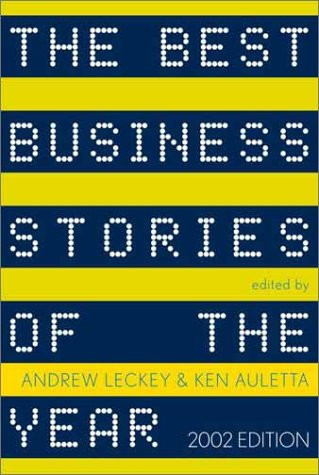
The Best Business Stories of the Year

Andrew Leckey,Ken Auletta
"[The editors] cast their net wide, picking up some excellent stories from nontraditional sources that even avid readers of the business press may have missed."-"USA Today," on the 2001 edition Series editor Andrew Leckey and guest editor Ken Auletta have scoured the print media, consulted with the editors of major business and general interest publications, and surveyed journalism school deans to find the best business stories from the last twelve months. Among those selected: Michael Lewis on teenage stock trader Jonathan Lebed, from "The New York Times Magazine"; James B. Stewart on the irrepressible Michael Milken, from "The New Yorker"; and many others from the pages of "The Wall Street Journal, Rolling Stone, Fortune, Rocky Mountain News, "and" Wired. " The second annual edition continues the excellence and comprehensive range of this fascinating anthology series.
Pantheon Books 2002 470 pages

Three Splendid Little Wars The Diary of Joseph K. Taussig, 1898-1901

Joseph K Taussig
The book reprints a diary found in the Naval War College archives of Joseph K. Taussig, later a distinguished U.S. naval officer, kept when as a naval cadet (midshipman and junior officer) he participated in the Spanish-American War, Philippine Insurrection, and Boxer Rebellion. The text is supported by helpful editorial notes and introduction, as well as by numerous period photographs and the diarist's sketches of the scenes and events.
U.S. Government Printing Office 2009-09 130 pages

Knowledge: Its Creation, Distribution and Economic Significance, Volume I Knowledge and Knowledge Production

Fritz Machlup
With this first of eight volumes, the eminent economist Fritz Machlup launches his monumental inquiry into the production of knowledge as an economic activity. Volume I presents the conceptual framework for this inquiry and falls into three parts: Types of Knowledge, Qualities of Knowledge, and Knowledge as a Product. Originally published in 1981. The Princeton Legacy Library uses the latest print-on-demand technology to again make available previously out-of-print books from the distinguished backlist of Princeton University Press. These editions preserve the original texts of these important books while presenting them in durable paperback and hardcover editions. The goal of the Princeton Legacy Library is to vastly increase access to the rich scholarly heritage found in the thousands of books published by Princeton University Press since its founding in 1905.
Princeton University Press 2016-04-19 304 pages

The Colonial Merchants and the American Revolution, 1763-1776

Arthur Meier Schlesinger
This work has been selected by scholars as being culturally important, and is part of the knowledge base of civilization as we know it. This work is in the "public domain in the United States of America, and possibly other nations. Within the United States, you may freely copy and distribute this work, as no entity (individual or corporate) has a copyright on the body of the work. Scholars believe, and we concur, that this work is important enough to be preserved, reproduced, and made generally available to the public. We appreciate your support of the preservation process, and thank you for being an important part of keeping this knowledge alive and relevant.
Creative Media Partners, LLC 2022-10-27 648 pages

Control of Information in the United States An Annotated Bibliography of Books

James R. Bennett
An essential reference book to the most important and relevant publications on the control of information in the United States, it includes books and articles on every aspect of this highly topical subject--from philosophical theory to the freedom of the press. It is the first bibliography to deal exclusively with this area and will be of interest to all those concerned with research in journalism, law, communications, and general American history.
Bloomsbury Academic 1987-12-31 616 pages

The crisis of Marxist ideology in Eastern Europe: the poverty of utopia

Tismaneanu, Vladimir
First published in 1988, The Crisis of Marxist Ideology in Eastern Europe states that since de-Stalinisation began in Eastern Europe, the 'dead hand' of institutional Marxism has been eroded by revisionist Marxism, with the turn to young Marx and the philosophy of human emancipation to undermine prevailing orthodoxies. But this revisionism clung to the old socialist dogmas and refused a total break with the system, and the effort eventually failed. The result was the emergence of a dissident counterculture rejecting the system entirely. Independent social movements (such as unofficial peace groups and trade unions like Solidarity) have given this counterculture a major role in Eastern Europe, whilst the ruling elites have responded with confusion. Tismaneanu concludes that the only hope for the anti-totalitarian intellectuals of Eastern Europe is to oppose the regimes with non-Marxist ideas - otherwise they will be permanently reduced to the status of a hopeless, albeit heroic minority. This book will be of interest to students of economics, political science and international relations.
Routledge 2025-03-31 238 pages