26 results for "Children"

Bringing up bébé: one American mother discovers the wisdom of French parenting

Druckerman, Pamela
"The secret behind France's astonishingly well-behaved children. When American journalist Pamela Druckerman has a baby in Paris, she doesn't aspire to become a "French parent." French parenting isn't a known thing, like French fashion or French cheese. Even French parents themselves insist they aren't doing anything special. Yet, the French children Druckerman knows sleep through the night at two or three months old while those of her American friends take a year or more. French kids eat well-rounded meals that are more likely to include braised leeks than chicken nuggets. And while her American friends spend their visits resolving spats between their kids, her French friends sip coffee while the kids play. Motherhood itself is a whole different experience in France. There's no role model, as there is in America, for the harried new mom with no life of her own. French mothers assume that even good parents aren't at the constant service of their children and that there's no need to feel guilty about this. They have an easy, calm authority with their kids that Druckerman can only envy. Of course, French parenting wouldn't be worth talking about if it produced robotic, joyless children. In fact, French kids are just as boisterous, curious, and creative as Americans. They're just far better behaved and more in command of themselves. While some American toddlers are getting Mandarin tutors and preliteracy training, French kids are-by design-toddling around and discovering the world at their own pace. With a notebook stashed in her diaper bag, Druckerman-a former reporter for the Wall Street Journal sets out to learn the secrets to raising a society of good little sleepers, gourmet eaters, and reasonably relaxed parents. She discovers that French parents are extremely strict about some things and strikingly permissive about others. And she realizes that to be a different kind of parent, you don't just need a different parenting philosophy. You need a very different view of what a child actually is. While finding her own firm "non", Druckerman discovers that children-including her own-are capable of feats she'd never imagined."--Provided by publisher.
Penguin Press 2012-02-07 284 pages

The heart of parenting: how to raise an emotionally intelligent child

Gottman, John Mordechai
This is a practical guide for parents on how to raise a child who can understand and control his or her emotions. It explains a child's different emotional needs at different ages, and shows parents how to help their children calm themselves down, how to focus their attention, how to give their children better emotional support through difficult times, such as divorce, and offers simple tools and techniques for parents to evaluate and improve on their own emotional parenting styles.
Simon & Schuster 1997 239 pages

Children: the challenge

Dreikurs, Rudolf
Children: The Challenge gives the key to parents who seek to build trust and love in their families, and raise happier, healthier, and better behaved children. Based on a lifetime of experience with children — their problems, their delights, their challenges — Dr. Rudolf Dreikurs, one of America’s foremost child psychiatrists presents an easy-to-follow program that teaches parents how to cope with the common childhood problems that occur from toddler years through early adolescence. This warm and reassuring reference helps parents to understand their children’s actions better, giving them the guidance necessary to discipline lovingly and effectively, all while fostering a healthy environment in which children will grow and develop into successful teenagers and adults.
Plume 1990 335 pages

The blessing of a skinned knee: using Jewish teachings to raise self-reliant children

Mogel, Wendy
In the trenches of a typical day, every parent encounters a child afflicted with ingratitude and entitlement. Parents want so badly to raise self-disciplined, appreciative, and resourceful children who are not spoiled. But how to accomplish this feat? The answer has eluded the best-intentioned individuals who overprotect, overindulge, and overschedule their children's lives. Sharing stories of everyday parenting problems and examining them through the lens of the Torah, the Talmud, and important Jewish teachings, The Blessing of a Skinned Knee shows parents how to teach children to honor and respect others. Parents will learn to accept that their children are both ordinary and unique, and treasure the power and holiness of the present. Mogel makes these teachings relevant for any era, and any household of any faith. A unique parenting book, The Blessing of a Skinned Knee is both inspiring and effective in the day-to-day challenge of raising self-reliant children --
Penguin Compass 2001 300 pages

You have to fucking eat

Mansbach, Adam
From the author of the international bestseller GO THE FUCK TO SLEEP comes a book about the other great parental frustration: getting your little angel to eat something that even vaguely resembles a normal meal. Profane, loving and deeply cathartic, YOU HAVE TO FUCKING EAT breaks the code of child-rearing silence, giving new, old, grand- and expectant parents a much-needed chance to laugh about a universal problem.**(You probably shouldn't read it to your children.)
Canongate 2014 32 pages

Free-range kids: giving our children the freedom we had without going nuts with worry

Skenazy, Lenore
FREE RANGE KIDS has become a national movement, sparked by the incredible response to Lenore Skenazy?s piece about allowing her 9-year-old ride the subway alone in NYC. Parent groups argued about it, bloggers, blogged, spouses became uncivil with each other, and the media jumped all over it. A lot of parents today, Skenazy says, see no difference between letting their kids walk to school and letting them walk through a firing range. Any risk is seen as too much risk. But if you try to prevent every possible danger or difficult in your child?s everyday life, that child never gets a chance to grow up. We parents have to realize that the greatest risk of all just might be trying to raise a child who never encounters choice or independence.
Jossey-Bass 2009-04-20 225 pages

The new childhood: raising kids to thrive in a digitally connected world

Shapiro, Jordan
"In The New Childhood, world-renowned global policy and education pioneer Jordan Shapiro provides a hopeful counterpoint to the fearful hand-wringing that has come to define our narrative around children and technology. Drawing on groundbreaking research in economics, psychology, philosophy and education, The New Childhood underscores how technology is guiding humanity toward a bright future in which children will be able to create new, better models of global citizenship, connection and community. Dividing the book into four sections: Self, Home, School and Society, Shapiro offers concrete, practical advice on how to parent and educate children effectively in a connected world and provides tools and techniques for using technology to engage with kids and help them learn and grow. He also draws on his own experience as a father of two sons, which helps bring the narrative to life. He compares the current moment to other great technological revolutions in humanity's past and presents entertaining micro-histories of cultural minutiae: the sandbox, finger painting, the family dinner and more. Most importantly, The New Childhood paints a timely, inspiring and positive picture of today's children, recognising that they are poised to create a progressive, diverse, meaningful and hyper-connected world that today's adults can only imagine. 'Timely, essential, and thought-provoking, The New Childhood is the must-read parenting guide for raising 21st century, digitally driven kids. Instead of raising a white flag and giving in to social media and the Internet, Jordan Shapiro tells parents how to embrace technology, stay involved in their children's lives, and prepare them for their future. Read it! I promise you'll rethink your parenting. I couldn't put it down.' - Michele Borba, EdD, author of UnSelfie: Why Empathetic Kids Succeed In Our All-About-Me World."--Publisher's description.
Yellow Kite 2019 308 pages

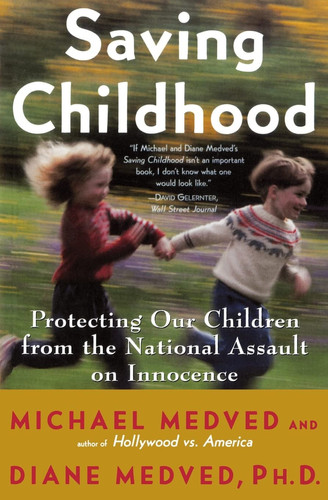
Saving childhood: how to protect your children from the national assault on innocence

Medved, Michael
Saving Childhood offers parents and grandparents practical strategies to cope with a society that seems perversely determined to frighten and corrupt its young. Cultural critic and popular radio host Michael Medved and his wife, psychologist Diane Medved, argue that in a mistaken effort to curb problems plaguing its youth, our culture has changed from protecting childhood as a precious time of growth to hammering even the smallest youngsters with a grim, harsh, and menacing view of the world. The Medveds systematically present unassailable scientific evidence, moving anecdotes, and personal experiences of raising their three young children to explain the attack from four primary directions--media, schools, peers, and even well-intentioned parents themselves. In a unique analysis the Medveds define innocence not as ignorance but as the result of three components--security, a sense of wonder and optimism. They empower parents and all who care about childhood with concrete, easily accomplished means to fend off the assault, as well as advice for handling hurdles such as the Internet, television, peer pressure, and the plague of pessimism. Saving Childhood enables us to restore and maintain for our children imagination, confidence, and hope for the future.
HarperCollinsPublishers 1998 324 pages

A good enough parent: a book on child-rearing

Bettelheim, Bruno.
In this book, the preeminent child psychologist of our time gives us the results of his lifelong effort to determine what is most crucial in successful child-rearing. His purpose is not to give parents preset rules for raising their children, but rather to show them how to develop their own insights so that they will understand their own and their children's behavior in different situations and how to cope with it. Above all, he warns, parents must not indulge their impulse to try to create the child they would like to have, but should instead help each child fully develop into the person he or she would like to be.
Vintage Books 1988-03-12 377 pages

When I am little again ; and, The child's right to respect

Korczak, Janusz
Review ...should be required reading for all educators. Its maxims should be read and put into practice.>>>> (Childhood Education) ...should be required reading for all educators. Its maxims should be read and put into practice. (Childhood Education) Product Description These two works belong to that group of books written by one of this century's fiercest and most devoted child advocates. In the first, Korczak uses fiction to reveal the joys and sorrows of a child, a ten-year-old, juxtaposing them against the feelings of an adult as they both react to two days of adventure spent together. Two prominent themes in his writing are the exploration of the place of children in an adult world and the examination of the treatment and regard children are accorded in that world. In his second book, Korczak spells out his 'Magna Charta Libertatis' in defense of the child's right to respect, right to be him or herself, and, most importantly, right to respect for the strenuous effort expended in the process of 'growing up.' About the Author E. P. Kulawiec is Associate Professor of Education and Curriculum at the University of Southern Maine.
University Press 1992-02-01 186 pages

Parenthood by proxy: don't have them if you won't raise them

Schlessinger, Laura
Children's welfare is the driving force behind Dr. Laura Schlessinger's mission. A devoted mother to her son, Deryk, she identifies herself as "her kid's mom" because that's her most important job. Never one to shy away from tough truths, Dr. Laura marshalls compelling evidence for the widespread neglect of America's children and convincingly condemns the numerous rationalizations to excuse it. Parents, special interest groups, and professionals in education and psychology all contribute to a dangerous trend that places adult fulfillment above obligation to children. Parenthood by Proxy addresses the serious causes and effects of this national crisis, among them the high rate of divorce, serial marriages, single parenting, the premature sexualization of children, dual-career families, disdain for religion, the redefinition of immoral behavior as lifestyle choices, and societal intolerance for the concept of judgment. In Parenthood by Proxy, Dr. Laura exhorts parents to make their own children their top priority and, if necessary, to change their lives to do so. In her inimitable, straight-shooting style, Dr. Laura entreats parents to involve themselves in their children's hearts, minds, and souls, to cherish and protect them, and to commit to the essential task of teaching them right from wrong. She acknowledges that parents no longer get much support from neighbors or public and private institutions, but she urges mothers and fathers to work even harder to counteract the prevailing culture of selfishness and irresponsibility. Parenthood by Proxy covers all aspects of parenting, from childbearing to discipline, from multiple families to being role models. Dr. Laura also tackles such cultural and societal concerns as abortion, modern sexuality, drug and alcohol use, violence, discipline, and a child's right to privacy. Parenthood by Proxy is a passionate and provocative summation of the perils of parenting and a road map to safety for America's families.
Cliff Street Books 2000-04-26 267 pages

Pricing the priceless child: the changing social value of children

Zelizer, Viviana A. Rotman
In this landmark book, sociologist Viviana Zelizer traces the emergence of the modern child, at once economically "useless" and emotionally "priceless," from the late 1800s to the 1930s. Having established laws removing many children from the marketplace, turn-of-the-century America was discovering new, sentimental criteria to determine a child's monetary worth. The heightened emotional status of children resulted, for example, in the legal justification of children's life insurance policies and in large damages awarded by courts to their parents in the event of death. A vivid account of changing attitudes toward children, this book dramatically illustrates the limits of economic views of life that ignore the pervasive role of social, cultural, emotional, and moral factors in our marketplace world.
Princeton University Press 1994-08-28 277 pages

Children without childhood

Winn, Marie
Since the 1960s a radical change has occurred in the way American society treats children and in the behavior of children themselves. In this provocative examination of childhood today, Marie Winn argues that adults have abandoned their traditional role of protectors of childhood innocence and, moreover, have encouraged early involvement in adult concerns. The disintegration of family life (due in part of divorce and to the return of women to the work force); the emphasis on sex in boos, films, and on television; and society's casual acceptance of "recreational" drugs have all contributed to the emergence of a generation of cynical, prematurely "sophisticated" children. -- Cover, page [4]
Penguin 1984 224 pages

How to raise a Jewish child: a practical handbook for family life

Diamant, Anita
From the New York Times bestselling author of The Red Tent —a classic parenting book that combines insights from Jewish tradition with contemporary thinking about how children learn and grow. In this updated edition, you will discover the practices, customs, and values that go into creating a Jewish home and raising joyful children within the rich traditions of Judaism.
Schocken Books 2008-08-26 291 pages

Oh, baby: true stories about conception, adoption, surrogacy, pregnancy, labor, and love

Lee Gutkind,Alice Bradley
"In these 23 original stories, mothers and fathers from all walks of life - straight, gay, single, surrogate, biological, adoptive - explore the challenges and rewards of parenthood. Here, among other adventures, parents fall hopelessly in love with newborns, secretly fear having made huge mistakes, race to finish birthing at home before the paramedics arrive, struggle with the bureaucracy of international adoption, despair of ever getting a one-year-old to nap, are nearly broken by colic, encounter other judgy parents in birthing class, learn how to parent children with special needs, and more. Together, these thoughtful, searing, often hilarious essays map the grand (and sometimes terrifying) journey that begins with each new life."--Page 4 of cover.
In Fact Books 2015-10-20 287 pages