4 results for "Children"

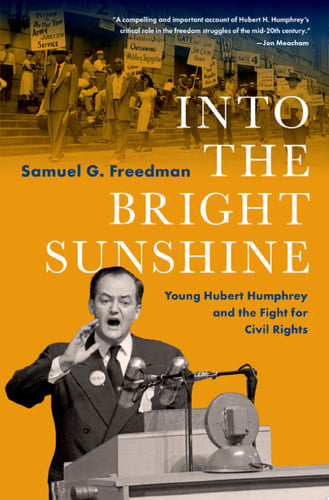
Into the bright sunshine: young Hubert Humphrey and the fight for civil rights

Freedman, Samuel G.
"Hubert Humphrey, a fallen hero and a dying man, rose on rickety legs to approach the podium of the Philadelphia Convention Hall, his pulpit for the commencement address at the University of Pennsylvania. He clutched a sheaf of paper with his speech for the occasion, typed and double-spaced by an assistant from his extemporaneous dictation, and then marked up in pencil by Humphrey himself. A note on the first page, circled to draw particular attention, read simply, "30 years ago--Here." In this place, at that time, twenty-nine years earlier to be precise, he had made history. From the dais now, Humphrey beheld five thousand impending graduates, an ebony sea of gowns and mortarboards, broken by one iconoclast in a homemade crown, two in ribboned bonnets, and another whose headgear bore the masking-tape message HI MA PA. In the horseshoe curve of the arena's double balcony loomed eight thousand parents and siblings, children, and friends. Wearing shirtsleeves and cotton shifts amid the stale heat, they looked like pale confetti from where Humphrey stood, and their flash cameras flickered away, a constellation of pinpricks"--
Oxford University Press 2023 488 pages

Impossible exodus: Iraqi Jews in Israel

Bashkin, Orit
Between 1949 and 1951, 123,000 Iraqi Jews immigrated to the newly established Israeli state. Lacking the resources to absorb them all, the Israeli government resettled them in maabarot , or transit camps, relegating them to poverty. In the tents and shacks of the camps, their living conditions were squalid and unsanitary. Basic necessities like water were in short supply, when they were available at all. Rather than returning to a homeland as native sons, Iraqi Jews were newcomers in a foreign place. Impossible Exodus tells the story of these Iraqi Jews' first decades in Israel. Faced with ill treatment and discrimination from state officials, Iraqi Jews resisted: they joined Israeli political parties, demonstrated in the streets, and fought for the education of their children, leading a civil rights struggle whose legacy continues to influence contemporary debates in Israel. Orit Bashkin sheds light on their everyday lives and their determination in a new country, uncovering their long, painful transformation from Iraqi to Israeli. In doing so, she shares the resilience and humanity of a community whose story has yet to be told.
Stanford University Press 2017 305 pages

Fundamental rights: history of a constitutional doctrine

Konvitz, Milton R.
One of the most important modern developments in American constitutional law has been the extension of the Bill of Rights to the states. The most important guarantees of the first eight amendments have been incorporated into the Due Process Clause of the Fourteenth Amendment, along with the doctrine that these are rights that are so "fundamental" that any restriction is subject to judicial "strict scrutiny." The process has nationalized fundamental rights, giving them a preferred dignity and majesty. In this volume, the renowned constitutional scholar, Milton Konvitz, traces the development of fundamental rights from the early days of American jurisprudence through twentieth-century cases involving the right to privacy, racial discrimination, voting rights, censorship, and abortion laws. In Konvitz's astute view, the Bill of Rights in the Constitution of the United States, like the Ten Commandments, places no priority among protected or guaranteed rights. He argues that values, ideals, rights, liberties, and privileges need to be placed in a hierarchical order or scale. The Supreme Court, acting on a case-by-case basis, has slowly and cautiously moved to designate some rights as superior to others. This idea that some rights are of a "fundamental" nature, while others are not, can be traced back to the early days of the nation's government. Konvitz shows that there may be said to be not one, but two or even three bills of rights, one for the Federal government and one for the States. Still another, may be an unwritten but evolving Bill of Rights. The Court has recognized rights or liberties that are in no written constitution, as for example, a right to marry, a right to have a family, a right to choose education of one's children in a private, even a religious, school, rather than a public school. In an illuminating fashion, Konvitz, whose writings have been cited in Supreme Court decisions, traces the controversial and very uneven line of development of such "fundamental rights." This volume is likely the first book on the subject and a pioneering work in the history of American constitutional law. Accessibly written for a general and scholarly audience, it will be of particular interest to political scientists, historians, and constitutional scholars.
Transaction 2007 182 pages