18 results for "Children"

People love dead Jews: reports from a haunted present

Horn, Dara
"A startling exploration of how Jewish history is exploited to comfort the living. Reflecting on subjects as far-flung as the international veneration of Anne Frank, the blockbuster travelling exhibition called "Auschwitz," the Jewish history of the Chinese city of Harbin, and the little known "righteous-gentile" Varian Fry, Dara Horn challenges us to confront the reasons why there might be so much fascination with Jewish deaths, as emblematic of the worst of evils the world has to offer, and so little respect for Jewish lives, as they continue to unfold in the present. Horn draws upon her own family life -- trying to explain Shakespeare's Shylock to a curious 10-year-old, her anger when swastikas are drawn on desks in her children's school in New Jersey, the profound and essential perspective offered by traditional religious practice, prayer, and study -- to assert the vitality, complexity and depth of this life against an anti-Semitism that, far from being disarmed by the mantra of "Never forget," is on the rise"--Provided by publisher.
W. W. Norton & Company 2021 237 pages

In my time of dying: how I came face to face with the idea of an afterlife

Junger, Sebastian
''Mind blowingly brilliant'' PHILIPPA PERRY''Few other writers have such passion for granular detail, intellectual heft and boundless curiosity'' THE TIMES''As suspenseful and pacy as an episode of peak-era ER'' GUARDIANA near-fatal health emergency leads to this powerful reflection on death―and what might follow―by the bestselling author of Tribe and The Perfect Storm.For years as an award-winning war reporter, Sebastian Junger travelled to many front lines and frequently put his life at risk. And yet the closest he ever came to death was the summer of 2020 while spending a quiet afternoon at the New England home he shared with his wife and two young children. Crippled by abdominal pain, Junger was rushed to the hospital by ambulance. Once there, he began slipping away. As blackness encroached, he was visited by his dead father, inviting Junger to join him. “It’s okay,” his father said. “There’s nothing to be scared of. I’ll take care of you.” That was the last thing Junger remembered until he came to the next day when he was told he had suffered a ruptured aneurysm that he should not have survived.This experience spurred Junger―a confirmed atheist raised by his physicist father to respect the empirical―to undertake a scientific, philosophical, and deeply personal examination of mortality and what happens after we die. How do we begin to process the brutal fact that any of us might perish unexpectedly on what begins as an ordinary day? How do we grapple with phenomena that science may be unable to explain? And what happens to a person, emotionally and spiritually, when we are forced to reckon with such existential questions?In My Time of Dying is part medical drama, part searing autobiography, and part rational inquiry into the ultimate unknowable mystery.''Moving, compact, philosophically ambitious … A humbling volume'' OBSERVER‘Stunning … A powerful book that comes as close as anything I’ve read in explaining what it means to be human’ JAMES PATTERSON''An instant classic that filled me with wonder, gratitude and awe'' WILL SCHWALBE''A stunning account I didn’t so much read as inhale, awed and riveted and forever changed'' MICHAEL FINKEL
4th Estate 2025-05-22 176 pages

The usual rules

Maynard, Joyce
It's a Tuesday morning in Brooklyn₇a perfect September day. Wendy is heading to school, eager to make plans with her best friend, worried about how she looks, mad at her mother for not letting her visit her father in California, impatient with her little brother and with the almost too-loving concern of her jazz musician stepfather. She's out the door to catch the bus. An hour later comes the news: A plane has crashed into the World Trade Center. Her mother's building Through the eyes of thirteen-year-old Wendy, we gain entrance to the world rarely shown by those who documented the events of that one terrible day: a family's slow and terrible realization that Wendy's mother has died, and their struggle to go on with their lives in the face of crushing loss. Absent for years, Wendy's real father shows up without warning. He takes her back with him to California, where she re-invents a life that comes to include a teenage mother, living on her own in a one-room apartment with a TV set and not much else; her father's cactus-grower girlfriend, newly reconnected with the son she gave up for adoption twenty years before; a sad and tender bookstore owner who introduces her to the voice of Anne Frank and to his autistic son; and a homeless skateboarder, on a mission to find his long-lost brother. Over the winter and spring that follow, Wendy moves between the alternately painful and reassuring memories of her mother and the revelations that come with growing to know her real father for the first time. Pulled between her old life in Brooklyn and a new one three thousands miles away, Wendy is faced with a world where the usual rules no longer apply but eventually discovers a strength and capacity for compassion and survival that she never knew she possessed. At the core of the story is Wendy's deep connection with her little brother, back in New York, who is grieving the loss of their mother without her. This a story about the ties of siblings, about children who lose their parents, parents who lose their children, and the unexpected ways they sometimes find one another again. Set against the backdrop of global and personal tragedy, and written in a style alternately wry and heartbreaking, The Usual Rules is an unexpectedly hopeful story of healing and forgiveness that will offer readers, young and old alike, a picture of how, out of the rubble, a family rebuilds its life.
St. Martin's Press 2003 390 pages

Prudence

Treuer, David
On a sweltering day in August 1942, Frankie Washburn returns to his family's rustic Minnesota resort for one last visit before he joins the war as a bombardier, headed for the darkened skies over Europe. Awaiting him at the Pines are those he's about to leave behind: his hovering mother; the distant father to whom he's been a disappointment; the Indian caretaker who's been more of a father to him than his own; and Billy, the childhood friend who over the years has become something much more intimate. But before the homecoming can be celebrated, the search for a German soldier, escaped from the POW camp across the river, explodes in a shocking act of violence, with consequences that will reverberate years into the future for all of them and that will shape how each of them makes sense of their lives.
Riverhead Books, a member of Penguin Group (USA) 2015 253 pages

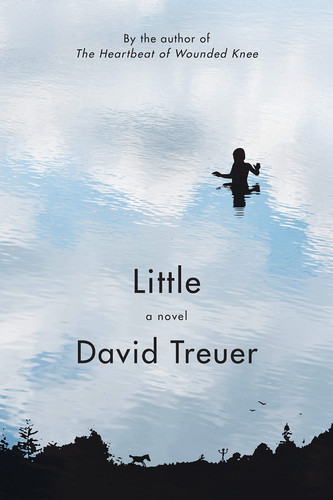
Little: a novel

Treuer, David
"'The grave we dug for my brother Little remained empty even after we filled it back in. And nobody was going to admit it.' So begins Little, first published by Graywolf Press in 1995 when David Treuer was just twenty-four. The narrative unfolds to reveal the deeply entwined stories of the three generations of Little's family, including Stan, a veteran of the Vietnam War who believes Little is his son; Duke and Ellis, the twins who built the first house in Poverty after losing their community to smallpox and influenza; Jeannette, the matriarch who loved both Duke and Ellis and who walked hundreds of miles to reunite with them. Each of these characters carries a piece of the mystery of Little's short life. With rhythmic and unadorned prose, Treuer uncovers in even the most frost-hardened ground the resilience and humor of life in Poverty. From the unbearable cruelty of the institutions that systematically unraveled Native communities at the turn of the century, to the hard and hallow emptiness of a child's grave, Treuer has orchestrated a moving account of kinship and survival. In his new introduction, Treuer, now among the foremost writers of his generation, reflects on the germ of this novel and how it fits into his lasting body of work centered on Native life. More than a quarter of a century later, Little proves as vital and moving as ever"--
Graywolf Press 2022 272 pages

If God is good why is the world so bad?

Blech, Benjamin
In these troubled times, people are asking very difficult questions about God and their faith: If I suffer, does that mean I deserve it? Why do innocent people, especially children, die tragically? How can God be so cruel? Does God ever intervene during times of trouble? Who really runs the world-God or man? Do my prayers do any good? Why does God allow sickness, torture and evil to exist? Benjamin Blech admits, the answers are not simple. There is no one-size-fits-all explanation. Indeed, not only are there many answers, but in different situations several explanations may apply. Blech wrote this book as an intellectual analysis of Jewish wisdom on the subject of suffering. His theories are the fruit of thousands of years of debate, examination and struggle. Jewish wisdom teaches that there are rich and inspiring answers to the ultimate question: If God is good, why is the world so bad? Take part in the most important spiritual journey of all-the quest for serenity in the face of adversity-and discover that in the accumulated wisdom of the ages lies a time-tested solution for turning despair into hope and sorrow into faith.
Simcha Press 2003-09-08 234 pages

What Daddy Did

Shusterman, Neal
Just One Big Happy Family... That's the way Preston Scott would have described his all-American family. His parents seemed to have everything, including the ideal marriage. But then their perfect life started to unravel. Mr. and Mrs. Scott began to. fight-vicious, hurtful, drawn-out battles that went on day after day. Finally one day Mrs. Scott moved out. And that's when Preston's nightmare began... Now, three years later, Preston's dad is getting out of prison, and Preston is no closer to coming to terms with his feelings about him. Because how can you forgive your father for killing someone...when that someone was your mother? Here is Preston's searing true story about upheaval, growth, faith ... and the power of love. No one has an inkling that handsome, athletic, and talented Preston Scott is carrying a terrible His father was imprisoned three years ago. Now Mr. Scott is coming home to live with Preston and his little brother, Tyler and Preston has yet to come to terms with his feelings about him. Because how can you forgive your father for killing someone . . . when that someone was your mother? This unforgettable novel is a fictionalized account based on the words of the boy who experienced these events firsthand. "Impossible to put down . . . a stunning novel." V. 1992 Best Books for Young Adults (ALA) Children's Choices for 1992 (IRA/CBC) Young Adult Choices for 1993 (IRA) 1992 Outstanding Young Adult Fiction Award (The Southern California Council on Literature) 1993 94 Sequoyah Young Adult Book Award (Oklahoma Library Association)
Perfection Learning Prebound 1993

Last impressions

Kertes, Joseph
"Zoltan Beck is dying. His devoted but long-suffering sons, Ben and Frank, are trying to prepare themselves and their families for Zoltan's eventual departure...but they can't quite bring themselves to believe that the end is really at hand, and neither can Zoltan himself. The head of a family marked by war and tragedy for decades, he "can't stand to be in a room with a miserable person" and has done his best to keep the pain of his refugee past from his beloved children. But as he faces the end of his life, he discovers a heartbreaking secret from the War that will ultimately bring the family together - or irrevocably disrupt it. Set in both mid-20th century Hungary and contemporary Toronto, this is a deeply moving novel that revels in the energy of its extraordinary characters. It is the story of lost love and newfound connections, of a father and his sons desperately reaching out to bridge an ever-widening gap...even as their time together ebbs away."--Provided by publisher.
Penguin Canada 2020-03-03 299 pages

Saying Kaddish: how to comfort the dying, bury the dead, and mourn as a Jew

Diamant, Anita
Diamant shows how to make Judaism's time-honored rituals into personal, meaningful sources of comfort. She guides the reader through Jewish practices that attend the end of life, from the sickroom to the funeral to the week, month, and year that follow. She describes the traditional Jewish funeral, and includes sections on caring for grieving children, mourning the death of a child, neonatal loss, suicide, and the death of non-Jewish loved ones.
Schocken Books 2019 238 pages

Tears of sorrow, seeds of hope: a Jewish spiritual companion for infertility and pregnancy loss

Nina Beth Cardin
A spiritual companion for those grieving infertility, pregnancy loss, or stillbirth, bringing solace from Jewish tradition. "This book begins where the others leave off. While the doctors do what they must do, when it is time for us to wait, or hope, or cry, or sleep, or pray, it is time for this book. The passages found within are drawn from the rich pool of spiritual responses that Judaism possesses. They reach out to us and embolden us to join our voices to the ancient prayers designed to get us through the night."--from the Introduction Enables those frustrated and pained in their attempts at parenthood to mourn the loss of a pregnancy or infertility through the prayers, rituals, and meditations of the Jewish tradition. This new edition--updated and expanded--includes guided questions and pages on which to add personal reflections of your own emotions and experiences along the path toward parenting.
Jewish Lights Pub 2007 187 pages

The farewell chronicles: how we really respond to death

Rufus, Anneli S.
The longer we live, the more of those around us will die. And while Hallmark sympathy cards and sad movies tell us we should grieve, death arouses a lot of other feelings in us as well—weird, unnerving, complicated feelings, which we’re terrified to talk about because we suspect that, if we did, we would be judged as crazy, cold, unfilial, unfaithful, or immature. So at these crucial times, facing the biggest and most momentous dramas of our lives, we lock away deep inside us our own true responses. In so doing, we cut ourselves off from the rest of the world and from whomever we’ve lost, from our hearts and minds and from the ultimate drama that is a death in the midst of life. Questioning our sanity, doubting our humanity, we hide, pretend—and even lie. This book helps us tell the truth—to ourselves, to the dead, and to each other. Revisiting the deaths of many people she has known—loved ones, casual acquaintances, children and adults, friends and enemies—prizewinning journalist Anneli Rufus gives powerful, eloquent voice to everyone who has ever lost anyone and whose reactions wouldn’t fit into the standard template of “feel sad, cry, then get over it.”
Marlowe & Co 2005 267 pages

The magic kingdom

Elkin, Stanley
-- Brimming with Elkin's comic brilliance and singular wordplay, The Magic Kingdom tells the story of Eddy Bale, who, determined to learn from the ghastly experience of his son's long, drawn-out death, decides to raise enough money to take seven terminally ill children to Disney World in order to give them a dream vacation before they die. -- Stanley Elkin, a two-timer winner of the National Book Critics Award and three-time nominee for the National Book Award, is widely considered to be one of the most important writers of the contemporary period. Author of over a dozen novels and short story collections, his works include The Franchiser, George Mills, and Mrs. Ted Bliss. -- First published by Dutton (1985), most recent paperback by Thunder's Mouth (1991).
Dalkey Archive Press 2000 317 pages