4 results for "Children"

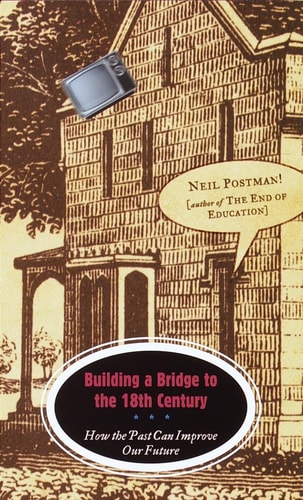
Building a bridge to the 18th century: how the past can improve our future

Postman, Neil
In Building a Bridge to the 18th Century , acclaimed cultural critic Neil Postman offers a cure for the hysteria and hazy values of the postmodern world. Postman shows us how to reclaim that balance between mind and machine in a dazzling celebration of the accomplishments of the Enlightenment-from Jefferson's representative democracy to Locke's deductive reasoning to Rousseau's demand that the care and edification of children be considered an investment in our collective future. Here, too, is the bold assertion that Truth is invulnerable to fashion or the passing of time. Provocative and brilliantly argued, Building a Bridge to the 18th Century illuminates a navigable path through the Information Age-a byway whose signposts, it turns out, were there all along.
Knopf 2000-10-10 213 pages

A power governments cannot suppress

Zinn, Howard
“Zinn writes with an enthusiasm rarely encountered in the leaden prose of academic history. . .” – New York Times Book Review A Power Governments Cannot Suppress is Howard Zinn’s major new collection of essays on American history, class, immigration, justice, and ordinary citizens who have made a difference. Howard Zinn unlocks America’s current political/ ethical crisis and challenges us to confront power for the common good. Bringing a profoundly human perspective to the diverse subjects he writes about – the Founding Fathers, government dishonesty, winning the war on terrorism, respecting the holocaust, defending the rights of immigrants – Zinn approaches history from an active, engaged point of view. He writes, “America’s future is linked to how we understand our past. For this reason, writing about history, for me, is never a neutral act.” Zinn opens the book with an essay titled “If History is to be Creative,” a reflection on the role and responsibility of the engaged historian. “To think that history-writing must aim simply to recapitulate the failures that dominate the past,” writes Zinn, “is to make historians collaborators in an endless cycle of defeat.” “If history is to be creative, to anticipate a possible future without denying the past, it should, I believe, emphasize new possibilities by disclosing those hidden episodes of the past when, even if in brief flashes, people showed their ability to resist, to join together, and occasionally win. I am supposing, or perhaps only hoping, that our future may be found in the past’s fugitive moments of compassion rather than in its solid centuries of warfare.” Buzzing with ideas, stories, and anecdotes spanning from the Revolutionary War and the War with Mexico through to World War II, Vietnam, 9/11, and the U.S. occupation of Iraq, Zinn’s view of American history is not a praise of famous leaders, but those who rebelled against them in the name of social justice. While writing extensively on current events and the consequences of U.S. policy in Afghanistan and Iraq, Zinn also dedicates entire chapters to troublemakers like Henry David Thoreau, Eugene Debs, Philip Berrigan, Italian immigrants Sacco & Vanzetti, and heralds not the soldiers who fought for George Washington, but those who deserted the Revolutionary Army because of intolerable mistreatment from elitist commanding officers. For Zinn, the voices and stories of ordinary working Americans, immigrants, working people, and soldiers comprise the real storyline of our history. Featuring essays penned over an eight-year period, A Power Governments Cannot Suppress is Howard Zinn’s first writerly work in several years, an invaluable post-9/11-era addition to the themes that run through his bestselling classic, A People’s History Of the United States. "Thank you, Howard Zinn. Thank you for telling us what none of our leaders are willing to: The truth. And you tell it with such brilliance, such humanity. It is a personal honor to be able to say I am a better citizen because of you." —Michael Moore “This brilliant new book – like Howard Zinn’s presence, and his whole life, is the best possible antidote to political despair. Read it, and rejoin the struggle for a human world and a foreign policy that’s good for children.” – Daniel Ellsberg
City Lights 2007 293 pages

The Politics of Petulance America in an Age of Immaturity

Alan Wolfe
How did we get into this mess? Every morning, many Americans ask this as, with a cringe, they pick up their phones and look to see what terrible thing President Trump has just said or done. Regardless of what he’s complaining about or whom he’s attacking, a second question comes hard on the heels of the first: How on earth do we get out of this? Alan Wolfe has an answer. In The Politics of Petulance he argues that the core of our problem isn’t Trump himself—it’s that we are mired in an age of political immaturity. That immaturity is not grounded in any one ideology, nor is it a function of age or education. It’s in an abdication of valuing the character of would-be leaders; it’s in a failure to acknowledge, even welcome the complexity of government and society; and it’s in a loss of the ability to be skeptical without being suspicious. In 2016, many Americans were offered tantalizingly simple answers to complicated problems, and, like children being offered a lunch of Pop Rocks and Coke, they reflexively—and mindlessly—accepted. The good news, such as it is, is that we’ve been here before. Wolfe reminds us that we know how to grow up and face down Trump and other demagogues. Wolfe reinvigorates the tradition of public engagement exemplified by midcentury intellectuals such as Richard Hofstadter, Reinhold Niebuhr, and Lionel Trilling—and he draws lessons from their battles with McCarthyism and conspiratorial paranoia. Wolfe mounts a powerful case that we can learn from them to forge a new path for political intervention today. Wolfe has been thinking and writing about American life and politics for decades. He sees this moment as one of real risk. But he’s not throwing up his hands; he’s bracing us. We’ve faced demagogues before. We can find the intellectual maturity to fight back. Yes we can.
University of Chicago Press 2019-08-22 220 pages

Designing democracy: what constitutions do

Sunstein, Cass R.
"In modern nations, political disagreement is the source of both the gravest danger and the greatest security," writes Cass Sunstein. All democracies face intense political conflict. But is this conflict necessarily something to fear? In this provocative book, one of our leading political and legal theorists reveals how a nation's divisions of conviction and belief can be used to safeguard democracy.Confronting one explosive political issue after another, from presidential impeachment to the limits of religious liberty, from discrimination against women and gays to the role of the judiciary, Sunstein constructs a powerful new perspective from which to show how democracies negotiate their most divisive real-world problems. He focuses on a series of concrete concerns that go to the heart of the relationship between the idea of democracy and the idea of constitutionalism. Illustrating his discussion with examples from constitutional debates and court-cases in South Africa, Eastern Europe, Israel, America, and elsewhere, Sunstein takes readers through a number of highly charged questions: When should government be permitted to control discriminatory behavior by or within religious organizations? Does it make sense to govern on the basis of popular referenda? Can the right to have an abortion be defended? Can we defend Internet regulation? Should the law step in if children are being schooled in discriminatory preferences and beliefs? Should a constitution protect rights to food, shelter, and health care?Disputes over questions such as these can be fierce enough to pose a grave threat. But in a paradox whose elaboration forms the core of Sunstein's book, it is a nation's apparently threatening diversity of opinion that can ensure its integrity.Extending his important recent work on the way deliberation within like-minded groups can produce extremism, Sunstein breaks new ground in identifying the mechanisms behind political conflict in democratic nations. At the same time, he develops a profound understanding of a constitutional democracy's system of checks and balances. Sunstein shows how a good constitution, fostering a "republic of reasons," enables people of opposing ethical and religious commitments to reach agreement where agreement is necessary, while making it unnecessary to reach agreement when agreement is impossible.A marvel of lucid, subtle reasoning, DESIGNING DEMOCRACY makes invaluable reading for anyone concerned with the promises and pitfalls of the democratic experiment.
Oxford University Press 2001-09-27 280 pages