51 results for "Children"

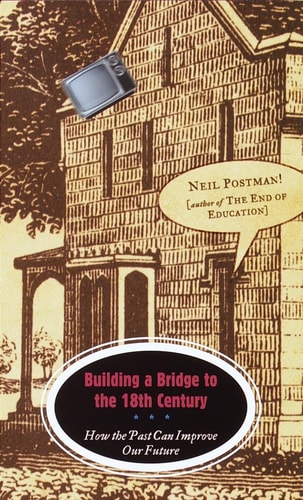
Building a bridge to the 18th century: how the past can improve our future

Postman, Neil
In Building a Bridge to the 18th Century , acclaimed cultural critic Neil Postman offers a cure for the hysteria and hazy values of the postmodern world. Postman shows us how to reclaim that balance between mind and machine in a dazzling celebration of the accomplishments of the Enlightenment-from Jefferson's representative democracy to Locke's deductive reasoning to Rousseau's demand that the care and edification of children be considered an investment in our collective future. Here, too, is the bold assertion that Truth is invulnerable to fashion or the passing of time. Provocative and brilliantly argued, Building a Bridge to the 18th Century illuminates a navigable path through the Information Age-a byway whose signposts, it turns out, were there all along.
Knopf 2000-10-10 213 pages

Ordinary Resurrections Children in the Years of Hope

Jonathan Kozol
Jonathan Kozol's books have become touchstones of the American conscience. In Ordinary Resurrections, he spends four years in the South Bronx with children who have become his friends at a badly underfunded but enlightened public school. A fascinating narrative of daily urban life, Ordinary Resurrections gives a human face to poverty and racial isolation, and provides a stirring testimony to the courage and resilience of the young. Sometimes playful, sometimes jubilantly funny, and sometimes profoundly sad, these are sensitive children—complex and morally insightful—and their ethical vitality denounces and subverts the racially charged labels that the world of grown-up expertise too frequently assigns to them. Yet another classic case of unblinking social observation from one of the finest writers ever to work in the genre, this is a piercing discernment of right and wrong, of hope and despair—from our nation's corridors of power to its poorest city streets.
Crown 2012-07-24 416 pages

Encouraging Children to Learn

Dreikurs, Rudolf
Encouragement is the basis for development of human potential in children and adults. It is the source of motivation for effective actions, goals and interpersonal relationships. Encouragement permits individuals to overcome setbacks and adversities, to have respect for self and for others, to be optimistic and to meet life's challenges. In an era that has witnessed high rates of depression, anxiety, suicide and violence, Encouraging Children to Learn provides crucial and well tested encouragement methods for improving attitudes, goals and actions.
Routledge 2016-08-26 174 pages

Class Warfare Inside the Fight to Fix America's Schools

Steven Brill
In a reporting tour de force that made national headlines and The New York Times bestseller list, award-winning journalist Steven Brill takes an uncompromising look at the adults who are fighting over America’s failure to educate its children—and points the way to reversing that failure. In a reporting tour de force, award-winning journalist Steven Brill takes an uncompromising look at the adults who are fighting over America’s failure to educate its children—and points the way to reversing that failure. Brill not only takes us inside their roller-coaster battles, he also concludes with a surprising prescription for what it will take from both sides to put the American dream back in America’s schools.
Simon and Schuster 2012-08-14 496 pages

Maintaining sanity in the classroom: classroom management techniques

Dreikurs, Rudolf
This book, based on Adlerian psychology, applies the techniques of motivation modification to realistic classroom problems, dealing step-by-step with handling behavior difficulties and providing the background that enables student teachers to understand the group dynamics of various classroom situations. The book is divided into five parts with 30 chapters. Part 1, "Theoretical Premises," includes (1) "Development of the Child's Potential," (2) "Goal Directed Behavior," (3) "The Four Mistaken Goals," (4) "Private Logic: A Diagnostic Technique for Understanding Behavior," (5) "Changing the Child's Goals," (6) "The Family Atmosphere," and (7) "The Family Constellation." Part 2, "Effective Democratic Methods," includes (8) "The Democratic Versus the Traditional Classroom," (9)"Discipline and Order," (10) "Winning Over the Child," (11) "Encouragement," (12) "Logical Consequences Versus Arbitrary Punishment," (13) "The Structure of the Group," (14) "Group Discussions in the Classroom," (15) "Specific Techniques: Group Discussions," and (16) "Training Children to Understand Behavior Through the Use of Stories." Part 3, "Coping with Special Academic Problems," includes (17) "Learning Disabilities," (18) "Reading Difficulties," (19) "Culturally Deprived Children," (20) "Pseudoretardation Referred to as Stupidity," (21) "Gifted Children and Homogeneous Grouping," and (22) "I.Q. Tests." Part 4, "Coping with Special Behavior Problems," includes (23) "The Adolescent," (24) "Juvenile Delinquency," (25) "Stealing," (26) "Lying and Swearing," and (27) "Fighting." Part 5,"Parental Involvement," includes (28) "Parent-Teacher Conferences," (29) "The Family Council," and (30) "Parent Education." (SM)
Accelerated Development 1998 353 pages

The Good News Club The Religious Right's Stealth Assault on America's Children

Katherine Stewart
In 2009, the Good News Club came to the public elementary school where journalist Katherine Stewart sent her children. The Club bills itself as an after-school Bible study, but Stewart soon discovered that its real mission is to convert children to fundamentalist Christianity. Astonished to discover that the Supreme Court had deemed this religious activity legal in public schools, Stewart began an investigative journey to dozens of cities across the nation to document the impact. As Stewart makes chillingly clear, the rapidly expanding network of Good News Clubs represents just one of a range of initiatives intended to insert religious values into public schools. Although they often appear to be spontaneous, local events, they are in fact organized and funded at a national level. Taken together, they represent a new strategy of the Religious Right in its long-running aim to "take back America," undermining our public education system and secular democracy itself.
PublicAffairs 2017-07-18 304 pages

Miss Manners' Guide to Rearing Perfect Children

Judith Martin
From Simon & Schuster, Miss Manners' Guide to Rearing Perfect Children is a primer for everyone worried about the future of civilization. In her inimitable, arch, no-nonsense style, Miss Manners provides etiquette guidance for every social situation from school dances to conversations at the family dinner table, explains how to impress a college admissions officer, and offers rules for divorced parents and weekend parents
Simon and Schuster 2002-05-17 432 pages

Teaching Children Compassionately How Students and Teachers Can Succeed with Mutual Understanding

Marshall B. Rosenberg
In this keynote address to a national conference of Montessori educators, Marshall Rosenberg describes his progressive, radical approach to teaching that centers on compassionate connection. Marshall describes the counterproductive role that power and punishment play in our schools, and challenges educators to motivate students instead "by a reverence for life." This practical application of Rosenberg's Nonviolent Communication (NVC) process offers educators the tools to create exceptional learning environments. This is an exceptional resource for teachers, school counselors, school administrators, child care providers and more! Nonviolent Communication will help you: - Maximize the individual potential of all students - Improve trust and connection in your classroom community - Strengthen student interest, retention and connection to their work - Find cooperation without using demands - Improve classroom teamwork, efficiency and results
PuddleDancer Press 2004 46 pages

Many children left behind: how the No Child Left Behind Act is damaging our children and our schools

Deborah Meier
Signed into law in 2002, the federal No Child Left Behind Act (NCLB) promised to revolutionize American public education. Originally supported by a bipartisan coalition, it purports to improve public schools by enforcing a system of standards and accountability through high-stakes testing. Many people supported it originally, despite doubts, because of its promise especially to improve the way schools serve poor children. By making federal funding contingent on accepting a system of tests and sanctions, it is radically affecting the life of schools around the country. But, argue the authors of this citizen's guide to the most important political issue in education, far from improving public schools and increasing the ability of the system to serve poor and minority children, the law is doing exactly the opposite. Here some of our most prominent, respected voices in education-including school innovator Deborah Meier, education activist Alfie Kohn, and founder of the Coalition of Essential Schools Theodore R. Sizer-come together to show us how, point by point, NCLB undermines the things it claims to improve: * How NCLB punishes rather than helps poor and minority kids and their schools * How NCLB helps further an agenda of privatization and an attack on public schools * How the focus on testing and test preparation dumbs down classrooms * And they put forward a richly articulated vision of alternatives. Educators and parents around the country are feeling the harshly counterproductive effects of NCLB. This book is an essential guide to understanding what's wrong and where we should go from here.
Beacon Press 2004-09-29 132 pages

Tech-Savvy Parenting A Guide to Raising Safe Children in a Digital World

Nikki Bush,Arthur Goldstuck
*Are you a parent looking to make sense of a daunting digital world, with new technical challenges appearing daily? * Feel you're not keeping up with the demands of technology? * Feel you're not keeping up with your children's use of social media? * Worried it's getting harder to keep your children safe in the digital world? Tech-Savvy Parenting brings together the experience, research, observations and advice of respected parenting expert Nikki Bush, and leading technology commentator Arthur Goldstuck. This insightful duo will help you get a handle on what's happening in the digital space to ensure your children are safe and savvy in this fast-changing world. They'll guide you through the terminology, dangers and opportunities of technology, while placing children's use of all things digital firmly in the context of the relationship between parents and their children. For families to remain connected, both online and offline, and for young people to develop into responsible digital citizens, parents must bridge the digital divide to their children by understanding the attraction of social media and technology, how communication is changing, and how technology is changing the world. This book is filled with practical advice that will help you to navigate the digital space, together with your children, with greater confidence.
Bookstorm 2015-01-13 256 pages

Breaking Free Public School Lessons and the Imperative of School Choice

Sol Stern
Explores the growing demand for school choice among poor families in the inner city. Stern describes the dramatic successes and occasional failures of this 'new civil rights movement' in three key cities: Milwaukee, Cleveland, and New York. Filled with timely insights and human drama, Breaking Free vividly describes how cash-starved Catholic schools in the South Bronx are performing small educational miracles every day with children the public schools have given up on. large numbers of poor minority children from violent, chaotic and failing public schools and allowed them to attend parochial and private schools where high expectations often result in high achievement. Drawing on personal observation and intimate conversations with parents, students and educators, Breaking Free is the first book to transform school choice from an abstract policy issue into a question of basic personal freedom, and indeed, for minority children at the bottom of the social ladder, into a question of survival. Equal access to the American dream through quality education is, Sol Stern convinces us, the unfinished business before us.
Encounter Books 2004-12 260 pages

The schools we need and why we don't have them

Hirsch, E. D.
The author of Cultural Literacy offers a powerful, compelling, and unassailable argument for reforming America's schooling methods and ideas. From kindergarten through high school, the American education is the worst in the developed world, and the causes of its failure and any possible solutions to it are hotly disputed. For over fifty years, American schools have operated on the assumption that challenging children is bad for them, teachers do not need to know the subjects they teach, that the learning "process" should be emphasised over the facts taught within it. Yet, as renowned educator and author E. D. Hirsch shows in The Schools We Need, this establishment ideology is a tragedy of good intentions gone awry. Hirsch argues that in eschewing content-based curricula for abstract--and disproved--theories of congnitive development, the educational establishment has done irreparable harm to America's students, and instead of preparing them for the country's highly competitive, information-based economy, the process-oriented curricula the establishment practices has severely curtailed their ability, and desire, to learn. Suggesting a curriculum based on hard work, knowledge aquisition, and rigorous testing that has been proven successful time after time, The Schools We Need offers a proficient and workable solution. By providing evidence of numerous studies proving that fact-based education works, and a glossary of brief, authoritative explanations of educational phrases often used to dazzle teachers and the general public, Hirsch proves that if children are taught substantial knowledge and skills, and learn to work hard to acquire them, their test scores will rise, their love of learning will grow, and they will become enthusiastic participants in the information-age civilization. The Schools We Need is a passionate and thoughtful book that will appeal to the millions of people who can't understand why American schools just don't work.
Doubleday 1996 317 pages

The schools we need and why we don't have them

Hirsch, E. D.
From kindergarten through high school, our public educational system is among the worst in the developed world. For over fifty years, the assumption that challenging children academically is unnatural for them, that teachers do not need to know the subjects they teach, that the learning "process" should by emphasized over the facts taught has prevailed. all this is tragically wrong. As renowned educator and author E.D. Hirsch, Jr., argues in The Schools We Need, in disdaining content-based curricula for abstract - and discredited - theories of how a child learns, the ideas uniformly taught by our schools have done terrible harm to America's students. Instead of preparing our children for the highly competitive, information-based economy in which we now live, our school practices have severely curtailed their ability, and desire, to learn. There is a solution. Mainstream research has shown that if children - all children, not just the privileged - are taught in ways that emphasize hard work, the learning of facts, and rigorous testing, their enthusiasm for school will grow, their test scores will rise, and they will become successful citizens in the information-age civilization.
Doubleday 1996 317 pages

Windows to Our Children

Violet Oaklander,Christiane Ellsbree
When originally published, this book filled a void in child therapy literature. Counselors and therapists, in schools, mental health centers and private practice, embraced this book. It is the largest selling book on the subject in the world. This brand-new 2nd edition includes over 300 pages of methods, materials, and techniques for working with children and adolescents. Also included are session transcripts, case examples and discussions. This edition includes a new introduction by Oaklander's long-time professional colleague and friend Christiane Elsbree and concludes with an in-depth interview with Oaklander by Elsbree.
Gestalt Journal Press 2015-05 458 pages

Why knowledge matters: rescuing our children from failed educational theories

Hirsch, E. D.
In this provocative book, influential scholar E.D. Hirsch, Jr., addresses critical issues in contemporary education reform - over-testing, teacher blaming, preschool fadeout, and the persistence of achievement gaps over time. In each case, he shows how cherished truisms about education and child development have led to unintended and negative consequences. Drawing on recent findings in neuroscience and new data from France, he provides new evidence for the argument that a coherent, knowledge-based elementary curriculum is essential to providing the foundations for children's life success and ensuring equal opportunity for students of all backgrounds.
Harvard Education Press 2016 270 pages