38 results for "Children"

Ghetto Diary

Janusz Korczak
"Janusz Korczak (1879-1942) is one of the legendary figures to emerge from the Holocaust. A successful pediatrician and well-known author in his native Warsaw, he gave up a brilliant medical career to devote himself to the care of orphans. Like so many other Jews, Korczak was sent into the Warsaw Ghetto after the Nazi occupation of Poland. He immediately set up an orphanage for more than 200 children. Many of his admirers, Jewish and gentile, offered to rescue him from the ghetto, but Korczak refused to leave his small charges. When the Nazi's ordered the children to board a train that was to carry them to the Treblinka death camp, Korczak went with them, despite the Nazis' offer of special treatment. His selfless behavior in caring for these children's lives and deaths has made him beloved throughout the world: he has been honored by UNESCO and commemorated on postage stamps in both Poland and Israel."--BOOK JACKET.
Knopf Doubleday Publishing Group 1978-05 198 pages

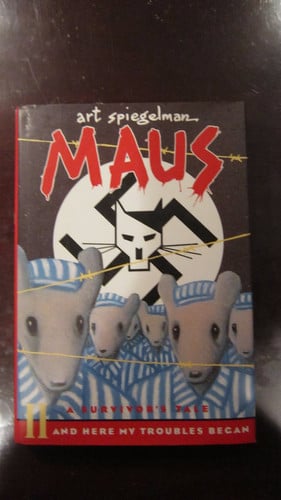
MetaMaus

Spiegelman, Art
Visually and emotionally rich, MetaMaus is as groundbreaking as the masterpiece whose creation it reveals. In the pages of MetaMaus, Art Spiegelman re-enters the Pulitzer prize-winning Maus, the modern classic that has altered how we see literature, comics, and the Holocaust ever since it was first published twenty-five years ago. He probes the questions that Maus most often evokes -- Why the Holocaust? Why mice? Why comics? -- and gives us a new and essential work about the creative process. MetaMaus includes a bonus DVD-R that provides a digitized reference copy of The Complete Maus linked to a deep archive of audio interviews with his survivor father, historical documents, and a wealth of Spiegelman's private notebooks and sketches. Compelling and intimate, MetaMaus is poised to become a classic in its own right. - Publisher.
Pantheon Books 2011-10-04 299 pages

Beyond these walls: escaping the Warsaw Ghetto - a young girl's story

Bauman, Janina
Janina Bauman was a year older than Anne Frank when the Second World War began but, unlike The Diary of Anne Frank, this is a story of survival. When Hitler's decree forced her family into the Warsaw Ghetto, Janina, an intelligent, lively girl, suddenly found herself in a cramped flat, hiding with other Jewish families. At first even curfews and the casual cruelty meted out by the German occupiers could not dim her passion for books, boys and romance. Then came the raids, and Janina, with her sister and mother, had to keep on the move, hiding in the ruins of the ghetto to avoid being one of thousands rounded up every day and deported to the camps. Their escape to the 'Aryan' side was followed by two years in hiding, taking shelter with those willing to help them and living in constant fear of betrayal. Told through her teenage diaries, giving her story a rare immediacy, this is the extraordinary tale of a passionate young woman's courage and survival.
Virago 2006-08-03 289 pages

Neighbors: the destruction of the Jewish community in Jedwabne, Poland

Gross, Jan Tomasz
One summer day in 1941, half of the Polish town of Jedwabne murdered the other half, 1,600 men, women, and children, all but seven of the town's Jews. Neighbors tells their story. Jan Gross pieces together eyewitness accounts and other evidence into a reconstruction of the horrific July day remembered well by locals but forgotten by history. His investigation reads like a detective story, and its unfolding yields wider truths about Jewish-Polish relations, the Holocaust, and human responses to occupation and totalitarianism. It is a story of surprises: The newly occupying German army did not compel the massacre, and Jedwabne's Jews and Christians had previously enjoyed cordial relations. After the war, the nearby family who saved Jedwabne's surviving Jews was derided and driven from the area. The single Jew offered mercy by the town declined it. Most arresting is the sinking realization that Jedwabne's Jews were clubbed, drowned, gutted, and burned not by faceless Nazis, but by people whose features and names they knew well: their former schoolmates and those who sold them food, bought their milk, and chatted with them in the street. As much as such a question can ever be answered, Neighbors tells us why.
Arrow Books 2003 271 pages

Child of the Warsaw ghetto

Adler, David A.
Intended for children, relates the Holocaust experiences of Froim Baum, born in Warsaw in April 1926. After his father died in 1932, his mother was left with seven children. Froim, the youngest, was placed in Janusz Korczak's orphanage. While in the ghetto, he was active in crossing to the Aryan side and smuggling food into the ghetto for his family and friends. When the orphanage was liquidated, Baum happened to be visiting his mother and was not taken away with the other children. The Baum family then escaped from the ghetto to Plonsk, but were arrested there and deported to Auschwitz and other camps. Froim was liberated in Dachau; only two of his brothers survived.
Holiday House 1995 32 pages

Tehran children: a Holocaust refugee odyssey

Dekel, Mikhal
"The extraordinary true story of Polish-Jewish child refugees who escaped the Nazis and found refuge in Iran. More than a million Jews escaped east from Nazi occupied Poland to Soviet occupied Poland. There they suffered extreme deprivation in Siberian gulags and "Special Settlements" and then, once "liberated," journeyed to the Soviet Central Asian Republics. The majority of Polish Jews who survived the Nazis outlived the war in Uzbekistan and Kazakhstan; some of them continued on to Iran. The story of their suffering, both those who died and those who survived, has rarely been told. Following the footsteps of her father, one of a thousand refugee children who traveled to Iran and later to Palestine, Dekel fuses memoir with historical investigation in this account of the all-but-unknown Jewish refuge in Muslim lands. Along the way, Dekel reveals the complex global politics behind this journey, discusses refugee aid and hospitality, and traces the making of collective identities that have shaped the postwar world--the histories nations tell and those they forget"--
W.W. Norton & Company 2019 417 pages

The diary of Dawid Sierakowiak: five notebooks from the Łódź ghetto

Sierakowiak, Dawid
"In the evening I had to prepare food and cook supper, which exhausted me totally. In politics there's absolutely nothing new. Again, out of impatience I feel myself beginning to fall into melancholy. There is really no way out of this for us." This is Dawid Sierakowiak's final diary entry. Soon after writing it, the young author died of tuberculosis, exhaustion, and starvation--the Holocaust syndrome known as "ghetto disease." After the liberation of the Lodz Ghetto, his notebooks were found stacked on a cookstove, ready to be burned for heat. Young Sierakowiak was one of more than 60,000 Jews who perished in that notorious urban slave camp, a man-made hell which was the longest surviving concentration of Jews in Nazi Europe.The diary comprises a remarkable legacy left to humanity by its teenage author. It is one of the most fastidiously detailed accounts ever rendered of modern life in human bondage. Off mountain climbing and studying in southern Poland during the summer of 1939, Dawid begins his diary with a heady enthusiasm to experience life, learn languages, and read great literature. He returns home under the quickly gathering clouds of war. Abruptly Lodz is occupied by the Nazis, and the Sierakowiak family is among the city's 200,000 Jews who are soon forced into a sealed ghetto, completely cut off from the outside world. With intimate, undefended prose, the diary's young author begins to describe the relentless horror of their predicament: his daily struggle to obtain food to survive; trying to make reason out of a world gone mad; coping with the plagues of death and deportation. Repeatedly he rallies himself against fear and pessimism, fighting the cold, disease, and exhaustion which finally consume him. Physical pain and emotional woe hold him constantly at the edge of endurance. Hunger tears Dawid's family apart, turning his father into a thief who steals bread from his wife and children.The wonder of the diary is that every bit of hardship yields wisdom from Dawid's remarkable intellect. Reading it, you become a prisoner with him in the ghetto, and with discomfiting intimacy you begin to experience the incredible process by which the vast majority of the Jews of Europe were annihilated in World War II. Significantly, the youth has no doubt about the consequence of deportation out of the ghetto: "Deportation into lard," he calls it. A committed communist and the unit leader of an underground organization, he crusades for more food for the ghetto's school children. But when invited to pledge his life to a suicide resistance squad, he writes that he cannot become a "professional revolutionary." He owes his strength and life to the care of his family.
Oxford University Press 1996-11-07 271 pages

When I am little again ; and, The child's right to respect

Korczak, Janusz
Review ...should be required reading for all educators. Its maxims should be read and put into practice.>>>> (Childhood Education) ...should be required reading for all educators. Its maxims should be read and put into practice. (Childhood Education) Product Description These two works belong to that group of books written by one of this century's fiercest and most devoted child advocates. In the first, Korczak uses fiction to reveal the joys and sorrows of a child, a ten-year-old, juxtaposing them against the feelings of an adult as they both react to two days of adventure spent together. Two prominent themes in his writing are the exploration of the place of children in an adult world and the examination of the treatment and regard children are accorded in that world. In his second book, Korczak spells out his 'Magna Charta Libertatis' in defense of the child's right to respect, right to be him or herself, and, most importantly, right to respect for the strenuous effort expended in the process of 'growing up.' About the Author E. P. Kulawiec is Associate Professor of Education and Curriculum at the University of Southern Maine.
University Press 1992-02-01 186 pages

Children of the flames: Dr. Josef Mengele and the untold story of the twins of Auschwitz

Matalon Lagnado, Lucette
Relates the life story of Josef Mengele and quotes from the testimonies of twin children who were the victims of his sadistic pseudo-medical experiments in Auschwitz. They speak about the complicated psychological problems which they confronted after the war, and which caused their silence in the 1950s-70s. In 1984 the organization of surviving twins, CANDLES, was established, which organized a trip to Auschwitz in 1985 and publicized their reminiscences.
Morrow 1991 320 pages

Once

Gleitzman, Morris
For three years and eight months, Felix has lived in a convent orphanage high in the mountains in Poland. But Felix is different from the other orphans. He is convinced his parents are still alive and will come back to get him. When a group of Nazi soldiers come and burn the nuns' books, Felix is terrified that his Jewish, bookseller parents will also be in danger. After escaping from the orphanage, Felix embarks on a long and dangerous journey through Nazi occupied Poland, befriending a little orphan girl called Zelda and a kindly dentist, Barney, who hides and cares for Jewish children. But when the Nazis discover them, Barney makes the ultimate sacrifice for the children.
Puffin 2006 149 pages

Escape from Auschwitz

Kulka, Erich
A former prisoner of the Gestapo, Kulka leads us through the horror of the Nazi death camps, describing such unbearable conditions as the over-crowded ghettos where Jewish minorities were left to starve, separation of families in cases where parents were brought to one concentration camp and children to another, and fear of an unknown fate such as the gas chambers of Auschwitz. Few people escaped from Auschwitz, and fewer survived such escape attempts. From personal experience as well as accounts from other survivors, Kulka details the only successful escape, led by Siegfried Lederer, where all those involved survived.
Bergin & Garvey Publishers 1986-01-30 150 pages